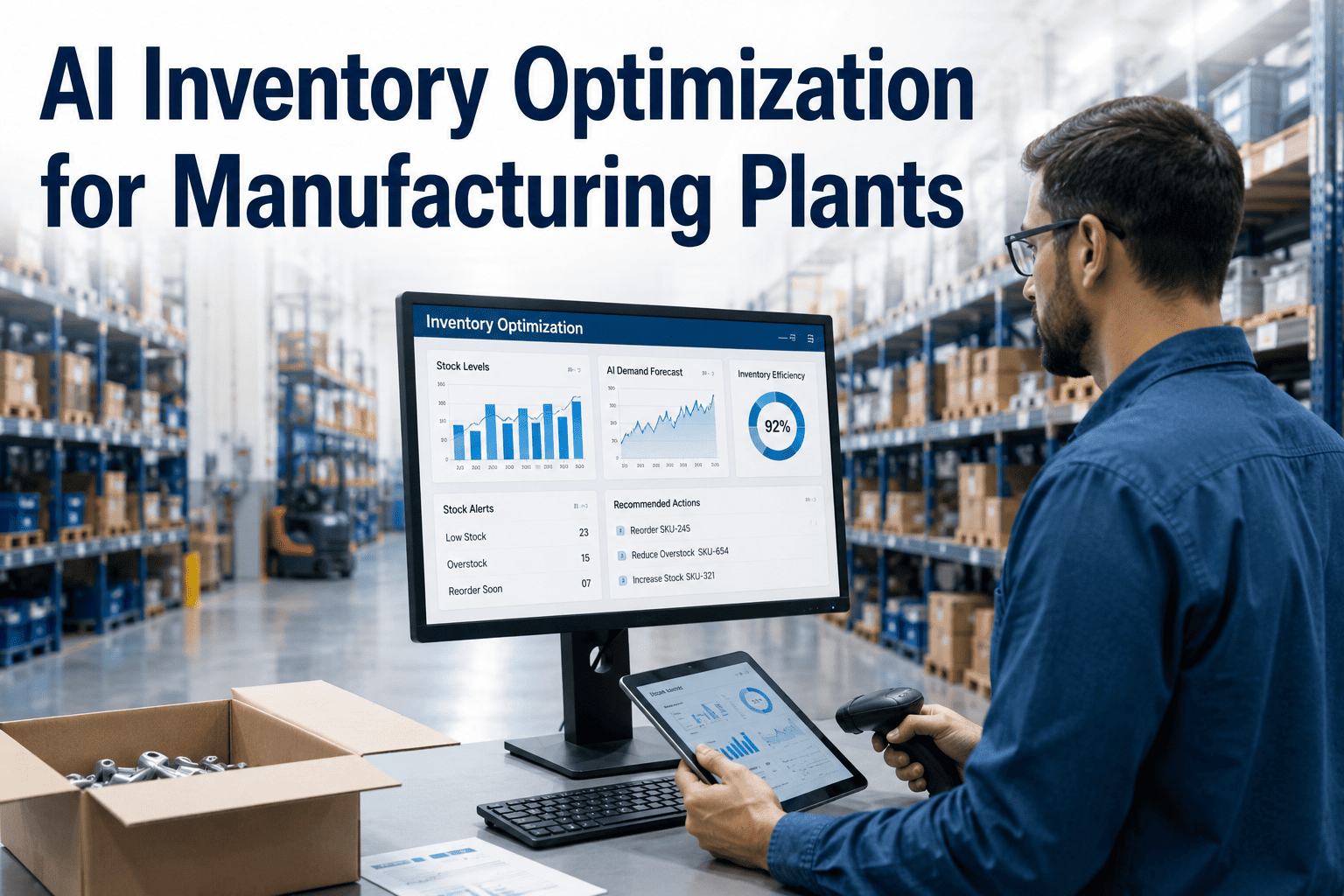
Inventory managers at manufacturing plants are sitting on a paradox: too much stock and not enough of it at the same time. The average plant carries roughly 20 to 30 percent more inventory than actual demand requires, tying up working capital in slow-moving materials, while still logging 5 to 15 stockout events a month that stall production lines. Static min-max reorder points and quarterly safety stock reviews are the root cause — they treat every SKU the same way and get updated long after the conditions that set them have changed. AI inventory optimization replaces that static approach with reorder points recalculated daily, per SKU, per location, through iFactory AI's inventory optimization platform.
Where Your Working Capital Is Actually Trapped
Every plant's inventory is made up of four very different kinds of stock, but most inventory systems track them as one undifferentiated number. Dead and obsolete stock sits on shelves generating carrying cost with zero chance of consumption. Excess safety stock exists because a buffer was set once, conservatively, and never revisited. Slow-moving buffer stock covers SKUs whose demand pattern shifted after the reorder point was calculated. Only the remainder is true active cycle stock doing productive work. Segmenting inventory this way is the first step toward knowing exactly where working capital is trapped instead of treating the whole warehouse as one number to cut.
The 45 percent of inventory sitting in the first three categories is exactly what AI-driven optimization targets first, since it represents working capital that can be reduced without touching the active cycle stock a plant actually needs. Book a inventory composition assessment to see this same breakdown run against your own SKU data.
The Formula AI Finally Gets Right
AI inventory optimization does not replace supply chain math — it automates the same formulas a planner would compute by hand, but runs them continuously across every SKU instead of periodically across a sample. The two formulas below drive nearly every reorder decision in a manufacturing plant.
Traditional systems calculate these once per quarter using a single average lead time. AI recalculates both daily, per SKU, per location — using the actual lead time distribution and current demand volatility rather than a static estimate.
Reorder points adjust daily per SKU per location instead of sitting fixed until the next quarterly planning cycle.
Buffers shrink automatically for stable SKUs and grow for volatile ones, instead of applying one blanket service level.
Upcoming work orders convert directly into material requirements against current bills of materials before demand hits.
Suppliers with drifting or inconsistent lead times automatically get wider buffers; reliable suppliers get tighter ones.
ABC/XYZ Segmentation: Why One Reorder Policy Never Fits the Whole Catalog
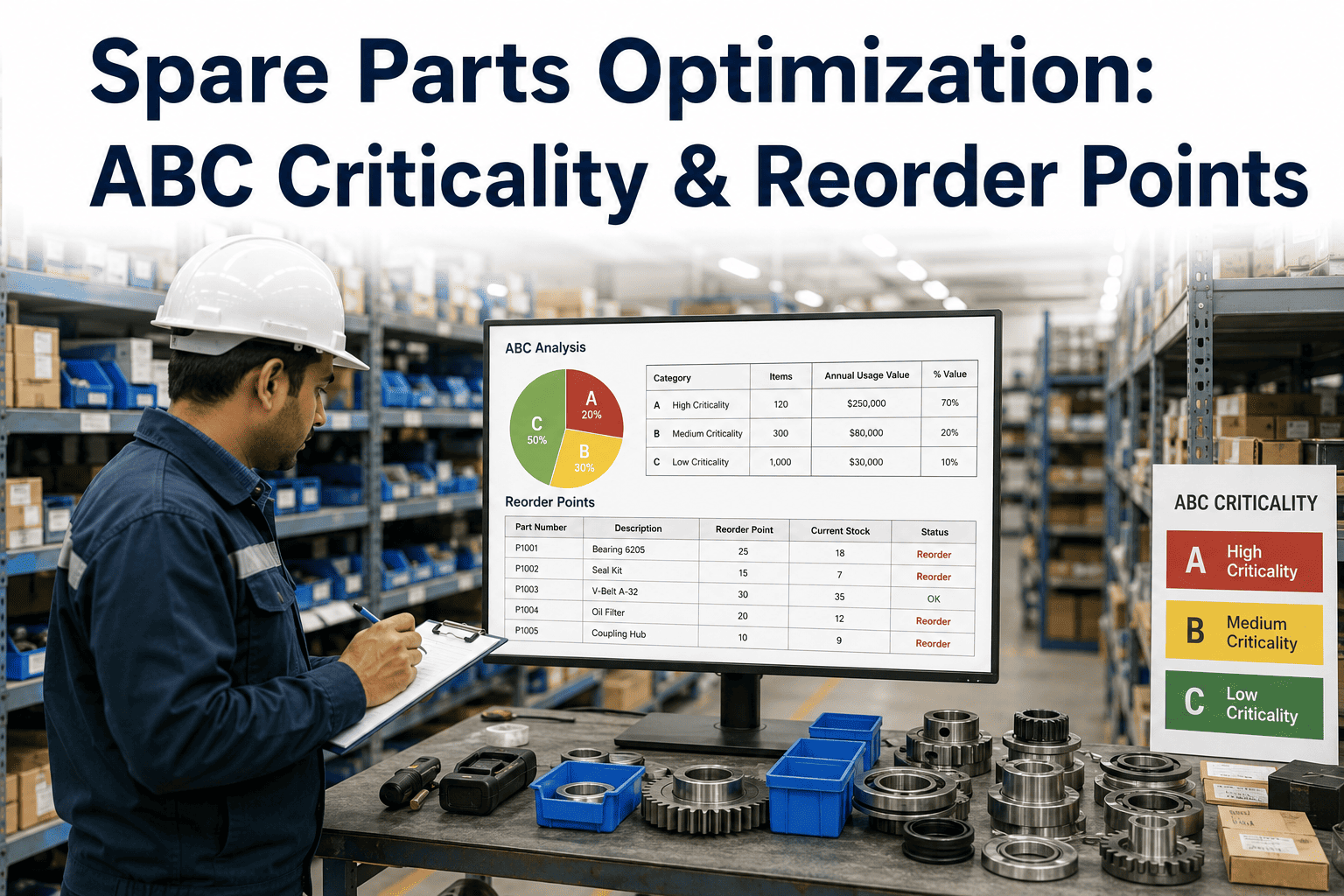
Treating a high-value, stable-demand component the same as a low-value, volatile-demand fastener is one of the most common causes of both excess inventory and stockouts. ABC/XYZ segmentation combines value (A, B, C) with demand volatility (X, Y, Z) to assign each SKU a fundamentally different inventory strategy.
| Segment | Characteristics | Traditional Treatment | AI-Driven Treatment |
|---|---|---|---|
| AX — High Value, Stable | Expensive, predictable consumption | Manually reviewed, tight buffers set once | Continuous fine-tuning; smallest safety margin needed |
| AZ — High Value, Volatile | Expensive, unpredictable consumption | Over-buffered out of caution, ties up capital | Dynamic buffer sized to real volatility, not a guess |
| CX — Low Value, Stable | Cheap, predictable consumption | Often ignored; risk of quiet stockouts | Automated reorder with minimal manual attention |
| CZ — Low Value, Volatile | Cheap, erratic consumption | Blanket high buffer applied to avoid line stoppage | Right-sized buffer freeing capital without added risk |
Multi-Plant Balancing: When Plant A Hoards While Plant B Stalls
A common failure mode in multi-site manufacturing networks is invisible to any single-plant inventory view: Plant A is sitting on 60 days of safety stock for a material while Plant B, consuming the same material, is three days from a stockout. Neither plant's local system flags the imbalance because neither sees the other's position. AI inventory optimization runs at the network level, identifying transfer opportunities and consolidated purchasing before either plant reaches a crisis point.
Documented Results From AI Inventory Optimization
Inventory Manager Perspective
I managed inventory across three plants for close to fourteen years, and for most of that time our reorder points were set from a spreadsheet nobody trusted but everybody used because it was the only one we had. We were running roughly 4,800 active SKUs, and our quarterly safety stock review process meant that by the time we caught a demand shift or a supplier's lead time creeping out, we had already either overordered for two months or scrambled through an expedited freight bill to cover a gap. The month we connected iFactory AI to our ERP and production schedules, the first thing that struck our team was how much of our safety stock was protecting SKUs that barely moved, while a handful of genuinely volatile components were quietly under-buffered the entire time. Within the first two quarters, our blended inventory investment dropped by just under 24 percent, stockout events fell from an average of eleven per month to four, and — the part that mattered most to my team personally — we stopped spending Friday afternoons rebuilding the same spreadsheet from scratch. The multi-plant visibility was the piece I did not expect to value as much as I do; seeing Plant A sitting on two months of a component that Plant B was about to run out of, in the same dashboard, changed how we think about inventory as a network problem instead of three separate warehouses. For any inventory manager still defending reorder points set from an annual spreadsheet exercise: the case for moving to daily, SKU-level recalculation is not close once you see the actual numbers.
— Inventory Manager, Multi-Plant Industrial Equipment Manufacturer — 14 Years Industry Experience — iFactory AI Reference Customer 2026Conclusion
Inventory optimization is not about cutting stock levels across the board — it is about knowing precisely which SKUs are trapping working capital in dead stock and excess buffers, and which are one lead time delay away from stopping a production line. Static min-max systems cannot make that distinction at scale; AI-driven, SKU-level recalculation can, and it does so continuously rather than once a quarter.
iFactory AI connects directly to the ERP, MES, and procurement systems inventory managers already use, applying dynamic safety stock and reorder point calculations across every SKU, every location, every day. Book a Demo to see your own inventory segmented and right-sized against real consumption and production data.
Frequently Asked Questions
Static min-max reorder points are calculated periodically, often quarterly, using a single average lead time and a blanket service level applied across many SKUs. AI inventory optimization recalculates both the reorder point and safety stock daily, per SKU, per location, using the actual distribution of demand and lead time rather than a single average. This means buffers shrink automatically for stable, low-risk SKUs and grow for genuinely volatile ones, instead of applying the same conservative assumption everywhere. iFactory AI's platform runs this recalculation continuously against your live ERP and production data; book a demo to see it applied to your own SKU catalog.
At minimum, the platform needs historical consumption or sales data per SKU, actual supplier lead time history rather than catalog estimates, current inventory positions by location, and a defined service level target per SKU or category. Where available, connecting production schedules and current bills of materials significantly improves accuracy, since it lets the system anticipate material requirements before demand hits rather than reacting after the fact. Data quality matters more than data volume — inconsistent SKU coding is the most common blocker to fast deployment.
Rather than using a single quoted lead time, AI models the actual distribution of delivery performance from purchase order history for each supplier — detecting drift when a supplier's average lead time creeps upward over several months, a pattern manual monitoring typically misses until it causes a stockout. Each supplier receives a reliability score, and SKUs sourced from less reliable suppliers automatically carry wider safety stock buffers while reliable suppliers support tighter ones. iFactory AI's support team can walk through how this scoring applies to your current supplier base.
Yes. Multi-plant balancing is one of the highest-value capabilities of network-level AI inventory optimization, since it identifies situations where one location is carrying excess stock of a material that another location is about to run short on — a pattern invisible to any single-site inventory system. The platform surfaces transfer opportunities and consolidated purchasing recommendations across the network rather than optimizing each plant in isolation, which typically produces meaningfully lower total inventory investment for the same aggregate service level.
Documented deployments typically report 20 to 35 percent of working capital freed through right-sized inventory, alongside 20 to 30 percent lower average inventory levels and up to 65 percent fewer stockout events, though results vary by starting inventory maturity, SKU count, and data quality. Facilities with a large proportion of dead stock and unreviewed safety stock buffers tend to see the fastest, largest gains. Book a Demo to get a working capital estimate specific to your current inventory position.