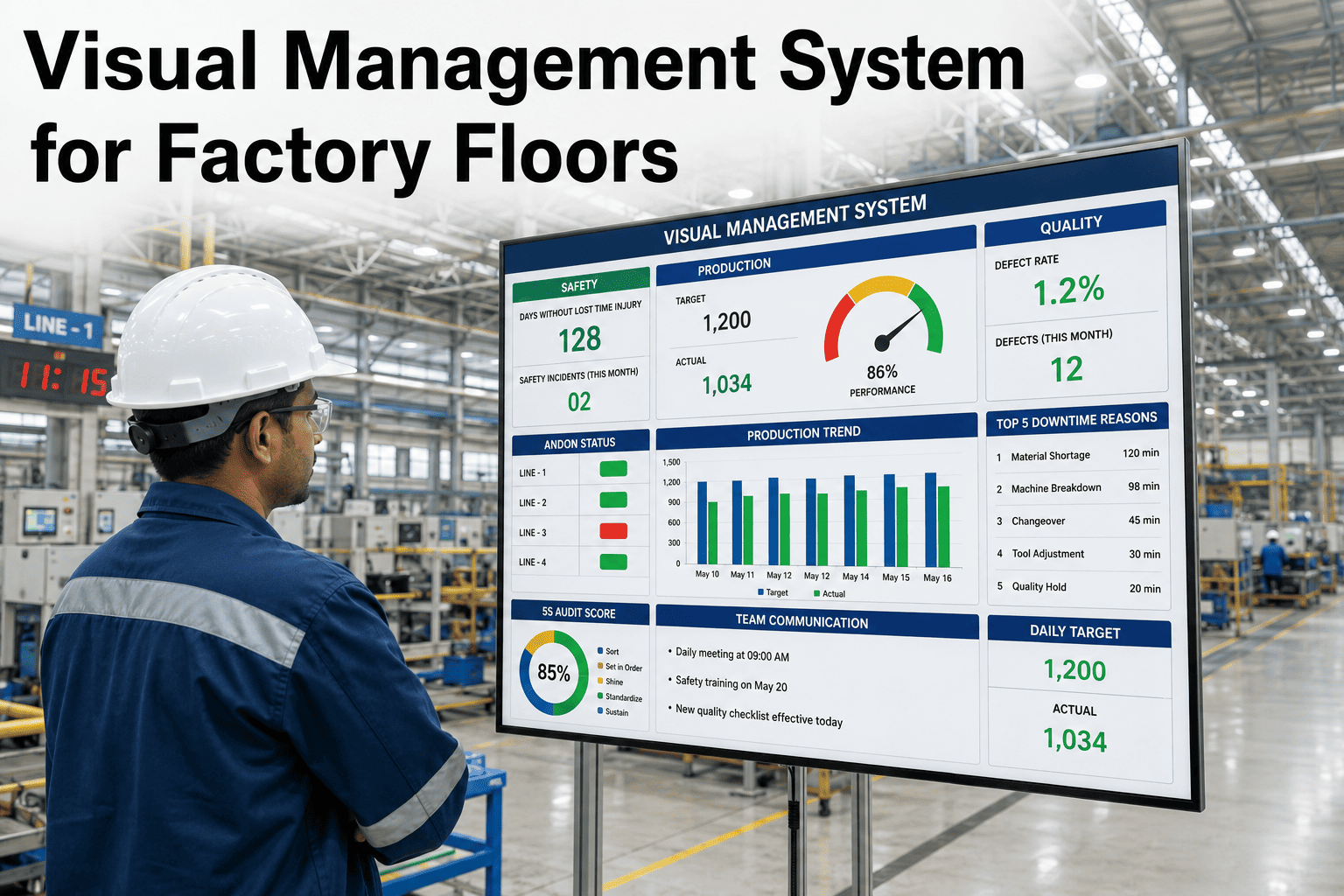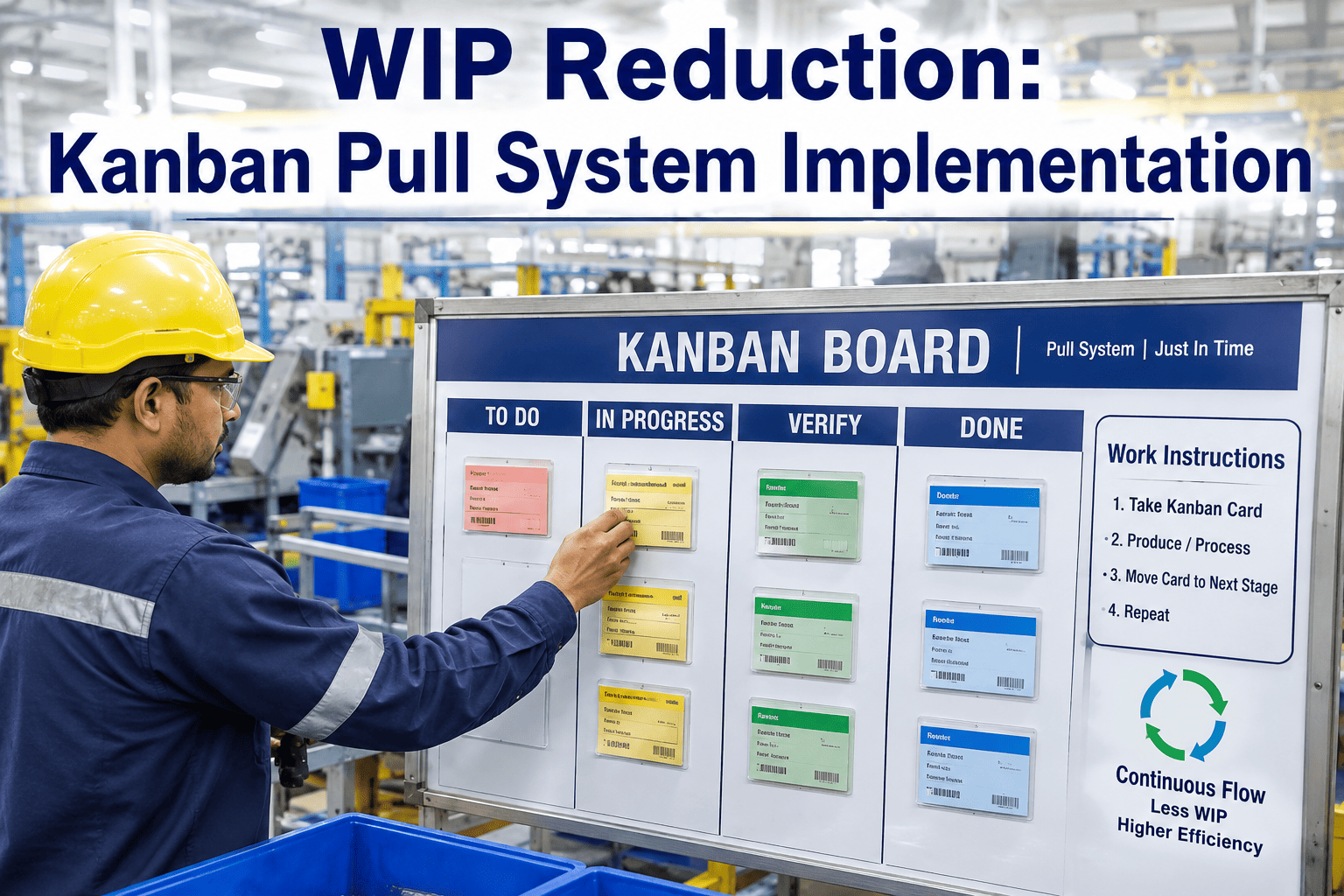
Walk any plant floor carrying more work-in-process than it needs and the signs are everywhere — pallets staged three deep between stations, operators searching through partially finished batches to find the part a downstream cell actually needs next, and a scheduling team that has stopped trusting the number on the ERP screen because the shop floor never quite matches it. None of this is a labor problem or a machine problem. It is a flow problem, and it has a name: excess WIP is hiding every other problem in the process instead of forcing them to the surface. A kanban pull system does not just tidy up inventory — it exposes exactly where flow breaks down, which is why so many lean transformations start there. Plants ready to size and launch a pull system correctly can Book a Demo to see kanban design built directly into a live production environment.
What Excess WIP Is Actually Costing the Plant
Work-in-process inventory feels harmless because it looks like productivity — machines are running, operators are busy, and pallets are moving somewhere. But every unit sitting between stations is cash that has left the bank account and hasn't turned into revenue yet, and it is also a problem in disguise. Excess WIP is exactly what allows a bottleneck, a quality defect, or an unreliable machine to hide for months without anyone noticing, because there is always another batch to work on while the real issue quietly repeats itself downstream.
Cash Tied Up in Half-Finished Product
Every unit sitting in a WIP buffer has already consumed labor, energy, and material cost, but generates zero revenue until it reaches a customer. High-WIP plants routinely have more capital parked on the floor than in finished goods.
Lead Time Stretches With Every Extra Batch
Little's Law is unforgiving here — the more units in process, the longer each one waits its turn. Doubling WIP without changing throughput roughly doubles the time a customer order sits in the system before it ships.
Defects Travel Further Before Anyone Catches Them
Large batches sitting between stations mean a quality issue at station one can pass through several more stations before an operator downstream notices, multiplying rework instead of catching the problem at the source.
Bottlenecks Stay Invisible
A push schedule keeps every station fed regardless of whether downstream can absorb the work, so the true constraint in the line stays buried under piles of buffer stock instead of surfacing as the priority it actually is.
None of these costs show up as a single line item on a P&L, which is exactly why excess WIP survives so long in most plants. Floor space consumed by buffer stock rarely gets billed back to the schedule that created it, and the extra handling, counting, and staging labor required to move partially finished product around gets absorbed into general overhead instead of being traced back to the batch sizes that caused it. A pull system does not eliminate these costs through a single dramatic fix — it removes them gradually, loop by loop, as card counts get tightened toward the true constraint of the line rather than the comfortable buffer everyone has learned to schedule around.
Little's Law: The Math Behind Every Pull System
Kanban is not a philosophy — it is applied math. The relationship that makes pull systems work was formalized by mathematician John Little, and it is the single equation that explains why reducing WIP shortens lead time even when nothing else on the line changes. Every kanban card count that follows below is really just a practical way of enforcing this relationship on the shop floor, so it is worth understanding before touching a single card.
Rearranged, this also means cycle time equals WIP divided by throughput — so for a fixed rate of output, cutting WIP in half cuts the average time a unit spends in the system in half as well. This is precisely why plants that reduce WIP without touching headcount or machine speed still see delivery lead times fall sharply within the first few weeks of running a pull system.
It also explains why simply telling operators to "carry less inventory" rarely works on its own. Without a mechanism that ties replenishment directly to actual consumption, WIP creeps back up the moment scheduling pressure returns, because nothing in a push-based system enforces the relationship Little's Law describes. Kanban succeeds where informal instructions fail because the card count itself becomes the enforcement mechanism — production simply cannot happen without an active signal authorizing it, which keeps the plant honest even under deadline pressure.
Calculating the Right Number of Kanban Cards
The most common reason a kanban rollout fails is not resistance to change — it is a card count that was guessed instead of calculated. Too few cards and the downstream process starves, stopping the line. Too many cards and the plant has simply rebuilt its old push-system inventory with a different label on it. The standard formula below removes the guesswork.
Worked Example: Sizing a Loop on the Floor
| Input | Value | What It Represents |
|---|---|---|
| Daily Demand (D) | 500 units/day | Average downstream consumption rate |
| Replenishment Lead Time (L) | 2 days | Time to produce and deliver one container |
| Safety Factor (S) | 20% | Buffer against demand and supply variability |
| Container Size (C) | 100 units | Standard batch quantity per card |
| Result: Kanban Cards (N) | 12 cards | (500 × 2 × 1.20) ÷ 100 = 12 |
| Resulting Total WIP | 1,200 units | 12 cards × 100-unit containers |
| Days of Supply | 2.4 days | Buffer covers the 2-day lead time plus margin |
Twelve cards is not a number a supervisor should feel locked into forever. The long-term direction in every mature lean operation is downward — shorten the replenishment lead time, shrink the container size, or tighten demand variability through level scheduling, and the required card count drops with it. Each card removed exposes whatever problem the extra buffer was quietly covering for, which is exactly the point.
Sizing the Supermarket: Where Pull Systems Actually Live
A kanban card is only half the system — the other half is the supermarket, the physical or digital buffer location where finished containers wait to be pulled. Getting supermarket sizing wrong is just as damaging as getting the card count wrong, and the two decisions have to be made together rather than in isolation.
Undersized Supermarkets
A supermarket sized too tight looks lean on paper but starves downstream the moment demand ticks up even slightly, or a single replenishment cycle runs late. The line stops, and the fix people reach for is usually to over-correct by adding far more buffer than was ever needed.
Oversized Supermarkets
A supermarket sized too generously quietly recreates the push-system inventory the pull system was meant to eliminate, tying up floor space and capital while masking the same variability problems a tighter buffer would have forced the team to fix.
Right-Sized Supermarkets
A properly sized supermarket holds exactly enough to absorb normal demand and lead time variation — no more — and is reviewed on a fixed cadence so it shrinks as replenishment reliability improves rather than staying fixed forever by default.
Visual Replenishment Signals That Keep the Pull System Honest
A kanban system only works if the signal to replenish is impossible to miss or misinterpret. Whether the plant uses physical cards, two-bin systems, or an electronic kanban board tied into a CMMS or MES, the signal path follows the same basic sequence on every well-run floor.
Downstream Consumes a Container
An operator or a cell pulls the last unit from a container, and the empty container or its card becomes the trigger — not a schedule, not a forecast, only actual consumption.
Signal Returns to the Supplying Process
The card or empty bin physically or digitally travels back upstream, authorizing exactly one more container's worth of production — nothing is made without an active signal in hand.
Upstream Replenishes Within Lead Time
The supplying process produces or picks the container within the agreed replenishment window, which is exactly the lead time value used in the original card calculation.
Supermarket Restocks and the Loop Resets
The full container returns to the supermarket, the card reattaches, and the loop is ready to repeat — a closed cycle with no forecasting step anywhere inside it.
Choosing a Signal Method: Cards, Bins, or Electronic Kanban
Not every line needs the same signal mechanism, and mixing methods across a plant is common and often correct. The right choice depends on part value, replenishment distance, and how tightly the loop needs to integrate with existing production systems.
| Method | Best Fit | Key Limitation |
|---|---|---|
| Physical Card Kanban | Short internal loops, stable demand, visual floor management | Cards can be lost or delayed without an audit process |
| Two-Bin System | Small, high-frequency parts like fasteners and consumables | Not suited to high-value or serialized components |
| Electronic Kanban (e-kanban) | Long or multi-site loops, supplier-linked replenishment | Requires system integration and reliable connectivity |
| Hybrid (ERP + Kanban) | Plants running long-range MRP planning with shop-floor pull execution | Needs clear rules for which system owns which decision |
Most real-world plants land on a hybrid model — an ERP or MRP system handles long-range material planning and customer order commitments, while kanban governs short-range execution on the floor itself. Getting this split wrong, by letting the ERP push schedules directly onto the floor alongside an active kanban loop, is one of the fastest ways to undermine a pull system that was otherwise sized correctly.
Part value and criticality also factor heavily into this decision. A low-cost fastener consumed hundreds of times a shift is a poor candidate for an electronic signal that requires scanning or system entry — a two-bin visual trigger will always be faster and cheaper to maintain there. A high-value subassembly sourced from a supplier three states away, on the other hand, benefits enormously from an electronic kanban tied into supplier portals, since a physical card traveling that distance would add days to the replenishment lead time the card count itself is trying to minimize. The right answer is rarely plant-wide standardization on one method — it is matching the signal mechanism to each individual loop's economics.
Rolling Out a Pull System Without Stopping the Line
Converting an entire plant to pull scheduling overnight is how kanban rollouts fail. A phased, loop-by-loop approach protects production continuity and gives the team a working reference loop to point to before asking the rest of the floor to change how it operates.
Pilot One High-Volume Loop
Choose a stable, high-volume part family for the first loop rather than the most chaotic one. A visible early win builds the credibility needed for every loop that follows.
Calculate and Calibrate Card Counts
Run the formula against real demand and lead time data, launch with a slightly conservative safety factor, and adjust the count weekly based on observed starvation or excess.
Expand Loop by Loop
Extend the model to adjacent part families and workstations, reusing the same sizing method so every loop across the plant follows one consistent design standard.
Tighten Continuously
Once a loop is stable, begin deliberately removing cards in small increments to expose and resolve the next constraint, moving the whole line closer to true one-piece flow.
Mistakes That Undo an Otherwise Correct Kanban Design
The math behind kanban sizing is straightforward, but plants still stumble during rollout in a handful of predictable ways. Recognizing these ahead of time saves months of rework and prevents a well-designed system from being abandoned for the wrong reasons.
Sizing Cards Off Peak Demand Instead of Average
Using peak demand as the baseline builds permanent excess WIP into the system to cover a spike that only happens occasionally. Average demand with an appropriate safety factor almost always produces a leaner, more accurate result.
Adding Cards to Cover for an Unreliable Process
When a loop starves, the instinctive fix is to add more cards. The correct fix is almost always to find and repair the source of unreliability — a slow changeover, an unstable machine, a late supplier — so the card count can stay lean instead of permanently inflating to hide the same problem.
Letting the ERP Push Schedule Override the Kanban Signal
If schedulers can still issue push orders directly onto a line running kanban, operators quickly learn to ignore the card system entirely, and WIP creeps right back up to where it started within a few months.
Never Revisiting Card Counts After Launch
A card count calculated once and never audited again drifts out of step with actual demand and lead time as the plant's product mix and supplier performance evolve, quietly eroding the accuracy of the whole system.
What a Correctly Sized Pull System Delivers
The payoff of a properly sized kanban system shows up fast, and it compounds as loops mature and card counts get progressively tighter. Plants that complete a full pull-system rollout consistently report the following shifts within the first two production quarters.
None of these results depend on adding headcount or capital equipment. They come directly from replacing a push schedule with a calculated pull signal — the same math, applied consistently, loop after loop, until the plant is running on genuinely lean inventory rather than inventory that simply looks organized.
The compounding effect is what tends to surprise plant leaders most. The first loop typically delivers the largest single WIP reduction, because it is removing years of accumulated buffer built up under a push schedule that never had a mechanism to question itself. Every loop after that delivers a smaller absolute reduction but a more durable one, because by then the team has already fixed the changeover times, supplier reliability issues, and quality escapes that the earlier, looser buffers were quietly covering for. A year into a full rollout, most plants describe the change less as an inventory project and more as a shift in how the entire floor thinks about what "normal" looks like.
Frequently Asked Questions: WIP Reduction and Kanban Pull Systems
How much WIP reduction should we realistically expect?
Most plants moving from a push schedule to a properly sized kanban loop see work-in-process fall by roughly 30 to 60% within the first two to three months of operating the new system, though the exact figure depends heavily on how much excess buffer existed beforehand and how quickly replenishment lead times can be tightened. Plants with highly variable demand or unreliable upstream supply typically see reductions toward the lower end of that range until the underlying variability is addressed, while stable, high-volume lines often see faster and larger gains. The reduction tends to continue well past the first quarter as cards are progressively tightened.
What happens if we set the kanban card count too low?
A card count set below what actual demand and lead time require causes starvation — the downstream process runs out of material before the upstream process can replenish it, forcing a line stop. This is why the formula includes a safety factor, and why most plants deliberately launch a new loop slightly conservative and reduce the count gradually as replenishment reliability is proven out. A starved loop should trigger a review of the underlying data, not an immediate abandonment of the pull system itself.
Can kanban and ERP scheduling coexist on the same plant floor?
Yes, and in practice most manufacturers run exactly this hybrid model — ERP or MRP handles long-range planning, customer order commitments, and material procurement, while kanban governs short-range execution and material movement on the shop floor itself. The critical rule is that once a loop is running on kanban, the ERP should not be allowed to push conflicting schedule instructions directly onto that line, or the pull signal loses its authority. Teams designing this split can contact iFactory Support for guidance on integration boundaries.
Do we need physical cards, or can the whole system be electronic?
Either approach works, and the right choice depends on the loop. Physical cards and two-bin systems are simple, visible, and require no connectivity, making them ideal for short internal loops and high-frequency small parts. Electronic kanban is better suited to longer loops, multi-site replenishment, or supplier-linked triggers where a digital signal can travel faster and more reliably than a physical card. Many plants run both simultaneously, matching the method to each loop's distance and part value rather than standardizing on one method plant-wide.
How often should kanban card counts be recalculated?
A reasonable cadence is a full review every quarter, with a lighter check-in monthly for high-mix or high-variability loops. Any meaningful shift in demand pattern, lead time, container size, or supplier reliability is also a trigger for an off-cycle recalculation, since a card count left unchanged as these inputs drift will quietly become either too tight, causing starvation, or too loose, quietly rebuilding the WIP the system was meant to eliminate.