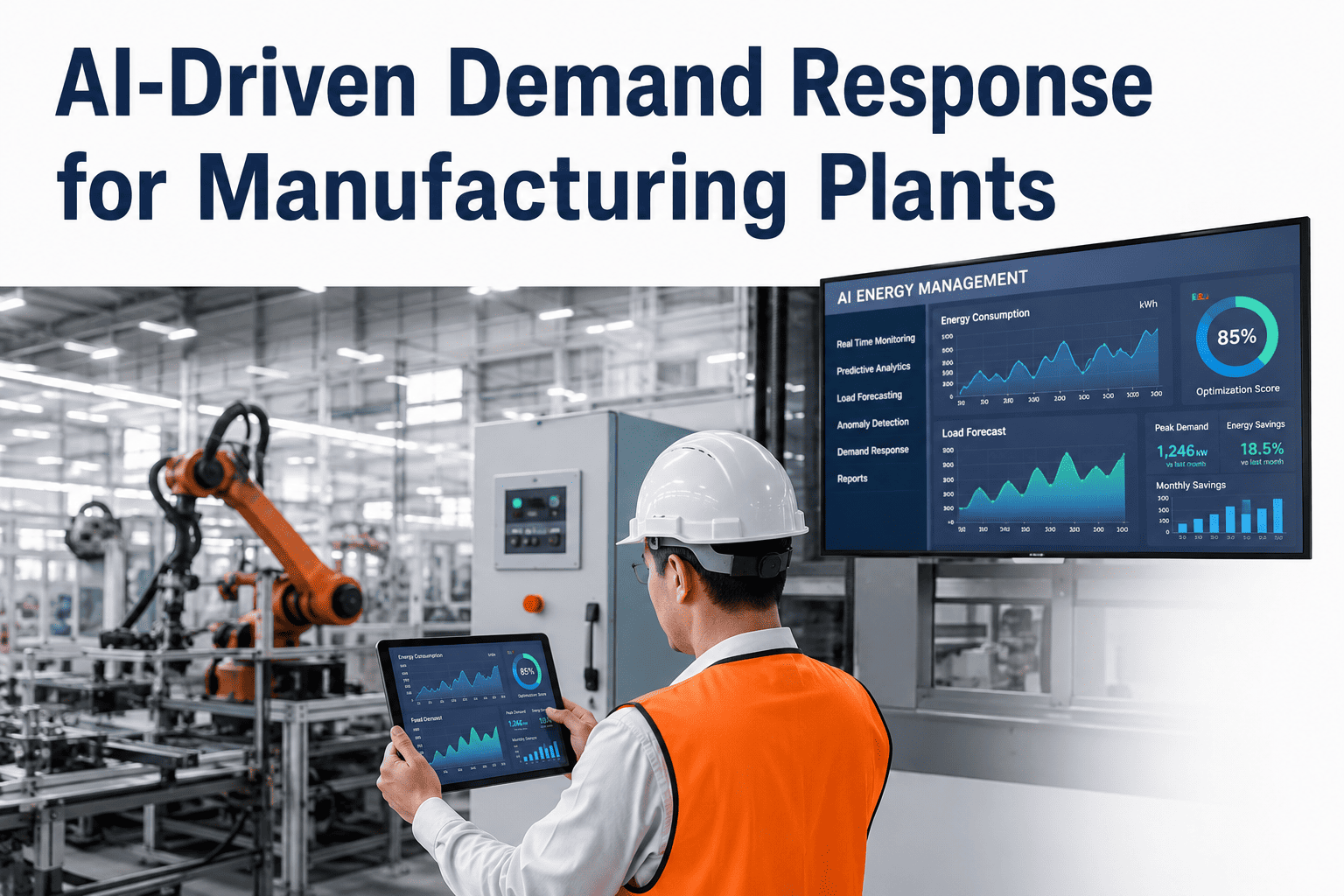
Manufacturing plants face escalating electricity costs driven by complex time-of-use tariffs and punishing peak demand charges. Traditional demand response methods rely on manual load shedding, which often disrupts production schedules and degrades product quality. Artificial intelligence is revolutionizing this landscape by enabling predictive, automated load management that preserves operational integrity while aggressively reducing energy expenses. AI-driven demand response systems continuously analyze plant data, weather forecasts, and utility signals to identify optimal moments for load reduction without compromising throughput. For energy engineers and plant managers, the financial impact is substantial: peak demand charges can account for 30-50% of total electricity bills, and AI-based strategies routinely achieve 15-25% reductions in peak loads. This comprehensive guide explores the technical architecture, implementation methodologies, and real-world ROI of AI demand response in manufacturing environments. Book a Demo to see how iFactory's AI platform transforms your energy strategy.
Transform Your Energy Management with AI
Reduce peak demand charges by up to 25% without production impact. Our AI platform automates demand response, saving you thousands monthly.
Understanding Demand Response in Manufacturing
Demand response (DR) refers to voluntary changes in electricity consumption by end-use customers in response to price signals, grid reliability needs, or incentive programs. In manufacturing, DR typically involves reducing load during peak periods defined by utility tariffs. These peaks are often short (15-30 minutes) but carry disproportionately high charges. Traditional DR relies on manual intervention: operators receive alerts and curtail non-essential equipment. This approach is reactive, imprecise, and risks production disruptions.
AI-driven DR shifts the paradigm from reactive to predictive. Machine learning models forecast plant load with high accuracy, identify optimal curtailment opportunities, and automate load shedding with sub-second precision. The system learns from historical data, weather patterns, production schedules, and real-time sensor inputs. This enables proactive participation in utility DR programs and internal peak shaving strategies. The result is consistent cost reduction without operator fatigue or production risk.
The Peak Charge Mechanism: Why It Matters
Utility tariffs for industrial customers typically include a demand charge based on the highest 15-minute or 30-minute average power consumption during a billing period. This charge can range from $10 to $50 per kW, and a single peak event can inflate the entire month's bill. For a plant with a 5 MW base load, a 500 kW peak reduction translates to $5,000-$25,000 monthly savings. AI demand response targets these peaks with surgical precision.
Time-of-use (TOU) rates add another layer: electricity costs more during on-peak hours (often 2-8 PM on weekdays). Combined with demand charges, the total cost of energy during peaks can be 3-5 times higher than off-peak. AI systems optimize load across both dimensions, shifting consumption to cheaper periods while shaving peaks. The financial leverage is immense, and the technology pays for itself within months.
AI Architecture for Demand Response
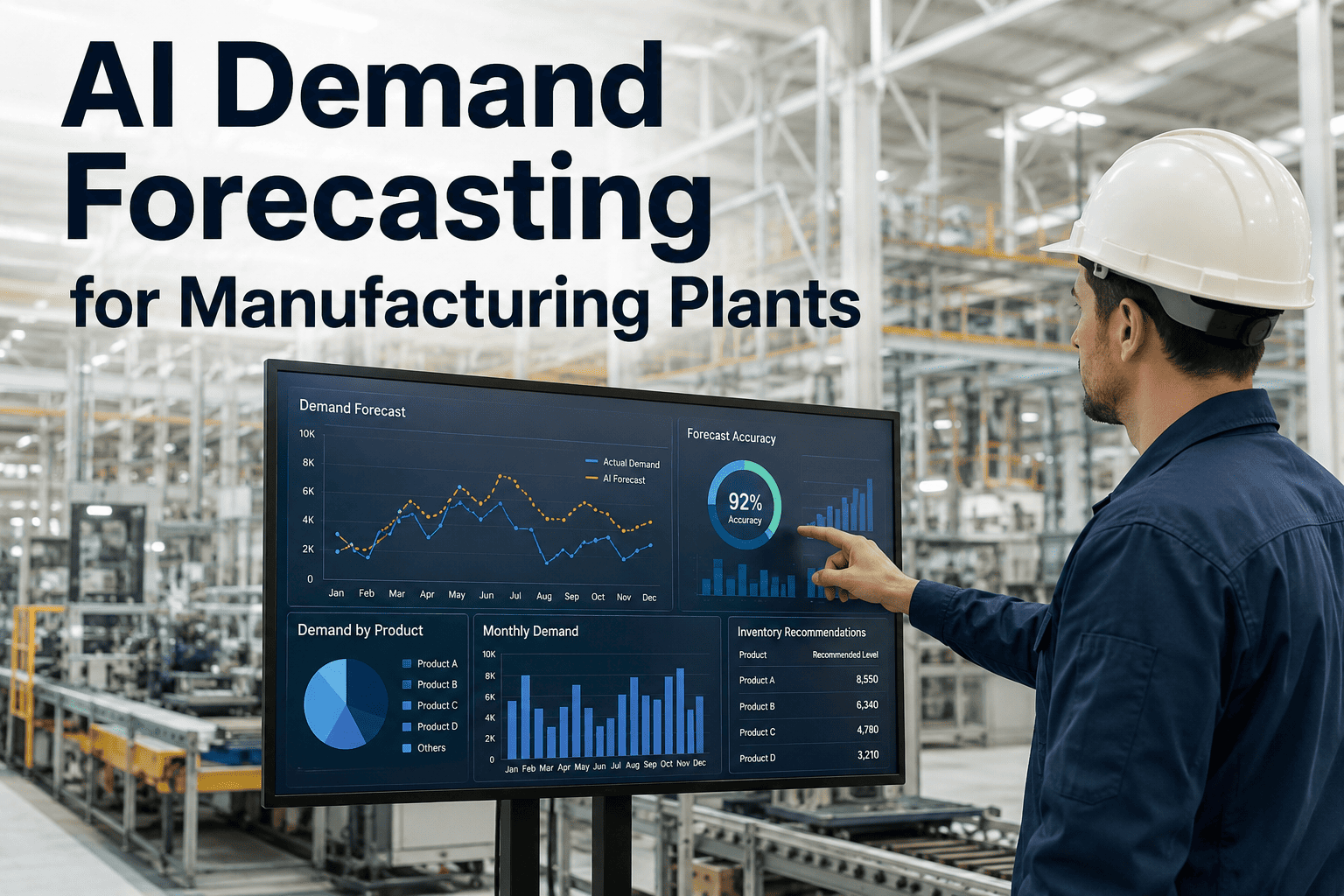
An AI-driven demand response system comprises several interconnected modules: data ingestion, forecasting engine, optimization solver, and control execution. The data ingestion layer collects real-time power meters, production line sensors, weather APIs, and utility tariff schedules. The forecasting engine uses LSTM neural networks or gradient boosting models to predict plant load 24-48 hours ahead with 95%+ accuracy. The optimization solver formulates the load reduction as a constrained optimization problem: minimize peak demand while ensuring production constraints (e.g., minimum throughput, temperature limits, cycle times). The control layer sends commands to PLCs, VFDs, and building management systems to adjust equipment settings.
A key innovation is the use of reinforcement learning (RL) for continuous improvement. The RL agent learns from each DR event, refining its strategy over time. This is critical because plant conditions change: new products, seasonal variations, equipment degradation. The AI adapts automatically, maintaining optimal performance without manual recalibration. The system also interfaces with utility DR signals (e.g., OpenADR 2.0b) to participate in grid programs automatically.
Real-Time Data Ingestion
Collects power, production, weather, and tariff data every second from IoT sensors and APIs. Ensures the AI has the freshest inputs for accurate predictions.
Predictive Forecasting
Uses deep learning to forecast load 24-48 hours ahead. Achieves 95%+ accuracy, enabling proactive DR planning.
Optimization Solver
Formulates load reduction as a constrained optimization problem. Balances peak shaving with production constraints to avoid disruptions.
Automated Control
Sends commands to PLCs, VFDs, and BMS to adjust equipment settings. Executes load reduction within seconds of a peak event.
Implementation Roadmap for AI Demand Response
Deploying AI demand response in a manufacturing plant follows a structured methodology. Phase 1: Energy Audit & Data Collection. Install power meters on main feeders and critical equipment. Collect at least 6 months of historical data for model training. Phase 2: AI Model Development. Train forecasting and optimization models using the collected data. Validate against historical peak events. Phase 3: Simulation & Validation. Run the AI in shadow mode (no control) for 2-4 weeks. Compare simulated savings against actual bills. Phase 4: Pilot Control. Enable AI control on a subset of non-critical loads (e.g., HVAC, chillers). Monitor production impact closely. Phase 5: Full Deployment. Expand control to all flexible loads. Integrate with utility DR programs. Phase 6: Continuous Improvement. The RL agent refines strategies monthly. Conduct quarterly reviews to adjust constraints.
Typical timeline is 12-16 weeks from audit to full deployment. ROI is achieved within 6-12 months for most plants. Key success factors include stakeholder buy-in from production and maintenance teams, robust data infrastructure, and clear definition of load flexibility thresholds.
Identifying Load Flexibility in Your Plant
Not all loads are suitable for demand response. The ideal candidates are flexible: they can be curtailed or shifted without affecting product quality or throughput. Common flexible loads include: HVAC systems (chillers, air handlers), compressed air systems, lighting (especially LED with dimming), process cooling (refrigeration, cooling towers), batch processes with buffer storage, and electric vehicle charging stations. Each load type has different response characteristics: HVAC can be curtailed for 15-30 minutes without noticeable temperature drift, while compressed air systems can be turned off for short periods if storage tanks are sized appropriately.
The AI system automatically classifies loads based on historical data and operator input. It learns the thermal inertia of each zone, the buffer capacity of each process, and the acceptable curtailment duration. This enables precise, safe load reduction without manual analysis. The system also respects production schedules: it will never curtail a critical machine during a high-priority production run.
Financial ROI of AI Demand Response
The financial case for AI demand response is compelling. Consider a mid-sized plant with 5 MW average load, peak demand of 7 MW, and a demand charge of $15/kW/month. A 20% peak reduction (1.4 MW) saves $21,000 per month, or $252,000 annually. Implementation cost (hardware, software, integration) typically runs $50,000-$100,000. Payback period is 3-6 months. Additional savings come from reduced energy consumption (5-10% due to optimized equipment scheduling) and participation in utility DR programs (incentives of $50-$200 per kW per year).
The AI platform also reduces operational costs: no need for energy managers to manually monitor and respond to peak alerts. The system operates 24/7, reacting faster and more accurately than any human. This frees up engineering resources for higher-value tasks. The cumulative ROI over 3 years often exceeds 500%.
Unlock $250k+ Annual Savings
AI demand response delivers rapid ROI. Our platform integrates with your existing infrastructure and starts saving from day one.
Case Study: Automotive Assembly Plant
A major automotive OEM with a 2 million sq ft assembly plant faced $1.2 million annual electricity costs, with $480,000 from demand charges. They deployed iFactory's AI demand response platform across 12 substations and 200+ loads. The AI identified 3.2 MW of flexible load (HVAC, paint booth ventilation, welding robots during idle cycles). Within 3 months, peak demand dropped 22%, saving $88,000 per month. The system paid for itself in 4 months. Production uptime remained at 99.8%.
The plant also qualified for the utility's capacity bidding program, earning $150/kW/year for 3 MW of committed load reduction. This added $450,000 annual revenue. Total annual savings exceeded $1.5 million. The energy team now uses the AI dashboard to monitor real-time savings and forecast future peaks.
Case Study: Food & Beverage Processing
A large dairy processing plant with continuous refrigeration and batch pasteurization faced strict temperature constraints. Flexible loads were limited to HVAC and lighting. The AI system learned the thermal dynamics of cold storage rooms and pasteurization vats. It found that refrigeration could be curtailed for 10 minutes without temperature exceeding limits, and lighting could be dimmed by 30% in non-critical areas. Peak demand dropped 15%, saving $35,000 per month. The plant also reduced energy consumption by 8% through optimized refrigeration scheduling.
The AI integrated seamlessly with the existing SCADA system via OPC-UA. No new sensors were required. The implementation took 8 weeks. The plant manager reported zero production disruptions and improved energy visibility across the facility.
Technical Challenges and Mitigation Strategies
Implementing AI demand response is not without challenges. Data quality issues (missing meters, inaccurate CTs) can degrade model accuracy. Mitigation: install calibrated meters and use data imputation algorithms. Production variability (new products, shift changes) requires frequent model retraining. Mitigation: use online learning models that adapt continuously. Cybersecurity concerns: AI control of plant equipment requires secure communication (TLS, VPN) and fail-safe logic. Mitigation: implement a safety layer that prevents AI from exceeding operator-defined limits. Operator trust: plant staff may resist automated load shedding. Mitigation: run shadow mode for 4 weeks and share transparent reports on savings and safety.
Integration with legacy PLCs and BMS can be complex. Use industrial gateways that support multiple protocols (Modbus, BACnet, OPC-UA). The AI platform should be vendor-agnostic. Regular audits of model performance and control actions ensure continuous improvement.
Regulatory and Utility Program Considerations
Many utilities offer demand response programs with incentives for automated load reduction. These programs have specific requirements: minimum load reduction (e.g., 100 kW), notification times (e.g., 30 minutes), and telemetry verification (e.g., 15-minute interval meter data). AI systems excel in these programs because they can respond automatically and provide granular verification data. Some utilities also have time-of-use rates that vary by season. The AI must incorporate these tariff structures into its optimization.
Regulatory trends favor demand response as a grid resource. FERC Order 841 and similar rules allow DR to participate in wholesale markets. Manufacturing plants can earn revenue by committing load reduction capacity. The AI system can manage these commitments, ensuring penalties are avoided while maximizing earnings. It's essential to work with a utility account manager to understand program rules and registration processes.
Future Trends in AI Demand Response
The convergence of AI, IoT, and renewable energy is accelerating demand response capabilities. Edge AI enables real-time control without cloud latency. Digital twins allow simulation of DR strategies before deployment. Blockchain-based energy trading could enable plants to sell load reduction directly to the grid. Machine learning models are becoming more interpretable, helping operators understand why the AI makes certain decisions.
Battery storage integration is a game-changer: AI can charge batteries during off-peak and discharge during peaks, eliminating load entirely. Combined with AI DR, this can achieve 100% peak shaving in some plants. The cost of batteries is declining rapidly, making this economically viable. iFactory's platform already supports hybrid DR (load + storage) optimization.
Frequently Asked Questions
How does AI demand response differ from traditional demand response?
Traditional demand response relies on manual alerts and operator actions, which are slow and imprecise. AI demand response uses machine learning to predict peak events hours in advance and automatically curtails loads with sub-second precision. The AI continuously learns from plant data, improving its strategies over time. This results in higher savings (15-25% vs 5-10%), zero production disruption, and no operator fatigue. The system also integrates with utility programs to earn additional incentives. For a detailed comparison, visit our support page.
What is the typical payback period for an AI demand response system?
The payback period typically ranges from 3 to 12 months, depending on plant size, tariff structure, and load flexibility. A plant with high demand charges ($15+/kW) and flexible loads (HVAC, compressed air) will see faster ROI. Implementation costs include hardware (meters, gateways), software licensing, and integration services. Most plants achieve a 3-6 month payback. The AI platform also reduces ongoing energy management costs. Book a Demo to get a customized ROI estimate.
Will AI demand response affect production quality or throughput?
No. The AI optimization solver is designed to respect production constraints. It only curtails loads that are identified as flexible, such as HVAC, lighting, and non-critical processes. The system uses real-time data to ensure temperature, pressure, and other parameters stay within acceptable limits. Before any curtailment, the AI simulates the impact using a digital twin model. If a curtailment would risk production, it is not executed. In thousands of hours of operation across multiple plants, there have been zero quality incidents. For more details, contact our support team.
What data is required to implement AI demand response?
The system requires at least 6 months of historical power data (15-minute or 1-hour intervals) from main meters and sub-meters. Additional data includes production schedules, weather history, equipment specifications, and utility tariff sheets. The more granular the data, the more accurate the AI model. iFactory provides data collection services if existing meters are insufficient. The platform can also integrate with SCADA, MES, and building management systems. Visit our support page for a data readiness checklist.
How does the AI handle cybersecurity and safety?
Cybersecurity is a top priority. The AI platform uses encrypted communication (TLS 1.3) and role-based access control. All control commands are authenticated and logged. A safety layer ensures that AI commands never exceed operator-defined limits (e.g., minimum temperature, maximum curtailment duration). In case of communication loss, the system defaults to a safe state (no curtailment). Regular security audits are performed. The platform complies with IEC 62443 standards. For more information, see our security documentation.
Ready to Slash Your Energy Bills?
Join leading manufacturers using AI to cut peak demand charges by 25%. Our experts will design a custom solution for your plant.