In the age of Industry 4.0, the manufacturing data platform stands as the foundational pillar for smart factory transformation. Yet, a disturbing pattern emerges across enterprises: within 12 months of deployment, manufacturing data lakes inexorably devolve into data swamps—unmanageable, low-trust environments where raw operational technology (OT) data accumulates without structure, governance, or actionable insight. This phenomenon, often termed the 'swamp trap,' stems from the inherent mismatch between traditional data lake architectures and the unique demands of time-series sensor data, PLC logs, and SCADA streams. A modern manufacturing data platform must transcend this limitation by adopting a lakehouse architecture—a paradigm that merges the flexibility of data lakes with the reliability of data warehouses. For CTOs, Plant Managers, and Maintenance Directors at the helm of digital transformation, understanding how to architect a lakehouse for OT data is not optional; it is the decisive factor separating predictive maintenance leaders from reactive laggards. This comprehensive guide dissects the anatomy of a manufacturing data lakehouse, exposes the root causes of data swamp formation, and provides a battle-tested blueprint for deploying a high-performance, AI-ready data platform. If your factory data is underperforming, it is time to Book a Demo and discover how iFactory's lakehouse solution eliminates the swamp trap for good.
Eliminate the Manufacturing Data Swamp
Stop wasting millions on ungoverned OT data. Our lakehouse architecture ensures your manufacturing data platform remains clean, fast, and AI-ready from day one.
The Swamp Trap: Why Manufacturing Data Lakes Fail
Manufacturing data lakes are particularly susceptible to becoming data swamps due to the high volume, velocity, and variety of OT data. Unlike IT data, which often has clear schema and governance boundaries, OT data streams from thousands of sensors with inconsistent naming conventions, variable sampling rates, and missing timestamps. Without a unified metadata layer and rigorous data quality enforcement, the lake quickly becomes a dumping ground. Within months, data scientists spend 80% of their time just finding and cleaning data, rather than building AI models. The swamp trap is not a technical failure—it is an architectural one.
Lakehouse Architecture: The Manufacturing Paradigm Shift
The data lakehouse combines the schema-on-read flexibility of a data lake with the ACID transaction guarantees and structured query capabilities of a data warehouse. For manufacturing, this means OT data can be ingested in its raw format, then incrementally transformed into clean, curated datasets without ever leaving the platform. Technologies like Delta Lake, Apache Iceberg, and Apache Hudi provide the foundation. A manufacturing lakehouse enables real-time streaming of sensor data, historical analysis of maintenance logs, and seamless integration with AI/ML pipelines—all within a single, governed environment.
Time-Series Data: The Heart of OT Data Platforms
Time-series data is the lifeblood of any manufacturing data platform. Unlike transactional data, time-series data is append-heavy, ordered by timestamp, and often requires downsampling for long-term storage. A lakehouse architecture must natively support time-series partitioning, retention policies, and windowed aggregations. Without these features, queries become prohibitively slow, and storage costs spiral. Implementing a time-series optimized storage layer—such as InfluxDB or TimescaleDB integrated with the lakehouse—ensures that historical trend analysis and anomaly detection queries run in seconds, not hours.
Step-by-Step Blueprint for a Manufacturing Lakehouse
Ingest Raw OT Data
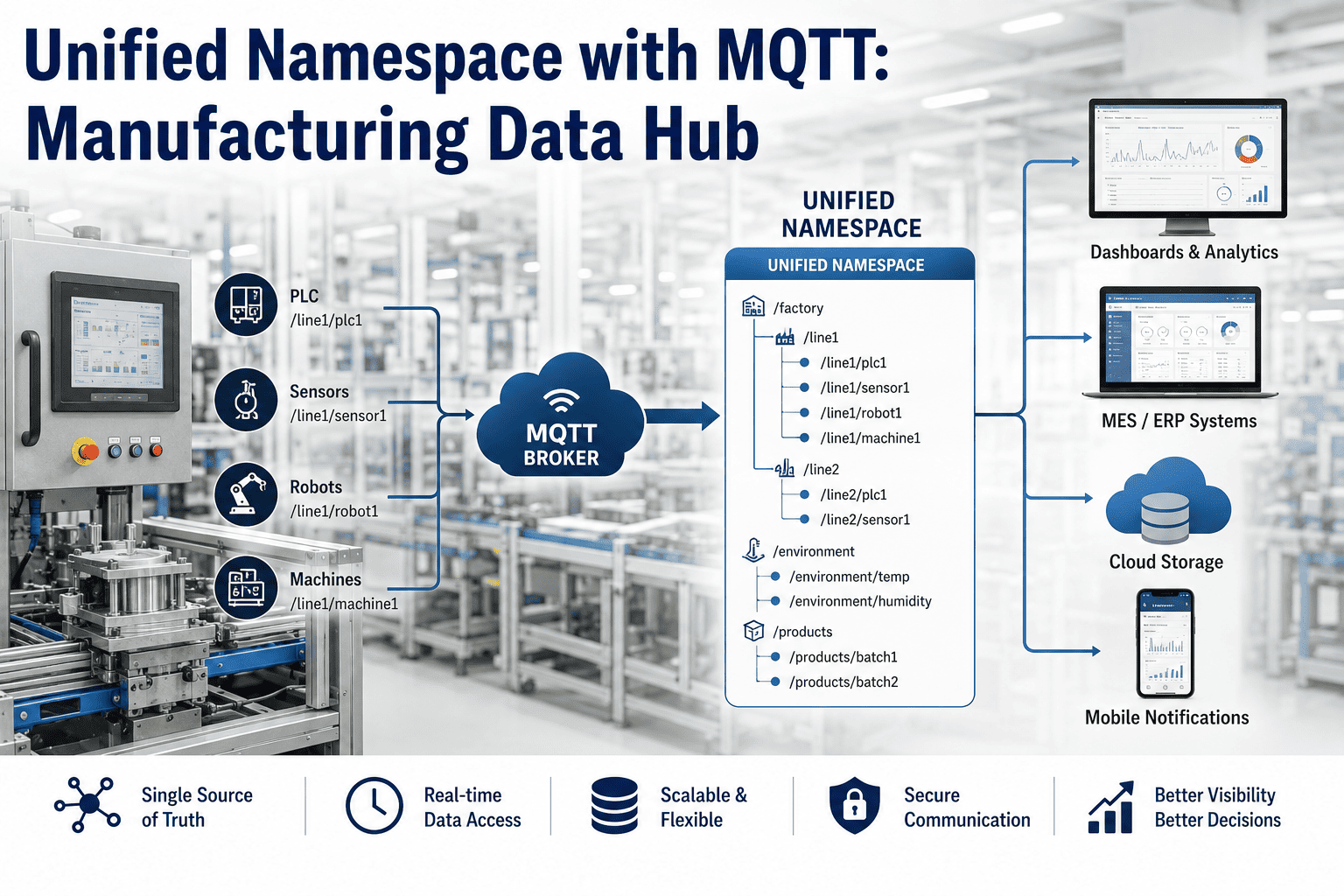
Use edge gateways or MQTT brokers to stream sensor data into a raw bronze layer. Retain all original timestamps and values. No transformation is applied at this stage.
Apply Schema-on-Read with Metadata
Define a metadata catalog that maps sensor IDs to asset hierarchies, units, and data types. This enables self-service discovery without moving data.
Clean and Curate into Silver Layer
Apply data quality rules: deduplicate, fill missing timestamps, normalize units, and tag outliers. Store results in an optimized columnar format like Parquet.
Aggregate into Gold Layer for Analytics
Create materialized views for common use cases: OEE dashboards, energy consumption trends, and predictive maintenance features. This layer directly serves BI tools and AI models.
Govern with Access Control and Lineage
Implement role-based access, data lineage tracking, and audit logs. Ensure compliance with plant security policies and GDPR if applicable.
Ready to Architect Your Manufacturing Data Platform?
Our experts will help you design a lakehouse tailored to your OT data. Eliminate swamps and unlock AI-driven insights.
Data Lake vs. Data Lakehouse for Manufacturing
| Feature | Data Lake | Data Lakehouse |
|---|---|---|
| ACID Transactions | Not supported | Fully supported (Delta Lake, Iceberg) |
| Schema Enforcement | Schema-on-read only | Schema-on-read + schema-on-write |
| Time-Series Optimization | Requires external tooling | Native partitioning and compaction |
| Data Governance | Limited metadata management | Unified catalog with lineage and access control |
| AI/ML Integration | Data must be exported | In-place feature engineering and model training |
| Query Performance | Slow on raw data | Optimized with indexing and caching |
Deep Dive: OT Data Governance in the Lakehouse
Governance is the single most critical factor in preventing the swamp trap. In a manufacturing data lakehouse, governance starts at the edge. Every sensor stream must be tagged with metadata—plant location, machine ID, data type, and sampling rate—before it enters the bronze layer. This metadata is stored in a central catalog (e.g., Apache Atlas or Unity Catalog) and is used to automatically enforce retention policies, data quality rules, and access controls. For example, vibration data from critical pumps may be retained for 5 years with monthly rollups, while temperature data from non-critical zones is purged after 90 days. Without such governance, the lakehouse becomes as chaotic as a swamp. Additionally, data lineage must be tracked end-to-end: from raw ingestion through transformations to final AI models. This enables root cause analysis when a model's predictions drift. iFactory's manufacturing data platform embeds governance at every layer, ensuring that your OT data remains trustworthy and actionable.
Real-Time Streaming Ingestion
Leverage Kafka or MQTT to ingest sensor data with sub-second latency. The lakehouse architecture supports stream-to-batch integration, enabling real-time dashboards without sacrificing historical analytics.
Unified Metadata Catalog
A single catalog that maps all OT data assets to business context. Data scientists can discover, understand, and trust the data they use for model training.
Automated Data Quality Checks
Define rules for completeness, accuracy, and timeliness. The lakehouse automatically flags anomalies and quarantines bad data before it affects downstream analytics.
AI-Ready Feature Store
Pre-compute features like rolling averages, FFT spectra, and anomaly scores. The feature store serves both training and inference, ensuring consistency between development and production.
Frequently Asked Questions
What is the difference between a data lake and a data lakehouse in manufacturing?
A data lake stores raw data in its native format without enforcing a schema, which often leads to a data swamp when managing OT data. A data lakehouse, by contrast, adds a metadata and governance layer on top of the storage, enabling ACID transactions, schema enforcement, and time-series optimizations. For manufacturing, this means you can ingest raw sensor data and then incrementally clean and curate it without ever moving it to a separate warehouse. The lakehouse also supports real-time streaming and AI/ML workloads natively, making it the superior architecture for Industry 4.0. To see how iFactory implements a manufacturing data lakehouse, Book a Demo.
How does a lakehouse prevent the data swamp problem?
The lakehouse prevents swamps by enforcing governance from the point of ingestion. Every data stream is tagged with metadata and stored in a multi-layered architecture (bronze, silver, gold). Data quality rules are applied automatically, and only clean, curated data is exposed to analytics and AI tools. Additionally, the lakehouse provides a unified catalog that allows users to discover and trust data without manual intervention. This eliminates the 'find, clean, and trust' cycle that plagues traditional lakes. For a deeper understanding of how iFactory's governance framework works, contact our support team.
What are the key technologies used in a manufacturing data lakehouse?
Key technologies include Delta Lake (for ACID transactions and schema evolution), Apache Spark (for distributed processing), Apache Kafka or MQTT (for real-time ingestion), and a metadata catalog like Apache Atlas or Unity Catalog. For time-series optimization, integrations with InfluxDB or TimescaleDB are common. The storage layer is typically object storage (e.g., S3, ADLS) with columnar file formats like Parquet. iFactory's platform integrates these technologies into a unified solution tailored for OT data. To explore how these components fit together in your environment, Book a Demo.
How does the lakehouse handle real-time sensor data and historical analytics together?
The lakehouse architecture uses a streaming-first approach. Real-time sensor data is ingested via Kafka or MQTT and immediately written to the bronze layer in small micro-batches. At the same time, a streaming engine (e.g., Spark Structured Streaming) can compute real-time aggregates for dashboards. Historical analytics are served from the silver and gold layers, which are optimized for columnar scans and time-range queries. The same storage layer holds both real-time and historical data, eliminating data duplication. This unified approach ensures that predictive maintenance models can train on years of historical data while scoring on live streams. For a custom architecture review, contact support.
What are the cost implications of migrating from a data lake to a lakehouse?
Migrating from a data lake to a lakehouse typically reduces total cost of ownership (TCO) by 30-50% due to elimination of data movement, reduction in data engineering effort, and improved query performance. While there is an initial investment in setting up the metadata catalog and governance rules, the long-term savings from avoiding the swamp trap are substantial. Additionally, the lakehouse reduces storage costs by using efficient columnar formats and automated data lifecycle management. iFactory provides a TCO calculator and migration roadmap to help you quantify the benefits. For a detailed cost analysis, Book a Demo.
Transform Your Manufacturing Data Platform Today
Don't let your data lake become a swamp. Our lakehouse architecture is purpose-built for OT data, ensuring high performance, governance, and AI readiness.