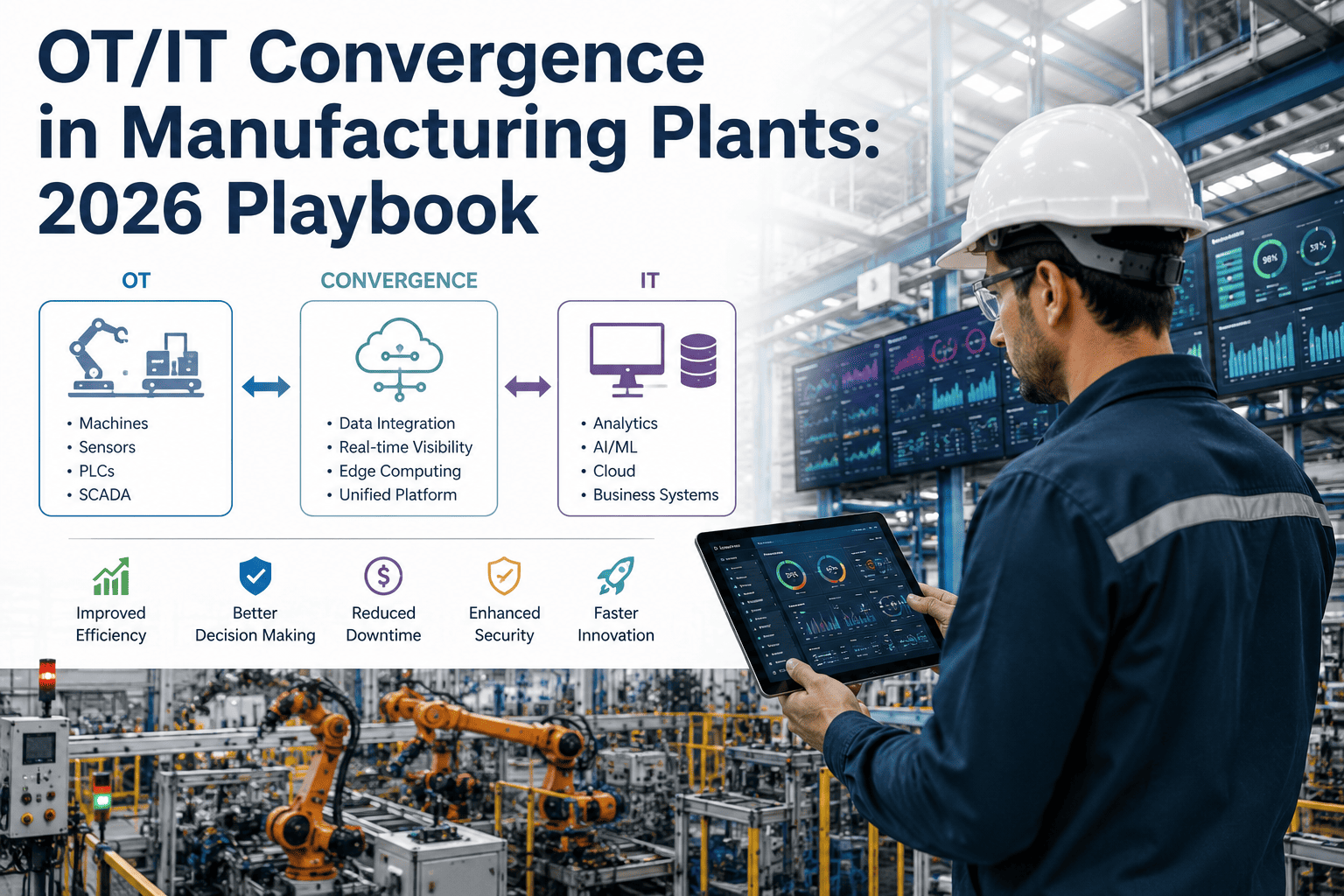
The convergence of Operational Technology (OT) and Information Technology (IT) in manufacturing plants is no longer a futuristic concept—it is an operational imperative for 2026. As plants evolve into smart factories powered by Industry 4.0, the once-clear boundary between OT systems (PLCs, SCADA, DCS) and IT infrastructure (servers, networks, cloud platforms) is dissolving. This integration unlocks unprecedented levels of predictive maintenance, real-time analytics, and autonomous decision-making. However, achieving true OT/IT convergence demands more than just network connectivity; it requires a fundamental shift in culture, architecture, security, and data governance. This playbook provides a comprehensive, enterprise-grade roadmap for plant managers, CTOs, and maintenance directors to navigate this complex transformation. From bridging the cultural divide between engineering and IT teams to implementing robust cybersecurity frameworks, every aspect is covered with technical depth and strategic insight. Book a Demo to see how iFactory can accelerate your convergence journey.
Why OT/IT Convergence Matters in 2026
The Fourth Industrial Revolution demands seamless data flow from the sensor to the boardroom. OT/IT convergence enables real-time visibility into production processes, reduces downtime through predictive analytics, and optimizes energy consumption. In 2026, manufacturers face increasing pressure to improve OEE, reduce costs, and meet sustainability targets. Convergence is the linchpin for achieving these goals.
Ready to Bridge the Gap?
Transform your plant with seamless OT/IT integration. Book a demo today.
Key Statistics Driving Convergence
Bridging the Cultural Divide
The biggest barrier to OT/IT convergence is not technology—it is culture. OT teams prioritize reliability, safety, and real-time control, often viewing IT as a disruptor. IT teams focus on data integrity, cybersecurity, and scalability, sometimes underestimating OT's operational constraints. Successful convergence requires mutual respect and cross-functional collaboration.
OT Perspective
Operational technology engineers are trained to keep production running at all costs. They value deterministic communication, low latency, and physical safety. Changes to control systems are rigorously tested and rarely made on the fly. OT teams often resist IT-led initiatives that could introduce latency or vulnerabilities.
IT Perspective
Information technology professionals prioritize data governance, network security, and system scalability. They are accustomed to frequent updates, cloud integration, and standardized protocols. IT teams may struggle to understand the criticality of continuous uptime and the need for specialized OT protocols like Modbus or Profinet.
Convergence Strategies
Create joint OT/IT steering committees, conduct cross-training workshops, and establish shared KPIs like overall equipment effectiveness (OEE) and mean time to repair (MTTR). Use a common language—avoid jargon from either side. Celebrate quick wins that demonstrate value for both teams.
Technical Architecture Patterns for Convergence
A robust architecture is the backbone of OT/IT convergence. The traditional Purdue model is evolving into a flat, data-centric network design. Key patterns include the use of DMZs, unidirectional gateways, and edge computing nodes. These components ensure secure, real-time data flow while maintaining operational integrity.
| Architecture Component | Function | OT/IT Integration Role |
|---|---|---|
| Unidirectional Gateway | Allows data flow from OT to IT only | Prevents cyber attacks from IT to OT |
| Edge Computing Node | Processes data at the plant floor | Reduces latency and bandwidth usage |
| Industrial DMZ | Isolated network zone | Secures communication between OT and IT |
| Data Historian | Time-series database for OT data | Provides structured data for IT analytics |
| API Gateway | RESTful interface for OT data | Enables IT applications to access OT data |
Cybersecurity in Converged Environments
Convergence expands the attack surface. Traditional air-gapped OT networks are now connected to IT networks, increasing vulnerability to ransomware and targeted attacks. A defense-in-depth strategy is essential, incorporating network segmentation, intrusion detection systems (IDS), and regular vulnerability assessments.
Network Segmentation
Divide the plant network into zones based on criticality. Use firewalls and VLANs to restrict traffic between zones. This limits the blast radius of any security incident.
Intrusion Detection
Deploy IDS sensors that monitor both OT-specific protocols (e.g., Modbus, DNP3) and traditional IT traffic. Anomaly detection algorithms can identify malicious behavior in real time.
Patch Management
Establish a rigorous patch management process that tests updates in a sandbox environment before deploying to production OT systems. Prioritize patches that address critical vulnerabilities.
Zero Trust Architecture
Assume that no device or user is inherently trustworthy. Implement multi-factor authentication, least-privilege access, and continuous monitoring for all converged systems.
Data Governance and Standardization
OT/IT convergence produces a deluge of data from diverse sources—sensors, PLCs, SCADA, MES, ERP. Without proper governance, data becomes siloed and unusable. Establish a unified data model, standardize on communication protocols like OPC UA or MQTT, and implement a data lake architecture that supports both structured and unstructured data.
Assess Current Data Sources
Catalog all OT and IT systems, their data formats, and existing interfaces. Identify gaps and redundancies.
Define a Common Data Model
Create a semantic model that maps OT data (e.g., temperature, pressure) to business metrics (e.g., OEE, energy cost). Use standards like ISA-95.
Implement Data Pipelines
Use edge gateways to collect, normalize, and transmit data to a central data lake. Ensure data quality through validation rules.
Enable Self-Service Analytics
Provide business users with tools to query and visualize OT/IT data without IT intervention. This democratizes data access.
Phased Implementation Timeline
Convergence is a journey, not a single project. A phased approach minimizes risk and allows for continuous learning. The timeline below outlines key milestones over 12 months.
Accelerate Your Convergence Journey
Our experts help you navigate cultural, technical, and security challenges. Book a demo now.
Evolving Roles and Responsibilities
OT/IT convergence blurs traditional job boundaries. Plant managers must now understand network security, while IT staff need to grasp production processes. New roles emerge, such as OT/IT integration architect and industrial data scientist.
OT/IT Integration Architect
Designs the converged network architecture, selects gateways and protocols, and ensures seamless data flow while maintaining security and reliability.
Industrial Data Scientist
Analyzes converged data to build predictive models for maintenance, quality, and energy optimization. Bridges the gap between data science and manufacturing.
Cybersecurity Engineer (OT)
Specializes in securing industrial control systems, conducting risk assessments, and implementing OT-specific security controls.
Plant IT Manager
Oversees the IT infrastructure within the plant, ensures uptime of networked systems, and collaborates with corporate IT on standards.
Real-World Case Study: Automotive Tier 1 Supplier
A leading automotive supplier faced frequent downtime due to siloed OT and IT systems. After implementing a converged architecture with edge computing and a unified data lake, they achieved a 40% reduction in unplanned downtime and a 20% increase in OEE within six months. The key was cross-functional team collaboration and a phased rollout.
Best Practices for Long-Term Success
- Start with a clear business case tied to measurable KPIs like OEE, MTTR, and energy cost.
- Invest in cross-training programs to build a shared understanding between OT and IT teams.
- Adopt open standards like OPC UA and MQTT to avoid vendor lock-in.
- Implement a robust change management process to handle updates without disrupting production.
- Conduct regular security audits and penetration testing on converged systems.
- Use a centralized data lake with role-based access to democratize data while maintaining security.
- Establish a governance committee with representatives from OT, IT, and business units.
- Monitor network performance continuously to detect anomalies early.
- Leverage digital twins to simulate convergence scenarios before deployment.
- Celebrate and communicate quick wins to maintain momentum and buy-in.
Frequently Asked Questions
What is OT/IT convergence in manufacturing?
OT/IT convergence refers to the integration of operational technology (such as PLCs, SCADA, and sensors) with information technology (such as servers, cloud platforms, and enterprise software) to enable seamless data flow and real-time analytics. This integration is essential for smart factory initiatives, allowing manufacturers to optimize production, reduce downtime, and improve decision-making. Book a Demo to learn how iFactory can help you achieve convergence.
What are the main challenges of OT/IT convergence?
The main challenges include cultural resistance between OT and IT teams, cybersecurity risks from expanded attack surfaces, data standardization across diverse protocols, and network latency concerns. Additionally, legacy OT equipment may lack modern connectivity features, requiring retrofitting or gateways. A phased approach with cross-functional collaboration is key to overcoming these hurdles. Contact support for guidance on your specific environment.
How does OT/IT convergence improve predictive maintenance?
By converging OT and IT data, manufacturers can feed real-time sensor data into machine learning models that predict equipment failures before they occur. This enables proactive maintenance scheduling, reducing unplanned downtime and extending asset life. The unified data environment also allows for correlation of production data with maintenance events, improving root cause analysis. Book a Demo to see our predictive maintenance module.
What security measures are needed for OT/IT convergence?
Essential security measures include network segmentation using DMZs, deployment of unidirectional gateways, implementation of intrusion detection systems for OT protocols, regular vulnerability assessments, and adoption of zero trust principles. Additionally, patch management processes must be adapted to OT environments to avoid disrupting production. Get support for a comprehensive security assessment.
How long does it take to implement OT/IT convergence?
The timeline varies based on plant complexity, but a typical phased implementation takes 6 to 12 months. The first phase (assessment) takes 1-2 months, followed by a pilot on a single line (3-5 months), scaling to full plant (6-9 months), and optimization (10-12 months). Factors like legacy equipment, team readiness, and budget can affect duration. Book a Demo for a personalized roadmap.
Transform Your Plant Today
Achieve true OT/IT convergence with iFactory's industry-leading platform. Book your demo now.