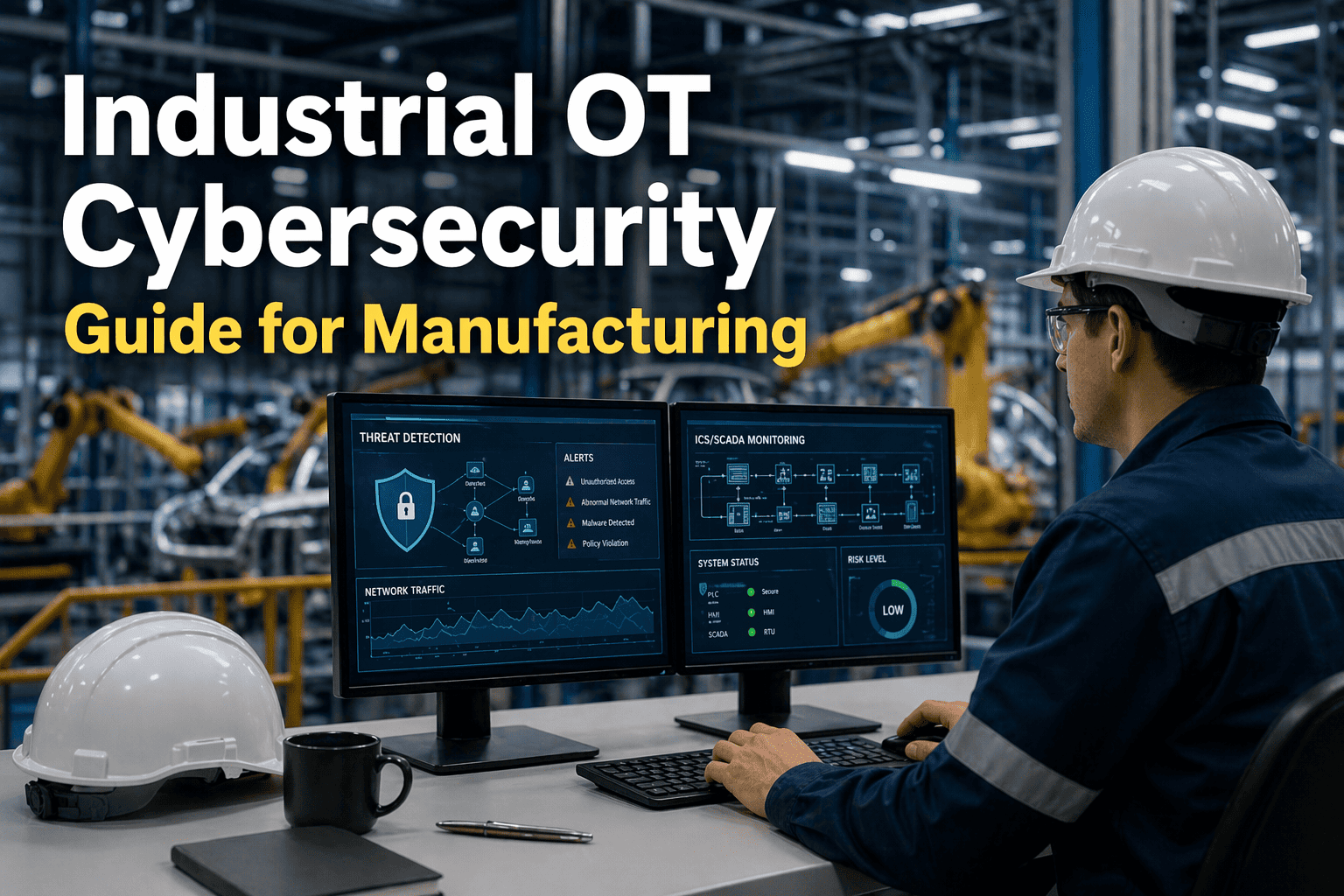
Smart factories are under siege. As manufacturers race to connect production lines, IoT sensors, and cloud analytics under Industry 4.0, cybercriminals are exploiting every new connection point to halt operations, steal trade secrets, and extort millions. With manufacturing now accounting for nearly 28% of all global cyberattacks—more than any other sector—the question is no longer whether your plant will be targeted, but when. This guide breaks down the real-world threats facing operational technology environments, the proven defense strategies that actually work on the factory floor, and why cyber resilience is now a prerequisite for modern manufacturing. Schedule a free cybersecurity assessment demo and let our OT security specialists evaluate your plant's risk exposure before attackers do.
Why Is Manufacturing the #1 Target for Cyberattacks?
For four consecutive years, manufacturing has topped the list of most-attacked industries worldwide. The reason is straightforward: factories depend on continuous uptime, they run legacy systems never designed for internet connectivity, and the financial pressure of halted production lines makes them more likely to pay ransoms quickly. Understanding the threat landscape is the first step toward protecting your operations.
28%
of all global cyberattacks hit manufacturing—the highest of any industry sector in 2025
$260K
average cost per hour of unplanned downtime caused by cyber incidents in production facilities
68%
of all industrial ransomware incidents specifically target manufacturing operations
The convergence of Information Technology (IT) and Operational Technology (OT) is at the heart of this crisis. Previously isolated control systems—PLCs, SCADA, HMIs—are now connected to enterprise networks for efficiency gains, but this connectivity also gives attackers a direct pathway from a phishing email to your production floor. A recent industry study found that 80% of manufacturers reported an increase in security incidents across their IT/OT environments, yet only 45% feel adequately prepared to respond.
The Real Cost of Complacency
The average manufacturing data breach now costs $5.56 million—an 18% jump from the previous year. But the true damage extends further: supply chain disruptions cascade to partners and customers, intellectual property theft undermines competitive advantage, and regulatory penalties compound financial losses. Manufacturers take an average of 199 days just to identify a breach, giving attackers months of undetected access to critical systems.
Don't wait for a breach to expose your vulnerabilities. iFactory helps manufacturers identify and close OT security gaps before attackers find them.
How Do Cyberattacks Compromise OT Systems in Factories?
Most manufacturing cyberattacks follow a predictable kill chain—entering through IT systems and pivoting into operational technology. Research shows that 75% of OT security incidents originate from IT-side breaches that spread into production environments. Knowing this attack progression helps security teams place defenses at the right points.
Phase 1
Reconnaissance and Initial Access
Attackers probe public-facing applications, remote access portals, and employee credentials. Phishing remains the top entry vector—over 90% of manufacturing breaches begin with a deceptive email. Exploitation of public-facing applications accounts for 32% of initial compromises, while stolen valid accounts represent another 16%.
Phase 2
Lateral Movement from IT to OT
Once inside the corporate network, threat actors move toward operational systems. Without proper network segmentation, the path from a business email server to a SCADA system can be disturbingly short. Attackers escalate privileges, harvest additional credentials, and map the industrial control architecture.
Phase 3
Production System Compromise
Attackers deploy ransomware across production systems, manipulate PLC parameters to sabotage quality, or exfiltrate proprietary manufacturing data. Legacy controllers running unpatched firmware and default credentials become easy targets. In 40% of manufacturing attacks, the goal is direct data theft targeting IP and trade secrets.
Phase 4
Operational Disruption and Extortion
Production halts, supply chains fracture, and the clock starts ticking on ransom demands. Recovery timelines stretch from weeks to months—with average ransomware downtime lasting 24 days. The financial impact ranges from $200,000 to $2 million per incident depending on severity. Don't let your factory reach Phase 4—
Get Support for iFactory's OT threat monitoring to detect and contain attacks before production stops.
Top Cyber Threats to Smart Manufacturing in 2025
The manufacturing threat landscape evolves rapidly as attackers adopt AI tools, exploit supply chain dependencies, and target the growing number of connected industrial devices. Here are the most critical threats that plant security teams need to defend against right now.
Critical
Industrial Ransomware
Manufacturing ransomware incidents surged 61% year-over-year. Attackers specifically target production systems knowing that downtime costs of $260K/hour create maximum pressure to pay. Groups like Sarcoma and LockBit have developed OT-specific payloads designed to freeze robotic assembly lines and chemical processes.
Critical
Supply Chain Infiltration
Attackers bypass direct defenses by compromising trusted third-party vendors, software suppliers, and hardware manufacturers. Global supply chains with smaller partners lacking strong cybersecurity provide easy footholds. A breach in one supplier can propagate across dozens of connected manufacturer networks within hours.
High
AI-Enhanced Phishing and Deepfakes
Generative AI enables hyper-personalized phishing campaigns that bypass traditional email filters. Deepfake technology creates convincing impersonations of executives—one documented case led to a $25 million fraudulent wire transfer via video call with a AI-generated executive. Manufacturing employees with OT access are high-value targets.
High
Nation-State Industrial Espionage
State-sponsored groups are responsible for approximately 4% of all targeting activity against manufacturers, driven by economic espionage and strategic disruption. Proprietary chip designs, manufacturing processes, and engineering blueprints command enormous value. Between 2024 and early 2025, 29 distinct threat groups were actively targeting the sector.
Elevated
Legacy OT System Exploits
CISA has cataloged over 1,200 known OT vulnerabilities from 300+ OEMs. Roughly 70% of OT environments still depend on legacy systems that cannot be easily patched. Unencrypted industrial protocols (Modbus, older Profinet) and default credentials on PLCs create persistent vulnerabilities that attackers reliably exploit.
Elevated
Insider Threats and Human Error
Negligent and malicious insider activity drives a significant share of OT cyber risk. In highly automated environments, a single misconfiguration can cascade into a full security incident. Only 14% of organizations report feeling fully prepared for insider-driven threats, highlighting a persistent capability and cultural gap between IT and OT teams.
See how iFactory detects threats before they reach your production floor. Get a live walkthrough of real-time OT monitoring and automated incident response.
IT Security vs OT Security: What Manufacturers Get Wrong
One of the most dangerous misconceptions in manufacturing cybersecurity is treating OT security the same as IT security. The priorities, constraints, and consequences are fundamentally different—and strategies that work in the data center can be catastrophic on the factory floor.
The critical takeaway: 48% of manufacturers identify operational risks including cybersecurity as the greatest danger to smart factory initiatives. Bridging the IT-OT security gap requires unified visibility, specialized OT-aware monitoring tools, and security teams that understand both environments. Schedule a demo to see unified IT-OT security monitoring in action and discover how iFactory closes the visibility gap across your entire factory network.
How to Build a Zero Trust Architecture for Your Factory
Zero Trust—the principle of "never trust, always verify"—has become the gold standard for manufacturing cybersecurity. Unlike perimeter-based defenses that assume everything inside the network is safe, Zero Trust treats every access request as potentially hostile, whether it originates from the corporate office or the production floor.
01
Complete Asset Visibility
You cannot protect what you cannot see. Maintain a definitive inventory of every OT asset—PLCs, HMIs, sensors, network switches, edge devices—with firmware versions, communication patterns, and risk scores. CISA and UK NCSC joint guidance identifies OT asset inventory as the foundation for effective incident response.
02
Micro-Segmentation
Divide your network into isolated zones so a breach in one area cannot spread to others. Create strict boundaries between IT and OT, between production lines, and between critical and non-critical systems. Industrial DMZs should mediate all cross-zone data flows.
03
Identity-Centric Access Control
Enforce multi-factor authentication for every access point—remote VPNs, local HMI terminals, engineering workstations. Apply least-privilege principles so each user and device only accesses what their role requires. Regularly rotate credentials and eliminate default passwords across all industrial equipment.
04
Continuous Traffic Monitoring
Deploy OT-aware intrusion detection that understands industrial protocols and can distinguish normal machine communication from anomalous behavior. AI-driven baselines adapt to production changes, shift patterns, and equipment aging—detecting threats that rule-based systems miss.
05
Automated Response Orchestration
Pre-built playbooks enable immediate containment actions—isolating compromised segments, blocking suspicious communications, and triggering alerts—without waiting for human intervention. Speed is critical: the difference between a contained incident and a plant-wide shutdown is measured in minutes.
Ready to implement Zero Trust on your factory floor? Our specialists will map your OT architecture and design a segmented, monitored environment that protects production while enabling innovation.
Get Support
Manufacturing Cybersecurity Compliance: NIST, IEC 62443, and Beyond
Regulatory pressure on manufacturing cybersecurity is intensifying rapidly. New mandates like NIS2 in Europe and evolving NIST guidance in the US are shifting cybersecurity from a best practice to a legal requirement. Understanding which frameworks apply to your operation—and how to meet them efficiently—is essential for avoiding penalties and maintaining market access.
Foundation
NIST Cybersecurity Framework (CSF 2.0)
The updated NIST CSF 2.0 provides a comprehensive, risk-based approach organized around six core functions: Govern, Identify, Protect, Detect, Respond, and Recover. It applies to organizations of all sizes and sectors, with specific guidance for manufacturing and critical infrastructure environments.
Industrial
IEC 62443 (Industrial Automation Security)
The global standard specifically designed for industrial automation and control systems. It defines security levels, zones, and conduits that map directly to factory architectures. Increasingly required by OEMs and integrators, IEC 62443 conformity is becoming a market differentiator for manufacturers.
European
NIS2 Directive and Cyber Resilience Act
NIS2 (effective October 2024) and the upcoming Cyber Resilience Act impose mandatory cybersecurity requirements on manufacturers operating in or selling to European markets. Non-compliance carries significant financial penalties and potential market access restrictions. Over 4,000 facility upgrades were triggered in Europe alone.
Proven Results: ROI of Proactive Manufacturing Cybersecurity
Investing in cybersecurity before an attack delivers measurable returns through prevented downtime, reduced breach severity, lower insurance premiums, and protected intellectual property. Companies that deploy security AI and automation see dramatically better outcomes when incidents do occur.
$1.88M
Average savings per breach for companies with security AI and automation vs. those without
80%
Faster anomaly detection with AI-powered continuous OT monitoring compared to manual methods
22 hrs
Reduction in recovery time objective achieved through hybrid cloud architecture and automated response
50%
Lower primary storage costs with cloud-native security platforms that eliminate single-site server dependencies
"
Cybersecurity has become a business enabler. It is no longer just about preventing threats—it is about empowering transformation with confidence. The most forward-thinking manufacturers are proactively leveraging advanced technologies like AI to stay ahead of evolving risks.
— State of Smart Manufacturing Report, Rockwell Automation, 2025
Stop Reacting. Start Defending.
Every minute without proper OT security is a minute your production lines, intellectual property, and supply chain integrity are at risk. iFactory gives manufacturers unified visibility across IT and OT environments, AI-powered threat detection calibrated for industrial protocols, and automated response workflows that contain incidents before they halt production.
Frequently Asked Questions
Why is manufacturing the most targeted industry for ransomware?
Manufacturing operations depend on continuous uptime, and even brief disruptions can cost hundreds of thousands of dollars per hour. This extreme time pressure makes manufacturers more likely to pay ransoms quickly. Combined with legacy OT systems full of known vulnerabilities, massive attack surfaces from connected IoT/IIoT devices, and high-value intellectual property, the sector presents attackers with both easy entry points and strong financial incentives.
Book a free demo to see how iFactory blocks ransomware before it reaches your production line.
What is IT/OT convergence and how does it create security risks?
IT/OT convergence refers to connecting traditional business systems (email, ERP, cloud) with operational technology (PLCs, SCADA, HMIs) that controls physical manufacturing processes. While this integration improves efficiency, it creates pathways for cyber threats to move from the corporate network directly into production systems. Research shows 75% of OT incidents originate from IT-side breaches. Proper network segmentation, Zero Trust access controls, and OT-aware monitoring are essential to manage this expanded risk.
How does Zero Trust architecture protect a smart factory?
Zero Trust eliminates the assumption that anything inside your network is trustworthy. Every user, device, and data flow must be verified before access is granted—whether the request comes from the executive office or a terminal on the production floor. For factories, this means micro-segmenting production zones, enforcing multi-factor authentication on all access points, continuously monitoring industrial protocol traffic, and automatically containing suspicious activity before it spreads.
What cybersecurity compliance frameworks apply to manufacturers?
The primary frameworks include NIST CSF 2.0 (risk-based cybersecurity management), IEC 62443 (industrial automation and control system security), and ISA/IEC standards for control systems. Manufacturers operating in or selling to Europe must also comply with NIS2 and the upcoming Cyber Resilience Act. Data protection regulations like GDPR and CCPA add additional requirements. Cyber insurance providers increasingly mandate MFA, documented incident response plans, and regular security assessments as prerequisites for coverage.
How quickly can a manufacturing plant implement effective cybersecurity?
High-impact improvements can begin within weeks. Asset inventory, network segmentation, and MFA deployment are typically achievable in 4-8 weeks. OT monitoring and threat detection can be operational within 8-12 weeks. Full cyber resilience maturity—including incident response drills, supply chain security, and continuous improvement—develops over 3-6 months through phased implementation that avoids production disruption.
Get Support for a personalized implementation roadmap tailored to your factory's OT environment.