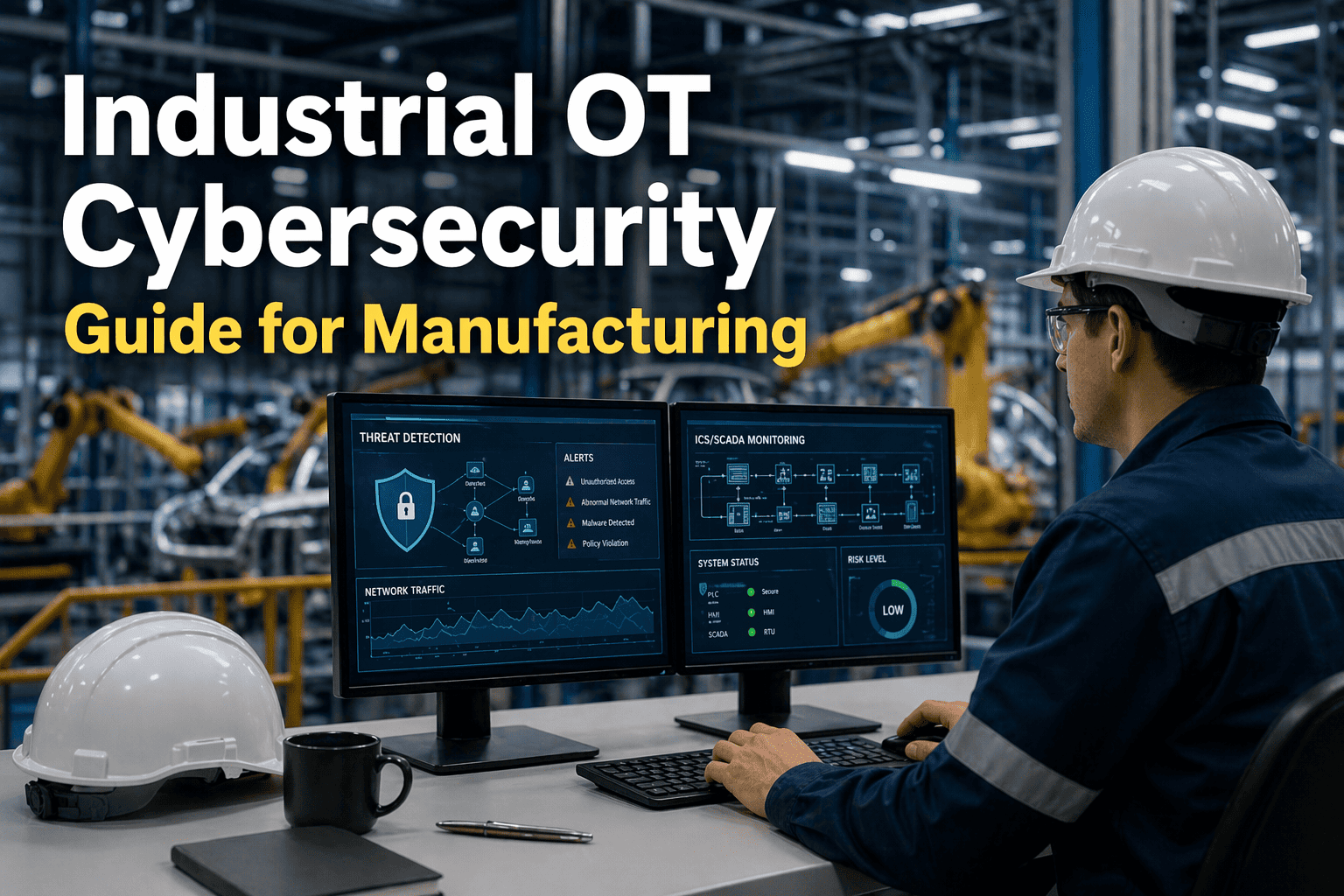
Every connected machine, every AI-driven sensor, every OT network endpoint in your factory is a potential entry point for attackers who are increasingly targeting industrial environments — not for data theft, but to halt production, trigger ransomware payouts, and exploit the operational pressure of downtime that costs manufacturers thousands per minute.
Is Your Connected Factory Defensible Against Modern Cyber Threats?
iFactory's AI-driven security framework helps manufacturers protect OT networks, IoT endpoints, and production systems with zero-trust architecture built for industrial scale.
Why Connected Manufacturing Is the New Frontline
The convergence of IT and OT environments — accelerated by AI-driven automation, IoT sensor networks, and cloud-connected MES platforms — has fundamentally changed the attack surface for U.S. manufacturers. Legacy OT systems were never designed for network exposure. Now they are exposed daily.
Industrial ransomware attacks increased by over 87% between 2022 and 2024. The Colonial Pipeline incident demonstrated how operational disruption — not just data breach — is the attacker's primary weapon against industrial targets. For manufacturers, the stakes are batch integrity, supply chain continuity, regulatory compliance, and worker safety.
Ransomware on OT Networks
Attacks that encrypt PLC logic, SCADA configurations, and historian databases, forcing production halts lasting days to weeks with average ransom demands exceeding $1.4M for manufacturing targets.
Supply Chain Infiltration
Nation-state actors and criminal groups targeting third-party vendors and OEM software updates to gain persistent access into manufacturing networks without direct intrusion.
Sensor and IoT Compromise
Exploitation of unpatched IoT endpoints — temperature sensors, pressure gauges, vision cameras — to pivot laterally into control networks or inject false process data.
Insider Threat Exposure
Privileged access misuse by contractors, remote maintenance technicians, and employees with excessive OT permissions — particularly acute in multi-site manufacturing environments.
Zero-Trust for the Factory Floor: What It Actually Means
Zero-trust is not a product you buy. It is an architectural principle: never implicitly trust any device, user, or network segment — verify continuously. In manufacturing, this means applying identity verification and least-privilege access controls to OT devices that have historically operated on implicit network trust. Implementing zero-trust in a connected factory requires a phased, OT-aware approach that does not disrupt production continuity.
Asset Discovery and Inventory
- Comprehensive OT/IoT asset enumeration using passive network discovery
- Identifying every PLC, HMI, sensor, and edge device without disrupting industrial protocols like Modbus and DNP3
- Continuous inventory update as new devices are added to production networks
Network Segmentation and Purdue Model Enforcement
- Security zones aligned to the Purdue Reference Model, isolating field devices from supervisory systems
- Unidirectional data flows enforced via industrial DMZ between OT and IT environments
- Micro-segmentation within production zones to limit lateral movement after initial compromise
Identity and Access Management for OT
- Role-based access controls for all remote and local OT access sessions
- Multi-factor authentication enforced for engineering workstations and HMI logins
- Replacement of shared credentials with individual user accounts across all OT systems
Continuous Monitoring and Behavioral Analytics
- AI-driven anomaly detection on OT traffic patterns flagging deviations from known-good process baselines
- Unauthorized protocol use and lateral movement attempts detected across segmented network zones in real time
- Alert triage contextualized to operational impact — not generic IT severity scores
Incident Response and Recovery Planning
- OT-specific incident response playbooks tested against real production shutdown scenarios
- Automated PLC and SCADA configuration backup on threat detection events
- Integration with plant safety systems for controlled process shutdown if a cyber event is confirmed
Book a demo to see how iFactory automates OT incident response end-to-end.
OT Security Frameworks: NIST CSF, IEC 62443, and NERC CIP Compared
U.S. manufacturers face multiple overlapping cybersecurity frameworks depending on sector, regulatory jurisdiction, and customer contractual requirements. Understanding which framework governs your environment is the first step toward a defensible compliance posture. Talk to an iFactory expert to map your compliance requirements.
| Framework | Primary Applicability | Core Focus | Mandatory? | iFactory Alignment |
|---|---|---|---|---|
| NIST CSF 2.0 | All U.S. manufacturers, federal contractors | Identify, Protect, Detect, Respond, Recover, Govern | Voluntary (mandatory for federal contractors) | Full coverage |
| IEC 62443 | Industrial automation and control systems | Security levels, zones and conduits, secure development lifecycle | Voluntary (contractually required in many supply chains) | Full coverage |
| NERC CIP | Electric utilities, energy manufacturers | Critical infrastructure protection, BES cyber systems | Mandatory for bulk electric system operators | Partial — energy sector |
| CMMC 2.0 | Defense industrial base manufacturers | NIST SP 800-171 controls, third-party assessment | Mandatory for DoD contractors | Full coverage |
| ISA/IEC 62443-3-3 | System integrators, OEM manufacturers | System security requirements and security levels | Contractual requirement for critical infrastructure OEMs | Full coverage |
How AI Changes Industrial Threat Detection — and the Risks It Introduces
AI-driven security platforms provide genuine operational advantages in manufacturing environments where the volume and diversity of OT network events exceeds human analyst capacity. Machine learning models trained on industrial protocol behavior can distinguish between a legitimate PLC firmware update and an attacker staging persistence — a distinction that signature-based tools cannot reliably make. See how iFactory's AI detection engine works — book a demo.
- Baseline behavioral profiling of OT device communication patterns, detecting deviations that precede attacks by hours or days
- Automated asset classification and vulnerability mapping without requiring manual inventory maintenance
- Reduction in mean time to detect from days to minutes for lateral movement and credential misuse
- Natural language threat reporting that communicates risk in operational terms, not security jargon
- Continuous learning from production environment baselines rather than relying on externally sourced threat intelligence
- Models trained on incomplete OT baselines produce high false-positive rates that erode operator trust and cause alert fatigue
- Adversarial inputs can be designed to evade ML-based detection systems — a known attack class against AI security tools
- AI security platforms themselves introduce new attack surfaces if deployed without proper network segmentation
- Over-reliance on AI anomaly detection without human-in-the-loop review can delay escalation in novel attack scenarios
- Data sovereignty and model training data must be carefully managed in cloud-connected AI security deployments
Connected Factory Security: 12-Point Operational Hardening Checklist
This checklist represents the minimum defensible posture for a connected manufacturing environment. Each control maps directly to NIST CSF 2.0 functions and IEC 62443 security levels. Use this as a gap assessment starting point — not a complete security program. Request a full operational gap audit from iFactory's security team.
Practitioner Perspective: What Most Manufacturers Get Wrong About OT Security
The most common mistake I see is manufacturers treating OT cybersecurity as an IT problem handed to a CISO with no industrial operations background. You cannot apply enterprise IT security controls directly to OT environments — you will either break production systems or create so much friction that operators route around your controls. The second mistake is believing that because your OT network is claimed to be air-gapped, it is safe. I have never audited a factory that claimed to be air-gapped and actually was. USB drives, vendor laptops, and engineering workstations with dual network cards — the air gap is always porous.
What works is a security program co-designed by operations engineers and security professionals — people who understand that a false positive halting a filling line at 2:00 AM costs more than the attack it was trying to prevent. Start with visibility. You cannot protect what you cannot see. iFactory's asset discovery module is a strong starting point — book a demo to see it in action.
iFactory Security Engine — Built for Industrial Reality
iFactory's connected security platform is designed from the ground up for manufacturing environments — not adapted from enterprise IT security tools. Every capability is built around the operational constraint that production continuity is non-negotiable.
- Zero-impact asset enumeration using passive protocol mirroring on span ports
- Automatic classification of Modbus, DNP3, EtherNet/IP, and PROFINET devices
- Continuous asset inventory update without polling industrial controllers
- Machine learning baseline modeling per device, protocol, and production zone
- Anomaly scoring tuned to industrial process rhythms — not generic IT thresholds
- Alert triage with operational context: impact on running batch and affected equipment
- Vendor-specific time-bounded access sessions with full session recording
- MFA enforcement without disrupting legacy HMI authentication workflows
- Real-time access monitoring with one-click session termination for security teams
- Pre-built report templates for NIST CSF, IEC 62443, and CMMC 2.0 assessments
- Evidence collection automation for audit-ready control documentation
- Multi-site compliance posture dashboards for security leadership
Protect Your Connected Factory Before the Next Attack Window Opens
iFactory's industrial cybersecurity platform gives manufacturing security leaders continuous OT visibility, AI-driven threat detection, and audit-ready compliance documentation — without disrupting production operations.
The Bottom Line for U.S. Manufacturers
Connected manufacturing is not reversible. The productivity gains from AI-driven automation, real-time OT monitoring, and cloud-connected production systems are too significant to abandon. The question is not whether to connect your factory — it is whether to secure it before or after a significant incident forces the issue.
The manufacturers building defensible OT security programs today are doing three things consistently: they have complete visibility into their OT asset inventory, they have enforced network segmentation between IT and OT environments, and they have deployed continuous monitoring that understands industrial protocol behavior — not just generic network traffic anomalies.
Frameworks like NIST CSF 2.0 and IEC 62443 provide the structural roadmap. AI-driven platforms provide the operational execution. The combination — properly implemented and continuously maintained — transforms cybersecurity from a compliance cost center into a genuine competitive advantage. Start with a 30-minute demo — see exactly how iFactory maps to your security gaps.
Connected Manufacturing Cybersecurity — Frequently Asked Questions
What is the difference between IT security and OT security in manufacturing?
IT security focuses on protecting data confidentiality and system availability in business networks where a temporary shutdown for patching is acceptable. OT security protects the availability and integrity of industrial control systems where unplanned shutdowns can mean millions in lost production, safety incidents, or product quality failures. OT security must be implemented without disrupting the real-time deterministic operation of PLCs, SCADA systems, and industrial sensors — requirements that standard IT security tools and methodologies do not account for.
How does zero-trust architecture apply to factory floor environments?
Zero-trust in OT manufacturing means eliminating implicit network trust between devices and enforcing continuous identity and behavior verification. In practice, this involves network microsegmentation by production zone, replacing shared device credentials with individual identities, requiring MFA for all remote OT access, and continuously verifying that device communication patterns match known-good operational baselines. The implementation must be phased carefully starting with visibility and segmentation before implementing active access controls.
Which cybersecurity framework should a mid-size U.S. manufacturer prioritize?
For most U.S. manufacturers without sector-specific regulatory requirements, NIST CSF 2.0 is the appropriate starting framework — it is comprehensive, widely recognized, and provides a clear maturity progression path. Manufacturers in the defense supply chain should layer CMMC 2.0 requirements on top. Those with safety-critical industrial automation should additionally align to IEC 62443. The key is to establish NIST CSF as your foundation first, then map additional requirements as overlays rather than implementing multiple frameworks simultaneously.
Can AI security tools be deployed in OT environments without disrupting production?
Yes — with the critical constraint that AI-based OT security tools must operate passively using network traffic mirroring or span ports rather than through active polling of industrial devices. Active network scanning that sends queries to PLCs and other OT devices can trigger unexpected behavior in systems designed for deterministic real-time operation. Properly deployed passive AI detection tools add zero production impact while providing continuous behavioral monitoring. The iFactory platform is specifically architected for passive OT deployment.
How long does it take to implement a defensible OT cybersecurity program?
A meaningful initial security posture — asset inventory, network segmentation, basic monitoring, and access controls — can be established within 60 to 90 days for a single manufacturing site. A mature OT security program aligned to IEC 62443 Security Level 2 typically requires 12 to 18 months of phased implementation. The timeline is heavily dependent on the complexity of existing OT infrastructure, the number of legacy systems requiring compensating controls, and available internal security operations capacity.