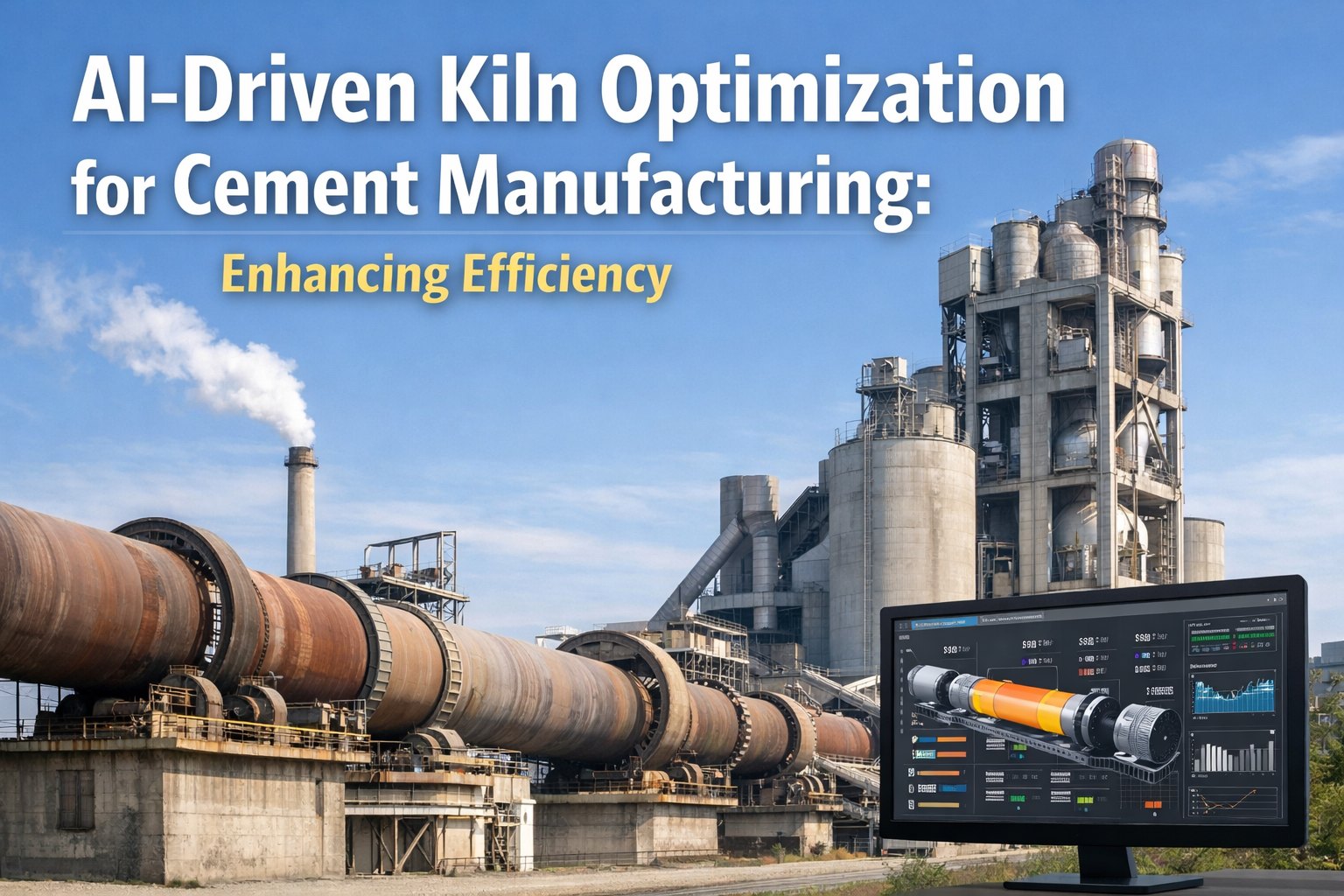
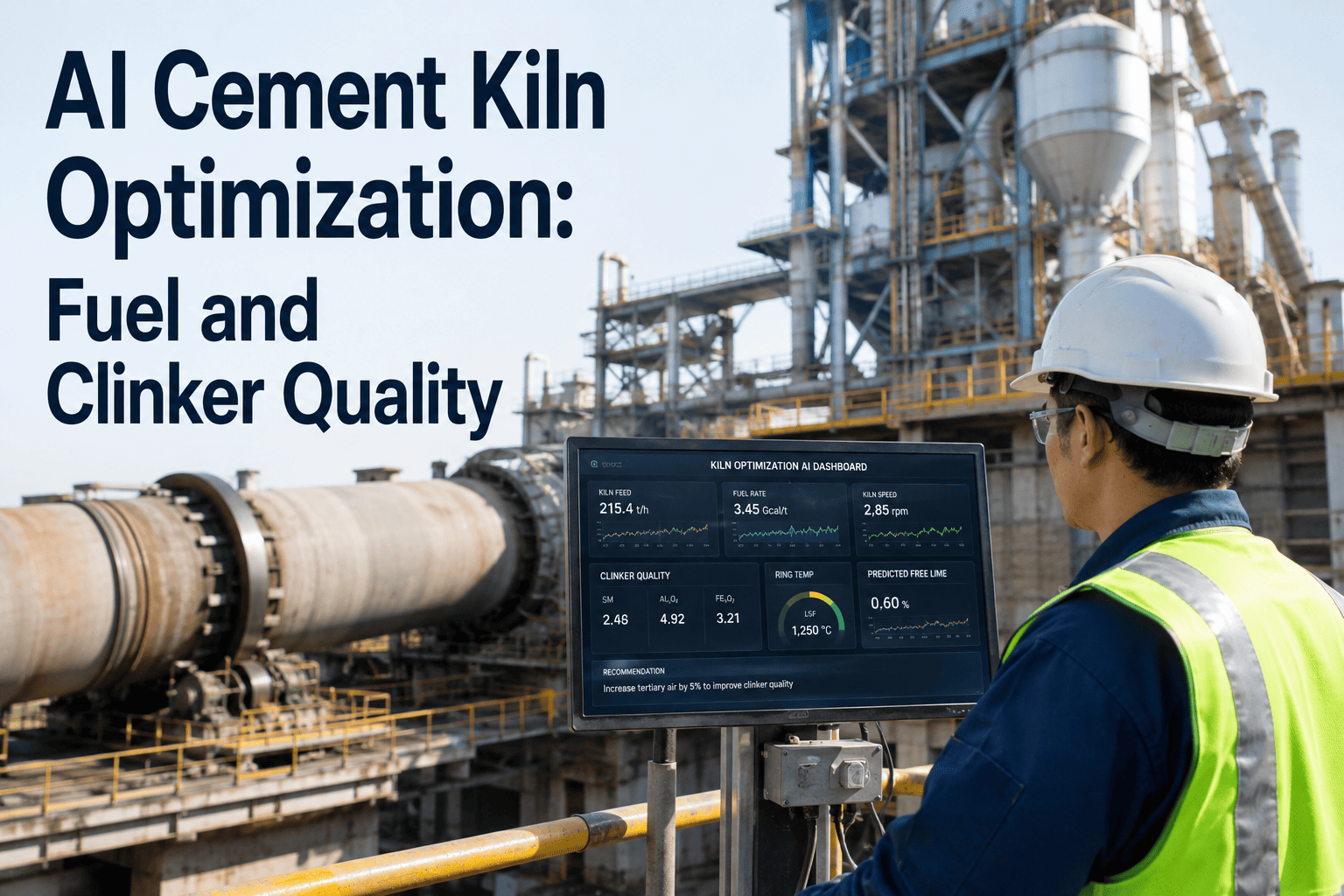
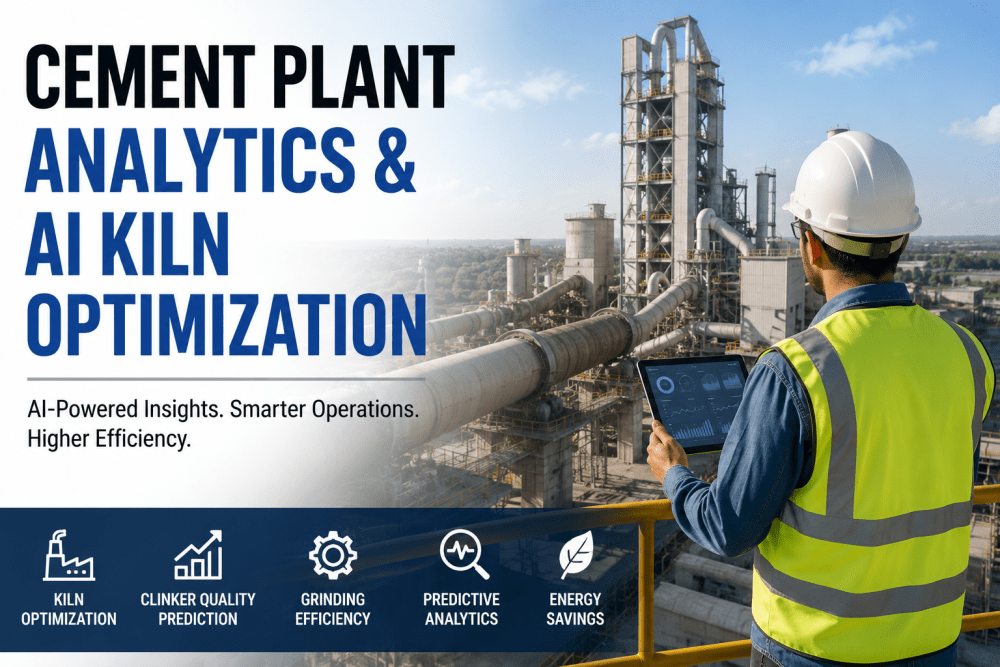
AI-Driven Kiln Optimization for Cement Manufacturing: Enhancing Efficiency
By Riley Quinn on February 26, 2026
Your rotary kiln burns at 1,450°C around the clock, consuming fuel that represents 30-40% of your entire production cost. Even a 1% efficiency gain saves tens of thousands annually. Yet most cement plants still rely on operators manually adjusting dozens of interdependent variables — fuel feed, air flow, raw meal chemistry — while chasing a moving target. AI-driven kiln optimization changes everything: 10-15% fuel reduction, 50,000+ tonnes of CO₂ eliminated per plant annually, and clinker quality consistency that human operators simply cannot match.
1,450°C
Rotary Kiln Operating Temperature
7%
of global CO₂ emissions from cement production
30-40%
of production costs go to energy
90%
of plant energy consumed by clinker production
The Energy Challenge in Cement Manufacturing
Where Your Energy Goes
Kiln Thermal Energy
70-80%
Grinding Operations
~25%
Other Processes
~5%
Only ~50% of fuel energy goes into clinker formation. The rest exits as recoverable waste heat.
AI builds a mathematical model of your specific kiln operation using historical sensor data — capturing relationships between raw materials, fuel mix, and outcomes unique to your plant.
2
Real-Time Analysis
The system continuously analyzes thousands of data points — temperature profiles, fuel flow, gas composition, quality metrics — calculating optimal setpoints every few seconds.
3
Predictive Control
Machine learning predicts kiln behavior 2-3 hours ahead, allowing proactive adjustments before problems occur — rather than reacting to deviations after the fact.
4
Continuous Learning
The AI retrains automatically using live data from the cloud, keeping models accurate as raw meal chemistry, fuel composition, and operating conditions shift.
The Kiln Variables AI Optimizes
Temperature Profile
Precise control of 1,450°C sintering zone temperature to maximize clinker quality while minimizing excess heat.
Combustion Efficiency
Optimal fuel-to-air ratio balancing complete combustion with minimal excess air that wastes energy.
Raw Meal Feed Rate
Dynamic adjustment based on kiln load, material moisture, and chemistry to maintain stable operations.
Draft & Airflow
Kiln draft control optimizing heat transfer between hot gases and raw meal throughout the preheater system.
Turn Kiln Instability Into Predictable Performance
iFactory's AI-powered platform monitors your kiln 24/7, predicting process behavior and recommending optimal setpoints that maintain clinker quality with minimum fuel consumption.
Ready to move beyond reactive control? Schedule a consultation with our cement process experts.
Real-World Case Study
Heidelberg Materials — Mokra Plant
4.1%Reduction in fuel cost index
2.2%Reduction in specific heat consumption
33%Reduction in C3S variance
4.5 kg/tCO₂ reduction per tonne clinker
Results achieved in first month of continuous AI operation, validated through one-month on/off testing.
Expert Perspective
Industry Research
"If you compared a good day and a typical day at a cement plant, there was quite a significant difference — revealing that kilns could burn less fuel if their operation was stabilized. AI can take on the constant monitoring, deep data analysis, and pulling together disparate operating data sets that operators simply don't have time for."
— UNIDO Industrial Decarbonization Report, 2025
Key Finding: Each deployment of AI kiln optimization reduces emissions by approximately 10,000 tonnes of CO₂ per year per plant — without requiring capital investment in new equipment.
iFactory's AI platform integrates with your existing DCS, sensors, and lab systems — no new hardware required. Start optimizing fuel consumption and clinker quality within weeks, not years.
How much can AI kiln optimization save a cement plant?
Production deployments document 10-15% fuel consumption reductions, translating to $400,000-$600,000 annual savings for a mid-sized 2,000 TPD facility. Beyond direct fuel savings, plants report reduced clinker quality variance (up to 33%), fewer downstream processing costs, and CO₂ reductions exceeding 50,000 tonnes per plant annually — critical for regulatory compliance as carbon pricing expands globally.
Does AI optimization require new hardware installation?
No. AI kiln optimization platforms integrate with your existing sensors, DCS, SCADA, and lab systems through standard industrial protocols. Cement plants already have extensive sensor coverage — temperature profiles, fuel flow meters, gas analyzers, quality measurements — because kiln operations require continuous monitoring for safety. The AI uses this existing data infrastructure, making deployment a software overlay rather than a capital equipment project.
How does AI handle variable raw materials and fuel quality?
AI systems continuously analyze raw meal chemistry, fuel composition, and moisture content, automatically adjusting setpoints as conditions change. Unlike traditional controls with fixed parameters, AI models retrain themselves using live data from the cloud, maintaining optimization accuracy even when switching between fuel types (coal, petroleum coke, alternative fuels) or processing different raw material batches. This adaptability is particularly valuable for plants increasing alternative fuel usage.
How quickly can AI kiln optimization be deployed?
Integration typically takes weeks rather than months. The platform connects to existing control systems, maps sensor data to process flows, and builds a digital twin using your historical operational data. Within 24 hours of model training, the AI can simulate roughly 100 years of cement plant operation, generating optimized recommendations. Plants see measurable improvements — fuel savings, quality consistency — within the first month of continuous operation.
What's the ROI timeline for AI kiln optimization?
With fuel costs representing 20-30% of cement production expenses and AI systems documenting 10-15% reductions, payback periods are typically measured in months rather than years. McKinsey research shows AI optimization delivering up to 10% improvement in both throughput and energy efficiency, with ROI compounding across the entire production flowsheet — kiln, preheater, grinding operations. The low-capital nature of software deployment means ROI calculations overcome only integration effort, not equipment purchases.