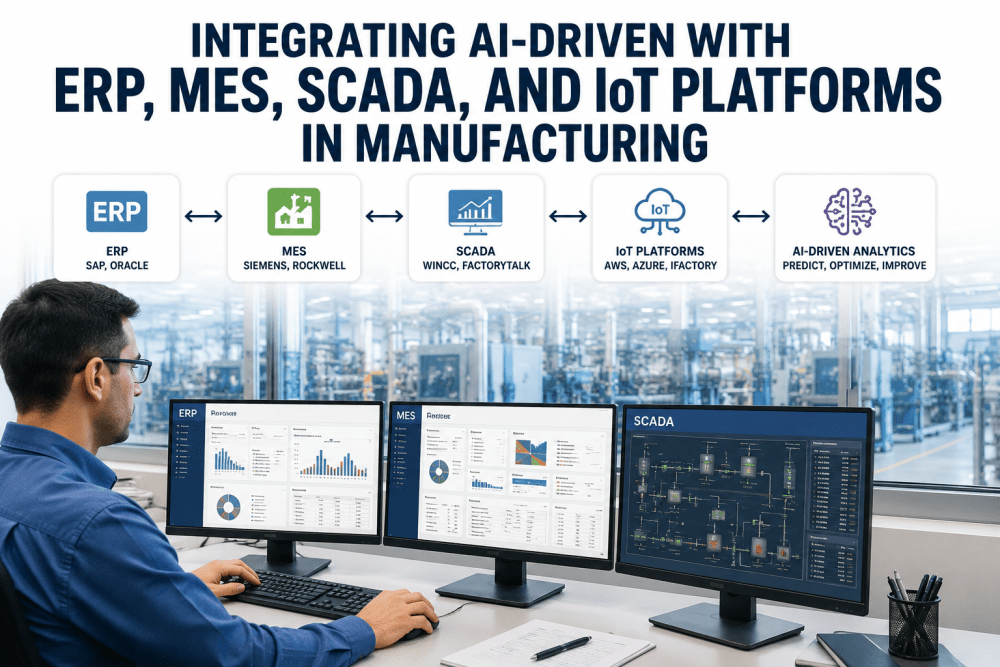
Modern manufacturing plants generate massive volumes of data across ERP systems, MES platforms, SCADA networks, and IoT sensors — yet most of this data remains trapped in disconnected silos. The result: fragmented decision-making, delayed production responses, and operational inefficiencies that erode competitiveness. AI-driven integration changes this reality by unifying enterprise, execution, control, and edge-level data streams into a single intelligent fabric. With APIs, OPC UA connectivity, and real-time data orchestration, manufacturers gain end-to-end visibility, predictive insights, and autonomous decision support across the entire production stack. Book a Demo to see how iFactory AI seamlessly connects your ERP, MES, SCADA and IoT systems into one intelligent platform.
Unify Your Manufacturing Stack with AI-Driven Integration
iFactory AI connects SAP, Oracle, Rockwell, Siemens, and edge IoT devices through OPC UA, REST APIs, and MQTT — eliminating data silos and unlocking real-time intelligence across your plant.
Why AI-Driven Integration Matters: Bridging the IT-OT Divide in Modern Manufacturing
The traditional separation between Information Technology (IT) systems — ERP, business intelligence, and planning platforms — and Operational Technology (OT) systems — SCADA, PLCs, and shop-floor controllers — has created one of the most persistent obstacles to manufacturing digital transformation. Enterprise systems like SAP S/4HANA or Oracle E-Business Suite contain demand forecasts, production schedules, and inventory positions. MES platforms hold work order execution data. SCADA systems carry real-time process variables. IoT sensors generate granular machine-level telemetry. Without integration, each layer operates blind to the others.
AI-driven integration platforms like iFactory AI eliminate this divide by translating data across protocols, normalizing it into a unified model, and applying machine learning to extract operational intelligence. The outcome is a connected factory where ERP-level decisions are informed by real-time SCADA data, and shop-floor events automatically update enterprise planning — closing the loop between strategy and execution. Book a Demo to explore IT-OT convergence in action.
The Four-Layer Integration Stack: ERP, MES, SCADA, and IoT Unified by AI
A successful AI-driven integration strategy requires understanding the role of each layer in the manufacturing technology stack and the specific data flows that must move between them. iFactory AI's integration framework operates across all four layers with purpose-built connectors and AI orchestration logic.
ERP Layer Integration: SAP, Oracle, Microsoft Dynamics & Infor
Enterprise Resource Planning systems own master data, production orders, BOM structures, inventory positions, and financial transactions. iFactory AI integrates with SAP S/4HANA, SAP ECC, Oracle Fusion Cloud, Microsoft Dynamics 365, and Infor CloudSuite through certified REST APIs, IDoc interfaces, and OData connectors. This bidirectional flow ensures that production orders flow down to the shop floor in real time, and that material consumption, yield, and completion confirmations flow back to ERP without manual intervention.
The AI layer enriches this exchange — automatically reconciling discrepancies between planned and actual material usage, flagging cost variances, and predicting inventory shortfalls before they impact production schedules.
MES Layer Integration: Work Order Execution & Genealogy Tracking
The Manufacturing Execution System layer translates ERP-level planning into shop-floor execution. iFactory AI's native MES capabilities — combined with integration adapters for Rockwell FactoryTalk, Siemens Opcenter, GE Proficy, and AVEVA MES — manage work order dispatch, operator instructions, electronic batch records, and full product genealogy. By unifying MES data with ERP and SCADA streams, manufacturers gain a single source of truth for every unit produced, from raw material lot to finished goods serial number.
iFactory AI's ML models analyze MES execution data in real time, identifying process bottlenecks, operator performance patterns, and quality risk indicators that would otherwise require weeks of manual analysis.
SCADA & PLC Layer Integration: OPC UA, Modbus & EtherNet/IP
SCADA systems and PLCs carry the lifeblood of plant operations — real-time process variables, alarm states, equipment status, and control logic outputs. iFactory AI connects to Siemens WinCC, Rockwell FactoryTalk View, Wonderware/AVEVA System Platform, Schneider EcoStruxure, and Ignition through OPC UA — the open industrial communication standard — alongside Modbus TCP, EtherNet/IP, Profinet, and MQTT for direct device-level data acquisition.
This control-layer integration enables AI models to consume sub-second machine signals — vibration, temperature, current draw, cycle times — and correlate them with MES and ERP context for true closed-loop intelligence. Book a Demo to see OPC UA connectivity in action.
IoT & Edge Layer Integration: Sensors, Gateways & Edge AI
The IoT layer extends visibility beyond traditional automation — capturing data from retrofit sensors, smart instruments, environmental monitors, and edge AI devices that legacy SCADA systems cannot reach. iFactory AI integrates with AWS IoT Core, Azure IoT Hub, Google Cloud IoT, and edge platforms like NVIDIA Jetson and Siemens Industrial Edge, providing a unified ingestion layer for high-frequency telemetry from both greenfield IoT deployments and brownfield retrofits.
Edge AI processing reduces cloud bandwidth requirements by performing initial anomaly detection and signal compression locally, while the central iFactory AI platform aggregates plant-wide patterns and triggers predictive maintenance workflows across the connected ecosystem.
Comparing Integration Approaches: APIs, OPC UA, MQTT & Legacy Middleware
Choosing the right integration approach depends on the source system, latency requirements, and security posture. Modern AI-driven platforms must support a hybrid mix of protocols to accommodate the heterogeneous reality of most manufacturing environments. The comparison below highlights where each integration method delivers the highest value.
| Integration Method | Best Use Case | iFactory AI Support |
|---|---|---|
| REST APIs & OData | ERP/MES master data & transactions | Native SAP, Oracle, Dynamics connectors |
| OPC UA | SCADA & PLC real-time process data | Full OPC UA client & server support |
| MQTT & Sparkplug B | High-frequency IoT telemetry | Native MQTT broker integration |
| SAP IDoc / RFC / BAPI | Legacy SAP ECC environments | Certified SAP integration adapters |
| Modbus TCP / EtherNet/IP | Direct PLC & field device polling | Native industrial driver library |
| Webhooks & Event Streaming | Real-time event-driven workflows | Kafka, RabbitMQ, Azure Event Hub |
| File-Based / CSV / XML | Legacy systems without modern APIs | SFTP & file-watcher fallback support |
How Real-Time Data Flows Across the Integrated Manufacturing Stack
An effective AI-driven integration architecture is defined not just by the connections it makes, but by the orchestration of data flows between layers. iFactory AI implements a bidirectional, event-driven data fabric where information moves seamlessly from edge to enterprise — and back — with millisecond latency at the OT layer and transactional consistency at the IT layer.
Edge Data Ingestion & Normalization
IoT sensors and PLCs publish telemetry via MQTT and OPC UA. iFactory AI edge agents perform protocol translation, timestamp synchronization, and unit normalization — converting raw signals into structured asset health data ready for AI processing.
MES Context Enrichment
Normalized OT data is enriched with MES context — work order ID, product SKU, operator, batch number, and quality plan. This contextualization is critical for AI models to interpret signals correctly across different production scenarios.
AI Analytics & Decision Layer
Machine learning models analyze the unified data stream to detect anomalies, predict failures, optimize OEE, and recommend actions. AI insights are published as structured events available to ERP, MES, and SCADA layers for closed-loop execution.
ERP Closed-Loop Synchronization
Production confirmations, material consumption, quality results, and maintenance work orders are pushed back to ERP through certified APIs — keeping enterprise planning, inventory, and finance perfectly aligned with shop-floor reality.
The Operational & Financial Impact of AI-Driven ERP/MES/SCADA/IoT Integration
The business case for unified integration extends far beyond IT modernization. Manufacturers that successfully connect their ERP, MES, SCADA, and IoT layers with AI orchestration unlock measurable improvements across throughput, quality, inventory accuracy, and decision velocity. The table below summarizes the typical impact areas observed across iFactory AI deployments.
| Impact Area | Before Integration | With iFactory AI | Typical Benefit |
|---|---|---|---|
| Production Order Visibility | Hours to days lag | Real-time sync | 68% faster response |
| Inventory Accuracy | 85–90% accuracy | 99%+ accuracy | Reduced stock-outs |
| Unplanned Downtime | 12–18% loss | Under 5% | $1.4M+/yr per plant |
| Manual Data Entry | 25–40 hrs/wk | Under 4 hrs/wk | 90% labor savings |
| Quality Defect Detection | Post-batch review | Real-time AI alerts | 62% lower rejects |
| Audit & Compliance Reporting | Days of compilation | Auto-generated | 85% time reduction |
For mid-size manufacturing operations, iFactory AI customers consistently report total integration ROI of 8–14 months driven by labor reduction, downtime elimination, and inventory optimization.
Expert Review: What U.S. Manufacturing Leaders Should Prioritize in 2026
Reviewed by industrial automation engineers and manufacturing IT architects with extensive experience deploying ERP, MES, SCADA, and IoT integrations across automotive, FMCG, pharmaceutical, and discrete manufacturing environments. The following observations reflect current best practice based on hundreds of integration projects executed across North American facilities.
First, integration is no longer a one-time project — it is a continuous architectural discipline. Manufacturers that treat integration as a static deliverable rapidly accumulate technical debt as ERP versions upgrade, new IoT devices are added, and SCADA platforms evolve. A modern AI-driven integration platform like iFactory AI must include version-managed connectors, automated schema drift detection, and self-healing data pipelines to remain resilient over time.
Second, OT cybersecurity must be designed into the integration architecture from day one. Bridging IT and OT networks expands the attack surface, and integration platforms must enforce zero-trust principles, network segmentation, certificate-based device authentication, and immutable audit trails. iFactory AI is engineered to meet IEC 62443 industrial cybersecurity standards and NIST SP 800-82 guidelines for industrial control system security. Book a Demo to review secure integration architecture options.
Third, the highest-value AI use cases emerge only after unified integration is achieved. Predictive maintenance, dynamic scheduling, autonomous quality control, and energy optimization all depend on having clean, contextualized data flowing across all four layers. Manufacturers that attempt to deploy AI on top of fragmented data sources almost universally fail to achieve sustained ROI — making integration the true foundation of any AI strategy.
Deploying AI-Driven Integration: The Phased Roadmap to a Connected Factory
Manufacturers cannot rip and replace their existing technology stack. Successful AI-driven integration follows a phased deployment roadmap that prioritizes high-impact connections first, validates value at each stage, and expands the integration footprint without disrupting production operations.
Assessment & Architecture Design
Comprehensive system inventory of ERP, MES, SCADA, and IoT assets. Data flow mapping, integration priority ranking, security architecture review, and connector selection. Deliverable: validated integration blueprint with phased deployment schedule.
SCADA & IoT Layer Connection
Deploy OPC UA gateways, MQTT brokers, and edge agents. Establish bidirectional connectivity with SCADA platforms and IoT sensor networks. Validate real-time data ingestion, latency benchmarks, and edge computing performance.
MES Integration & Context Enrichment
Connect MES execution data with the unified data layer. Enable work order context, genealogy tracking, and shop-floor visibility dashboards. Validate AI model accuracy against contextualized data streams.
ERP Integration & Closed-Loop Activation
Activate SAP, Oracle, or Dynamics connectors. Enable bidirectional flow of production orders, confirmations, material consumption, and quality results. Full closed-loop manufacturing intelligence live and operational.
Frequently Asked Questions: AI-Driven ERP/MES/SCADA/IoT Integration
Does iFactory AI work with legacy SAP ECC environments or only S/4HANA?
iFactory AI supports both modern and legacy SAP environments. For S/4HANA deployments, native OData and REST API connectors provide real-time bidirectional integration. For SAP ECC systems, certified IDoc, RFC, and BAPI adapters deliver equivalent capability — making iFactory AI a future-proof choice regardless of where your SAP modernization journey stands today.
How does iFactory AI handle OT cybersecurity during ERP-to-shop-floor integration?
iFactory AI is architected around zero-trust principles aligned with IEC 62443 and NIST SP 800-82 standards. All OPC UA connections use certificate-based authentication, network segmentation isolates OT from IT, and DMZ-based broker patterns prevent direct exposure of control systems. Comprehensive audit trails track every data exchange for compliance and forensic analysis.
Can we integrate older PLCs and SCADA systems that lack OPC UA support?
Yes. iFactory AI's industrial driver library supports legacy protocols including Modbus RTU/TCP, EtherNet/IP, Profibus, DNP3, Allen-Bradley DF1, and Siemens S7. For systems with no network connectivity at all, optional edge gateways provide non-invasive signal acquisition through retrofit sensors, enabling integration of even decades-old equipment.
What is the typical performance impact on existing ERP and SCADA systems?
Performance impact is minimal. iFactory AI uses event-driven, asynchronous integration patterns that read only changed data rather than performing continuous polling. For SCADA systems, OPC UA subscriptions are configured with rate-limited update thresholds to ensure no degradation of operator HMI responsiveness, while ERP systems benefit from batch processing and intelligent queue management.
How does AI add value beyond traditional integration middleware?
Traditional middleware moves data — AI-driven platforms understand it. iFactory AI applies machine learning across the integrated data fabric to detect anomalies, predict failures, optimize schedules, and recommend actions automatically. This transforms integration from a passive data pipe into an active intelligence layer that drives autonomous decision-making across ERP, MES, SCADA, and IoT systems.
Conclusion: AI-Driven Integration Is the Foundation of the Connected Factory
The manufacturers achieving the highest returns on Industry 4.0 investments are those that have unified their ERP, MES, SCADA, and IoT layers into a single AI-orchestrated data fabric. Disconnected systems generate disconnected decisions — and in an era of compressed margins, accelerating product cycles, and increasing regulatory complexity, manufacturers can no longer afford the inefficiency of fragmented technology stacks. AI-driven integration is the bridge between operational data and operational intelligence.
iFactory AI delivers this transformation through certified connectors for SAP, Oracle, Microsoft Dynamics, Rockwell, Siemens, Schneider, AWS, and Azure — combined with open protocol support for OPC UA, MQTT, Modbus, and EtherNet/IP. Whether you are connecting a single plant or unifying a global enterprise, the platform provides the flexibility, security, and AI intelligence required to operate a truly connected factory.
Connect ERP, MES, SCADA & IoT into One Intelligent Platform
iFactory AI is already enabling connected factory operations at leading U.S. manufacturers. Schedule a live walkthrough of the integration platform and see how unified data unlocks measurable ROI — no obligation.