The license quote for a manufacturing software platform is almost never the number that determines whether the project was worth doing. Implementation labor, historian integration, operator training, and the ongoing maintenance a system needs after go-live routinely add sixty to a hundred percent on top of the license line, and most of that spending happens quietly, spread across departments that never compare notes. A CMMS, an MES, and an analytics platform each carry a different cost shape, and comparing them on license price alone is how plants end up locked into the wrong one. iFactory publishes its full cost structure up front — see the breakdown at iFactory support.
Digital Transformation ROI · Cost Modeling
The Manufacturing Software Quote You Received Is Missing Half the Total Cost
License fees are the visible part of a manufacturing software platform's cost. Implementation, integration, training, and multi-year maintenance are the part that shows up later — and they are what actually determines total cost of ownership for CMMS, MES, and analytics platforms.
The Hidden Cost Layer
Five Cost Categories Most Budget Requests Never Include
A license quote answers one question. Total cost of ownership answers the question that actually matters: what will this platform cost across a five-year deployment, from first integration to the last renewal.
License & Subscription
The visible cost. Per-seat, per-asset, or flat annual fees, usually the only number included in the initial budget request.
Implementation Labor
Internal and vendor hours spent configuring workflows, building dashboards, and mapping the platform to plant-specific processes.
Integration Cost
Connecting the platform to SCADA, historians, ERP, and existing sensor infrastructure, often the single largest hidden line item.
Training & Adoption
Operator and technician training time, refresher sessions, and the productivity dip during the adoption curve after go-live.
Where the Budget Actually Goes
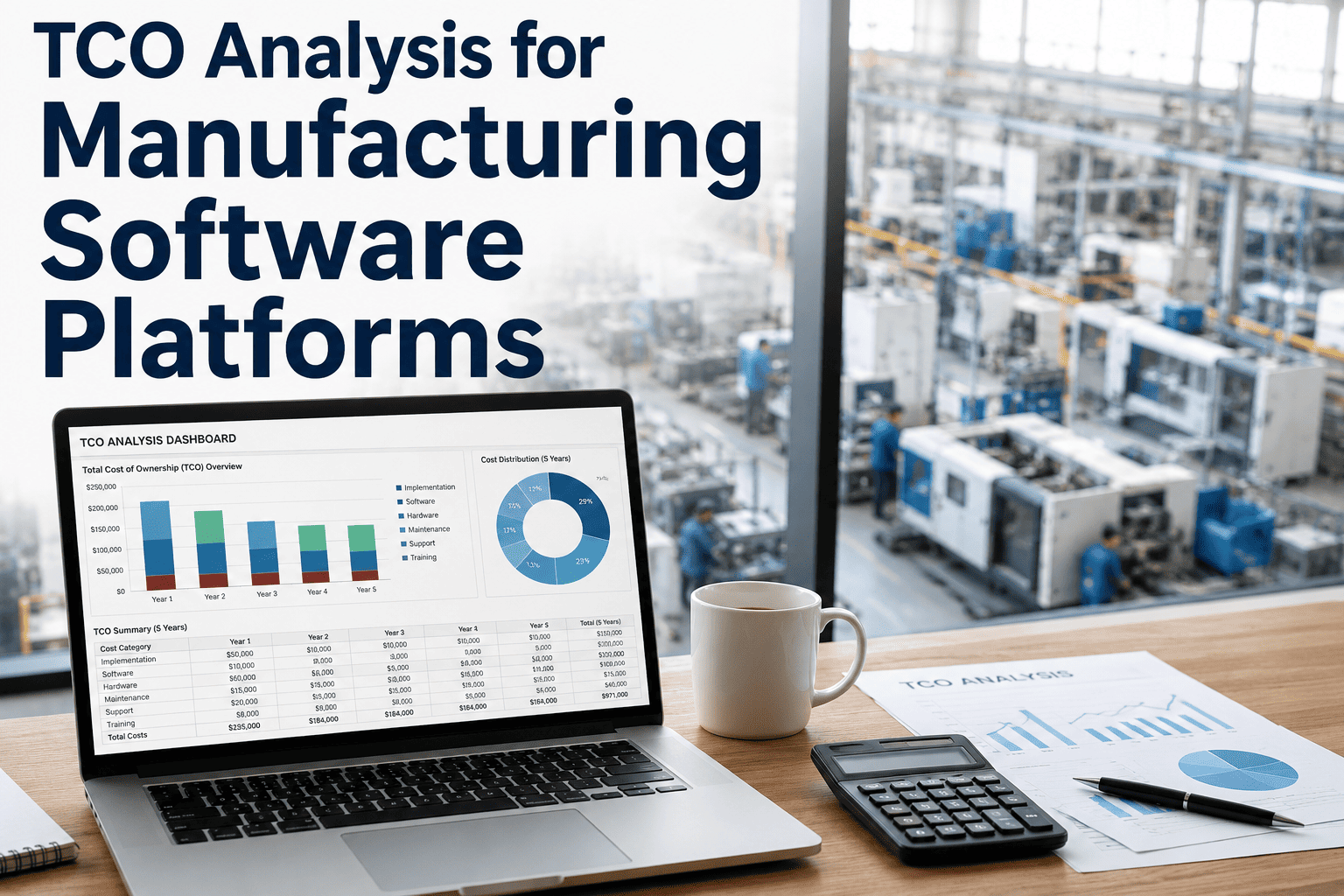
A Typical Five-Year TCO Breakdown for a Mid-Size Plant Deployment
Across CMMS, MES, and analytics platform deployments, license fees consistently represent less than half of what the platform costs over its useful life.
License & Subscription
35%
Integration & Data Engineering
25%
Ongoing Maintenance & Support
8%
Get a TCO Model, Not Just a License Quote.
iFactory provides a full five-year cost breakdown covering integration, training, and support alongside license pricing, so the budget request is accurate the first time.
Platform Comparison
CMMS vs. MES vs. Analytics Platform — TCO Characteristics
Cost Driver
CMMS
MES
Analytics Platform
Integration Complexity
Low — mostly asset and work order data
High — deep production line integration
Moderate — sensor and historian connections
Typical Implementation Time
6–10 weeks
4–9 months
6–12 weeks
Training Burden
Low, familiar workflow for maintenance teams
High, changes operator workflow directly
Low, mostly dashboard-based for engineers
Ongoing Maintenance Load
Low
High, tied to production changes
Moderate, model retraining and tuning
Measured Outcomes
What Plants See When They Model TCO Before Signing
30–45%
Budget Variance Reduced
Plants that model full TCO before signing see far less cost overrun during implementation than those budgeting on license price alone.
$180K
Average Hidden Integration Cost
The typical unbudgeted integration spend discovered mid-project across mid-size plant software deployments.
5 yrs
Standard TCO Modeling Horizon
The window over which license, integration, training, and maintenance costs should be compared across competing platforms.
Field Case
A License Quote That Was Half the Real Number
A mid-size discrete manufacturer budgeted for an MES deployment based on the vendor's license quote alone, expecting a total first-year cost close to the subscription price. Once integration work began, the historian connection, custom reporting builds, and operator training sessions added a sum roughly equal to the license fee itself, and the project required an emergency budget request mid-year to stay on schedule. On the next platform evaluation, the plant required a full five-year TCO model from every vendor before signing, including integration hours, training time, and maintenance fees. The resulting budget request was approved on the first pass, and the actual deployment cost landed within a small margin of the modeled figure instead of requiring a supplemental request.
~2xActual cost vs. original license quote
1Emergency budget request required
0Overruns on the following TCO-modeled project
Cost Reduction Levers
Six Ways to Lower Total Cost of Ownership Without Cutting Capability
TCO is not fixed once a platform is chosen. These levers consistently reduce the total five-year cost of a manufacturing software deployment without reducing what the platform actually does for the plant.
Negotiate Multi-Year Terms Early
Locking a three to five-year subscription rate at signing avoids annual price increases that compound significantly over the ownership period.
Reuse Integration Work Across Sites
A documented integration pattern built at the first site cuts engineering hours substantially at every subsequent facility on the network.
Train Internal Super-Users First
A small group trained deeply and used as internal support reduces total training hours compared to broad simultaneous training for every operator.
Right-Size the License Tier
Matching license scope to actual asset count and user seats, reviewed annually, prevents paying for unused capacity across the contract term.
Bundle Maintenance Into the Contract
Pre-negotiated support and maintenance terms are typically cheaper than ad hoc support requests purchased after go-live.
Phase Rollout by Site Readiness
Deploying to data-ready sites first avoids paying for premature integration work at facilities that need infrastructure upgrades regardless of platform choice.
Frequently Asked Questions
Manufacturing Software TCO — What Buyers Ask First
What is typically the single largest hidden cost in a manufacturing software deployment?
Integration cost is consistently the largest unbudgeted line item, since connecting a new platform to existing SCADA systems, historians, ERP data, and sensor infrastructure requires engineering hours that are difficult to estimate accurately before the project begins. Plants with older or poorly documented control systems tend to see this cost run higher than plants with modern, well-documented infrastructure. Getting a firm integration cost estimate from the vendor before signing, rather than a rough range, is one of the most effective ways to avoid a mid-project budget surprise.
How does TCO differ between a CMMS, an MES, and an analytics platform?
An MES typically carries the highest total cost of ownership because it integrates deeply with production line control and changes operator workflow directly, which drives up both integration and training spend. A CMMS generally has the lowest TCO since it operates on asset and work order data that is simpler to integrate and requires less retraining of existing maintenance workflows. An analytics platform sits in between, with moderate integration complexity tied to sensor and historian connections but comparatively lower training burden since it is largely dashboard-facing for engineers rather than a workflow change for operators.
Over what time horizon should we model total cost of ownership?
A five-year horizon is the standard window for comparing manufacturing software platforms, since it captures the initial implementation and integration spend alongside multiple years of subscription renewals, maintenance fees, and the periodic retraining or reconfiguration that most platforms require as plant processes evolve. Modeling over a shorter window, such as a single year, tends to understate ongoing platforms like MES and overstate the relative cost of platforms with a heavier upfront integration phase but lower long-term maintenance.
Book a Demo to get a five-year model built for your specific plant.
Can we reduce training and adoption costs without cutting corners?
Training cost is driven largely by how closely the new platform matches existing operator workflows rather than by the raw number of training hours delivered. Platforms that require operators to learn an entirely new interface or process tend to carry both higher direct training cost and a longer productivity dip during adoption, while platforms designed to fit into existing workflows reduce both. Phased rollout, where a smaller group of operators is trained first and becomes internal support for the wider team, also reduces total training spend compared to training the entire workforce simultaneously.
Should we ask vendors for a TCO breakdown before requesting quotes?
Yes, and requesting it early in the evaluation process rather than after selecting a preferred vendor produces a more accurate comparison across platforms. A vendor unwilling or unable to provide a detailed breakdown covering integration, implementation labor, training, and maintenance beyond the license fee is a signal worth taking seriously, since it often means those costs have not been modeled internally either.
Contact support to request iFactory's full published cost structure for your deployment size.
Budget for the Platform You Are Actually Going to Run, Not the License Line Alone.
iFactory publishes integration, training, and maintenance costs alongside license pricing so your budget request survives contact with the real project.