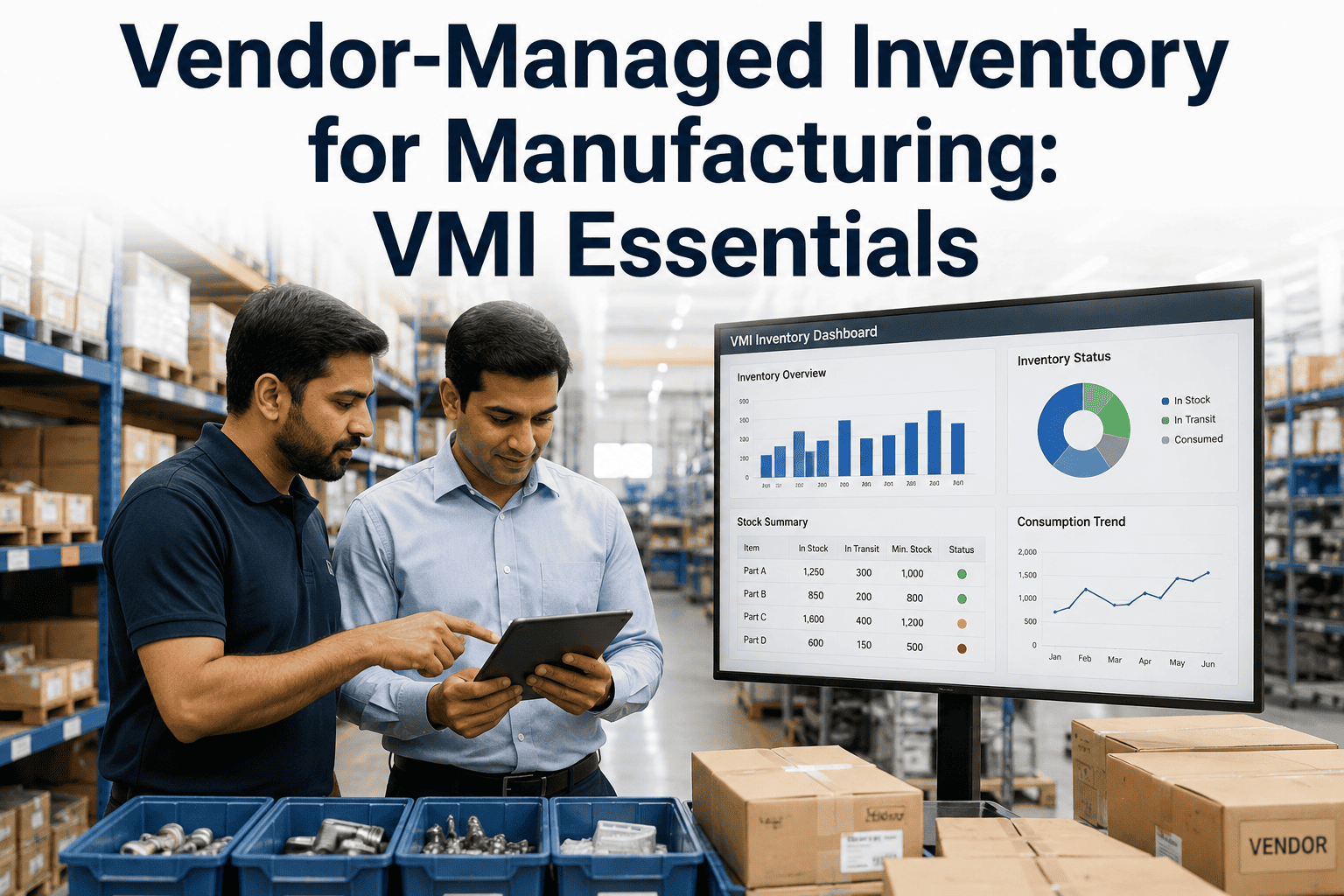
Every manufacturer that carries raw materials, fasteners, or MRO stock eventually runs into the same tension: order too much and cash sits frozen on a shelf, order too little and a stalled line costs far more than the part itself. Traditional procurement puts every one of those calls on a buyer's desk, guessing at demand weeks before it actually materializes. Vendor-managed inventory flips that model, handing replenishment authority to the supplier who already sees lead times, production schedules, and material flow more clearly than anyone downstream. Consignment stock takes the idea further, letting inventory sit on your floor without touching your balance sheet until it is actually consumed. Manufacturers moving to these models are freeing up working capital that used to sit dormant in a stockroom, and it starts by booking a VMI readiness call with iFactory's supply chain team.
Find Out Which Model Fits Your Categories
Not every part number belongs in the same program. iFactory's team can map your fastener, packaging, and MRO categories against VMI, consignment, and kanban models in a single working session.
What the Numbers Say About VMI and Consignment Programs
The shift toward supplier-managed replenishment is not a fad born out of a single case study. Manufacturers across fasteners, packaging, electronics, and raw stock categories have been quietly restructuring how inventory gets owned and reordered for over a decade, and the pattern in the data keeps repeating: lower carrying cost, fewer stockouts, and buyers who spend far less time babysitting low-value items. The following figures reflect what independent research and industry benchmarking have found across VMI and consignment rollouts.
What makes these numbers worth paying attention to is where they come from. This is not a curve fit to one company's best quarter. It shows up across fastener distributors, packaging suppliers, and raw material vendors, in facilities that range from a single line to sprawling multi-plant operations, and it tends to hold whether the program runs on a basic EDI feed or a fully automated supplier portal. The common thread is always the same: once a supplier can see real consumption instead of waiting for a purchase order, the entire replenishment cycle compresses, and inventory stops behaving like a buffer against uncertainty and starts behaving like a managed asset.
average reduction in on-hand inventory levels reported across studied VMI programs
typical drop in stockout incidents once suppliers manage replenishment against agreed thresholds
reduction in total supply chain cost seen in combined VMI plus consignment stock models
annual carrying cost burden that oversized safety stock typically adds, before right-sizing
Traditional Purchasing, VMI, and Consignment Are Not the Same Question
These three terms get used interchangeably on the plant floor, but they actually answer three different questions. Traditional purchasing is about who issues the order. Vendor-managed inventory is about who decides when and how much to replenish. Consignment is about who owns the stock while it sits on your shelf. A program can mix and match these depending on the category, and most mature supply chains end up running more than one model side by side.
Choosing between them usually comes down to two questions: how stable is demand for the item, and how much capital exposure is acceptable for that category. Standard VMI tends to work best for high-volume, repetitive parts where demand is fairly predictable and the supplier can be trusted to manage the pull without constant oversight. Consignment shifts more of the financial risk onto the supplier, which makes it a natural fit for slow-moving, high-cost components where a buyer would rather not carry the liability of a part that might sit for weeks before it is used. A growing number of programs also layer in kanban or scan-based triggers underneath either model, using an empty bin or a barcode scan at the point of use as the signal that starts the whole replenishment cycle.
Traditional Procurement
The buyer owns the stock the moment it is received and carries the full financial risk of it. Every replenishment starts with a manual count, a demand guess, and a purchase order, which means the buyer is reacting to shortages rather than preventing them. Ownership transfers at receipt regardless of when the material is actually used.
Standard VMI
The supplier watches consumption data against agreed minimum and maximum thresholds and decides when to ship, removing the manual purchase order from the cycle. Ownership still transfers to the buyer at shipment or receipt, so the financial exposure is similar to traditional purchasing, but the labor and guesswork of reordering disappear.
Consignment VMI
The supplier both manages replenishment and retains ownership of the material until it is pulled from the bin or consumed on the line. This is the model that frees the most working capital, since nothing on the shelf shows up as a liability until it is actually used, though suppliers often price consigned material slightly higher to offset their own holding risk.
How a VMI or Consignment Program Actually Runs, Step by Step
A VMI relationship is not a handshake agreement that runs on good intentions. It is a defined cycle with data flowing in one direction and material flowing in the other, bounded by thresholds both sides agreed to up front. Here is what that cycle looks like once it is running well.
Programs that skip straight to automation without nailing down this sequence tend to stall within the first quarter, usually because thresholds were set once and never revisited, or because ownership rules for returns and unused stock were never written down. The manufacturers who get the most out of VMI treat it less like a one-time system rollout and more like a living agreement, one that gets tuned as consumption patterns, supplier lead times, and production schedules shift throughout the year.
Agreement and Threshold Setup
Both sides define minimum and maximum stock levels per item, review frequency, lead time expectations, fill rate targets, and whether ownership transfers at shipment or at consumption.
Data Sharing Goes Live
The buyer connects consumption and on-hand data to the supplier through EDI transactions, a supplier portal, or a direct ERP integration, replacing the periodic phone call or email order.
Supplier-Triggered Replenishment
When on-hand quantity approaches the minimum threshold, the supplier's system calculates the right order quantity from consumption velocity and lead time, and generates the shipment without a manual purchase order.
Receipt, ASN Matching, and Reconciliation
Advance shipment notices are matched against what physically arrives, put-away is recorded against the correct bin or location, and for consignment items ownership only converts to the buyer once the material is scanned as consumed.
Performance Review and Threshold Tuning
Fill rate, inventory turns, and stockout counts are reviewed against the pre-program baseline on a set cadence, and minimum or maximum thresholds are adjusted as demand patterns shift.
Manual Replenishment vs a Managed VMI/Consignment Platform
The gap between a spreadsheet-driven reorder process and a properly instrumented VMI program shows up in almost every operational metric that matters to a plant manager. Here is the comparison across the dimensions that tend to matter most when a program is being evaluated.
Swipe left to see the full comparison
What the iFactory VMI and Consignment Platform Actually Does
A VMI program is only as strong as the system tracking it. iFactory builds the layer that connects supplier replenishment logic, your ERP, and the physical bin on the floor, so nobody is reconciling spreadsheets at month end to figure out who owns what.
Real-Time Consumption Visibility
Point-of-use scans, MES pulls, or barcode and RFID capture feed consumption data to the supplier continuously, instead of in a periodic batch export.
Automated Min/Max Threshold Engine
Thresholds are calculated from consumption velocity and lead time rather than a static guess, and recalculated automatically as demand patterns shift.
Supplier Portal and EDI Integration
Standard EDI transactions and REST-based supplier portals connect replenishment logic directly to your ERP, avoiding manual email-based ordering entirely.
Consignment Ownership Ledger
Every consigned unit is tracked from arrival to the exact consumption event, so financial ownership converts automatically at the right moment, not at month-end guesswork.
ASN Matching and Automated Put-Away
Advance shipment notices are matched against physical receipts automatically, cutting the manual verification step out of every incoming delivery.
KPI Dashboards and Replenishment Analytics
Fill rate, inventory turns, stockout count, and days sales of inventory are tracked against a pre-program baseline, with exception alerts when a supplier drifts off target.
From the Bin on the Floor to the Ledger in Finance
A VMI or consignment program touches operations, procurement, and finance at once, which is exactly why so many programs stall at the spreadsheet stage. iFactory connects all three layers so the data only has to be entered once.
Consumption and On-Hand Feed
ERP, MES, and scan data are pulled continuously so the current on-hand position and consumption trend are always current, not reconstructed from a monthly cycle count.
Threshold Engine and Supplier Portal
Minimum and maximum thresholds, lead times, and replenishment logic run automatically, triggering supplier shipments without a purchase requisition in the loop.
Ownership Ledger and Invoicing
Consignment ownership conversion, consumption-based invoicing, and inventory reduction targets roll up into finance-ready reporting. Talk to a specialist about your ERP setup before scoping an integration.
What Changes Once Replenishment Stops Being a Guessing Game
Manufacturers that move from manual reordering to a managed VMI or consignment program consistently see the same shift across a handful of metrics. Here is the typical before-and-after on a mid-sized plant running several hundred active part numbers.
Perspective From the Field
We used to have a buyer whose entire week revolved around counting bins and chasing suppliers for fasteners and packaging stock. Now the supplier sees our consumption the moment it happens and ships before we would have even noticed we were low. The bigger surprise was the consignment piece. We stopped carrying that inventory value on our books at all until it actually gets used on the line, and that freed up more working capital than any single cost-cutting project we tried the year before.
— Priya Raman, Operations Director, precision components manufacturer
active part numbers typically moved into a first-phase VMI or consignment rollout
typical length of a structured pilot before a program expands to more suppliers
consumption and on-hand visibility replacing periodic manual cycle counts
Frequently Asked Questions
Does moving to VMI mean we lose control over what gets ordered?
No, control shifts from order-by-order approval to setting the boundaries the supplier has to operate within. You still define the minimum and maximum thresholds, the fill rate targets, and which categories are even eligible for the program, so nothing ships without falling inside rules your team set in advance. What changes is who watches the day-to-day numbers and pulls the trigger on a routine reorder. Most manufacturers keep strategic sourcing and supplier selection firmly in-house while handing off only the repetitive replenishment decisions. Book a call to see how the guardrails are typically structured.
What is the real difference between VMI and consignment stock?
VMI is about who decides when to replenish, while consignment is about who owns the material while it sits on your shelf. In standard VMI, the supplier manages the replenishment decision but ownership still transfers to you at shipment or receipt, so the financial exposure looks similar to traditional purchasing. In consignment VMI, the supplier both manages replenishment and keeps ownership of the stock until it is actually pulled or consumed, which is the model that frees the most working capital for the buyer. Many programs blend both approaches depending on the category and how much capital exposure a part number represents.
How is ownership actually tracked day to day in a consignment model?
Every consigned unit is logged from the moment it arrives on your dock through the exact scan or transaction that marks it as consumed on the line. Until that consumption event, the material shows up as the supplier's inventory rather than yours, even though it is physically sitting in your facility. This is where a manual spreadsheet process tends to break down, since ownership status has to be reconciled against thousands of individual transactions rather than a single receipt date. An automated ownership ledger, tied to the same system tracking bin levels, is what keeps this from becoming a monthly audit headache.
What integration does a VMI program need with our existing ERP?
Most programs run on standard EDI transactions or a supplier portal connected to your ERP through a REST API, sharing consumption data and on-hand quantities in close to real time. Manual email-based ordering generally disqualifies a category from meaningful VMI benefits, since the whole model depends on the supplier seeing usage data continuously rather than reacting to a purchase order after the fact. The integration scope depends heavily on how many suppliers and part numbers are in scope, and whether consignment ownership tracking needs to sit alongside the replenishment logic. Talk to a specialist about what your current ERP setup can support.
How long does it take to get a VMI or consignment pilot running with one supplier?
A structured pilot with a single supplier and a limited set of part numbers typically moves from initial agreement to a live replenishment cycle within a matter of weeks, since most of the work is defining thresholds and connecting existing data feeds rather than building new infrastructure. A common approach is running one category for around ninety days, tracking fill rate and inventory turns daily, and reviewing weekly before deciding whether to expand to additional suppliers or categories. The exact timeline depends on supplier data maturity and how much manual reconciliation the current process still relies on. Book a scoping call to get a timeline specific to your supplier base.
Stop Letting Working Capital Sit Idle on a Shelf
Book a 30-minute scoping call and iFactory will map your highest-volume categories against VMI, consignment, and kanban models to build a rollout plan specific to your supplier base.