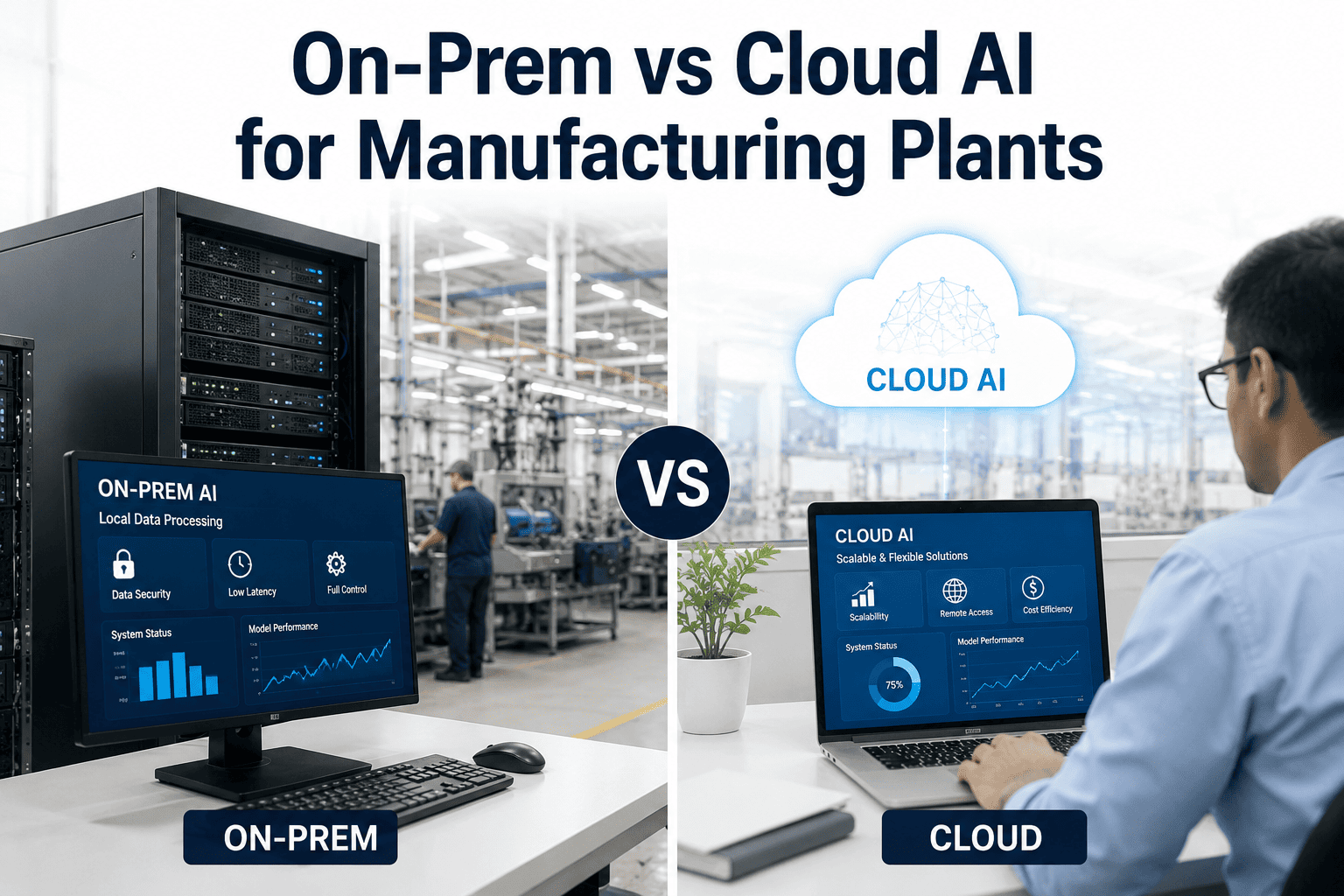
Manufacturing architects in 2026 face a deployment decision that was far simpler five years ago: where to host the AI models that will drive real-time production control, predictive maintenance, and quality inspection across their plants. Cloud-based AI platforms dominated early manufacturing AI deployments because they eliminated infrastructure management complexity and enabled rapid analytics deployment. However, as AI use cases have migrated from retrospective analytics to real-time process control and closed-loop automation, the latency, bandwidth, and availability limitations of cloud-only architectures have become structural blockers for a growing category of mission-critical manufacturing AI applications. Understanding the precise boundary between what cloud AI can reliably deliver and what requires on-premises or edge deployment is now the defining architectural decision for any manufacturing AI initiative. To explore the right architecture for your specific use cases, you can book a demo with our architecture team.
The Three AI Deployment Architectures for Manufacturing Plants
Every manufacturing AI deployment ultimately falls into one of three architectural models, each defined by where the AI model inference, data processing, and model training occur relative to the physical plant floor. The distinction between these models is not theoretical — it directly determines which use cases are achievable, what latency is achievable, what happens when network connectivity is lost, and how much the deployment costs over a five-year horizon. Manufacturing architects must understand the structural characteristics, advantages, and limitations of each model before committing to a deployment strategy, because migrating between architectures after initial deployment is significantly more expensive than choosing correctly at the design stage.
- AI model training, serving, and inference all execute on servers physically located in the plant or on the corporate campus
- Data never leaves the plant network, eliminating data sovereignty and cybersecurity exposure entirely
- Latency limited only by internal network infrastructure, typically 2-8ms round-trip for inference
- Full operational continuity during external network outages — no dependency on internet or WAN connectivity
- Higher upfront capital investment for GPU servers, cooling, and infrastructure; lower ongoing operational spend
- Model training, serving, and inference all execute in public cloud infrastructure such as AWS, Azure, or GCP
- Plant data must traverse the internet or dedicated WAN connection to reach cloud-based AI models for inference
- Latency inherently limited by network round-trip time, typically 50-200ms depending on connectivity and cloud region
- Complete operational dependency on network connectivity — any outage halts all AI-driven capabilities
- Lowest upfront capital investment; highest ongoing operational spend due to cloud compute, bandwidth, and data transfer costs
- Model training executes in the cloud where GPU scalability and managed ML services reduce complexity and cost
- Trained models are deployed to on-premises or edge inference servers for real-time execution at the plant floor
- Inference latency matches on-premises performance at 2-8ms while retaining cloud-scale training capabilities
- Graceful degradation — inference continues during outages; only model updates and analytics are delayed
- Balanced capital and operational investment with the flexibility to scale each layer independently
Latency Reality — Why Cloud Inference Fails for Real-Time Manufacturing Control
Latency is the single most consequential technical differentiator between on-premises and cloud AI deployment for manufacturing applications. The following analysis maps the actual round-trip inference latency ranges observed across each architecture model against the latency requirements of common manufacturing AI use cases. Where the inference latency range of an architecture exceeds the use case requirement, that use case cannot be reliably deployed on that architecture — regardless of model accuracy or any other capability. This is not a performance optimization question; it is a binary feasibility constraint that architects must evaluate before any deployment decision.
Architecture Inference Latency
Use Case Latency Requirement
Use Case Deployment Matrix — Where Each Manufacturing AI Application Belongs
The following decision matrix maps the most common manufacturing AI use cases against the four deployment architectures, providing a clear recommendation for where each use case should be hosted based on latency requirements, data sensitivity, connectivity dependency, and operational criticality. This matrix is the practical tool manufacturing architects use to translate their use case portfolio into an infrastructure requirement specification. Use cases marked as Recommended have no significant trade-offs at the indicated architecture. Use cases marked Possible have specific conditions or constraints that architects must evaluate. Use cases marked Not Recommended have fundamental feasibility or risk barriers at the indicated architecture. For a tailored assessment of your specific use case portfolio, book a demo and our architecture team will build a custom deployment map.
| Manufacturing AI Use Case | On-Premises | Edge | Cloud-Only | Hybrid |
|---|---|---|---|---|
| Closed-Loop Process Control | Recommended | Recommended | Not Recommended | Recommended |
| Real-Time Visual Quality Inspection | Recommended | Recommended | Not Recommended | Recommended |
| Predictive Maintenance Inference | Recommended | Recommended | Possible | Recommended |
| AI-Driven CIP Verification | Recommended | Recommended | Not Recommended | Recommended |
| Energy Consumption Optimization | Possible | Possible | Recommended | Recommended |
| Production Scheduling Optimization | Possible | Not Recommended | Recommended | Recommended |
| Enterprise OEE Analytics | Possible | Not Recommended | Recommended | Recommended |
| Supply Chain Demand Forecasting | Not Recommended | Not Recommended | Recommended | Recommended |
| AI Model Training and Retraining | Possible | Not Recommended | Recommended | Recommended |
| Multi-Plant Benchmarking | Not Recommended | Not Recommended | Recommended | Recommended |
Five-Year Total Cost of Ownership — On-Premises vs Cloud vs Hybrid
Total cost of ownership over a five-year horizon reveals a fundamentally different economic picture than the upfront cost comparison that many manufacturing organizations use to make deployment decisions. Cloud architectures offer dramatically lower initial costs but accumulate higher operational expenses through recurring compute charges, data transfer fees, and bandwidth costs that scale with production volume. On-premises architectures require significant upfront capital but achieve lower per-unit costs at scale. Hybrid architectures balance these dynamics by placing only the inference workload on-premises — where the highest data volumes and inference frequencies drive cloud costs — while retaining cloud for training and analytics where costs are proportional to training frequency rather than production volume. The following TCO comparison is modeled for a mid-size manufacturing plant with 200 connected assets, 8 production lines, and 15 active AI models.
| Cost Category | Year | On-Premises | Cloud-Only | Hybrid |
|---|---|---|---|---|
| Infrastructure and Compute | Year 1 | $380,000 | $45,000 | $195,000 |
| Year 2 | $28,000 | $52,000 | $34,000 | |
| Year 3 | $32,000 | $61,000 | $38,000 | |
| Year 4 | $35,000 | $72,000 | $41,000 | |
| Year 5 | $38,000 | $85,000 | $44,000 | |
| Bandwidth and Data Transfer | Year 1 | $8,000 | $95,000 | $18,000 |
| Year 2 | $8,500 | $108,000 | $19,000 | |
| Year 3 | $9,000 | $124,000 | $20,000 | |
| Year 4 | $9,500 | $142,000 | $21,500 | |
| Year 5 | $10,000 | $163,000 | $23,000 | |
| 5-Year Total TCO | $558,000 | $947,000 | $453,500 | |
| Annual Average | $111,600 | $189,400 | $90,700 |
Security, Compliance, and Data Sovereignty — Architecture Assessment
Manufacturing AI deployments operate within a complex security and compliance environment that varies significantly by industry, geography, and data classification. The following assessment evaluates each architecture model against the security and compliance requirements that manufacturing architects most frequently encounter when designing AI deployment strategies. The assessment is structured as a capability evaluation: Pass indicates the architecture natively satisfies the requirement without additional measures. Partial indicates the requirement can be met but requires supplementary controls, additional cost, or operational complexity. Fail indicates the architecture has a structural limitation that prevents reliable satisfaction of the requirement under normal operating conditions.
Hybrid Architecture Blueprint — The Optimal Layer Model for Manufacturing AI
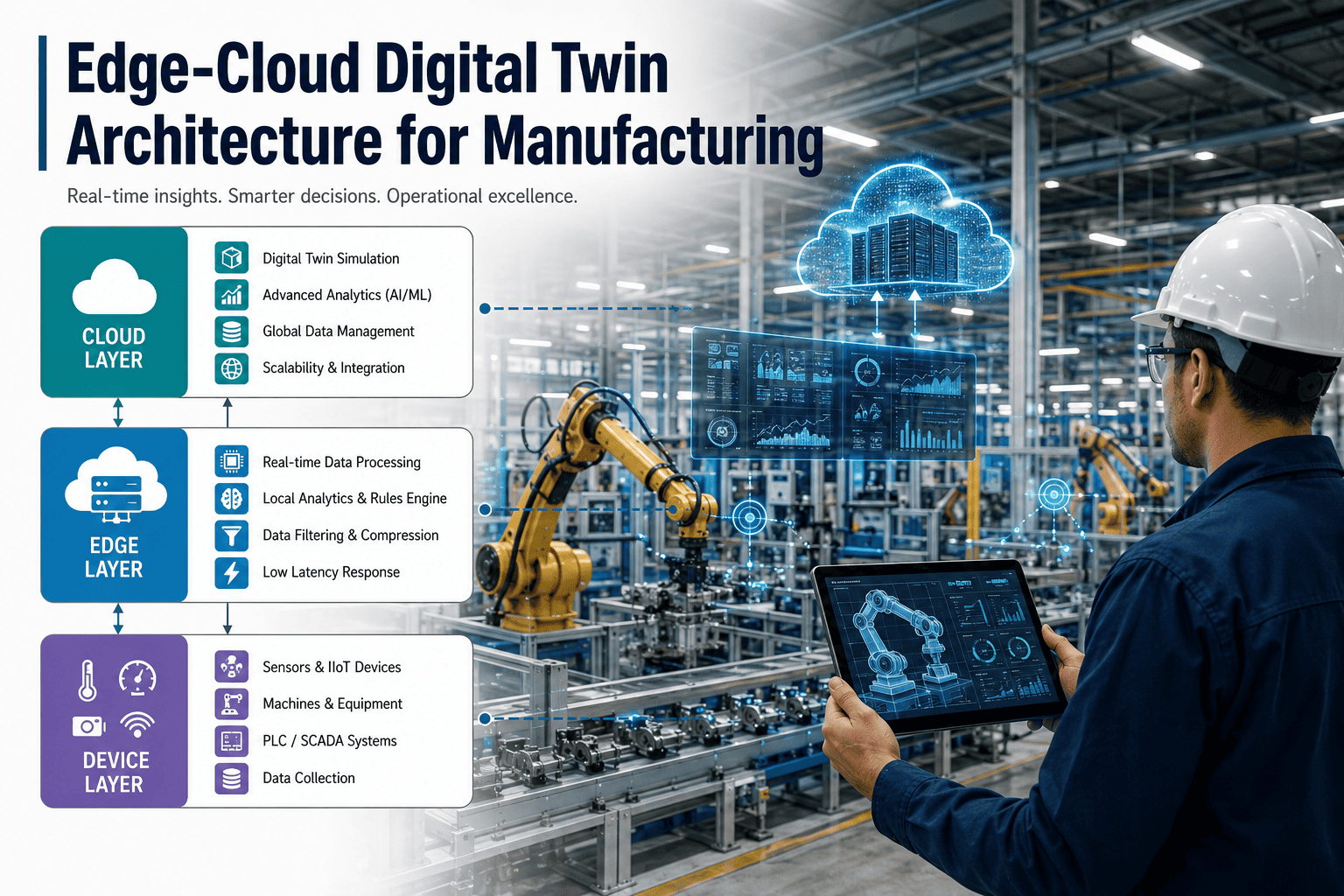
The hybrid architecture blueprint below represents the deployment model that an increasing majority of manufacturing AI architects are converging on in 2026. It resolves the fundamental tension between cloud economics for training and on-premises performance for inference by distributing AI workloads across four distinct layers, each optimized for the specific processing requirements it handles. The data flow between layers is unidirectional for inference (top-down) and bidirectional for model lifecycle management (bottom-up for training data, top-down for model updates). This blueprint is the reference architecture that iFactory's platform is designed to implement, and it is the architecture that delivers the broadest use case coverage with the lowest total cost of ownership over a five-year horizon.
Migration Roadmap — From Current State to Hybrid AI Architecture
Migrating from an existing manufacturing IT environment to a hybrid AI architecture follows a structured four-phase approach that minimizes operational disruption while building capability incrementally. The critical principle is that each phase must deliver standalone operational value — the organization should never be in a position where it has invested in infrastructure but cannot yet run AI workloads. The following roadmap has been validated across manufacturing environments ranging from brownfield plants with legacy DCS systems to greenfield facilities with modern industrial networking. If you want a migration timeline customized to your current infrastructure and use case priorities, book a demo and our architects will build a phased plan for your environment.
Assessment and Edge Infrastructure Deployment
Conduct a complete inventory of connected assets, existing data infrastructure, network topology, and current AI use case requirements. Classify each planned AI use case by latency requirement, data sensitivity, and connectivity dependency using the decision framework. Deploy edge gateway appliances at critical production areas to establish the data collection and protocol translation foundation. Validate data quality and flow from physical layer sensors through edge gateways to a temporary cloud analytics environment for baseline assessment.
Asset inventory, use case classification, edge gateways operational, data quality validatedCloud Analytics Activation and On-Premises Server Provisioning
Activate cloud-based analytics, model training pipelines, and enterprise reporting for non-real-time use cases such as OEE benchmarking, yield analytics, and supply chain integration. Simultaneously, procure and provision on-premises inference servers in the plant data center with GPU acceleration appropriate for the real-time inference workload portfolio. Establish the secure API connection between cloud training environment and on-premises inference servers. Begin training initial AI models on cloud infrastructure using the data collected through Phase 1 edge deployment.
Cloud analytics live, on-prem servers provisioned, secure cloud-to-plant connection establishedReal-Time Inference Deployment and Validation
Deploy trained AI models from the cloud training environment to on-premises inference servers. Activate real-time inference for latency-critical use cases including closed-loop process control, predictive maintenance alerting, and quality inspection. Validate inference latency, model accuracy at the edge, and operational integration with existing control systems. Implement model version management and A/B deployment capabilities to enable safe model updates without production disruption. Begin operational monitoring of the complete hybrid data flow from physical sensors through edge gateways, on-prem inference, and cloud analytics.
Real-time AI inference operational, latency validated, hybrid data flow confirmedOptimization, Scaling, and Continuous Model Lifecycle
With the hybrid architecture fully operational, enter the continuous optimization phase. Implement automated model retraining pipelines that use production data to improve model accuracy on a regular cadence. Optimize edge gateway data filtering to reduce bandwidth consumption while maintaining inference quality. Scale the architecture to additional production lines and facilities using the validated deployment playbook. Establish formal model governance procedures including approval workflows for model promotion from training to production, performance monitoring with automated drift detection, and rollback capabilities for model quality degradation events.
Automated model lifecycle, optimized data flow, scalable deployment playbook, governance frameworkOn-Prem vs Cloud AI for Manufacturing — Common Questions
Can cloud AI achieve the same inference latency as on-premises if we invest in dedicated connectivity like a direct cloud connection or AWS Direct Connect?
Dedicated connectivity such as AWS Direct Connect or Azure ExpressRoute reduces network latency compared to public internet routing, typically bringing round-trip times down to 15-40ms depending on distance to the cloud region. However, this latency range still exceeds the sub-10ms requirement for closed-loop process control and the sub-20ms requirement for real-time quality inspection. The physics of signal propagation over fiber — approximately 5ms per 1,000 kilometers — creates a floor that dedicated connectivity cannot overcome. For manufacturing plants located more than 400 kilometers from the nearest cloud region, even dedicated connectivity cannot deliver the inference latency that on-premises or edge deployment provides. To understand the specific latency achievable for your plant location and use case requirements, book a demo and our architecture team will model the actual latency for your environment.
What happens to on-premises AI inference when the model needs to be updated or retrained — does the plant go offline?
In a properly designed hybrid architecture, model updates do not require plant downtime. The updated model is trained in the cloud, validated in a staging environment, and then pushed to the on-premises inference server through the secure API connection. The on-premises server runs an A/B deployment model where the new model is loaded alongside the existing model, inference traffic is gradually shifted to the new model, and the system automatically rolls back to the previous model if the new model shows any performance degradation. The entire update process occurs without interrupting production because the inference server maintains both model versions simultaneously during the transition period. This is one of the key architectural advantages of the hybrid model over pure on-premises — the cloud training environment enables rapid model iteration without requiring the plant to maintain its own GPU training infrastructure. To see how A/B model deployment works in practice, book a demo and request a model update demonstration.
How much on-premises infrastructure is actually needed for a hybrid AI deployment in a typical manufacturing plant?
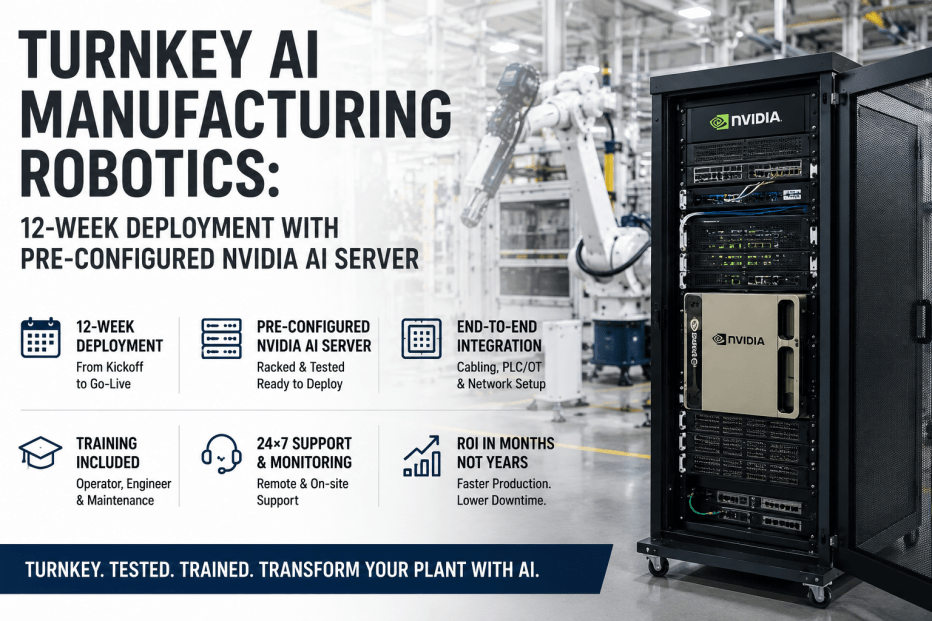
The on-premises infrastructure requirement for a hybrid AI deployment is significantly smaller than most manufacturing IT teams assume because only the inference workload runs locally — model training, data lake storage for analytics, and enterprise reporting all remain in the cloud. For a mid-size plant with 200 connected assets and 10-15 active AI models, the typical on-premises inference server specification is a single 2U server with 2-4 inference-grade GPUs such as NVIDIA T4 or L4, 128GB RAM, and NVMe storage. This hardware costs approximately $25,000-$45,000 depending on GPU selection and fits within a standard plant server room without requiring specialized cooling or power infrastructure. The edge gateway layer adds small form-factor appliances at each production area, typically $2,000-$5,000 per gateway. For a precise infrastructure sizing based on your asset count, model complexity, and inference frequency requirements, contact our support team for a detailed hardware specification.
Is a hybrid AI architecture significantly more complex to manage than a cloud-only or on-premises-only deployment?
Hybrid architecture management complexity is concentrated in two areas: the secure API connection between cloud and on-premises layers, and the model deployment pipeline that moves trained models from cloud to on-premises inference servers. Both of these complexity points are addressed by purpose-built manufacturing AI platforms like iFactory that provide managed connectors, automated model deployment pipelines, and unified monitoring dashboards that present the entire hybrid stack as a single operational environment rather than separate cloud and on-premises systems. The operational team manages a single platform interface while the platform handles the complexity of distributed model deployment, data synchronization, and connectivity monitoring behind the scenes. Organizations that attempt to assemble hybrid architectures from separate cloud AI services and on-premises inference frameworks without a unifying platform consistently report significantly higher management overhead than those that deploy a purpose-built hybrid manufacturing AI platform. To understand how iFactory simplifies hybrid architecture management, book a demo and our team will walk through the operational management interface.
How does the hybrid architecture handle data governance when some data stays on-premises and some goes to the cloud?
Data governance in a hybrid architecture is managed through a classification framework that determines which data remains on-premises and which data is eligible for cloud transmission. Raw sensor data from the physical layer is processed at the edge and on-premises inference server for real-time AI applications, and only aggregated, anonymized, or statistically summarized data is transmitted to the cloud for analytics and model training. This approach means that detailed process data with potential IP sensitivity never leaves the plant perimeter, while the cloud training environment receives the statistically sufficient data it needs to build accurate models without accessing raw production data. The data classification rules are configurable at the field level, allowing manufacturing architects to designate specific sensor data points — such as proprietary process parameters — as on-premises-only while permitting aggregated metrics like OEE, downtime duration, and defect rates to flow to the cloud for enterprise analytics. For a data governance framework tailored to your industry and regulatory requirements, book a demo and our architecture team will design a classification policy for your data landscape.