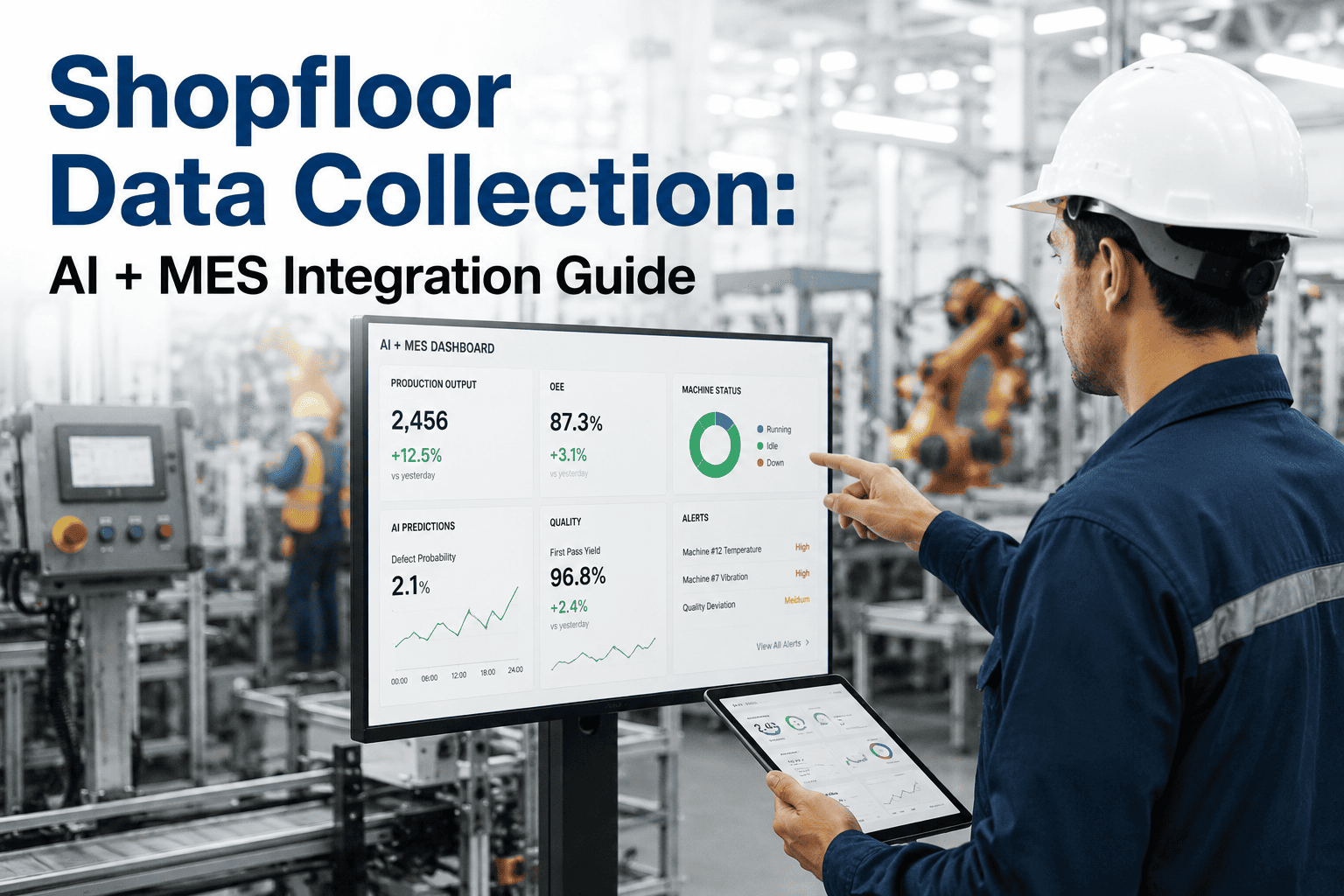
In the era of Industry 4.0, the convergence of operational technology (OT) and information technology (IT) has become the linchpin of manufacturing excellence. Yet, the most sophisticated AI models and advanced MES platforms fail when the foundational layer—shopfloor data collection—is compromised by inconsistency, latency, or poor granularity. For plant managers and CTOs, the challenge is not merely capturing data but architecting a pipeline that ensures every byte flowing into the AI layer is accurate, timestamped, and contextually rich. This guide dissects the anatomy of a robust data collection framework, from edge sensors to cloud analytics, and demonstrates how to align MES data structures with AI requirements for real-time, actionable insights. Book a Demo to explore how iFactory’s platform unifies these layers.
Transform Your Shopfloor Data into AI-Ready Intelligence
Stop fighting fragmented data. Start driving predictive maintenance and OEE gains with a unified, AI-optimized data architecture.
Why Shopfloor Data Collection Is the Achilles’ Heel of AI-Driven Manufacturing
Manufacturers invest heavily in AI for predictive maintenance, quality prediction, and production optimization. However, a 2023 McKinsey study revealed that 70% of AI initiatives in manufacturing fail to scale due to poor data quality at the source. The root cause is not the algorithm but the data architecture: inconsistent naming conventions, missing timestamps, variable polling intervals, and disconnected OT systems. Without a disciplined approach to shopfloor data collection, AI models are built on sand. For example, a vibration sensor sampling at 1 Hz cannot feed a model requiring 10 kHz resolution for bearing fault detection. Similarly, MES data aggregated hourly masks micro-stops that drive OEE losses. This section explores the criticality of data fidelity and the architectural decisions that separate successful AI deployments from failed pilots.
Data Granularity: The Sampling Rate Imperative
AI models for predictive maintenance require high-frequency data. For rotating equipment, a sampling rate of 10 kHz is standard for vibration analysis. However, most MES systems aggregate data at 1-minute intervals, losing transient events. The solution is edge computing: deploy IIoT gateways that buffer raw sensor data at native rates and compress it for MES ingestion. This preserves the fidelity needed for AI while maintaining compatibility with existing MES schemas.
Semantic Consistency: The Ontology Challenge
A common pitfall is inconsistent naming of tags across lines or plants. For instance, “Temperature_Oven_1” in one line and “Oven1_Temp” in another create data silos. Implement a standardized ISA-95-based ontology for all shopfloor tags. Use a data dictionary that maps every sensor to a unique, hierarchical identifier. This ensures that AI models can generalize across equipment and sites without manual remapping.
Temporal Alignment: Synchronizing OT and IT Clocks
When PLC timestamps drift by seconds, correlation between sensor events and production logs becomes unreliable. Deploy NTP (Network Time Protocol) across all OT devices to achieve sub-millisecond synchronization. For legacy equipment without NTP support, use edge gateways to re-stamp data upon ingestion. This temporal alignment is critical for root cause analysis and AI model training.
Architecting the Data Pipeline: From Edge to AI
A modern shopfloor data pipeline consists of four layers: acquisition, edge processing, transport, and storage/analytics. At the acquisition layer, sensors and PLCs generate raw data streams. Edge gateways perform initial cleaning, filtering, and compression. The transport layer uses protocols like MQTT or OPC UA to move data to a central data lake or MES database. Finally, the analytics layer applies AI models. Each layer introduces latency and potential data loss. To minimize this, implement a publish-subscribe pattern where edge nodes push data only when changes exceed a threshold (deadband filtering). This reduces network load while preserving critical events. For example, a temperature sensor might report every 10 seconds normally, but if it exceeds a threshold, it switches to 1-second reporting. This adaptive sampling ensures that AI models receive high-resolution data during anomalies without overwhelming the system.
Step-by-Step Implementation Roadmap
Audit Existing Data Sources
Catalog all PLCs, sensors, and MES tables. Identify sampling rates, data types, and communication protocols. Use an automated discovery tool to map the OT landscape.
Define Data Quality KPIs
Set targets for completeness (>99.9%), accuracy (no drift >1%), and timeliness (<100ms latency). Establish automated monitoring dashboards.
Deploy Edge Gateways with Deadband Filtering
Install IIoT gateways that support configurable deadband thresholds. Ensure they buffer data locally to survive network outages.
Implement Standardized Tag Ontology
Use ISA-95 or a custom hierarchy. Map all tags to a unified namespace. Validate with automated scripts.
Integrate with MES via OPC UA
Use OPC UA as the standard protocol for secure, interoperable data exchange. Configure MES to subscribe to edge-published topics.
Train AI Models with Historical Data
Use at least 6 months of clean, timestamped data. Validate model accuracy on a holdout set before deployment.
Ready to Architect Your Data Pipeline?
iFactory’s platform provides pre-built connectors, edge gateways, and AI models that integrate seamlessly with your existing MES.
Data Collection Approaches: Traditional vs. AI-Optimized
| Aspect | Traditional MES-Centric | AI-Optimized (Edge + MES) |
|---|---|---|
| Sampling Rate | 1-minute aggregates | Native sensor rate (e.g., 10 kHz) |
| Tag Naming | Inconsistent, site-specific | Standardized ISA-95 ontology |
| Latency | Seconds to minutes | Sub-100ms edge to cloud |
| Data Retention | 30 days rolling | Raw data archived for model retraining |
| Anomaly Handling | Batch processing after event | Real-time adaptive sampling |
Overcoming Common Data Quality Pitfalls
Even with a robust architecture, data quality issues can persist. One common problem is sensor drift, where a sensor’s readings gradually deviate from true values. Implement automated calibration checks using redundant sensors or known reference signals. Another issue is data loss during network outages; edge gateways with local storage can buffer data for hours and replay it when connectivity resumes. Additionally, ensure that timestamps are generated at the edge, not at the server, to avoid network delay skew. For AI models, missing data can be handled by imputation, but only if the missing rate is below 5%. Beyond that, the model’s accuracy degrades significantly. Regular data quality audits using dashboards that track completeness, accuracy, and timeliness are essential. These audits should be automated and trigger alerts when KPIs fall below thresholds.
Sensor Calibration and Redundancy
Deploy dual sensors for critical measurements (e.g., temperature, vibration). Use voting algorithms to detect drift. Schedule automated calibration based on usage hours or environmental conditions.
Edge Buffering and Data Replay
Equip gateways with at least 48 hours of local storage. Use a store-and-forward mechanism to ensure zero data loss during WAN outages. Implement priority queuing for critical alarms.
Timestamp Integrity at Source
Stamp data at the PLC or gateway using a synchronized clock. Avoid server-side timestamping. Use Precision Time Protocol (PTP) for sub-microsecond accuracy.
Frequently Asked Questions
What is the minimum sampling rate required for AI-based predictive maintenance on rotating equipment?
For vibration analysis, a minimum sampling rate of 10 kHz is recommended to capture high-frequency fault signatures such as bearing defects. However, for slow-speed equipment (below 600 RPM), 2 kHz may suffice. Always consult the AI model’s input requirements; some deep learning models can work with lower rates if augmented with synthetic data. iFactory’s platform includes adaptive sampling that adjusts rates based on equipment speed and health. Book a Demo to see how our edge gateways handle variable sampling.
How do I standardize tag naming across multiple plants without disrupting existing MES operations?
Start by creating a master data dictionary that maps legacy tags to a new ISA-95-based hierarchy. Use an integration layer (e.g., MQTT broker with topic mapping) to translate on the fly without modifying the MES. This allows coexistence during migration. Over time, update the MES configuration to use the new names. iFactory’s data harmonization module automates this mapping and validates consistency. Contact support for a detailed migration guide.
What are the best practices for synchronizing timestamps between PLCs and the MES?
Deploy a central NTP server that all OT devices synchronize to. For PLCs without NTP support, use edge gateways that timestamp data upon acquisition. Ensure that the MES uses the same time source. Avoid relying on Windows time services in industrial environments; use dedicated hardware NTP appliances. iFactory’s edge gateways include built-in PTP support for sub-microsecond synchronization. Book a Demo to see our synchronization in action.
How can I ensure data quality when integrating legacy equipment that only supports analog signals?
Use analog-to-digital converters (ADCs) with high resolution (16-bit or higher) to minimize quantization error. Install signal conditioners to filter noise. Then, feed the digital signal into an edge gateway that applies deadband filtering and timestamping. For very old equipment, consider retrofitting with smart sensors that communicate via IO-Link or OPC UA. iFactory’s hardware-agnostic platform supports over 200 industrial protocols, including legacy Modbus RTU. Get support for a compatibility assessment.
What is the role of a data lake in an AI-MES architecture, and how does it differ from the MES database?
A data lake stores raw, unaggregated data from all sources, including high-frequency sensor data, logs, and images. It serves as the training ground for AI models, allowing data scientists to explore and transform data without impacting MES performance. The MES database, in contrast, holds structured transactional data (orders, batches, quality results) optimized for operational reporting. The two coexist: the data lake feeds AI model training, while the MES provides real-time context for inference. iFactory’s architecture includes a built-in data lake that integrates with your existing MES via OPC UA. Book a Demo to see the integration.
Take the Next Step Toward Data-Driven Manufacturing
Don’t let poor data quality undermine your AI investments. iFactory provides end-to-end data collection, harmonization, and AI integration.