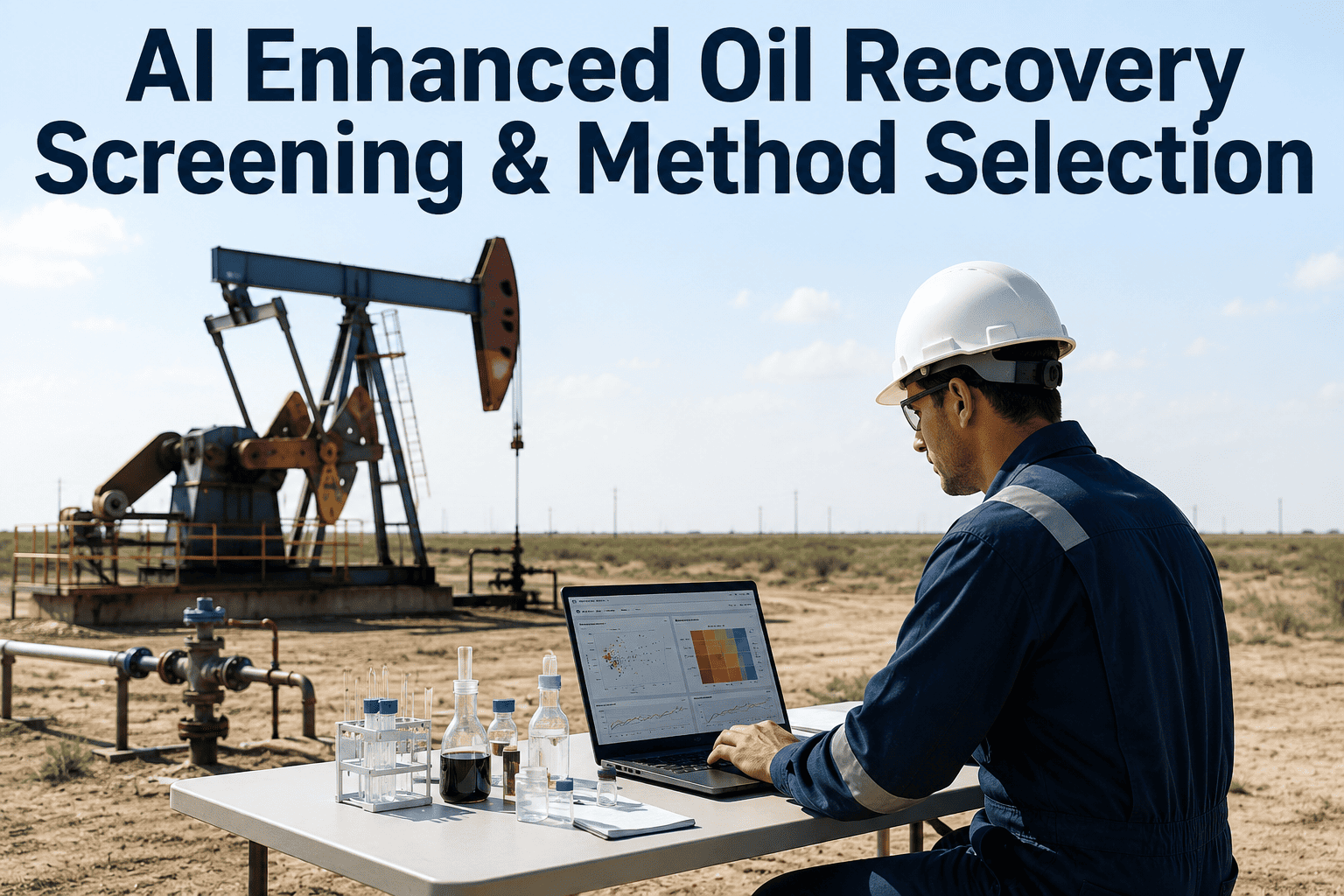
Two-thirds of the oil in a typical reservoir stays trapped underground after primary and secondary recovery run their course, and choosing the wrong enhanced recovery method to chase it can waste years and millions of dollars on a technique the reservoir was never suited for. Classical look-up tables have guided this decision for decades, but they were built on rough averages and leave too much financial risk on the table. Reservoir engineers now have a faster, sharper option. See how AI screening compares to the methods your team may already be using.
AI-Driven EOR Screening for Chemical, Thermal, and CO2 Methods
Matching reservoir properties to the right enhanced recovery technique used to mean flipping through decades-old look-up tables. Machine learning models now do it with far greater precision, and this guide shows exactly how.
Why Traditional EOR Screening Falls Short
Enhanced oil recovery is a complex, multidisciplinary decision spanning reservoir engineering, chemical engineering, and geology, and finding the most suitable technique for a candidate reservoir has traditionally relied on classical look-up tables built from broad historical averages. With the growing number of available EOR techniques, from chemical and thermal flooding to CO2 and hydrocarbon gas injection, those static tables introduce considerable financial and technical risk and uncertainty into a decision that can cost tens of millions of dollars to execute and years to reverse if it turns out to be wrong.
The core weakness of a look-up table is that it treats reservoir screening as a simple category match, when in reality the relationships between porosity, permeability, viscosity, depth, temperature, and recovery performance are highly nonlinear and interact with one another in ways a static grid cannot represent. Two reservoirs with nearly identical average properties can respond very differently to the same EOR technique because of factors a table averages away, which is exactly the kind of pattern machine learning models are built to capture.
The Three EOR Method Families AI Screens For
Chemical Flooding
Polymer, surfactant, and nanofluid flooding techniques that improve sweep efficiency and reduce interfacial tension, best suited to reservoirs with specific viscosity and salinity profiles where secondary recovery has already left significant oil in place.
Thermal Recovery
Steam flooding, in-situ combustion, and steam-assisted gravity drainage that reduce oil viscosity through heat, typically applied to heavy oil reservoirs with shallower depths where the oil is otherwise too viscous to flow economically.
Gas Injection
CO2, nitrogen, and hydrocarbon gas injection methods that improve oil mobility and, in the case of CO2, offer a secondary benefit in long-term carbon storage, making them increasingly relevant to operators managing both recovery and emissions goals.
Stop Guessing Which EOR Method Fits Your Reservoir
iFactory pairs AI-driven screening models with your existing reservoir data to shortlist the recovery methods worth simulating, instead of starting from a blank look-up table.
How Machine Learning Screening Actually Works
Rather than matching a reservoir against a handful of broad categories in a static table, machine learning screening models are trained on data from hundreds or thousands of real-world EOR projects worldwide, learning the nonlinear relationships between reservoir parameters like permeability, porosity, viscosity, depth, and temperature and the recovery techniques that performed well under similar conditions. Algorithms including random forest, support vector machines, and neural networks classify a candidate reservoir against this historical project data, and in published research, random forest models have reached high classification accuracy across chemical, thermal, and gas injection categories, giving engineers a ranked shortlist instead of a single static answer.
The practical benefit is speed combined with defensibility. Instead of a screening exercise that takes weeks of manual comparison against reference tables, engineers get a ranked, data-backed shortlist in a fraction of the time, freeing up simulation budget to focus deep technical work on the two or three methods most likely to succeed rather than spreading it thin across every option in the book. It also gives technical teams a clearer story to bring to management and investment committees, since a ranked recommendation backed by hundreds of comparable field projects is easier to defend than a judgment call pulled from a decades-old reference table.
Reservoir Property Fit by EOR Method Family
| Property | Chemical Flooding | Thermal Recovery | Gas Injection |
|---|---|---|---|
| Oil Viscosity | Low to medium | High, heavy oil | Low, light oil |
| Reservoir Depth | Shallow to medium | Shallow preferred | Medium to deep |
| Formation Type | Sandstone favored | Sandstone, unconsolidated | Sandstone or carbonate |
| Typical Recovery Uplift | Moderate to high | High for heavy oil | Moderate, plus storage benefit for CO2 |
CO2-EOR: Recovery and Carbon Storage Together
CO2 injection deserves particular attention because it carries a dual benefit that other methods do not: it improves oil mobility while offering long-term carbon storage potential, making it an increasingly attractive option as operators face both recovery economics and climate-related reporting pressure. Screening for CO2-EOR candidacy involves evaluating miscibility conditions, sweep efficiency challenges, and reservoir containment properties, and machine learning models trained on CO2-foam flooding and CO2 sequestration project data are increasingly used to predict oil recovery factor and injection performance before committing to costly laboratory or pilot testing.
One persistent challenge with CO2 injection is sweep efficiency, since the gas can bypass significant portions of the reservoir rather than displacing oil uniformly. CO2-foam injection has emerged as a way to address this, and machine learning models built on general regression neural networks and gradient boosting techniques have shown strong results predicting recovery factor for foam-assisted CO2 flooding, giving engineers a faster way to evaluate whether the added complexity of a foam approach is justified for a given reservoir before committing to expensive laboratory screening.
Screening Mistakes That Cost Operators the Most
Relying on One Reference Field
Comparing a candidate reservoir to a single analog field, rather than a broad dataset of historical projects, dramatically narrows the range of patterns a screening process can actually detect and increases the odds of an overlooked but well-suited method.
Skipping Uncertainty Ranges
Treating reservoir parameters as fixed single values instead of ranges ignores the heterogeneity that real reservoirs exhibit and can push a screening result toward false confidence in a method that only fits part of the field.
Jumping Straight to Simulation
Committing simulation budget before narrowing the field of candidate methods wastes engineering time on techniques that were unlikely to fit the reservoir from the start, delaying the methods that actually deserved deeper technical review.
Ignoring Economic Screening Alongside Technical Fit
A technically suitable method that is not economically viable at current infrastructure and commodity price conditions still needs to be filtered out early, not after a costly pilot has already consumed budget and time.
Where iFactory Fits Into Your EOR Workflow
Screening is only the starting point of a good EOR decision, and the same data discipline that powers a strong screening model also strengthens everything downstream of it. iFactory connects reservoir and production data to AI-driven forecasting, procurement, and predictive maintenance tools, so once a method is selected, the operational side of executing it, from sourcing injection chemicals and equipment to tracking well performance against forecast, runs on the same connected data foundation rather than a separate set of disconnected spreadsheets and systems.
That continuity matters because EOR projects are long-running and capital intensive. A screening result that sits in a report and never connects to procurement planning or maintenance scheduling loses much of its value the moment field execution begins. Keeping the data pipeline continuous from screening through execution is what turns a good technical decision into a well-run project.
Frequently Asked Questions
How accurate is AI-based EOR screening compared to traditional methods?
Published studies using algorithms like random forest have shown strong classification accuracy across chemical, thermal, and gas injection categories, generally outperforming static look-up tables because the models capture nonlinear relationships between reservoir parameters that simple tables cannot represent. Screening should still be paired with simulation and, where feasible, laboratory testing before final investment decisions. Reach out through a demo session to see it applied to your data.
Does AI screening replace reservoir simulation entirely?
No, AI screening narrows the field of candidate methods quickly and cost-effectively, but detailed simulation and, in many cases, laboratory core flood testing remain essential before committing capital to a full-scale EOR project. Think of screening as the filter that focuses your simulation budget on the most promising methods rather than a replacement for the rigorous engineering work that follows.
What data do we need to run an AI screening model?
Core reservoir parameters including permeability, porosity, oil viscosity, depth, temperature, and formation lithology are the minimum inputs most screening models require, and the more historical field and lab data you can provide, the sharper the ranked recommendations become. Our support team can help assess what you already have on hand.
Is CO2-EOR only viable for large operators with carbon capture infrastructure?
Not necessarily. Many CO2-EOR projects source CO2 from nearby industrial facilities or existing pipeline infrastructure rather than requiring operators to build capture systems themselves, which has made the method increasingly accessible to mid-size operators evaluating mature fields.
How long does an AI-assisted screening process take?
Once reservoir data is assembled and cleaned, a screening pass typically takes hours rather than the days or weeks required to manually cross-reference multiple look-up tables and technical papers, though data preparation quality has the biggest impact on how fast this moves.
Find the Right EOR Method Faster and With More Confidence
Let's run your reservoir data through an AI-driven screening pass and see which recovery methods actually deserve your simulation budget.

-optimization.png)