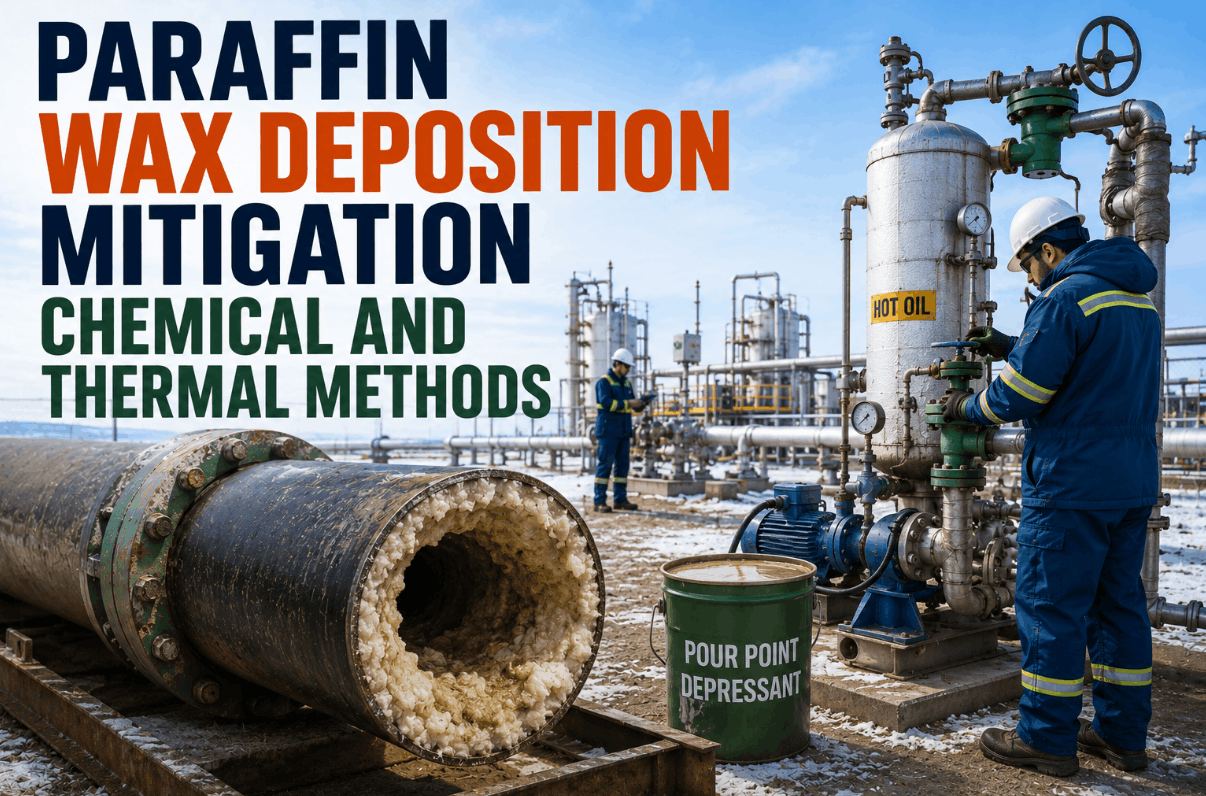
Paraffin wax deposition remains one of the most persistent flow assurance challenges facing upstream and midstream operators today. As crude oil cools below its wax appearance temperature (WAT), dissolved n-alkanes crystallize and adhere to pipe walls, gradually restricting flow diameter, raising pumping pressure, and in severe cases, causing full flowline blockages. The industry has long relied on a mix of chemical, thermal, and mechanical countermeasures—pour point depressants, hot oiling, and pigging—each with distinct cost and performance trade-offs. This guide compares these proven wax mitigation strategies and explains how iFactory AI helps reliability and production teams move from reactive wax cutting to predictive, data-driven flow assurance. Teams evaluating their current wax program can Book a Demo to see how continuous monitoring fits into an existing mitigation plan.
Catch Wax Buildup Before It Costs You Production
iFactory's AI Vision and Digital Twin platform tracks the operating conditions that drive wax deposition, giving flow assurance teams earlier warning than pressure-drop alone can provide.
Why Paraffin Wax Deposition Is So Difficult to Control
Wax deposition is a temperature-driven phase change problem, not a contamination issue, which is why it defeats so many one-size-fits-all fixes. Once bulk fluid temperature drops near the WAT, paraffin molecules nucleate into crystals that bond to the cooler pipe wall faster than they bond to each other in the flowing core. The result is a hard, insulating wax layer that thickens over time, narrows the effective bore, and pushes pumping pressures higher until intervention is unavoidable. Operators typically choose between three mitigation families—chemical, thermal, and mechanical—often combining them based on well depth, crude composition, and ambient conditions. Production engineers comparing these options against their own field data can Book a Demo to review wax-prone assets with the iFactory team.
Pour Point Depressants
Core Mechanism: PPDs are polymeric crystal modifiers injected upstream of the WAT. They co-crystallize with paraffin molecules, disrupting the wax lattice so crystals stay smaller and more dispersed instead of bonding to the pipe wall.
Hot Oil Treatment
Core Mechanism: Heated crude or produced water is circulated through the flowline to raise wall temperature above the wax disappearance temperature (WDT), melting existing deposits so they re-enter the flow stream.
Pigging & Scraping
Core Mechanism: Mechanical pigs or wireline-run scrapers physically shear wax deposits from the pipe wall on a scheduled or condition-based interval, restoring bore diameter without chemical or thermal input.
iFactory AI Monitoring
Core Mechanism: Continuous pressure, temperature, and flow analytics flag deposition trends early, helping teams time PPD dosing, hot oil runs, and pigging windows against actual conditions instead of a fixed calendar.
Our wax program used to run on a fixed pigging calendar regardless of what the crude was actually doing that week. Once we had continuous pressure and temperature trending on the flowline, we could see deposition building days before a pig run was even scheduled. We stopped over-pigging healthy lines and started focusing interventions on the wells that actually needed them.
Chemical vs. Thermal vs. Mechanical: Matching Method to Asset
No single wax mitigation method is correct for every well or pipeline segment. Deepwater and ESP-lifted wells often favor continuous PPD or inhibitor injection because mechanical intervention is costly and infrequent, while shallow onshore wells with easy wireline access can rely more heavily on scheduled scraping. Hot oiling sits in between—effective for clearing established deposits but limited by reheating costs and the risk of wax re-precipitating downstream once the fluid cools again. The table below summarizes how each approach performs across the variables that matter most to a flow assurance program.
| Evaluation Factor | Chemical (PPD) | Thermal (Hot Oil) | Mechanical (Pigging) | iFactory Advantage |
|---|---|---|---|---|
| Primary Use Case | Prevent crystal growth | Remove set deposits | Restore bore diameter | Time every method correctly |
| Injection / Action Point | Above WAT, wellhead or downhole | Above WDT, full circulation | Scheduled or condition-based | Live WAT-relative tracking |
| Ongoing Cost Driver | Chemical volume & dosing | Fuel / heating energy | Trucking & downtime | Fewer unnecessary runs |
| Key Limitation | Must dose before crystallization | Risk of re-deposition downstream | Requires piggable geometry | Removes calendar-based guesswork |
| Best Fit Asset | Deepwater / ESP wells | Mid-length flowlines | Onshore, piggable lines | Mixed-asset portfolios |
How iFactory Supports a Smarter Wax Mitigation Program
iFactory does not replace chemical, thermal, or mechanical wax treatments—it makes them more precisely timed. By continuously trending wellhead and flowline pressure differentials, temperature profiles relative to WAT, and historical pigging or hot-oiling outcomes, the platform helps engineers identify which wells are trending toward deposition risk before a pressure spike forces a reactive response. Maintenance and production planners use this visibility to schedule PPD injection rate changes, hot oil circulation windows, and pigging runs around actual wax behavior rather than a fixed interval. Teams ready to connect this kind of monitoring to an existing wax program can Book a Demo with the iFactory team.
Expert Review: Building a Mitigation Strategy That Actually Holds Up
Flow assurance specialists generally agree that effective wax control starts with characterizing the crude itself—running WAT, pour point, and cold finger tests before selecting an inhibitor package or thermal schedule. From there, a layered approach tends to outperform any single method: continuous low-dose PPD injection to slow crystal growth, periodic hot oiling or pigging to clear what does accumulate, and monitoring to confirm the program is actually working rather than assuming it is. The most common gap reviewers flag is the monitoring piece—many operators size their chemical dosage or pigging frequency once during commissioning and rarely revisit it as well conditions, water cut, or seasonal temperatures shift. Closing that gap with real-time data, rather than periodic manual checks, is where platforms like iFactory add the most measurable value to an existing program. Engineers reviewing their current dosing and pigging cadence can Book a Demo to walk through field data with the iFactory team.
Paraffin Wax Mitigation — Frequently Asked Questions
What is the difference between WAT and WDT?
WAT is the temperature at which wax crystals first form as crude cools; WDT, usually higher, is the temperature needed to fully redissolve existing deposits. Thermal treatments must reach WDT, not just WAT, to be effective.
When should pour point depressants be injected?
PPDs must be dosed above the WAT to be effective, since they work by modifying crystal structure before wax solidifies. Injecting below the WAT significantly reduces their performance.
How often should pigging or hot oiling be scheduled?
Frequency depends on crude composition, flow rate, and ambient temperature, and is typically set during commissioning. Continuous monitoring allows that schedule to be adjusted as actual conditions change.
Can chemical and thermal methods be used together?
Yes. Many operators combine continuous PPD injection to slow buildup with periodic hot oiling or pigging to clear residual deposits, particularly on longer or insulated flowlines.
Does iFactory replace existing wax treatment chemicals or pigging programs?
No. iFactory adds monitoring and trend visibility on top of existing chemical, thermal, and mechanical programs, helping teams time interventions more precisely rather than replacing the treatments themselves.
Bring Data-Driven Visibility to Your Wax Mitigation Program
Combining proven PPD, hot oiling, and pigging practices with continuous condition monitoring helps flow assurance teams intervene earlier and more cost-effectively. See how iFactory fits into your current wax strategy.