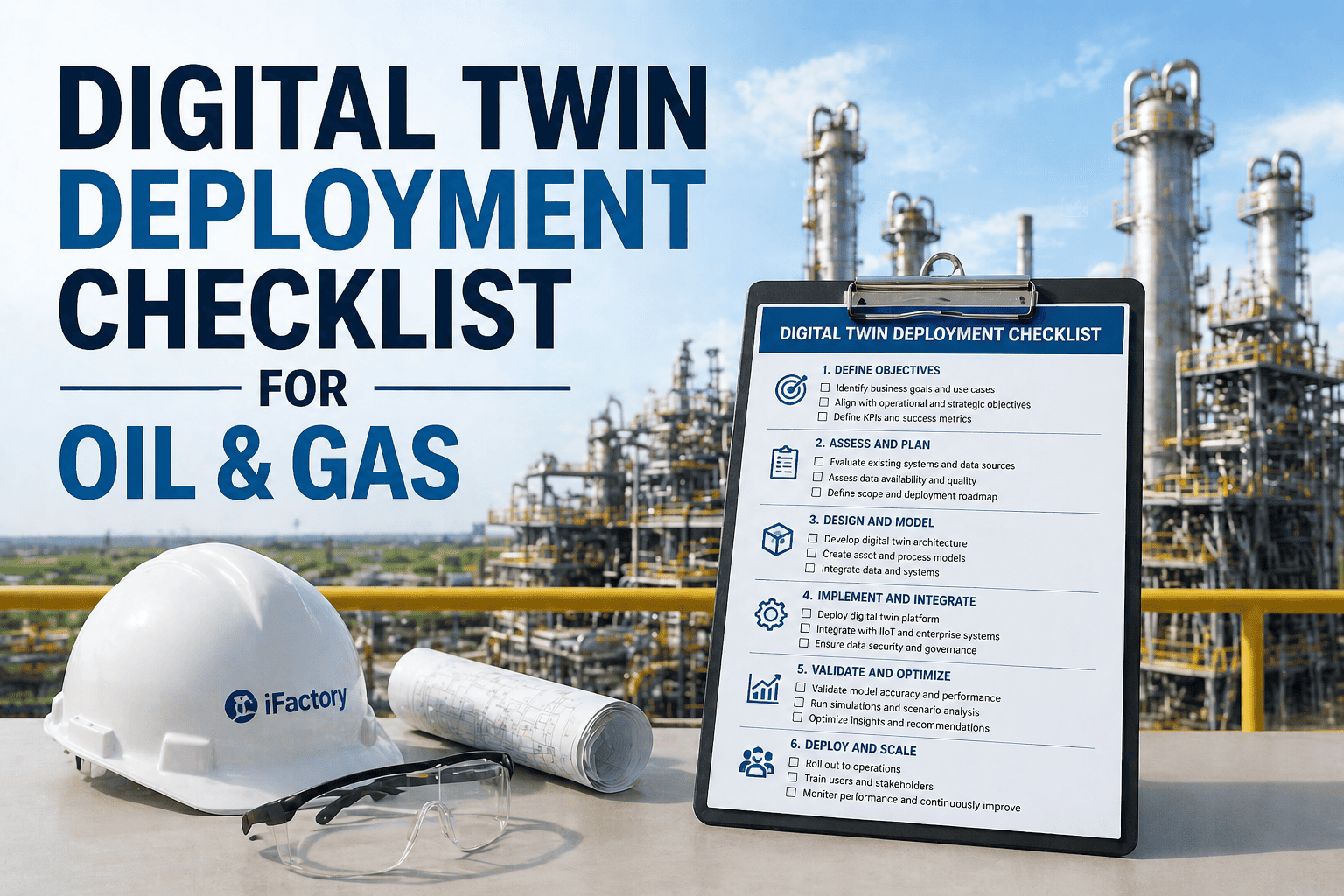
Oil and gas operators lose an average of 4,200 production hours annually to unplanned equipment downtime, with 68% of failures preventable through structured digital twin inspection programs. A single pipeline leak or facility shutdown costs $150,000 to $3.2M in immediate losses, environmental fines, and emergency remediation. Digital twin protocols that integrate SCADA/DCS data with IoT sensors catch equipment degradation 3-4 weeks before failure, eliminating reactive responses and preserving production revenue. Book a demo to see how iFactory converts this checklist into automated digital twin work orders assigned across your facility asset hierarchy.
4,200
Production hours lost annually to unplanned downtime across midstream and upstream operations
68%
Of equipment failures preventable through predictive maintenance and early intervention protocols
$3.2M
Maximum cost impact from single pipeline incident or facility shutdown including regulatory fines and remediation
6
Inspection zones for complete digital twin coverage across equipment, SCADA, pipelines, and compliance
Checklist Scope and Usage
Six inspection zones with priority ratings per item. Critical — immediate equipment removal from service and emergency alert escalation. Monitor — raise high-priority work order, re-inspect within 7 days, implement temporary controls. Routine — document trend analysis and forecast maintenance window. All Critical and Monitor findings require SCADA data validation and photo documentation before escalation. Run routine inspections weekly, comprehensive inspections monthly, and full ESG audit inspections quarterly with third-party verification.
Zone 1 — Equipment Integrity and Condition Assessment
Equipment failures in upstream and midstream operations cascade rapidly when early degradation is missed. SCADA-integrated sensors detect vibration, temperature, and pressure anomalies 2-4 weeks before mechanical failure. Visual inspection validates sensor findings and identifies threats that instrumentation alone cannot catch. Book a demo to see how iFactory links equipment condition ratings directly to sensor baselines for each asset.
Pump and Compressor Condition
Heat Exchanger and Cooler Condition
Valve and Control Hardware
Zone 2 — SCADA, DCS, and Real-Time Monitoring Systems
Automate This Checklist with iFactory Digital Twin — Real-Time Data Validation
Zone-based inspection on mobile, timestamped sensor validation, and automatic work order routing for every Critical and Monitor finding — with SCADA integration linking each record to live equipment baselines. Book a demo to see it configured for your facility.
Zone 3 — Pipeline Networks and Corrosion Monitoring
Pipeline failures account for 15% of all oil and gas accidents and over 60% of environmental incidents. Internal corrosion, external loading, and coating degradation are detectable through structured monitoring before catastrophic failure. Routine pigging, ultrasonic thickness testing, and SCADA flow anomaly analysis prevent emergency shutdowns and environmental liability.
Pipeline Integrity Assessment
Fitting, Flange, and Joint Condition
Zone 4 — Structural Foundations and Support Systems
Structural failure of equipment bases and pipeline supports can cascade to multiple assets. Concrete degradation, anchor bolt corrosion, and foundation settlement are often invisible until catastrophic failure occurs. Routine foundation assessment prevents unexpected collapses and extends equipment life.
Equipment Foundation Assessment
Zone 5 — Data Connectivity and Network Infrastructure
Digital twin models depend on continuous, reliable data flow from field sensors and equipment. Network outages, communication failures, and latency issues blind the predictive system. Daily connectivity audits ensure early warning system remains active.
Zone 6 — ESG Compliance and Regulatory Documentation
Environmental, Social, and Governance compliance requires documented evidence of operational discipline. Methane emissions, flaring, and VOC management depend on continuous monitoring and maintenance records. Regulatory audits increasingly focus on integrity of inspection and maintenance documentation.
Emissions and Environmental Monitoring
Compliance and Audit Documentation
Inspection Zone Summary — Frequency and Priority Distribution
Inspection Zone
Weekly
Monthly
Quarterly
Critical
Total
Zone 1 — Equipment Integrity
Vibration and temperature
All items
Oil analysis
4
13
Zone 2 — SCADA & DCS
System uptime check
Data quality audit
Full system validation
3
11
Zone 3 — Pipeline Networks
Flow anomalies
All items
Pigging/ultrasonic
3
12
Zone 4 — Foundations
Visual only
All items
Levelness check
2
8
Zone 5 — Data Connectivity
Gateway status
Network performance
Full connectivity audit
3
9
Zone 6 — ESG Compliance
Emissions monitoring
All items
Compliance review
2
10
Total Checklist Items
Selected
All 63
All 63
17
63
iFactory Results at Oil & Gas Facilities
92%
Inspection Compliance Rate
Weekly and monthly completion rate at iFactory-deployed facilities versus 58% without structured digital scheduling
64%
Reduction in Critical Findings
Reduction in Critical-rated findings at 12 months post-deployment as deferred maintenance backlog was systematically addressed
100%
Work Order Linkage
Critical and Monitor findings automatically routed to corrective work orders with photo evidence and sensor data linked to the asset record
3 wks
Deployment Time
Average time to live digital twin inspections across a facility portfolio including asset hierarchy, sensor integration, and staff training
Frequently Asked Questions
QWhat inspection frequency does API recommend for oil and gas equipment?
QWhat documentation does a facility need to defend against a safety or environmental liability claim?
Regulators and courts look for three elements: evidence a structured inspection program existed, evidence the specific hazard was either absent at last inspection or had a documented work order raised, and evidence the facility responded within reasonable timeframes. iFactory produces timestamped, GPS-located, photo-evidenced records satisfying all three. Book a demo to review documentation output for your facility.
QHow far in advance can digital twins predict equipment failure?
Depending on equipment type and failure mode, predictive models typically identify risk 2-6 weeks before failure. Centrifugal pumps and compressors: 2-4 weeks. Heat exchangers: 3-6 weeks. Pipeline corrosion: 3-6 months trending. The earlier the warning, the more time to plan repairs and order parts without emergency logistics.
QCan digital twins integrate with existing SCADA and historian systems?
Yes. iFactory integrates directly with OSIsoft PI, Aspen InfoPlus.21, Honeywell, and other industrial historians via OPC-UA and standard data connectors. No replacement of existing SCADA required—the digital twin ingests data from your existing infrastructure and adds predictive AI on top. Book a demo to review your specific SCADA architecture.
QHow do I justify digital twin investment to management with capital constraints?
QHow long does it take to deploy a digital twin across a facility?
Most facilities deploy digital twins in 8-12 weeks: Weeks 1-2 planning and asset mapping, Weeks 3-4 SCADA integration and data validation, Weeks 5-6 AI model training, Weeks 7-8 workflow testing, Weeks 9-12 operator training and full operational launch. Pilot phases on single asset classes can complete in 4 weeks.
Deploy This Checklist as Live Digital Twin Inspections Across Your Facility
Every zone and every item available as a structured digital inspection — assigned to your equipment asset hierarchy, completed on mobile with photo and sensor data validation, and automatically routing Critical and Monitor findings to corrective work orders before the inspector leaves the field.