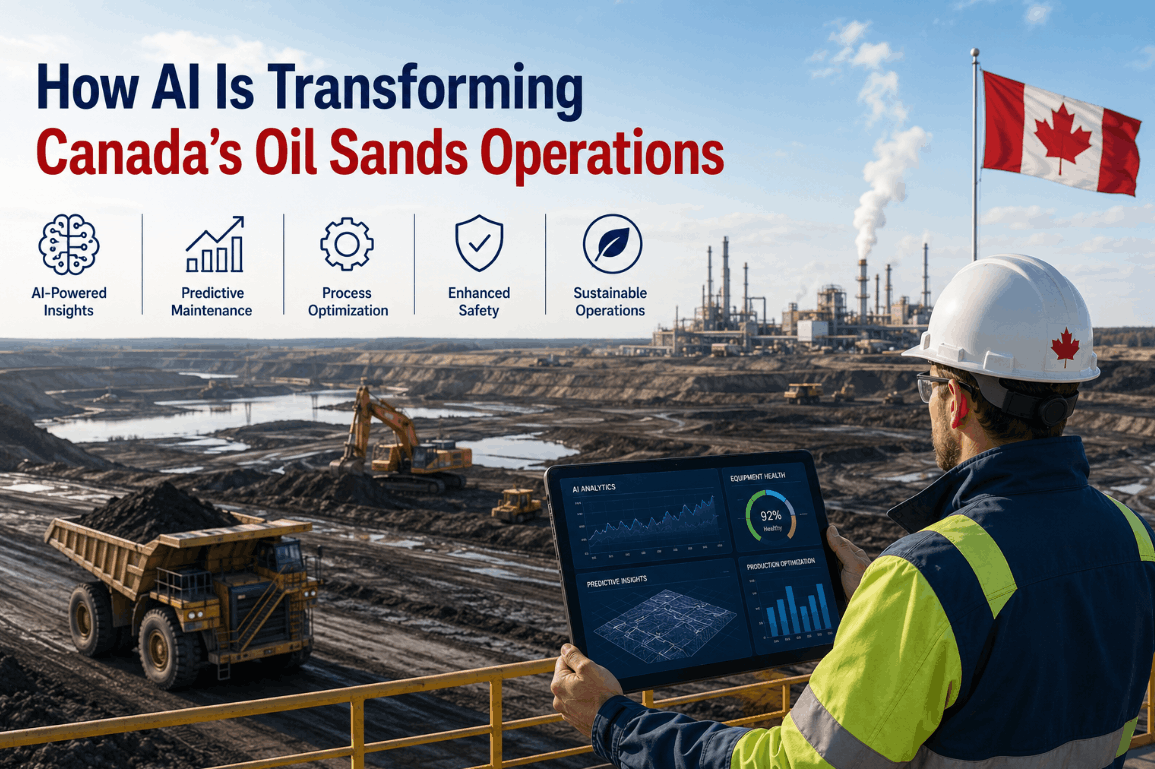
Canada's oil sands represent one of the most operationally complex and capital-intensive industrial environments on the planet. Spread across the Athabasca region of northern Alberta, these assets produce over 3 million barrels of oil per day and face a set of engineering challenges — extreme cold, abrasive bitumen slurries, remote locations, and razor-thin per-barrel cost margins — that have no direct equivalent anywhere else in the global energy industry. Artificial intelligence is now reshaping how Canada's largest oil sands operators manage those challenges. Suncor Energy, Canadian Natural Resources Limited (CNRL), and Imperial Oil have each deployed AI and autonomous systems at production scale, generating measurable reductions in operating costs, improvements in equipment reliability, and new levels of operational visibility that paper-based and legacy-software workflows could never deliver. For industrial operations professionals in any capital-intensive sector, the AI transformation underway in Canada's oil sands offers a detailed, data-rich blueprint for what is possible when digital technology is applied systematically to complex asset management.
Bring Oil Sands–Grade AI Intelligence to Your Operations
iFactory's unified AI platform delivers the predictive maintenance, real-time asset monitoring, and digital work order capabilities driving efficiency in Canada's most demanding industrial environments — built for manufacturers worldwide.
The Operational Case for AI in Canada's Oil Sands
Oil sands production is structurally different from conventional drilling. In surface mining operations, enormous shovels and haul trucks move hundreds of thousands of tonnes of oil sand daily before bitumen is separated through hot-water extraction. In in-situ operations — primarily Steam-Assisted Gravity Drainage (SAGD) — steam is injected deep underground to mobilize bitumen, which is then pumped to surface facilities. Both methods are energy-intensive, equipment-heavy, and acutely sensitive to unplanned downtime. A single unplanned shutdown of a SAGD facility or a primary extraction plant can cost millions of dollars per day in lost production. With operating cost benchmarks as aggressive as $11 to $23 per barrel at leading operators like CNRL, there is virtually no margin for the inefficiency that manual workflows and reactive maintenance produce. AI is not optional in this environment — it is the mechanism by which leading operators protect their cost position. Book a Demo to see how iFactory delivers comparable capabilities for industrial manufacturing operations.
$11.04/bbl
CNRL's 2024 average thermal in-situ operating cost — an industry-leading figure attributed to decades of data-driven process optimization and AI-assisted operational control.
140 Trucks
CNRL's projected Autonomous Haulage System fleet size by end of 2025 — the largest deployment of driverless mining trucks in the Canadian oil sands, using GPS, advanced sensors, and AI-driven dispatch.
$1.2B/yr
Imperial Oil's digital technology portfolio annual benefit value from cost savings and production uplift — delivered by over 50 successfully deployed and expanding digital initiatives across its Kearl and Cold Lake operations.
>4,500 Wells
Imperial Oil's machine learning dashboard monitors over 4,500 wells for performance, condition, and production anomalies — replacing manual surveillance rounds with continuous AI-driven oversight.
How Canada's Three Largest Oil Sands Operators Are Deploying AI
The AI transformation in Canada's oil sands is not a uniform story — each major operator has pursued a distinct strategy shaped by its asset mix, capital structure, and operational priorities. Understanding these differences reveals the range of entry points available to any industrial organization beginning its own AI journey. Reliability and operations professionals can Book a Demo to see how iFactory's modular platform supports a similarly flexible deployment approach.
Autonomous Haulage and AI Dispatch at Mildred Lake
Suncor operates one of the most advanced autonomous vehicle fleets in the Canadian oil sands at its Mildred Lake mine site. The Autonomous Haulage System (AHS) deploys driverless haul trucks that use GPS, onboard sensors, and wireless communication to transport oil sands ore from the mine face to extraction facilities without human operators in the cab. Beyond the trucks themselves, Suncor has integrated AI into its dispatch system, where artificial intelligence handles routine fleet management tasks — assigning trucks to dump stations, directing them to refuelling points, and optimizing traffic flow — while human dispatchers remain available for complex or exception-based decisions. The company also entered a multi-year strategic alliance with Microsoft to accelerate cloud-based AI and Industrial IoT deployments across its operations, enabling faster rollout of machine learning, automation, and enhanced production visibility.
Industry-Leading Cost Structure Through Data-Driven Optimization
Canadian Natural Resources Limited (CNRL) has built what analysts describe as the most cost-efficient oil sands operation in the industry — with 2024 mining and upgrading operating costs of $22.88 per barrel, an estimated $7 to $10 per barrel below its peer average. That differential translates to an incremental annual margin advantage of approximately $1.2 to $1.7 billion. CNRL's AI strategy is anchored in its deployment of an Autonomous Haulage System projected to reach 140 vehicles by the end of 2025. Complementing the AHS is an AI-driven dynamic dispatch system that continuously optimizes truck assignments and routing in real time to eliminate bottlenecks and maximize ore movement throughput. CNRL's operational philosophy — decades of meticulous, data-informed process control — has created an organizational culture that treats AI not as a pilot project but as a production tool.
A $1.2 Billion Digital Portfolio Across Kearl and Cold Lake
Imperial Oil's digital technology program is one of the most comprehensively documented AI deployments in the Canadian oil sands. With over 50 successful digital initiatives deployed and expanding across its Kearl oil sands mine and Cold Lake in-situ operations, Imperial's annual digital benefit is estimated at approximately $1.2 billion in combined cost savings and production uplift. Key deployments include: robotics generating over $30 million per year in savings; advanced controls and analytics capturing over 2,000 barrels per day of additional production worth more than $45 million annually; a machine learning dashboard monitoring over 4,500 wells; autonomous drone inspections of fixed equipment for safety and inspection efficiency; pumpjack condition-based monitoring replacing manual surveillance rounds; AI-driven shovel and truck analytics for mine optimization; and predictive hydrotransport inspection technologies with AI-based failure forecasting.
AI Use Cases Mapped to Oil Sands Operations
Canada's oil sands present a diverse set of operational challenges across three distinct production environments: surface mining, in-situ SAGD facilities, and upgrading plants. AI has been deployed differently across each environment, with use cases selected based on where the cost and reliability impact is greatest. Operations professionals looking to apply similar thinking to their own facilities can Book a Demo to see how iFactory maps AI capabilities to specific asset classes.
| Production Environment | Primary AI Application | Operator Example | Measured Outcome |
|---|---|---|---|
| Surface Mining (Athabasca) | Autonomous Haulage System + AI Dispatch | Suncor, CNRL | Eliminated operator fatigue risk; continuous 24/7 ore movement; optimized truck routing |
| In-Situ SAGD (Cold Lake, Christina Lake) | ML-based well surveillance across 4,500+ wells | Imperial Oil, CNRL | Replaced manual inspection rounds; early anomaly detection; production optimization |
| Extraction and Upgrading Plants | Predictive maintenance via condition-based monitoring | Imperial Oil, Suncor | Reduced unplanned shutdowns; extended asset life; lower emergency repair costs |
| Mine Operations (Kearl) | Shovel and truck analytics; AI ore selectivity modeling | Imperial Oil | Improved bitumen recovery; reduced waste; optimized extraction chemistry |
| Fixed Equipment Inspection | Autonomous drone inspections; robotics surveillance | Imperial Oil | >$30M/yr savings from robotics; safer inspections; faster defect identification |
| Hydrotransport Infrastructure | Advanced HT inspection with predictive AI forecasting | Imperial Oil | Early pipeline wear detection; reduced unplanned maintenance events |
What Manufacturing Operations Can Learn from Canada's Oil Sands
The operational principles that drive AI success in Canada's oil sands — sensor-dense asset monitoring, condition-based maintenance replacing calendar-driven inspection, AI-driven dispatch and workflow automation, and digital surveillance replacing manual field rounds — are not unique to extractive industries. They are universal principles of industrial AI that apply with equal force to steel plants, chemical facilities, automotive assembly, and any other environment where equipment reliability and per-unit operating cost determine competitive position.
The critical lesson from the oil sands is that AI returns are not achieved through a single technology choice. They compound across dozens of use cases, each delivering incremental value that aggregates into a transformational competitive advantage. Imperial Oil's $1.2 billion annual digital benefit did not come from one platform — it came from over 50 deployed initiatives, each tied to a specific operational outcome. For manufacturers evaluating AI investment, this is both a caution and an encouragement: the path to large-scale returns runs through systematic, use-case-by-use-case deployment, not a single large technology bet. Book a Demo to see how iFactory structures that same phased, outcome-driven deployment for your facility.
Analyst Perspective: Evaluating Canada's Oil Sands AI Strategy
Canada's oil sands operators have demonstrated that AI delivers its highest industrial returns when it is applied to the most cost-sensitive, high-frequency operations — haul truck routing, well surveillance, and equipment condition monitoring — rather than being reserved for flagship innovation projects. CNRL's $7 to $10 per barrel cost advantage over its peer average is not the product of geological advantage; it is the product of what decades of data-informed operational discipline looks like when it reaches maturity. Imperial Oil's $1.2 billion annual digital benefit figure is particularly instructive: it comes from over 50 individual initiatives, each with its own financial justification, deployed sequentially as data infrastructure matured. This is the model that transfers to manufacturing — not "deploy AI," but "identify the 50 operational levers where AI reduces cost or increases output, and work through them systematically." For manufacturing operations leaders, the oil sands benchmark is both a proof point and a deployment roadmap.
Canada's Oil Sands as a Global AI Operations Benchmark
The AI transformation underway in Canada's oil sands is one of the most data-rich demonstrations of industrial AI at production scale in the world today. Suncor's autonomous truck fleets and AI-driven dispatch systems, CNRL's industry-leading cost structure built on data-informed operational control, and Imperial Oil's $1.2 billion annual digital portfolio collectively represent a body of evidence that removes the "does industrial AI actually work?" question from the table. It works. The remaining question — for manufacturers in every sector — is how to structure the deployment pathway that delivers comparable returns for their specific assets and operational context. The principles are consistent across industries: build sensor-dense data infrastructure first, apply AI to the highest-frequency, most cost-sensitive operations, tie every deployment to a specific financial outcome, and compound those returns systematically over time. The operators who apply this framework in their own facilities today are building the same kind of durable cost advantage that Canada's oil sands leaders have taken years to create.
AI in Canada's Oil Sands — Frequently Asked Questions
Which Canadian oil sands operator is the most advanced in AI deployment?
Imperial Oil has the most comprehensively documented AI portfolio with over 50 active initiatives and approximately $1.2 billion in annual digital benefit, while CNRL leads on autonomous haulage scale with a fleet of 140 driverless trucks projected by end of 2025.
How do autonomous haul trucks work in oil sands mining?
Autonomous Haulage Systems use GPS, onboard sensors, and wireless communication to navigate mine sites without drivers, while AI-driven dispatch software optimizes truck routing, assignments, and refuelling in real time.
What is CNRL's operating cost advantage and how is AI involved?
CNRL's 2024 oil sands mining costs of $22.88 per barrel are $7 to $10 below the peer average, a gap attributed to decades of data-driven process discipline and AI-assisted operational optimization across its mining and in-situ operations.
Can AI principles from oil sands operations apply to manufacturing?
Yes — predictive maintenance, condition-based monitoring, AI-driven workflow automation, and digital equipment surveillance translate directly to steel, chemical, and discrete manufacturing environments facing similar equipment reliability and cost pressures.
What is the fastest way to start building an AI operations foundation for a manufacturing facility?
The proven starting point is digitizing inspection workflows and connecting critical assets to real-time monitoring — the same foundation that preceded every large-scale AI deployment in the oil sands — before layering predictive analytics and AI Vision on top.
Apply the Oil Sands AI Model to Your Manufacturing Operations
iFactory brings the same foundational AI capabilities — sensor-based condition monitoring, predictive maintenance, digital field worker tools, and AI Vision inspection — that have delivered billions in value across Canada's oil sands, to manufacturers in any sector.