Norway's offshore oil industry has always been defined by technical ambition. Operating in some of the world's most demanding marine environments — from the harsh swells of the North Sea to the remote waters of the Barents Sea — Norwegian operators have consistently pushed the boundaries of what is operationally possible. Today, artificial intelligence is accelerating that tradition at a pace that has few parallels anywhere in the global energy sector. Equinor, Norway's dominant offshore operator, reported $130 million in AI-driven savings in 2025 alone, and more than $330 million since 2020. These are not projections or pilot program estimates. They represent verified, production-scale financial returns from AI deployments spanning predictive maintenance, seismic interpretation, well planning, and digital field operations — across platforms that collectively produce hundreds of thousands of barrels of oil equivalent every day.
Norway's Offshore AI Landscape: Why It Matters for Global Manufacturers
Norway is not the largest oil producer in the world, but it is arguably the most technically sophisticated. The Norwegian continental shelf hosts some of the most heavily instrumented, data-rich offshore assets in existence. Equinor alone monitors more than 700 rotating machines across its facilities using 24,000 sensors — a sensor density that generates volumes of operational data far beyond what any human team could analyze in real time. The country's regulatory environment, which places strict requirements on safety and environmental performance, has also pushed operators to adopt predictive and condition-based maintenance frameworks decades ahead of many competing regions. For manufacturing professionals in any sector, Norway's North Sea is one of the clearest live demonstrations of what industrial AI can achieve when deployed with organizational commitment and proper data infrastructure.
The Three AI Use Cases Driving Equinor's Financial Returns
Equinor's AI strategy is deliberately focused on operational use cases with direct, measurable financial impact. Rather than investing broadly in experimental technology, the company has concentrated its deployments in three areas that directly affect production uptime, asset longevity, and exploration efficiency. Book a Demo to see how iFactory delivers comparable capabilities for manufacturing operations.
AI-Powered Predictive Maintenance: $120 Million in Asset Protection
Equinor's flagship AI deployment monitors over 700 rotating machines — compressors, pumps, turbines, and motors — using 24,000 sensors distributed across offshore platforms and land facilities. The system continuously analyzes vibration signatures, temperature profiles, and performance trends, predicting equipment failures before they occur. Since 2020, this predictive maintenance capability has generated $120 million in value by preventing unplanned shutdowns that would otherwise trigger emergency repairs, production curtailment, and — critically in offshore environments — unnecessary flaring and elevated CO2 emissions. The shift from calendar-based inspection rounds to continuous condition monitoring represents one of the most consequential operational changes in modern offshore practice.
AI-Accelerated Seismic Interpretation: 2 Million km² Analyzed in 2025
Interpreting seismic data to identify subsurface reservoirs has historically been one of the most time-intensive tasks in upstream operations, requiring months of specialist geophysicist time for large datasets. Equinor's AI seismic interpretation tool delivers a tenfold increase in processing capacity, enabling the company to analyze substantially larger areas of the Norwegian continental shelf in the same time window. In 2025 alone, approximately 2 million square kilometers of seismic data were analyzed using AI tools — an area that would have taken years to process using conventional workflows. For a company whose future production depends on continued North Sea discoveries, this acceleration directly impacts the quality and pace of exploration decisions.
AI-Driven Well Planning: The Johan Sverdrup $12 Million Discovery
Well planning and field development decisions involve an enormous number of variables — reservoir geometry, drilling trajectories, completion strategies, production forecasts — that human engineers can only evaluate through a limited number of scenarios. At Johan Sverdrup phase 3, one of Equinor's most strategically important North Sea assets, AI-driven planning tools generated thousands of development alternatives simultaneously. In doing so, the system identified an option that no engineer on the project had previously considered, one that ultimately saved the field partnership $12 million. This case study illustrates a fundamental principle: AI does not replace engineering judgment, but it dramatically expands the solution space that engineers can evaluate.
Digital Field Worker Tools and the Digital Twin
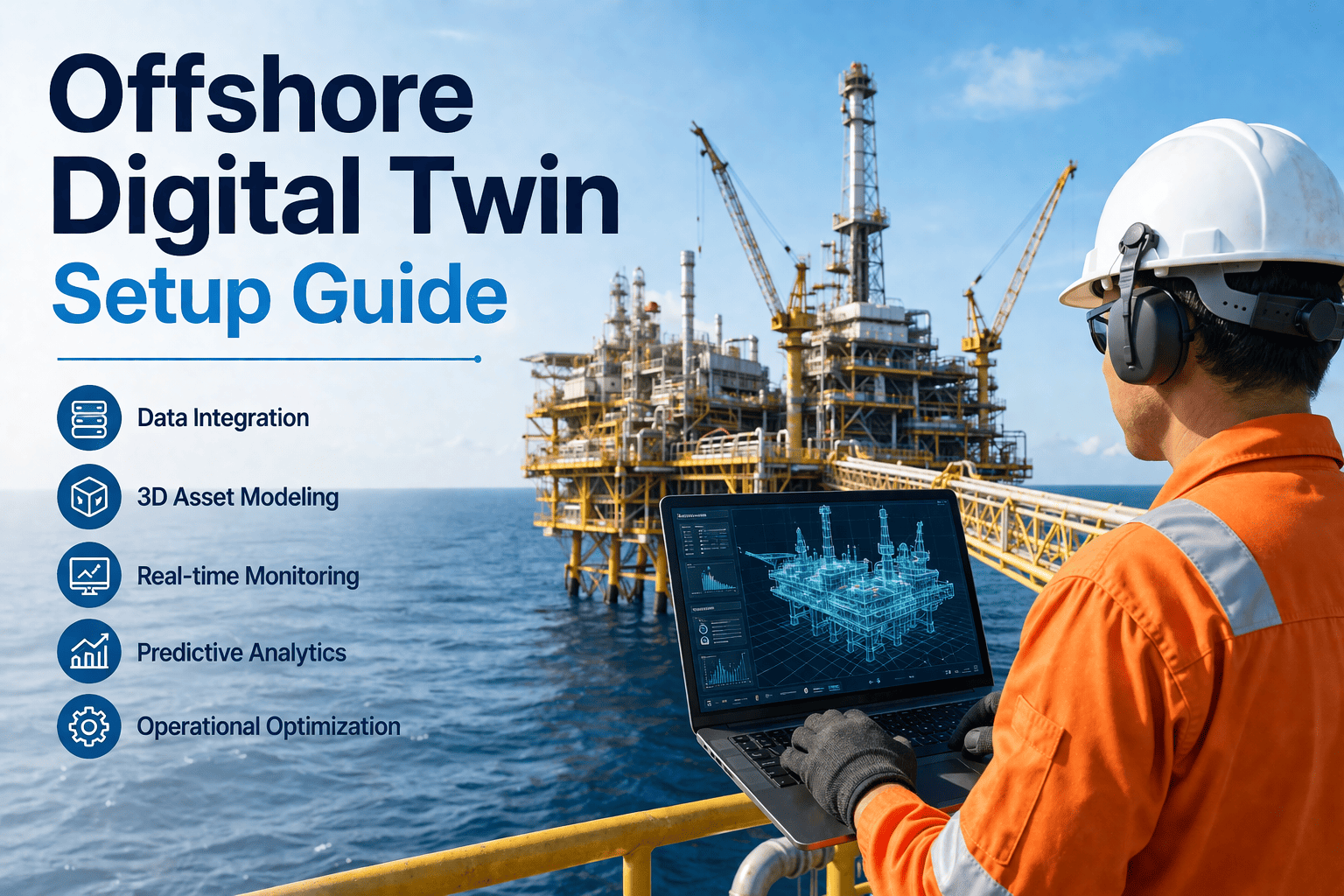
At Johan Sverdrup, platform operators conduct their daily rounds using tablets connected to a live digital twin of the platform — a virtual replica synchronized to real-time sensor data. Rather than recording observations on paper clipboards and transcribing them later, field workers log data directly into the digital system, which automatically cross-references readings against asset histories and maintenance schedules. The digital twin enables operators to test "what-if" scenarios — such as the effect of weather events or mechanical stress — before they occur in physical reality, reducing unplanned downtime through proactive operational adjustments.
AI Use Cases Compared: Norway Offshore vs. Traditional Offshore Operations
The performance gap between AI-enabled Norwegian offshore operations and conventional approaches is measurable across every major operational metric. Book a Demo to understand how iFactory closes this same gap for manufacturing facilities.
| Operational Area | Traditional Offshore Approach | AI-Enabled Norway Offshore (Equinor) | Measured Outcome |
|---|---|---|---|
| Rotating Equipment Maintenance | Calendar-based inspection rounds; reactive breakdown response | 24,000 sensors monitoring 700+ machines; AI predicts failures before occurrence | $120M value since 2020; reduced unplanned shutdowns |
| Seismic Data Interpretation | Manual geophysicist analysis; months per large dataset | AI tools processing 2M km² per year at 10x conventional speed | Tenfold capacity increase; faster exploration decisions |
| Well Planning | Engineers evaluate limited number of development scenarios | AI generates thousands of alternatives; specialists focus on optimal solutions | $12M saved at Johan Sverdrup phase 3 alone |
| Field Worker Data Collection | Paper rounds, clipboard logs, end-of-shift transcription | Tablet-based digital field workers; live connection to digital twin | Eliminated transcription lag; real-time data accuracy |
| Subsea Inspection | Scheduled dive support vessel deployments; high cost per inspection | Hydrone R autonomous underwater drone; 240-day continuous operation record | Substantially reduced inspection vessel mobilization costs |
What the Norway Model Reveals About Industrial AI Maturity
Norway's offshore AI results are not the product of one technology or one breakthrough deployment. They are the compounding result of a disciplined, multi-year investment in operational data infrastructure, workforce upskilling, and the systematic identification of use cases where AI delivers the highest production impact. Several structural factors explain why Norway has advanced further and faster than most competing offshore regions.
Sensor Density as a Foundation
Norway's platforms are among the most heavily instrumented industrial assets in the world. The 24,000 sensors Equinor operates across its rotating equipment fleet represent years of capital investment in data generation infrastructure. AI is only as effective as the quality and volume of data feeding it — which is why sensor deployment always precedes meaningful AI returns.
Regulatory Pressure as an Accelerant
Norway's Petroleum Safety Authority enforces strict requirements on equipment reliability, emissions reporting, and worker safety that effectively mandate condition-based monitoring approaches. Compliance requirements that would otherwise slow innovation have instead created organizational readiness for AI-driven maintenance systems, because the data frameworks those systems require were already in place.
A Risk-Based AI Governance Model
Equinor has explicitly adopted a risk-based approach to AI deployment, focusing on responsible use and including its workforce through structured upskilling programs. This governance model, which treats AI as an industrial tool requiring the same rigor as any other operational technology, has prevented the failed pilots and organizational resistance that have stalled AI adoption elsewhere.
100+ Identified Use Cases in the Pipeline
Equinor currently has over 100 additional AI use cases identified across its business, beyond those already in production. This pipeline signals that the $130 million 2025 result is not a ceiling but a baseline — and that the financial trajectory of AI returns is compounding, not plateauing, as the company's digital capabilities mature.
Equinor's AI savings have grown from roughly $40 million per year in the early years of deployment to $130 million in 2025. This acceleration illustrates a critical principle for any industrial organization evaluating AI investment: the returns are not linear. As data accumulates, models improve, and organizational AI capabilities deepen, each additional year of deployment generates disproportionately larger returns than the year before. The manufacturers and industrial operators who begin building AI-ready data infrastructure now will have a compounding advantage over those who delay. Book a Demo to start building that foundation with iFactory.
Applying Norway's Offshore AI Lessons to Manufacturing Operations
The principles behind Equinor's AI success are directly transferable to manufacturing facilities. The operational problems — reactive maintenance, manual data collection, fragmented asset visibility, and the inability to process large volumes of machine data in real time — are not unique to offshore oil platforms. They are the defining challenges of any large industrial facility operating complex equipment at high utilization rates.
"AI is a central part of our operations. Moving forward, AI will become even more important for solving industrial tasks safely, faster, more profitably, and at scale. With AI, we can analyse seismic data ten times faster, plan wells and field development in new and better ways and operate our facilities more efficiently." — Hege Skryseth, Executive VP for Technology, Digital & Innovation, Equinor
Expert Review: Evaluating Norway's Offshore AI Trajectory
Norway's offshore AI results deserve careful study by operations leaders in any capital-intensive industry, not because every facility can replicate Equinor's exact approach, but because the underlying pattern of success is consistent and learnable. Three elements stand out. First, Equinor's investment in sensor infrastructure — 24,000 sensors across 700+ machines — preceded its AI deployments, not the reverse. The data foundation came first, and AI was built on top of it. Second, every major AI initiative was tied to a specific, quantifiable financial outcome: $120 million from predictive maintenance, $12 million from a single well planning insight, $130 million in a single year. This financial accountability ensured continued organizational investment and prevented the stall that kills most AI programs. Third, the trajectory is compounding. The $130 million 2025 figure represents acceleration, not a plateau — a direct result of organizational AI capability deepening over five years of sustained deployment. For manufacturers evaluating industrial AI platforms, these three structural lessons — data first, financial accountability always, long-term commitment — are more important than any specific technology choice.
Conclusion: Norway's North Sea as a Blueprint for Industrial AI
The story of AI in Norway's offshore oil industry is ultimately a story about what industrial AI looks like when it works at scale. Equinor's $330 million in cumulative AI value since 2020, accelerating to $130 million in 2025 alone, is not the result of a single technology breakthrough. It is the result of five years of consistent investment in sensor infrastructure, data governance, workforce capability, and the patient accumulation of production-grade AI deployments across hundreds of operational use cases. For manufacturing and industrial operations professionals worldwide, this trajectory offers both a benchmark and a roadmap. The same principles — sensor-rich data foundations, condition-based maintenance, digital field worker tools, and AI-accelerated analysis — that are transforming Norway's North Sea platforms are equally applicable to steel mills, chemical plants, automotive facilities, and any other industrial environment where equipment reliability, operational visibility, and cost efficiency determine competitive position. The question is not whether AI delivers at industrial scale. Norway has answered that definitively. The question is when your facility begins building the infrastructure to capture those returns.
Frequently Asked Questions
How much has AI saved Equinor in Norway's offshore operations?
Equinor reported $130 million in AI-driven savings in 2025 and more than $330 million in cumulative value from AI in industrial processes since 2020.
What is the most impactful AI use case in Norway's offshore oil industry?
Predictive maintenance has been the highest-value application, with 24,000 sensors monitoring 700+ rotating machines delivering $120 million in value since 2020 by preventing unplanned shutdowns.
How does Equinor use AI for seismic interpretation?
Equinor's AI tools deliver a tenfold increase in seismic interpretation capacity; in 2025, approximately 2 million square kilometers of data were analyzed using these tools to support North Sea exploration.
What is the digital twin used for at Johan Sverdrup?
Johan Sverdrup's digital twin is a live virtual replica of the platform used by field workers on tablets for daily operations, enabling real-time data capture and "what-if" scenario modeling to reduce unplanned downtime.
Can manufacturing facilities outside oil and gas apply the same AI principles?
Yes — predictive maintenance, sensor-based condition monitoring, digital work orders, and AI Vision inspection are directly applicable to steel, automotive, chemical, and other industrial manufacturing environments.