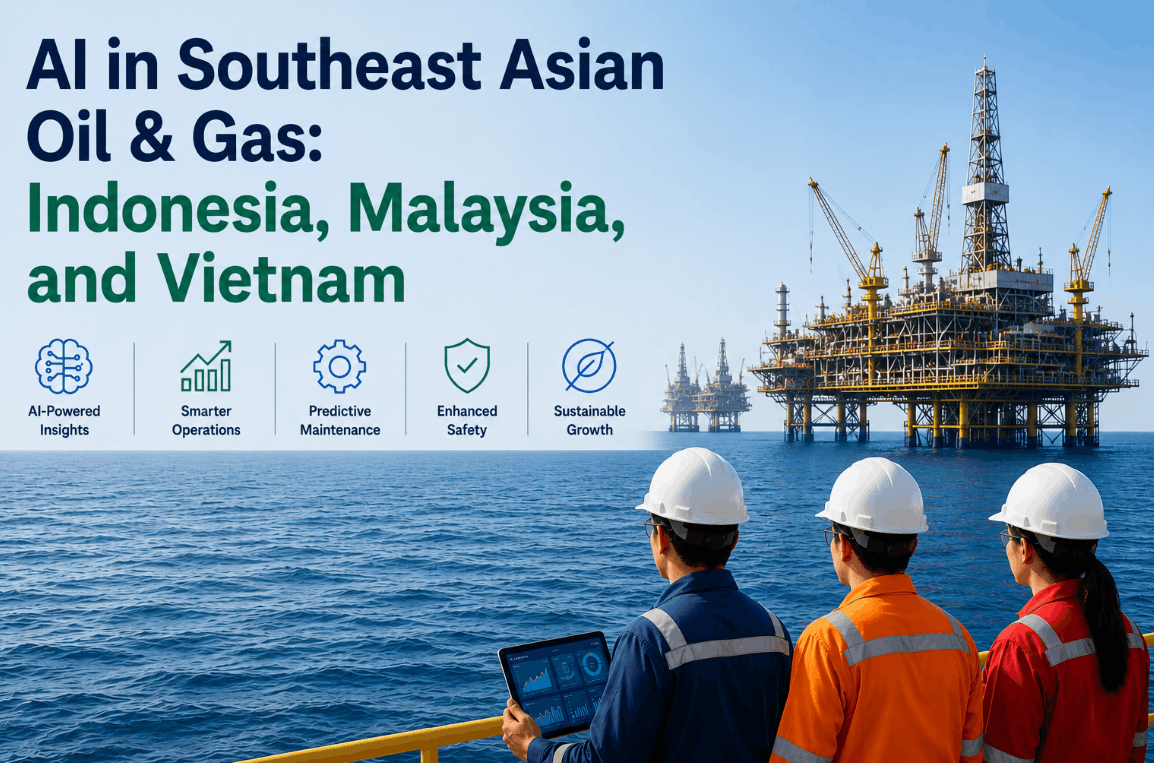
The oil and gas industries of Indonesia, Malaysia, and Vietnam are at an inflection point. As production from mature fields becomes costlier and global energy demand climbs, operators across Southeast Asia are turning to artificial intelligence not as an experiment — but as an operational necessity. From Pertamina's offshore platforms off Sumatra to PETRONAS's deepwater assets off Sabah, AI is now quietly running in the background of every major energy decision in the region. Maintenance engineers and asset managers who want to understand where this shift is heading can Book a Demo to see how AI-driven platforms are being deployed across Southeast Asian energy assets today.
AI-Driven Operations for Indonesia, Malaysia & Vietnam Energy Assets
iFactory's Mobile AI platform delivers real-time equipment health monitoring, predictive failure modeling, and operational analytics — purpose-built for upstream, midstream, and downstream energy facilities across Southeast Asia.
Why Southeast Asia Is the Next Frontier for AI in Oil & Gas
Southeast Asia's oil and gas sector contributes a combined output of more than 2.5 million barrels per day, with Indonesia, Malaysia, and Vietnam serving as the region's three largest producers. Yet decades of development have left many fields in a state of natural decline — recoverable reserves are shrinking, lifting costs are rising, and the pressure to do more with aging infrastructure has never been higher. Against this backdrop, AI adoption in the region's energy sector has moved from boardroom strategy to active field deployment. Operators are deploying machine learning for reservoir characterization, computer vision for pipeline inspection, and digital twins for real-time facility simulation. Those who want to see how these tools apply to their specific operational environment are increasingly choosing to Book a Demo before committing to a full platform evaluation.
The urgency is not purely financial. Environmental compliance obligations are tightening across the region, workforce demographics are shifting, and government-linked national oil companies face political pressure to maximize production yield from every licensed block. AI offers a path to all three goals simultaneously — higher recovery, lower operational emissions, and reduced reliance on manual inspection cycles that are expensive and inconsistent in offshore environments.
Indonesia
Pertamina's INOVASI AI platform spans upstream through refinery. AI-assisted asset inspection and drone-based monitoring are active on offshore Sumatra platforms.
Malaysia
PETRONAS runs one of Asia's most advanced predictive analytics programs, with AI-driven maintenance forecasting reducing unplanned downtime across LNG and deepwater assets.
Vietnam
PetroVietnam and regional tech firms are deploying AI for reservoir modeling and production optimization, supported by Vietnam's national AI economic integration strategy.
Regional Momentum
Southeast Asia's AI sector was valued above $4 billion in 2024 and is projected to grow fourfold by 2033. Energy is a primary vertical attracting investment and deployment.
Indonesia: Pertamina's AI-Driven Energy Transformation
Indonesia is Southeast Asia's largest oil producer, with Pertamina processing roughly 1.6 million barrels per day across refineries in Cilacap, Balikpapan, and Dumai. Following an organizational restructuring in early 2025, Pertamina centralized its AI operations through a new Digital Hub spanning all six of its major sub-holdings — upstream, gas, commercial trading, renewables, refinery, and shipping. The INOVASI platform, which earned the Data and AI category at the 2024 Enterprise Innovation Awards, now coordinates AI-driven analytics across this entire value chain. Maintenance professionals evaluating similar consolidated digital approaches can Book a Demo with iFactory to see how a mobile-first AI platform scales across multi-site operations.
On the offshore side, FPT Corporation signed a landmark agreement with Pertamina to deploy AI technologies specifically for asset inspection and workplace safety on Pertamina Hulu Energi's offshore Southeast Sumatra platforms. The deployment uses drone-collected sensor data analyzed by AI models to identify equipment degradation before it results in production loss or safety incidents — a significant step forward from traditional walk-down inspection schedules that are both labor-intensive and cycle-limited in an offshore environment.
Amazon Web Services launched its Asia Pacific Jakarta Region with a $5 billion commitment, establishing cloud infrastructure critical to Pertamina's digital programs.
Pertamina's INOVASI AI platform wins the Data and AI category at the Enterprise Innovation Awards, validating its centralized remote surveillance and command center model.
FPT Corporation formally partners with Pertamina to deploy AI-driven asset inspection using drone data analysis on offshore Southeast Sumatra platforms, targeting both reliability and safety.
Pertamina restructures into a unified Digital Hub. AI programs spanning all six sub-holdings are now coordinated through a single data and analytics architecture.
Malaysia: PETRONAS and the Predictive Analytics Benchmark
PETRONAS stands as one of the most advanced practitioners of predictive analytics in Asia's oil and gas sector. The company's Pengerang Integrated Complex pairs 300,000 barrels per day of refining capacity with 3.3 million tons of petrochemical throughput — a scale of operation where even marginal improvements in equipment uptime translate directly to hundreds of millions in recovered revenue. PETRONAS's AI-driven maintenance forecasting program provides not just early warning alerts but precise time-to-failure estimates and specific maintenance action guidance, allowing the company to plan interventions at optimal scheduled windows rather than reacting to sudden breakdowns.
Malaysia's national policy environment has also accelerated adoption. The government established the National AI Office (NAIO) in 2024 to draft responsible AI integration frameworks across industries. Microsoft committed $2.2 billion to AI and digital infrastructure in Malaysia, and Google launched the country's first cloud region the same year — collectively giving energy operators access to enterprise-grade AI infrastructure that did not exist at this scale in the country two years prior. For manufacturing and energy operations managers looking to align their own reliability programs with this level of AI maturity, iFactory's platform offers a direct pathway — teams often begin by choosing to Book a Demo to assess their current sensor and SCADA infrastructure against predictive readiness requirements.
Vietnam: Rising AI Adoption in a State-Directed Energy Model
Vietnam's oil and gas sector is tightly integrated with PetroVietnam, the state-owned national oil company that controls exploration, production, and downstream refining. Unlike Malaysia and Indonesia, where AI adoption has been primarily enterprise-led, Vietnam's energy AI strategy is government-directed at its core. Vietnam unveiled plans in 2024 to integrate AI into its national economic strategy, and NVIDIA formalized a partnership with the Vietnamese government to build AI research facilities and data centers — a move that positions Vietnam as an emerging AI infrastructure hub rather than merely an adopter of externally built tools.
On the cross-border collaboration front, PETRONAS and PetroVietnam extended their upstream arrangements for the PM3 CAA concession overlapping waters offshore Malaysia and Vietnam by a further 20 years in 2025, indicating long-term alignment between the two national operators. As this shared asset matures, the case for shared AI-driven predictive maintenance frameworks across joint production platforms becomes increasingly compelling. Vietnam-based technology firms, led by FPT Corporation, are themselves becoming AI exporters — FPT's $30 million multi-year industrial AI transformation agreement with a major Southeast Asian manufacturing conglomerate in 2025 demonstrates that Vietnam is building transferable AI capability, not just importing it for domestic use.
| AI Use Case | Indonesia (Pertamina) | Malaysia (PETRONAS) | Vietnam (PetroVietnam) |
|---|---|---|---|
| Predictive Maintenance | Active — drone-based asset inspection on offshore platforms | Advanced — AI forecasts time-to-failure with action guidance | Developing — supported by FPT and national AI strategy |
| Reservoir Analytics | Via INOVASI platform upstream sub-holding | Integrated into digital twin simulations | Being piloted via national research partnerships |
| Refinery Optimization | Cilacap, Balikpapan, Dumai — hydrocracker AI integration | Pengerang Complex — AI-driven throughput optimization | Dung Quat and Nghi Son refineries — early-stage digital control |
| Safety & Inspection | Drone + AI computer vision on PHE OSES offshore | Automated anomaly detection on LNG assets | Transitioning from manual to sensor-integrated monitoring |
| Government AI Policy | AI regulations targeting Q2 2025, $1.7B Microsoft commitment | National AI Office (NAIO) established 2024 | AI integrated into national economic strategy 2024 |
How iFactory AI Supports Oil & Gas Operations Across Southeast Asia
Most Southeast Asian oil and gas operators are navigating a critical gap: they have aging SCADA and PLC systems that generate enormous amounts of operational data, but lack the AI layer needed to convert that data into actionable maintenance intelligence. iFactory's mobile-first AI platform bridges this gap without requiring a full infrastructure overhaul. It integrates with existing industrial protocols — OPC-UA, Modbus, 4-20mA — and delivers real-time equipment health scores, anomaly detection, and predictive failure alerts directly to field technicians through a mobile app. Reliability teams across the region building these capabilities frequently begin the process by scheduling a session to Book a Demo to map their existing sensor architecture against deployment requirements.
Connect Existing Sensors
iFactory integrates with your current SCADA, PLCs, and field sensors via standard industrial protocols. No hardware rip-and-replace required for most upstream or refinery environments.
AI Anomaly Baseline
The platform establishes normal operating signatures for each asset — compressors, pumps, heat exchangers, valve actuators — then monitors continuously for deviations that signal early degradation.
Predictive Work Orders
When the AI detects a high-probability failure trajectory, it automatically generates work order recommendations and integrates with your existing CMMS to schedule intervention at the optimal maintenance window.
Mobile Field Execution
Technicians receive geo-tagged alerts on the iFactory mobile app with asset-specific health scores and step-level corrective actions — no matter whether they are on an onshore refinery or an offshore production platform.
"The gap between Southeast Asian oil and gas operations and leading AI deployments elsewhere is closing faster than most people expect. What used to take a North Sea operator a decade to implement, a Pertamina or PETRONAS sub-holding is now doing in 18 to 24 months. The combination of maturing cloud infrastructure, available regional AI talent, and increasing pressure on aging field assets has created a genuine urgency. The operators that will lead in the next decade are the ones that treat predictive asset intelligence as a core operational competency — not a technology pilot."
The Path Forward for AI in Southeast Asian Oil & Gas
Indonesia, Malaysia, and Vietnam are not simply adopting AI as a technology trend — they are deploying it as a structural answer to the fundamental challenge facing every mature oil and gas market: producing more from assets that are getting older, in environments that are getting more complex, while costs must come down. The investments being made by Pertamina, PETRONAS, and their technology partners in 2024 and 2025 represent a genuine shift in how these national operators think about operational intelligence.
For independent operators, mid-tier refiners, and facility managers across the region who cannot yet match the scale of these national programs, the practical entry point is a purpose-built industrial AI platform that connects to existing infrastructure and delivers measurable value quickly. iFactory is built precisely for this segment — providing the AI-driven predictive maintenance, equipment health monitoring, and mobile field intelligence that defines the regional benchmark, at a deployment scale that works for individual facilities and multi-site operators alike. To understand how this applies to your specific operation, the clearest next step is to Book a Demo and work through a site-specific readiness assessment with the iFactory engineering team.
AI in Southeast Asia Oil & Gas — Frequently Asked Questions
How is AI being used in Indonesia's oil and gas sector?
Pertamina is leading deployment through its INOVASI platform and a 2025 partnership with FPT Corporation, using AI for offshore asset inspection, drone-based monitoring, and centralized predictive maintenance across its six operational sub-holdings.
What makes PETRONAS's predictive analytics program significant?
PETRONAS goes beyond simple early-warning alerts — its AI models forecast the precise time to equipment failure and recommend the most efficient corrective action, enabling planned rather than reactive maintenance at large-scale LNG and deepwater assets.
Is Vietnam investing in AI for its energy sector?
Yes — Vietnam integrated AI into its national economic strategy in 2024, partnered with NVIDIA to build AI infrastructure, and domestic firms like FPT are deploying AI tools across industrial and energy operations both within Vietnam and regionally.
Can AI platforms like iFactory integrate with existing Southeast Asian oil and gas infrastructure?
Yes. iFactory connects via OPC-UA, Modbus, and 4-20mA protocols to existing SCADA and PLC systems, eliminating the need for full infrastructure replacement while delivering real-time AI-driven health monitoring and predictive alerts.
What ROI can an oil and gas facility expect from an AI predictive maintenance deployment?
Most facilities reach positive ROI within 8 to 12 months, primarily driven by preventing a single major unplanned production stoppage and extending the working life of high-cost rotating equipment like compressors and pumps.
Deploy AI-Driven Operations Across Your Southeast Asia Energy Assets
iFactory's Mobile AI platform delivers real-time equipment health scores, predictive failure alerts, and CMMS-integrated work order automation — built for operators in Indonesia, Malaysia, Vietnam, and across the region.