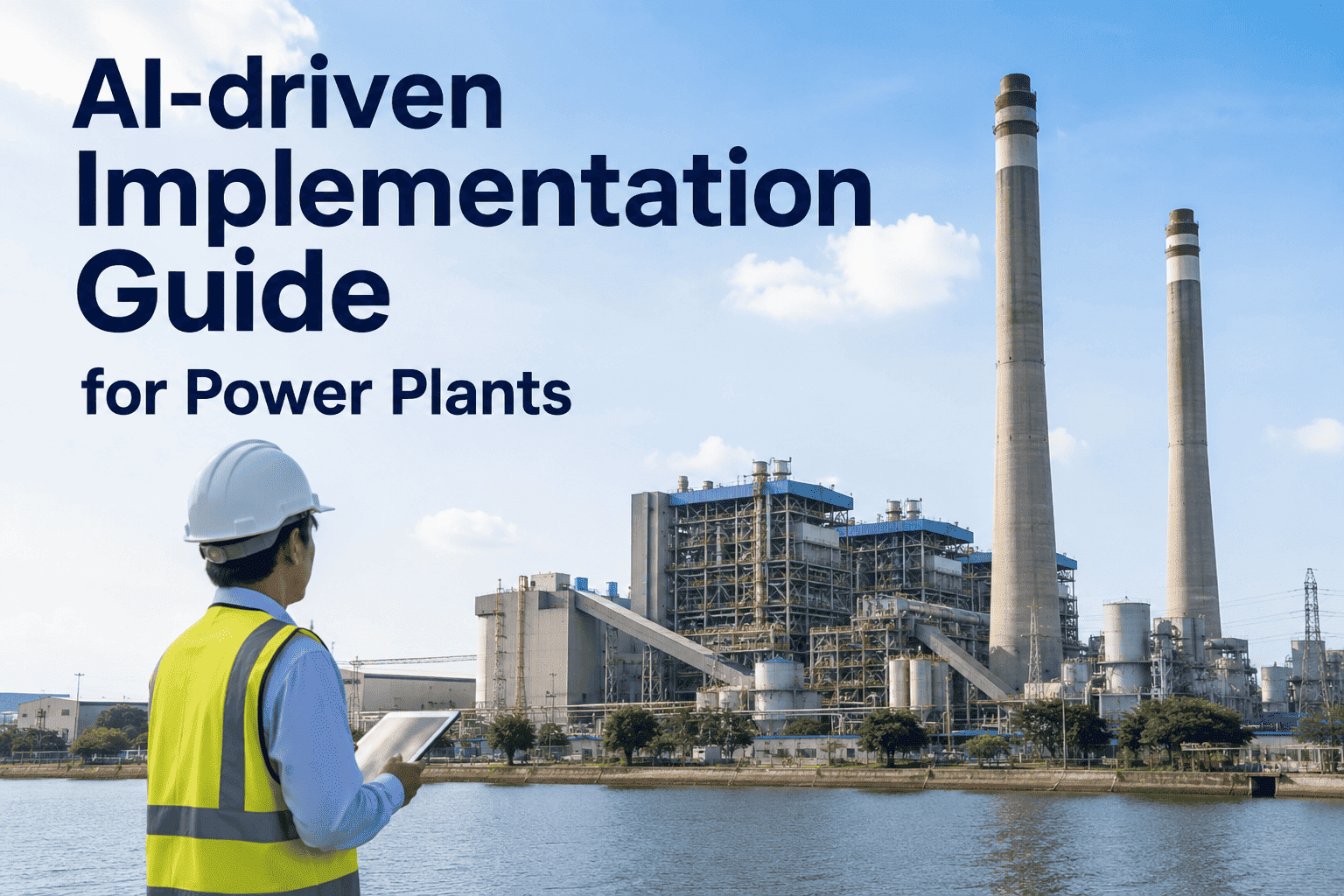
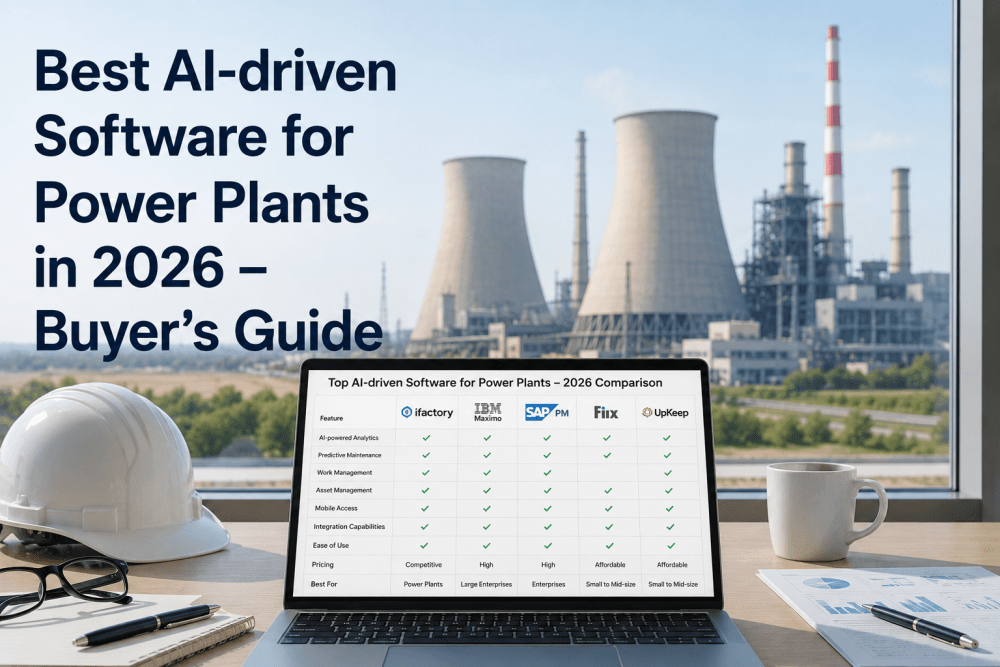
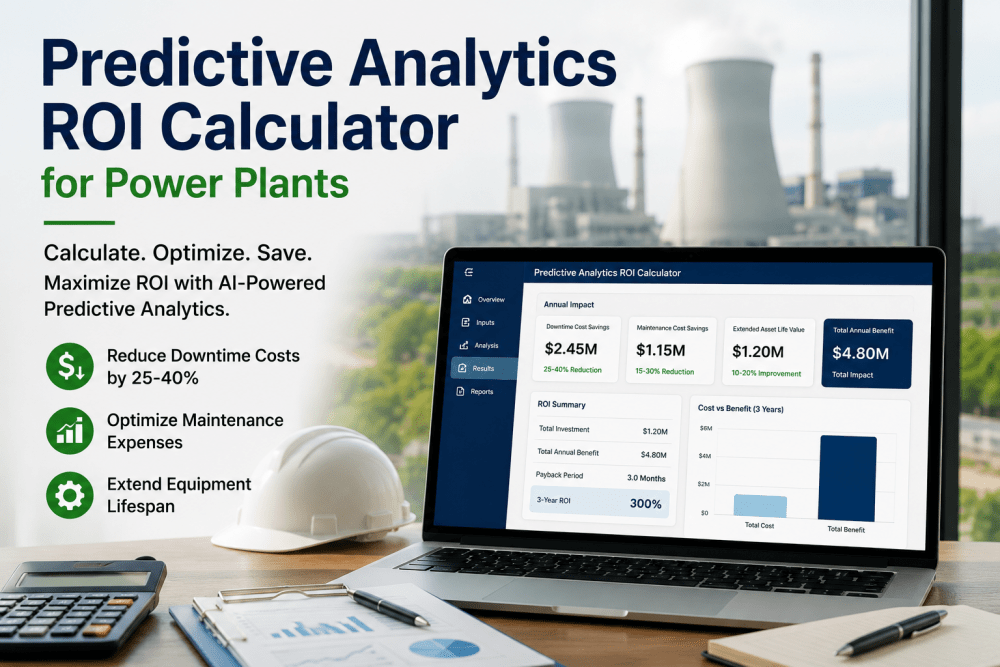
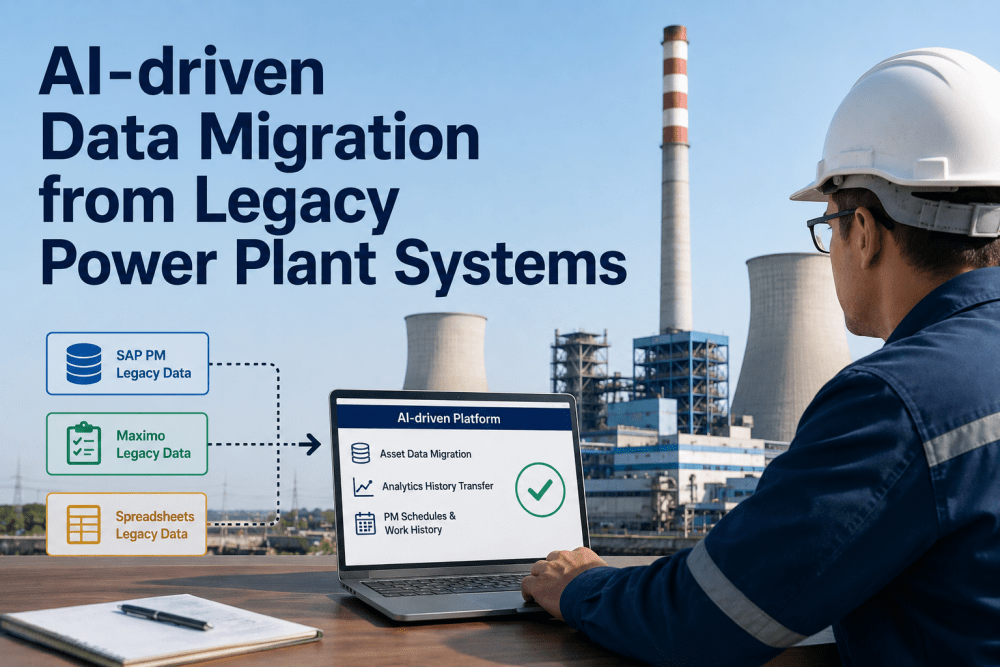
Implementing AI-driven analytics in a power plant is not a software installation — it is an operational transformation. Done wrong, it disrupts shift routines, creates data silos, and earns a reputation as "another system nobody uses." Done right, it becomes the operating backbone that maintenance, reliability, and operations teams depend on every day .This guide walks U.S. manufacturing and energy professionals through every phase of a proven AI-driven implementation process — from initial asset data migration to full technician adoption — without disrupting a single shift.
Power Plant AI Implementation · 2026
AI-Driven Implementation Guide for Power Plants
A step-by-step operational playbook — from data migration to full deployment — built for U.S. plant professionals
68%
of AI rollouts fail due to poor data migration
12 wks
Avg. time to full operational deployment
$240K
Avg. first-year savings per 100 MW plant
91%
Technician adoption rate with structured onboarding
Want a site-specific implementation plan for your plant? Book a technical walkthrough with iFactory's power plant team.
Why Most AI Implementations Stall Before Go-Live
The statistics are consistent across the industry: most AI-driven analytics projects in power generation either fail outright or underperform against projections. The root causes are rarely the technology itself. They are process failures — specifically, rushing past the data readiness and stakeholder alignment phases to get to the "AI part" faster.
68%
Fail due to incomplete or unclean asset data
54%
Stall during IT/OT integration without a defined protocol
47%
Abandoned within 6 months due to low technician adoption
39%
Produce inaccurate AI outputs from insufficient model training data
The implementation process outlined in this guide is sequenced specifically to eliminate each of these failure modes before they occur. Each phase has defined entry criteria, outputs, and validation checkpoints. Skipping or compressing any phase — particularly the data audit and pilot validation — consistently produces the outcomes listed above.
Phase-by-Phase Implementation Roadmap
A complete AI-driven implementation for a power plant runs across six sequential phases spanning approximately 10–14 weeks depending on plant size and data readiness. The timeline below reflects a standard 100–500 MW generating facility. Larger portfolios or multi-site rollouts extend the pilot and rollout phases proportionally.
Weeks 1–2
Phase 01
Asset Data Audit & Readiness Scoring
Pull the full asset register from your CMMS (Maximo, SAP PM, or similar). Score each asset class for data completeness: sensor coverage, historical failure records, maintenance logs, and nameplate data. Assets with fewer than 18 months of clean sensor history require supplemental data strategies before AI model training begins.
CMMS ExportSensor Gap AnalysisData Quality Score
Output: Asset readiness scorecard with data gap remediation plan
Weeks 3–4
Phase 02
IT/OT Integration & Data Pipeline Build
Establish the secure data pathway between your OT environment (DCS, SCADA, historian) and the AI platform. This requires coordination between plant IT, OT, and the vendor's integration team. Define read-only OPC-UA or Modbus connections, set historian polling intervals, and validate data fidelity before any AI training begins.
Output: Live data pipeline with validated fidelity report
Weeks 4–6
Phase 03
AI Model Training on Site-Specific Data
Generic AI models trained on industry-wide datasets underperform on site-specific equipment. Your plant's turbines, boilers, or inverters have failure signatures unique to their operating environment, load profile, and maintenance history. Site-specific training on your historian data — validated against known failure events — is the step that separates 70% accuracy from 94% accuracy in fault detection.
Output: Validated AI model package per asset class (>90% accuracy threshold)
Weeks 7–8
Phase 04
Pilot Deployment on Priority Asset Group
Deploy on a single critical asset group — one turbine string, one boiler train, one inverter block. Run parallel operations: existing processes continue unchanged while the AI platform monitors alongside. Compare AI alerts against actual maintenance findings over a 3–4 week window. This pilot phase de-risks the full rollout and builds technician trust before scaling.
Output: Pilot performance report with alert precision/recall metrics
Weeks 9–11
Phase 05
Full Plant Rollout & Workflow Integration
Expand deployment across all asset classes. Integrate AI-generated alerts directly into existing work order workflows — the AI does not replace the CMMS, it feeds it. Configure alert routing: which fault types auto-generate work orders, which require supervisor approval, which go to operations for monitoring only. Workflow mapping at this stage drives adoption.
Output: Full plant live on AI platform with integrated work order flow
Weeks 11–12
Phase 06
Technician Training & Adoption Acceleration
Training is not a one-day event. The highest-adoption implementations run a structured three-week program: classroom orientation in Week 1, supervised field use in Week 2, and independent operation with feedback loops in Week 3. Train on real plant data — not generic demos. The fastest path to adoption is showing technicians an alert they would have missed, on their own equipment, in the first session.
Output: Fully operational plant with >85% technician adoption rate
iFactory's implementation team manages every phase of this process end-to-end. Book a technical walkthrough to see how the rollout fits your plant's schedule.
Asset Data Migration: The Make-or-Break Phase
Data migration is the phase most teams underestimate and most vendors underexplain. Getting it wrong produces AI models that generate false positives, miss real faults, and erode technician trust within the first month. The following checklist defines what a complete, production-ready data migration looks like for a power plant AI implementation.
Migration Task
Acceptance Criteria
Common Failure Mode
Asset Register Export
100% of critical assets tagged with equipment class, manufacturer, install date, and nameplate specs
Incomplete tags force manual enrichment — adds 2–3 weeks to training phase
Historian Data Pull
Minimum 24 months of sensor data at native resolution; no gaps exceeding 72 hours
Downsampled or compressed historian exports reduce AI training accuracy by 15–30%
Failure Event Labeling
All P1/P2 corrective work orders mapped to timestamped sensor events for supervised training
Unlabeled failures produce models that cannot distinguish anomaly from failure — generates false positives
Maintenance Log Migration
3+ years of PM and corrective records migrated with asset tag, technician, parts used, and labor hours
Missing labor data prevents ROI tracking and work order optimization modeling
Parts & BOM Data
Bill of materials loaded for all Tier 1 assets; part numbers linked to vendor lead times
Missing BOM prevents AI from generating actionable parts pre-order recommendations
Compliance Records
NERC CIP, EPA, and OSHA inspection records loaded with inspection type, date, and finding codes
Missing compliance baseline prevents automated regulatory report generation at go-live
IT/OT Integration Without Disrupting Operations
Connecting an AI platform to a power plant's operational technology environment is the step most likely to create friction between IT security teams and operations. The following framework defines the integration approach that satisfies both cybersecurity requirements and operational continuity constraints.
01
Read-Only OT Access Only
AI platforms require read access to sensor data — never write access to control systems. Enforce this at the network architecture level, not just the software configuration level. A unidirectional data diode between OT and the AI platform is the gold standard for NERC CIP compliance.
Security Principle
02
Historian as the Integration Point
Connect the AI platform to the process historian — not directly to the DCS or PLC. The historian already aggregates sensor data and provides a controlled, buffered interface. OSIsoft PI, Honeywell Uniformance, and GE Proficy connectors are pre-built in most enterprise AI platforms.
Architecture Pattern
03
Phased Network Segmentation
Do not attempt to connect all OT zones simultaneously. Start with the Historian DMZ, validate data fidelity and security posture, then expand to secondary sensor networks. Each zone expansion requires a signed network change record and a 48-hour observation window before the next zone is connected.
Operational Safety
04
Latency Tolerance by Use Case
Not all AI use cases require real-time data. Fault detection for rotating equipment requires sub-60-second latency. Predictive maintenance scheduling tolerates 15-minute intervals. Compliance reporting works on hourly batch pulls. Right-sizing data polling frequency reduces OT network load and historian licensing costs.
Performance Design
Planning an IT/OT Integration for Your Plant?
iFactory's integration team has executed OT connections at coal, gas, wind, solar, and hydro facilities across the U.S. — including NERC CIP-regulated environments. Get a site-specific integration architecture review before your implementation begins.
The most technically sophisticated AI implementation fails if the people working with it every day do not trust it, understand it, or find it faster than their existing workflow. Technician training is not a checkbox — it is the primary ROI driver. The following comparison shows what structured adoption programs deliver versus standard one-day onboarding sessions.
Standard One-Day Onboarding
Structured 3-Week Adoption Program
Adoption Rate at 90 Days
34%
91%
Time to Independent Field Use
6–8 weeks
2–3 weeks
False Alert Dismissal Rate
61% dismissed without investigation
12% dismissed without investigation
Work Order Completion in System
44% completed in-system at 60 days
97% completed in-system at 60 days
Supervisor Confidence in AI Output
Low — manual override common
High — AI alerts actioned same shift
First-Year ROI Achievement
Below projection in 71% of deployments
At or above projection in 88% of deployments
The 3-Week Adoption Program: Structure
Week 1
Classroom & System Orientation
Dashboard navigation, alert interpretation, work order workflow, and role-based feature access — using live plant data from the pilot deployment
Week 2
Supervised Field Operation
Technicians respond to live AI alerts with a trainer present. Each alert response is reviewed for accuracy, documentation quality, and time-to-action. Feedback is specific and immediate
Week 3
Independent Operation + Review
Full independent use with a weekly supervisor review of alert response quality. Misclassified alerts are reviewed in group sessions. Confidence and accuracy accelerate in this phase
Expert Review
Diana R., Plant Manager
480 MW Combined Cycle Gas Plant, Southwest Region
"We had tried two AI platforms before iFactory — both failed at the data integration phase. The lesson we learned is that the implementation process is the product. iFactory spent three weeks on our historian data before writing a single line of model code. They flagged sensor gaps we did not know existed and told us we needed 90 more days of data on two of our gas turbines before they could meet their accuracy guarantee. That honesty was unusual and it turned out to be the reason the deployment worked. By month four, our technicians were using the platform on every shift without prompting. We have not had an unplanned outage on our GT-1 or GT-2 units in 14 months. The process matters more than the software."
14 mo
Zero Unplanned GT Outages
100%
Technician Adoption Rate
$410K
Avoided Failure Costs Year 1
Frequently Asked Questions
A full implementation — from data audit to technician go-live — typically runs 10–14 weeks for a single-site, 100–500 MW facility. The most variable phases are data audit (depends on CMMS completeness) and AI model training (depends on historical data volume and quality). Multi-site rollouts add 4–6 weeks per additional site once the first site is validated. Attempting to compress below 10 weeks consistently produces low AI accuracy and poor adoption outcomes.
No. AI-driven platforms are designed to integrate with — not replace — your existing CMMS. Platforms like iFactory connect to SAP PM, IBM Maximo, Infor EAM, and other major CMMS solutions via standard APIs. The AI layer sits above your CMMS, enriching it with predictive alerts and auto-generating work orders based on fault detection outputs. Your existing work order history, asset records, and technician workflows remain intact and become training data for the AI models.
The practical minimum for a supervised fault detection model is 18 months of clean sensor data with at least 5–8 labeled failure events per asset class. Models trained on less data can be deployed, but they require industry-baseline priors from the vendor's training library and typically produce higher false positive rates (15–25% higher) until site-specific data accumulates. Plants with less than 12 months of clean data should plan for a 90-day parallel-running period before relying on AI alerts for maintenance decisions.
NERC CIP compliance during OT integration requires that all new network connections involving BES Cyber Systems are documented in your ESP (Electronic Security Perimeter) change log and reviewed against CIP-005 and CIP-007 requirements before activation. The AI platform should be classified as an External Routable Connectivity (ERC) point and subject to access monitoring. Read-only unidirectional data flows via a data historian DMZ are the most compliant architecture — they satisfy CIP-005 R2 requirements without requiring a full CIP-compliant system classification for the AI platform itself.
First-year ROI at power plants varies significantly by asset criticality and baseline maintenance maturity. Plants with high-value rotating equipment (gas turbines, steam turbines, large compressors) typically see the fastest payback — a single avoided major failure can return 3–8x the annual platform cost. Plants with mature PM programs see smaller avoided-failure gains but strong labor efficiency and compliance savings. The median first-year ROI across iFactory's power generation deployments is $240K per 100 MW of installed capacity, with positive ROI achieved between months 6 and 14 depending on plant type and data readiness at go-live.
Conclusion: The Implementation Is the Investment
AI-driven analytics in power generation delivers measurable, sustained returns — but only when the implementation process is treated with the same rigor applied to the technology itself. The plants that achieve fault detection accuracy above 90%, technician adoption above 85%, and positive ROI within 12 months share a common characteristic: they did not rush the data audit, pilot, or training phases.
The roadmap outlined in this guide — six phases, 10–14 weeks, with defined entry criteria and validation outputs at each step — reflects what successful deployments actually look like in U.S. power generation environments. The technology is ready. The question for every operations leader is whether the implementation process is equally ready.
Ready to Start Your AI Implementation?
Get a site-specific implementation assessment — including a data readiness score, integration architecture review, and estimated timeline — based on your plant type and current system environment.