Complete Power Plant Maintenance Audit Checklist: Thermal, Hydro, and Nuclear
By shreen on March 10, 2026
Power plant maintenance audits are the single most effective tool for preventing catastrophic forced outages — yet over 60% of thermal, hydro, and nuclear facilities still rely on fragmented, paper-based audit processes that miss critical degradation patterns across turbine, boiler, and generator systems. A comprehensive audit program, integrated with AI-powered CMMS, can cut unplanned downtime by 40% and extend asset life by decades. This guide provides the complete maintenance audit framework for thermal, hydro, and nuclear plants — covering every critical system, the inspection parameters that matter, and the workflows that turn audit findings into preventive action. Book a free 30-minute audit strategy session to see how iFactory connects audit data directly to maintenance execution across your entire generation fleet.
The Audit Gap in Power Generation
Why Structured Maintenance Audits Are Non-Negotiable in 2026
$2.8M
Average cost of a single 14-day forced outage at a 500MW thermal unit
77%
Of mechanical forced outages caused by just three systems — turbines, boilers, and generators
43%
Of forced outages are preventable with proper condition monitoring and audit cycles
10:1
Average return on investment from predictive maintenance audit programs
Why This Matters Now
NERC reliability data confirms that forced outage rates for conventional generation remain at historically elevated levels. Coal plant WEFOR now averages 10–12%, aging infrastructure is accelerating component fatigue, and cycling operations are compounding thermal stress. A structured maintenance audit is not bureaucratic overhead — it is the difference between a $5,000 planned repair and a $1.2 million emergency shutdown. Plants running iFactory's AI-powered audit workflow detect degradation patterns 30–60 days before failure, converting emergency events into scheduled maintenance windows.
Boiler tube failures account for 52% of all forced outages at thermal plants. A thorough boiler audit covers waterwall tube thickness mapping via ultrasonic testing, superheater and reheater tube condition assessment, economizer fin and tube integrity checks, soot blower alignment and performance verification, and refractory lining inspection for erosion and spalling. Every finding must be severity-graded, geo-tagged to the boiler section, and linked directly to a maintenance work order. Plants using AI-integrated CMMS report catching tube wall thinning 45 days before failure threshold — saving an average of $280,000 per avoided emergency shutdown.
52% of all forced outagesCreep and fatigue damageThermal cycling stress
Turbine and Generator Systems
Steam Turbine and Generator Audit
Turbines and generators together account for 25% of mechanical forced outages. The audit scope includes blade erosion and fatigue crack detection via borescope inspection, bearing condition analysis through vibration spectrum monitoring, rotor alignment and balance verification, generator winding insulation resistance testing (polarization index), and hydrogen seal integrity assessment. Continuous vibration monitoring integrated with your CMMS creates a living audit record — each data point updates the asset health score, and trending analysis flags deviations months before manual inspection would detect them.
Vibration trending catches early defectsAutomated severity scoringWork order auto-generation
Thermal Plant — Balance of Plant Audit
Critical Auxiliary Systems That Cannot Be Overlooked
Balance of plant systems cause 15% of forced outages. These components are often under-audited because they lack the visibility of primary generation assets — but a single pump or valve failure can cascade into a full unit trip.
Feedwater and Condensate
Inspect feedwater pump bearings, condensate polisher resin condition, heater drain valve operation, and deaerator vent system performance. Monitor pump vibration continuously to detect cavitation and seal degradation before costly failures develop.
Pump and Valve Integrity
Fuel Handling and Combustion
Audit coal conveyor belt condition and alignment, pulverizer classifier wear, burner nozzle erosion, and gas supply pressure regulation systems. For gas-fired plants, inspect combustion turbine compressor blade health and combustion liner cracking.
Combustion Efficiency
Cooling Water Systems
Check condenser tube fouling and leak detection, cooling tower fill condition, circulating water pump performance curves, and chemical treatment effectiveness. Condenser performance degradation directly impacts heat rate and unit efficiency.
Heat Rate Impact
Emissions and Environmental
Audit SCR catalyst activity levels, ESP plate condition and rapping system function, FGD absorber spray nozzle wear, and CEMS calibration records. Environmental compliance failures carry penalties that can exceed $100,000 per incident.
Regulatory Compliance
Thermal Plant Audit Automation
See How iFactory Converts Audit Findings Into Work Orders in Real Time
In a 30-minute demo, we walk through the full audit-to-action workflow: sensor data ingestion, anomaly scoring, severity grading, and automated work order generation — using real thermal plant data. Every audit finding becomes a tracked maintenance action with zero manual data entry.
Hydro Plant Maintenance Audit — Civil, Mechanical, and Electrical
Hydroelectric plants present unique audit challenges: submerged infrastructure, massive civil structures, long asset lifecycles exceeding 80 years, and seasonal operational variability. A comprehensive hydro audit must cover dam safety, water conveyance, turbine-generator condition, and environmental compliance simultaneously.
01
Dam and Civil Structures
Inspect dam face for cracking, seepage, and displacement. Monitor piezometer readings for uplift pressure, perform spillway gate operational tests under load, and verify penstock liner thickness via ultrasonic measurement. Seismic instrumentation calibration must be confirmed annually. FERC Part 12D compliance requires documented evidence of all civil structure inspections.
FERC Compliance Critical
02
Turbine and Wicket Gate Assessment
Audit Francis, Kaplan, or Pelton runner condition for cavitation erosion, leading edge pitting, and fatigue cracking. Wicket gate bushing wear and stem seal leakage must be measured and compared against manufacturer tolerances. Draft tube liner condition and stay vane crack inspection round out the hydraulic path assessment. Cavitation damage left unchecked can reduce turbine efficiency by 3–5% and eventually require full runner replacement costing $2–5 million.
Efficiency and Longevity
03
Generator and Electrical Systems
Perform stator winding insulation resistance and partial discharge testing, rotor pole and damper bar inspection, thrust bearing and guide bearing condition analysis, excitation system performance verification, and governor control system response testing. Hydro generators often operate for 40–60 years, making progressive degradation monitoring essential. Integrate partial discharge trending into your CMMS for continuous health scoring.
Long-Lifecycle Assets
04
Water Conveyance and Gates
Audit intake trash rack integrity, headgate and tailrace gate operation, penstock expansion joint condition, and surge tank level instrumentation accuracy. Sediment management systems including desanders and sluice gates must be tested for operational readiness. Many hydro forced outages originate from gate failures and debris blockage — systems that are often audited less frequently than rotating equipment.
Often Overlooked
Audit Frequency Matrix: Thermal vs. Hydro vs. Nuclear
Recommended audit intervals vary significantly across plant types based on regulatory requirements, component degradation rates, and operational profiles. This matrix reflects industry best practice and regulatory minimums.
Recommended Audit Intervals by Plant Type
Audit Domain
Thermal (Coal/Gas)
Hydroelectric
Nuclear
Primary Rotating Equipment
Every major outage + continuous vibration
Annual + continuous vibration
Continuous + refueling outage
Boiler / Reactor Vessel
Annual UT + visual
N/A
Per NRC tech spec intervals
Civil Structures
5-year cycle
FERC Part 12D (5-year formal)
10 CFR 50.65 monitoring
Electrical Systems
Annual insulation testing
Annual + partial discharge trending
Per maintenance rule program
Safety Systems
Per OSHA / EPA schedule
Annual dam safety + FERC review
Surveillance per tech specs (daily to 18-month)
Environmental Compliance
Continuous CEMS + annual audit
Fish passage / water quality quarterly
Radiological effluent continuous + quarterly
Condition Monitoring Integration
Vibration, thermal, oil analysis
Vibration, partial discharge, seepage
Online + ISI per ASME Section XI
Nuclear Plant Maintenance Audit
Nuclear Maintenance Audit — The Highest Regulatory Standard
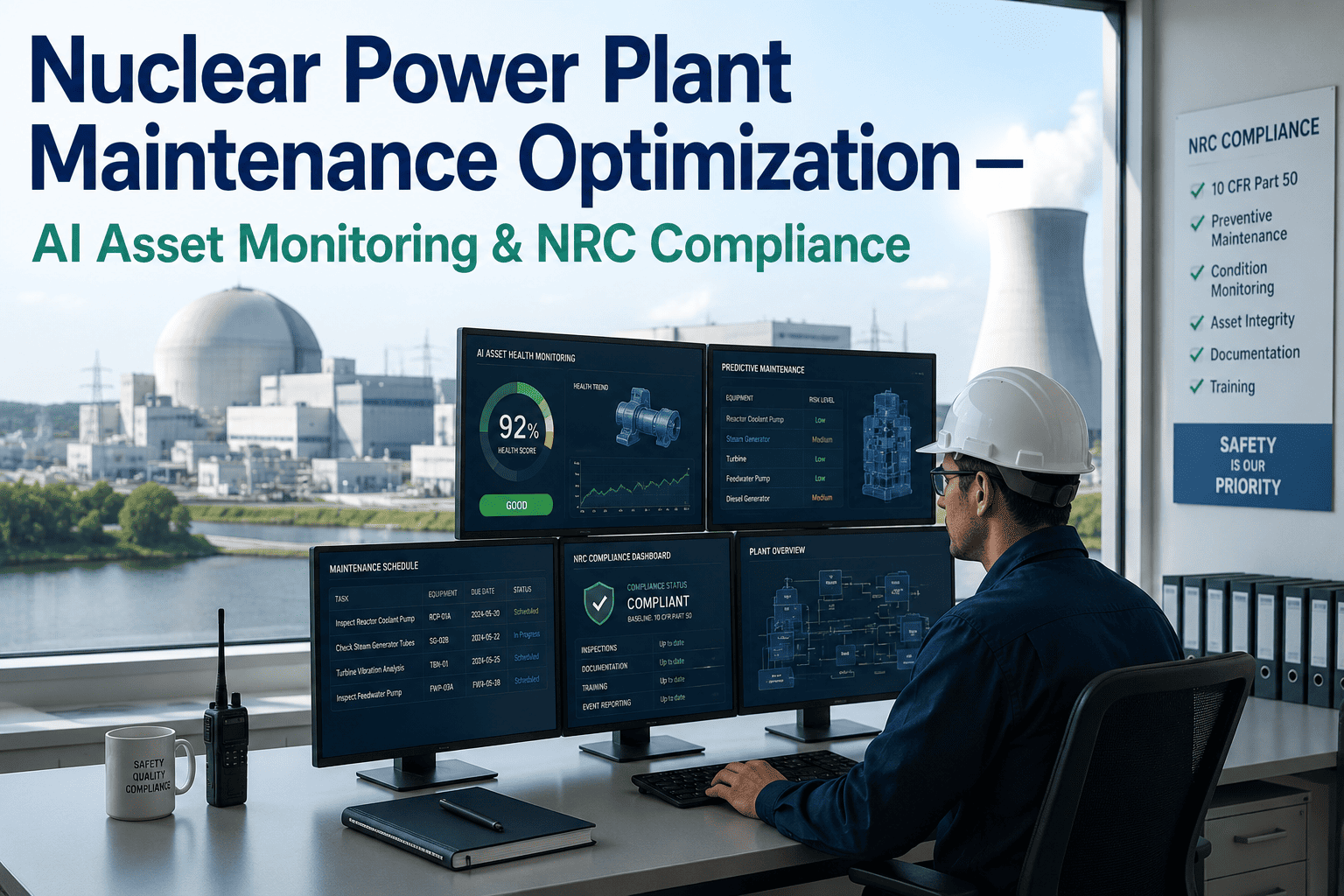
Nuclear plant maintenance audits operate under the most rigorous regulatory framework in power generation. The NRC's Maintenance Rule (10 CFR 50.65) requires plants to monitor the effectiveness of maintenance for safety-significant structures, systems, and components. Every audit finding must be classified, tracked, and resolved within defined timelines — making CMMS integration not optional, but essential for license compliance.
Reactor Coolant System
ASME Section XI in-service inspection of reactor vessel welds, pressurizer heater condition, steam generator tube eddy current testing, reactor coolant pump seal and bearing monitoring, and boric acid corrosion assessment. Every inspection record must meet 10 CFR 50 Appendix B quality assurance requirements.
Safety Systems Surveillance
Emergency diesel generator load testing and fuel oil quality, ECCS pump and valve operability verification, containment isolation valve leak rate testing, safety-related instrument calibration per technical specifications, and DC battery capacity testing. Surveillance intervals range from daily to 18-month refueling outage cycles — each with mandatory completion criteria.
Aging Management Programs
License renewal aging management reviews per NUREG-1801 (GALL Report), cable condition monitoring for medium and low voltage systems, concrete degradation assessment for containment and safety-related structures, and buried piping inspection programs. With many U.S. reactors now operating under 60-year or 80-year license extensions, aging management audit rigor directly determines continued operating viability.
Maintenance Rule Compliance
10 CFR 50.65 (a)(1) and (a)(2) classification tracking, maintenance preventable functional failure (MPFF) documentation, risk-informed performance indicators per RG 1.160, expert panel review records, and corrective action program integration. A CMMS that automatically tracks (a)(1)/(a)(2) status and flags performance threshold crossings is the only practical way to maintain compliance across thousands of monitored components.
What AI-Integrated Audit Programs Deliver
These outcomes represent documented results from power generation facilities that replaced fragmented audit processes with AI-powered CMMS-integrated maintenance audit workflows.
40%
Reduction in forced outage incidents within 12 months
50%
Faster mean time to repair with pre-populated work orders
30%
Reduction in total maintenance spend through optimized intervals
90%
Audit finding closure rate within regulatory timelines
Book a demo to see how iFactory's audit management module tracks every finding from detection to closure — across thermal, hydro, and nuclear assets in a single platform.
How AI Transforms the Plant Maintenance Audit Cycle
The traditional audit cycle — inspect, document, file, wait, maybe act — fails because it creates a time gap between finding and action. AI-integrated audits eliminate that gap entirely.
Step 01
Structured Audit Execution
Technicians follow digitized audit templates on mobile devices — each inspection point pre-loaded with acceptance criteria, measurement parameters, and historical comparison data. Photos, readings, and condition assessments are captured at the point of inspection and immediately uploaded to the CMMS. No transcription delays, no lost paperwork.
Step 02
AI Severity Scoring and Trending
Machine learning models compare each audit finding against the asset's historical baseline and fleet-wide degradation patterns. Each finding receives an automated severity score, a predicted failure timeline, and a recommended intervention window. Trending analysis highlights items degrading faster than expected — even when individual readings appear within tolerance.
Step 03
Automated Work Order Generation
Critical and degrading findings automatically generate prioritized work orders — pre-populated with the fault description, recommended repair procedure, required parts, estimated labor hours, and optimal scheduling window aligned with planned outages. No audit finding sits in a report waiting for someone to act on it.
Step 04
Compliance Reporting and Audit Trail
The system automatically generates audit-ready reports organized by regulatory requirement — NERC GADS, FERC Part 12D, NRC Maintenance Rule, OSHA, EPA, and internal KPIs. Every finding, action, closure, and sign-off is timestamped and immutably recorded. Audit preparation time drops from weeks to hours, and regulatory inspectors receive exactly the documentation they require.
We audited six thermal units and two hydro stations on iFactory's platform over 14 months. The automated severity scoring caught a generator rotor imbalance that our manual inspections had been marking as acceptable for three consecutive cycles — the trending data showed it was accelerating. That one catch prevented an estimated $1.8 million forced outage. Our audit finding closure rate went from 67% to 94%, and our NERC GADS reporting went from a 3-week manual exercise to a 2-hour automated export.
VP of Asset ManagementRegional Power Generation Utility — 4,200MW Combined Fleet, Southeast U.S.
Start Your Maintenance Audit Transformation
iFactory — One Platform for Thermal, Hydro, and Nuclear Maintenance Audits
iFactory replaces fragmented audit processes with a unified AI-powered maintenance audit platform that connects inspection data to work orders, tracks every finding from detection to closure, automates compliance reporting, and provides the real-time asset health visibility your plant needs to prevent forced outages. Deploy on your first unit in days — not months.
Digitized audit templates for thermal, hydro, and nuclear systems
AI severity scoring with automated work order generation
NERC GADS, FERC, and NRC compliance reporting built in
Continuous condition monitoring integration across all plant types
How does a maintenance audit differ from a routine inspection?
A maintenance audit is a comprehensive, structured assessment of an entire system's condition, maintenance history, compliance status, and remaining useful life — whereas a routine inspection typically checks individual components against pass/fail criteria. Audits integrate data from multiple inspection types (visual, UT, vibration, thermal) into a holistic asset health picture and generate prioritized action plans. Book a demo to see how iFactory structures audit workflows that connect every inspection data point to actionable maintenance intelligence.
Can one CMMS platform handle thermal, hydro, and nuclear audit requirements?
Yes — but only if the platform supports configurable audit templates per plant type, regulatory-specific compliance reporting (NERC, FERC, NRC), and flexible condition monitoring integration. iFactory is designed for multi-fleet power generation operations, with pre-built audit frameworks for each plant type and automated compliance documentation that meets the specific regulatory requirements of thermal, hydro, and nuclear facilities within a single unified platform.
What is the biggest mistake plants make with maintenance audits?
Treating audits as documentation exercises rather than action drivers. The most common failure pattern is conducting thorough audits, generating detailed reports, and then allowing findings to age in filing systems without timely corrective action. AI-integrated CMMS platforms solve this by automatically converting audit findings into tracked work orders with assigned owners, deadlines, and escalation paths — ensuring nothing falls through the cracks. Sign up to see how automated finding-to-action workflows prevent audit findings from going stale.
How long does it take to deploy a digital audit system across a power generation fleet?
Initial deployment on a single unit typically takes 2–4 weeks, including audit template configuration, sensor integration, and user training. Fleet-wide rollout across multiple plant types generally follows a phased approach over 3–6 months. Plants with existing condition monitoring infrastructure deploy faster because sensor data feeds are already available. Book a 30-minute assessment to get a deployment timeline specific to your fleet configuration.
What regulatory standards require documented maintenance audits at power plants?
The regulatory framework varies by plant type. Thermal plants must comply with NERC GADS reporting, EPA emissions monitoring (CEMS), and OSHA process safety management. Hydroelectric plants operate under FERC dam safety (Part 12D), state water quality requirements, and fish passage regulations. Nuclear plants face the most stringent requirements under NRC 10 CFR 50.65 (Maintenance Rule), ASME Section XI (in-service inspection), and 10 CFR 50 Appendix B (quality assurance). All plant types benefit from a CMMS that automatically maps audit findings to the applicable regulatory requirements.
How does predictive analytics improve audit effectiveness beyond scheduled inspections?
Predictive analytics continuously monitors equipment health between scheduled audits, catching degradation that develops in the intervals between formal inspections. For example, a boiler tube may pass its annual ultrasonic inspection in January but develop accelerated wall thinning by May due to changing fuel quality. Continuous monitoring detects this trend in real time and triggers an interim inspection or repair before the next scheduled audit. Sign up to connect continuous monitoring data with your audit cycles for complete lifecycle visibility.