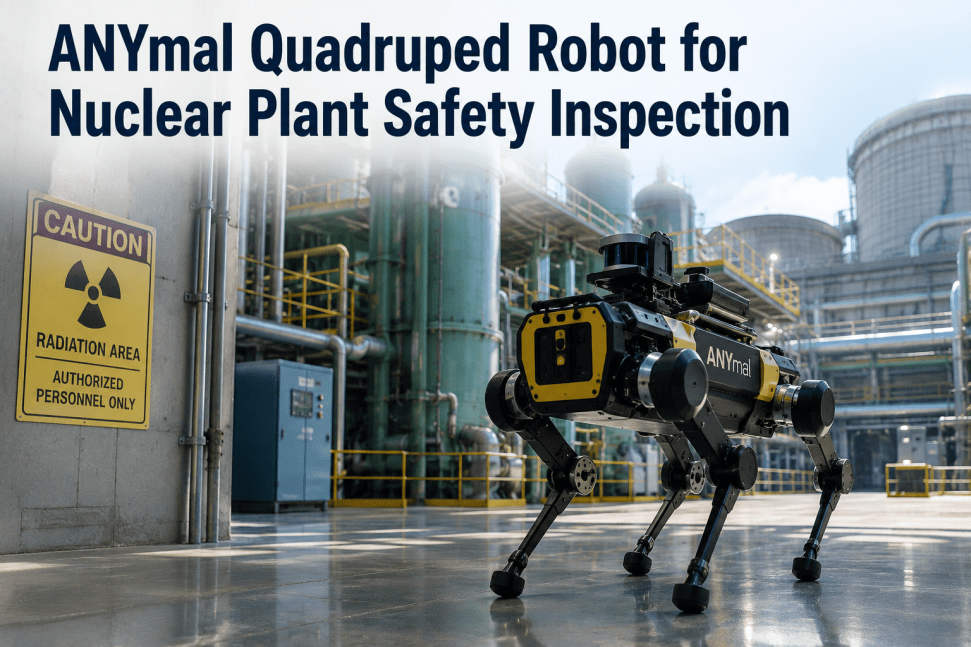
Every hour a nuclear plant delays a scheduled safety inspection because the radiation zone has not decayed to safe human-entry levels, the facility is accumulating risk exposure that compounds with every minute of deferred visual assessment, thermal scan, and acoustic survey. ANYmal — the autonomous quadruped robot built by ANYbotics eliminates this delay by navigating containment areas, turbine halls, and auxiliary buildings while radiation levels are still elevated, transmitting high-resolution inspection data to engineers who remain safely outside the controlled zone. Book a Demo to see how iFactory's robotics integration platform deploys and manages ANYmal inspection missions across your nuclear facility.
Is Your Nuclear Plant Still Sending Humans Into Radiation Zones for Routine Inspection?
iFactory's Robotics Integration platform deploys ANYmal quadruped robots for autonomous nuclear safety inspection — navigating radiation zones, detecting anomalies, and reporting findings directly into your asset management and compliance systems.
What ANYmal Brings to Nuclear Plant Safety Inspection
Nuclear facilities face an inspection burden that no other industrial environment matches: radiation zones that restrict human access, containment structures that require frequent visual and thermal assessment, and regulatory inspection schedules that cannot be deferred without NRC compliance consequences.
Radiation Zone Autonomous Patrol
ANYmal navigates controlled radiation areas with up to 500 mSv/h dose rates — zones that would trigger immediate human evacuation. The robot executes programmed inspection routes through containment buildings, spent fuel areas, and waste processing zones, transmitting sensor data to operators outside the controlled boundary.
Thermal and Acoustic Anomaly Detection
Integrated thermal cameras detect hot spots on electrical connections, steam pipe insulation breaches, and bearing temperature rise before they escalate into failures. Acoustic sensors capture ultrasonic emissions from pressure boundary leaks and valve seat degradation that human inspectors cannot hear in high-noise plant environments.
Confined Space and Elevated Access
ANYmal's quadrupedal design enables stair climbing, grating traversal, and maneuvering through narrow containment passages that wheeled or tracked robots cannot negotiate. The robot inspects elevated pipe racks, cable trays, and containment liner surfaces without requiring scaffolding or aerial lift deployment.
Integrated Reporting and Compliance Documentation
Every inspection mission generates timestamped thermal images, radiation survey readings, visual inspection photos, and equipment condition notes that flow directly into iFactory's asset management platform — creating audit-ready documentation that satisfies NRC inspection record requirements without manual report compilation.
ANYmal Specifications and iFactory Integration Architecture
ANYmal's hardware and software architecture is purpose-built for the most demanding industrial inspection environments, and iFactory's robotics integration platform provides the mission control, data management, and compliance reporting layer that transforms autonomous patrol data into actionable maintenance and safety intelligence. The table below maps ANYmal's core specifications against the iFactory integration capabilities that activate each inspection function.
| Capability | ANYmal Specification | iFactory Integration Function | Nuclear Application | Value Delivered |
|---|---|---|---|---|
| Radiation Tolerance | Up to 500 mSv/h dose rate | Radiation zone mission scheduling and dose logging | Containment area walkdowns during outages | Eliminates human dose exposure |
| Thermal Imaging | 640 x 480 radiometric thermal camera | Thermal trend analytics and alarm thresholding | Steam line and electrical connection inspection | Early failure detection |
| Acoustic Sensing | Ultrasonic microphone array | Acoustic signature library and leak classification | Valve and pressure boundary leak detection | Reduces manual stethoscope rounds |
| Gas Detection | Optional O2, H2, CO, radiation sensor payload | Gas trend logging and alert integration with plant SCADA | Confined space gas monitoring during entry prep | Continuous atmosphere monitoring |
| Autonomy Level | Fully autonomous with remote override | Mission planning, execution, and exception handling | 24/7 patrol of unoccupied auxiliary buildings | Reduces security patrol labor |
| Data Integration | Real-time LTE/5G and local mesh networking | Direct data ingestion into iFactory asset records | NRC-format inspection report generation | Eliminates manual report writing |
5-Step Deployment: ANYmal Robotic Inspection Integration at Nuclear Plants
Integrating ANYmal autonomous inspection into a nuclear facility's safety program requires more than robot deployment — it demands a structured integration of mission planning, sensor configuration, data management, and compliance documentation that aligns with NRC inspection requirements and plant operations protocols. The roadmap below guides nuclear safety and maintenance teams through a deployment that delivers measurable inspection coverage improvement within the first operating quarter. Book a Demo to review iFactory's pre-built ANYmal integration templates for nuclear applications.
Radiation Zone Mapping and Mission Route Planning
Survey the facility to identify all inspection routes and zones where ANYmal can replace or augment human patrols — containment buildings, turbine halls, spent fuel areas, radwaste processing, and auxiliary systems. Define radiation level profiles, access constraints, and inspection frequency requirements for each zone, and program mission routes into iFactory's robotics mission control interface.
Sensor Payload Configuration and Calibration
Configure ANYmal's payload for the specific inspection missions at your facility: thermal imaging threshold profiles for electrical and steam systems, acoustic signature libraries for valve and pressure boundary monitoring, and radiation survey parameters aligned with your plant's ALARA program requirements. Calibrate all sensors against known reference conditions and validate data quality before live deployment.
iFactory Platform Integration and Data Workflow Configuration
Connect ANYmal's inspection data streams to iFactory's asset management and compliance platform. Configure automated report templates for NRC-format inspection documentation, set alert thresholds for thermal and acoustic anomaly detection, and establish data retention protocols that meet nuclear record-keeping requirements for inspection records and equipment condition history.
Pilot Mission Execution and Validation
Execute a structured pilot program covering one containment zone and one auxiliary building over a four-week period. Validate that ANYmal's inspection data quality meets or exceeds the equivalent human walkdown standard, confirm that iFactory integration captures all required data fields for NRC compliance, and gather operator feedback on mission planning and exception handling workflows.
Full Deployment and Continuous Improvement
Scale the deployment to cover all planned inspection zones, establish recurring mission schedules aligned with the plant's preventive maintenance calendar and NRC inspection cycles, and implement a continuous improvement process that incorporates inspection findings back into mission route planning and sensor configuration optimization.
Nuclear Industry Perspective on Quadruped Robot Inspection
We spoke with the robotics and inspection technology lead at a U.S. nuclear generating station to understand how ANYmal deployment changes the safety and efficiency equation for regulated nuclear facilities.
"ANYmal has fundamentally changed our approach to containment building inspection. We schedule walkdowns based on robot availability, not radiation dose budget — and that inversion has given us inspection frequency we never thought we could achieve."
The reality of nuclear plant inspection before ANYmal was that every human entry into a radiation-controlled area consumed a portion of the annual dose budget allocated to each technician — a finite resource that constrained inspection frequency regardless of equipment criticality. ANYmal eliminated that constraint entirely. The robot does not accumulate dose. It does not require two-hour donning and doffing of protective equipment. It does not need to exit the zone for lunch breaks or shift changes. A single ANYmal unit operating on a 24-hour patrol schedule can complete more inspection hours in one week than a five-person human crew can complete in a month — without any of the dose exposure that crews accumulate during the same walkdowns.
ANYmal patrols those same connections weekly during normal operation, and we have already identified two developing hot spots on 4 kV breaker connections that would have gone undetected until the next outage — by which time they would likely have failed, causing a forced derate.
Deploy ANYmal Robotic Inspection Across Your Nuclear Facility with iFactory
From radiation zone autonomous patrol to thermal anomaly detection and NRC-compliant inspection reporting — iFactory's robotics integration platform deploys, manages, and documents ANYmal inspection missions across your entire nuclear facility in a single unified system.
ANYmal Is Redefining What Nuclear Safety Inspection Looks Like
Nuclear facilities operate under an inspection burden that no other industrial sector matches — and the cost of deferring or reducing inspection frequency is measured not in maintenance dollars but in regulatory compliance exposure and, ultimately, in public and workforce safety confidence.
The technology is proven, the integration architecture is established, and the regulatory pathway for robotic inspection in nuclear environments has been validated at operating facilities across the U.S. fleet. The question for plant leadership is no longer whether autonomous robotic inspection will become standard practice in nuclear safety programs — it is how quickly their facility will capture the safety, efficiency, and compliance advantages that early adopters are already realizing. Book a Demo to build your facility's ANYmal deployment plan with iFactory's robotics integration team.
ANYmal Quadruped Robot for Nuclear Plant Inspection — Frequently Asked Questions
What radiation dose rate can ANYmal withstand during nuclear plant inspection missions?
ANYmal is rated for continuous operation in radiation environments up to 500 mSv/h — a dose rate that would exceed annual human exposure limits within minutes. The robot's electronics and sensors are radiation-hardened to operate in containment buildings, spent fuel handling areas, and radwaste processing zones where human entry is restricted or requires extensive protective equipment and dose budgeting.
How does ANYmal navigate stairways, grating, and confined spaces in nuclear facilities?
ANYmal's quadrupedal walking design provides mobility that wheeled or tracked robots cannot match in nuclear plant environments. The robot climbs standard and steep industrial stairs, traverses open grating floors and elevated walkways, maneuvers through narrow containment passages and pipe alleyways, and maintains stability on sloped surfaces and uneven terrain common in turbine building mezzanines and auxiliary structures.
What inspection data does ANYmal collect, and how does it integrate with iFactory's platform?
ANYmal collects thermal imagery (640 x 480 radiometric), high-resolution visual inspection photos, acoustic recordings for leak detection, radiation survey readings, gas concentration measurements, and equipment condition observations during each autonomous patrol mission.
Does ANYmal require facility modifications for autonomous operation in nuclear plants?
ANYmal does not require facility modifications for most inspection routes. The robot navigates using onboard LIDAR and stereo vision mapping that builds and maintains a digital model of the facility without requiring floor markers, guide wires, or facility-side infrastructure. Radiation zone boundaries are mapped in software rather than hardware, enabling mission routes to be updated dynamically as plant conditions change. iFactory's mission control interface handles route programming, multi-mission scheduling, and exception handling — including autonomous return-to-dock on low battery, communication loss, or anomaly detection.
What is the typical ROI timeline for ANYmal deployment in a nuclear facility?
Nuclear facilities deploying ANYmal for routine safety inspection typically recover the platform investment within 12–18 months through a combination of reduced personnel radiation dose costs, decreased protective equipment and contamination control expenses, avoided forced outage costs from earlier detection of developing equipment issues, and elimination of manual inspection documentation labor. Facilities operating two or more generating units with shared robotic inspection resources typically see compressed ROI timelines due to the leverage of deploying a single ANYmal unit across multiple units and inspection regimes. Book a Demo to model your facility-specific ANYmal ROI scenario with iFactory's nuclear robotics team.
Start Your ANYmal Robotic Inspection Program with iFactory Today
Nuclear facilities across the U.S. are deploying ANYmal autonomous quadruped robots through iFactory's robotics integration platform — reducing radiation dose exposure, increasing inspection frequency, and generating NRC-compliant documentation from every autonomous patrol mission.