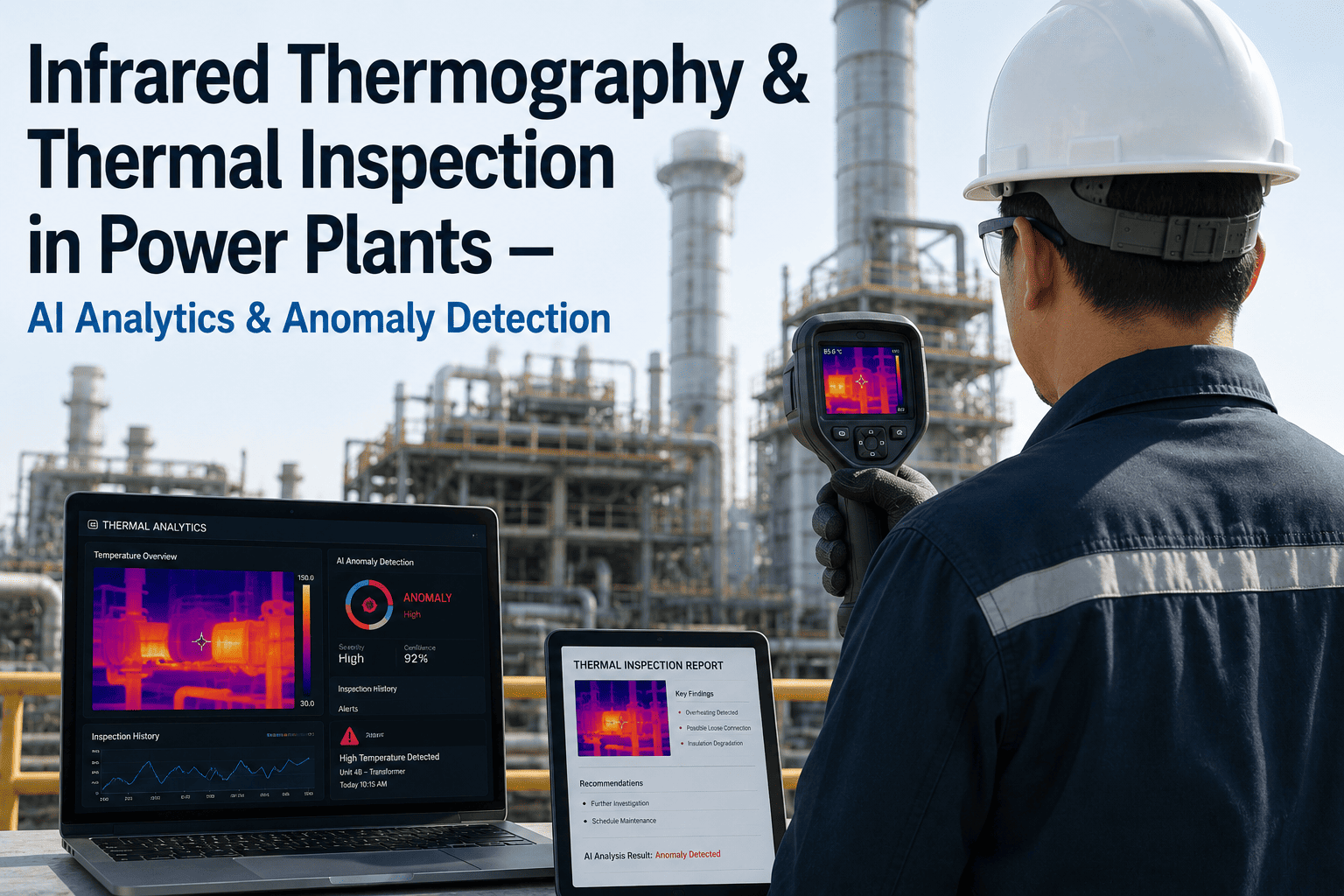
Power plant thermography programs have long relied on periodic manual inspections that capture only a snapshot of thermal conditions at a single point in time. Electrical switchgear, boiler refractory, steam piping, and transformer windings all develop thermal anomalies that progress from minor deviations to critical failures — often between scheduled inspection routes. AI-powered infrared analytics changes this by enabling continuous thermal monitoring with automated anomaly detection, trend analysis, and severity classification that flags developing problems days or weeks before they become visible to periodic inspection. Book a Demo to see AI thermal analytics applied to your plant systems.
Infrared Thermography & Thermal Inspection in Power Plants
AI Analytics & Anomaly Detection
From electrical hot spots to refractory degradation — a technical guide to deploying AI-powered infrared thermography across power plant critical systems.
Where Undetected Thermal Anomalies Hide in Power Plants
Every power plant has hundreds of thermal monitoring points. Understanding the distribution of risk levels helps reliability engineers prioritize where AI thermography delivers the most value.
Normal Operating Range
Thermal signature within established baseline. No deviation detected from reference patterns. Standard monitoring continues without intervention.
Watch — Minor Deviation
Temperature 5-15 degrees above baseline. AI tracks rate of change and cross-references with load and ambient conditions. Increased monitoring frequency activated.
Warning — Significant Rise
Temperature 15-30 degrees above baseline with sustained trend. Correlation analysis identifies probable cause. Inspection and corrective planning initiated within 7 days.
Critical — Threshold Exceeded
Temperature exceeds safe operating limits. Immediate alert with recommended action. Risk of equipment damage, arc flash, or forced outage if unaddressed.
How AI Transforms Raw Thermal Images into Actionable Diagnostics
Modern AI thermal analysis systems process infrared imagery through multiple analytical layers to deliver automated fault detection and severity assessment.
Automated Thermal Image Acquisition
Fixed-mount infrared cameras capture high-resolution thermal imagery at programmed intervals — typically every 15-60 minutes per monitoring point. AI automatically registers each image against equipment geometry, compensates for ambient temperature variations, and normalizes emissivity settings to ensure consistent baselines across changing environmental conditions and load profiles.
AI Anomaly Detection & Classification
Deep learning models trained on thousands of verified thermal fault images compare each new capture against learned normal patterns and known fault signatures. The AI classifies anomalies by type — loose connection, overload, insulation failure, blockage, refractory damage — and severity level, eliminating subjective visual interpretation that varies between thermographers.
Multi-Source Data Correlation
Thermal anomalies are cross-referenced with vibration data, electrical current signatures, process parameters, and maintenance history to confirm root cause and eliminate false positives. A hot connection in switchgear is validated against load current data. A refractory hot spot is correlated with boiler operating mode and fuel type for accurate diagnosis.
Prognostic Trend Forecasting
AI projects thermal degradation trajectories based on historical rate-of-change patterns for each anomaly type. The system estimates when a watch-level anomaly will reach warning or critical thresholds, enabling maintenance teams to schedule interventions during planned outages rather than reacting to emergency conditions. Book a Demo to see prognostic forecasting capabilities.
What AI Thermal Analytics Detects Across Power Plant Systems
A complete AI-powered thermography program identifies and classifies thermal anomalies across electrical, mechanical, and structural systems.
| Anomaly Type | Equipment Affected | Delta-T Indicator | Recommended Response |
|---|---|---|---|
| Loose Electrical Connection | Switchgear, MCCs, transformer bushings | +15 to +40°C | Schedule re-torquing within 7 days |
| Overloaded Circuit | Breakers, bus bars, cable terminations | +5 to +15°C | Verify load balance and rating |
| Refractory Damage | Boiler walls, furnace linings, ductwork | +40 to +150°C | Plan refractory repair at next outage |
| Bearing Overheating | Motors, pumps, fans, turbines | +15 to +35°C | Investigate lubrication and alignment |
| Insulation Breakdown | Steam piping, turbine casings, vessels | +8 to +20°C | Assess insulation integrity and energy loss |
| Cooling System Degradation | Heat exchangers, condensers, radiator banks | +12 to +30°C | Check fouling, flow restrictions, and fans |
| Transformer Winding Fault | Power transformers, voltage regulators | +30 to +80°C | Immediate DGA and load reduction |
AI Thermography Coverage Across Power Plant Systems
Every major equipment category presents unique thermal failure modes that AI infrared monitoring addresses with zone-specific detection models.
Electrical Distribution & Switchgear
AI monitors bus connections, breaker terminals, fuse holders, and cable terminations for the thermal signatures of loose connections, overloading, and phase imbalance. Electrical faults progress rapidly — a 20-degree rise today can become an arc flash in weeks. AI catches these trends at the watch level, giving maintenance teams days to respond rather than hours.
Transformers & Reactors
Thermal imaging of transformer tanks, bushings, and cooling systems detects winding hot spots, bushing connection faults, and cooling system degradation. AI correlates thermal patterns with DGA results and loading history to distinguish between normal load-related heating and developing internal faults.
Boiler Refractory & Insulation
Full-surface thermal scanning of boiler walls, furnace areas, and ductwork identifies refractory thinning, spalling, and insulation voids that create localized hot spots. AI tracks the growth rate of each anomaly to project when refractory repair becomes necessary, enabling planned maintenance during scheduled outages.
Motor & Drive System Thermography
AI monitors bearing housings, motor windings, and coupling surfaces for thermal patterns indicating bearing degradation, winding insulation breakdown, misalignment, and overloading. Thermal trends are correlated with vibration and current data to confirm fault diagnosis and severity.
Steam System & Piping Insulation
Thermal scanning of steam lines, valves, and fittings identifies insulation damage that causes energy loss and creates safety hazards. AI quantifies the extent of insulation failure and estimates energy cost impact, building a prioritized repair list based on financial and safety significance.
Manual Thermography vs AI-Powered Thermal Analytics
The operational gap between periodic manual infrared inspection and continuous AI thermal monitoring directly impacts your ability to prevent thermal failures.
Inspection Frequency
Anomaly Detection Consistency
Trend Analysis Capability
Root Cause Identification
Reporting & Documentation
Critical Anomaly Response Time
Measurable Value from AI-Powered Thermography Programs
Deploying AI thermal analytics delivers returns across failure prevention, energy savings, and inspection efficiency from the first month of operation.
Fewer Undetected Thermal Faults
Continuous monitoring eliminates the blind spots between periodic manual inspections where most thermal failures develop and escalate unnoticed.
Reduction in Inspection Labor
AI automates routine thermal scanning, freeing thermographers to focus on exception handling, root cause analysis, and specialized inspections.
Energy Loss Reduction
Systematic detection and repair of insulation failures on steam systems and heated surfaces delivers measurable energy cost savings.
Ready to Deploy AI Thermal Analytics Across Your Plant?
In 30 minutes, we'll demonstrate how iFactory's AI thermography platform integrates with your existing infrared cameras and condition monitoring infrastructure to deliver automated thermal anomaly detection from day one.
Deploying AI Thermography: From Assessment to Full Coverage
A structured rollout ensures your AI thermal monitoring system delivers accurate diagnostics quickly while building coverage across critical plant areas.
Thermal Risk Assessment
Identify critical monitoring points across electrical, mechanical, and refractory systems. Prioritize by failure consequence, accessibility for camera installation, and existing thermal history data availability.
Camera Installation & Integration
Install fixed-mount infrared cameras at prioritized locations. Connect to the AI analytics platform and configure image capture schedules, emissivity settings, and reference regions for each monitoring point.
AI Model Training & Validation
Train anomaly detection models using collected thermal imagery and verified fault cases. Validate detection accuracy against expert-confirmed findings from your plant's thermography history.
Operational Go-Live & Expansion
Activate automated monitoring for initial zones with parallel verification. Expand coverage to additional plant areas as confidence in AI accuracy builds with each operational week.
AI Thermography for Power Plants — Questions Answered
The most common questions from reliability engineers evaluating AI-powered infrared thermal analytics for their plant.
Q: How does AI thermal anomaly detection improve on experienced thermographer inspection?
AI thermal analysis complements thermographer expertise rather than replacing it entirely. The key advantage is consistency and frequency — an AI system applies identical analytical precision to every image captured every hour, while even the best thermographer can only inspect each point a few times per year. AI also detects subtle rate-of-change trends across hundreds of sequential images that are impossible to identify through periodic visual comparison. The combination of AI continuous monitoring with expert thermographer validation on exceptions delivers more comprehensive coverage than either approach alone. Book a Demo to see how AI and human expertise work together.
Q: How does AI thermography handle changing ambient temperatures and load conditions?
AI thermal analytics uses Delta-T methodology — comparing the temperature of a monitoring point against a reference region on the same component under identical conditions. This automatically compensates for ambient temperature changes because both the anomaly point and reference point shift together with environmental changes. Additionally, the AI system correlates thermal readings with real-time load data, process parameters, and weather conditions to distinguish between normal load-related temperature variation and true anomaly development. This contextual awareness eliminates the false positives that plague simple temperature threshold monitoring systems.
Q: What types of infrared cameras are compatible with AI thermal analytics platforms?
Most modern fixed-mount infrared cameras with standard digital outputs are compatible with AI thermal analytics platforms. The system typically supports radiometric JPEG, streaming video, and proprietary camera protocols through integration adapters. Camera resolution requirements depend on the monitoring distance and the size of anomalies you need to detect — most power plant applications work well with cameras in the 320x240 to 640x480 resolution range. The AI platform manages camera configuration, image capture scheduling, and data normalization, so you can mix camera models from different manufacturers within the same monitoring system if needed.
Q: Can AI thermal analytics detect refractory damage through boiler casing?
Yes. AI thermal analytics is particularly effective for refractory monitoring because it detects the external surface temperature pattern caused by internal refractory thinning or damage. The AI system establishes a baseline thermal profile for each monitored boiler surface area and then detects localized hot spots that deviate from this pattern. By tracking the growth rate of each hot spot over time, the AI estimates the extent of refractory loss and projects when repair will become necessary — enabling refractory maintenance to be planned for scheduled outages rather than requiring emergency shutdowns. Book a Demo to see refractory monitoring capabilities.
Q: What is the typical implementation timeline for a full-plant AI thermography deployment?
Full-plant AI thermography deployment typically follows a phased approach over 3-6 months. The initial phase covers the highest-priority equipment — usually electrical switchgear and critical transformers — and delivers operational value within 8-12 weeks. Subsequent phases expand coverage to boiler refractory, rotating equipment, and steam systems based on risk prioritization. Most plants choose to start with 20-30 monitoring points and expand to 100+ over the first year as the AI platform proves its detection accuracy and the maintenance team builds confidence in the automated alert system. The modular nature of the platform means value delivery begins with the first installed camera rather than waiting for full-plant completion.
Every Hot Spot Detected. Every Trend Tracked. Every Failure Prevented.
AI-powered infrared thermography for power plants is the operational standard for reliability engineers who refuse to wait for the next scheduled inspection to discover a developing thermal failure. Let iFactory deploy it across your critical systems.