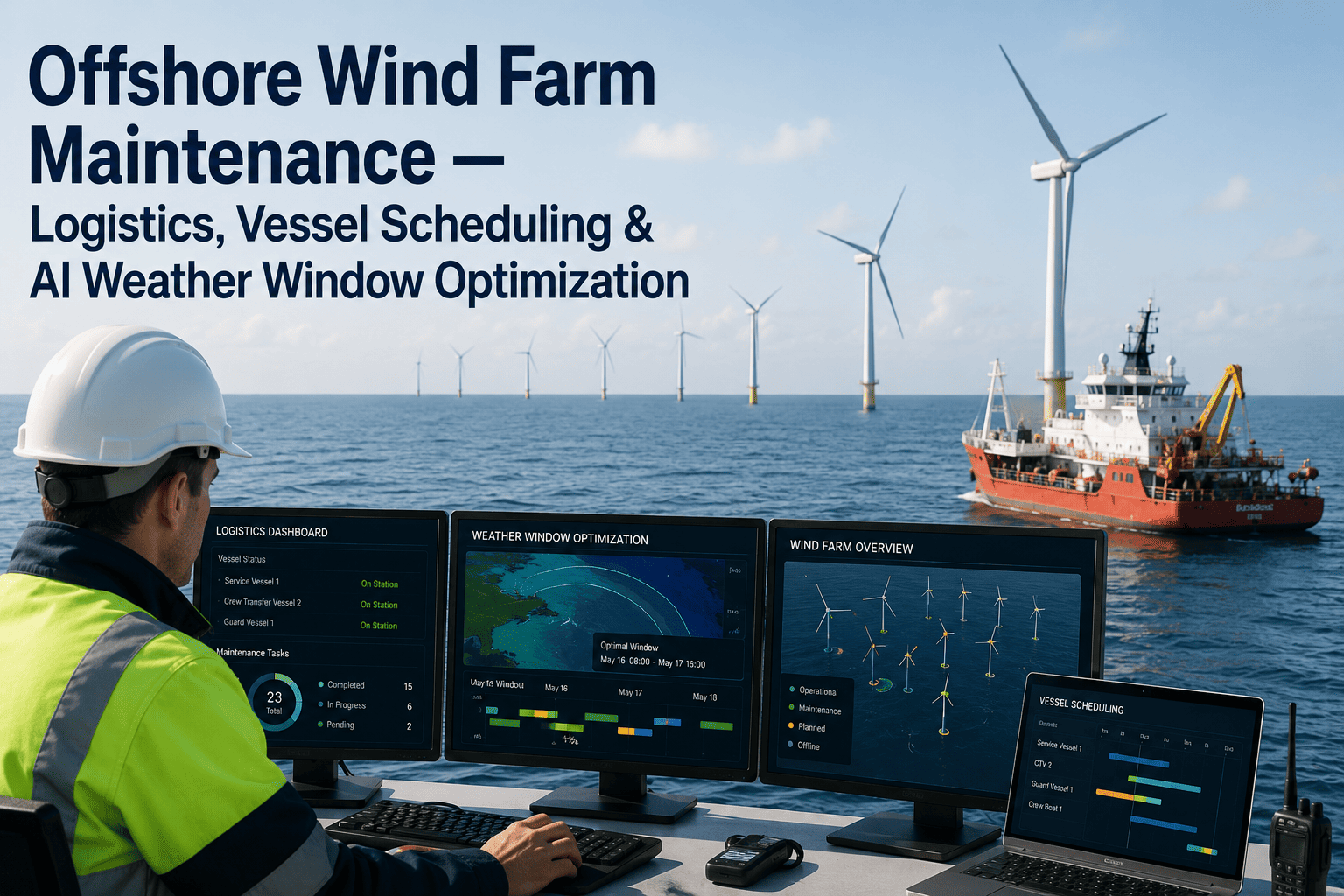
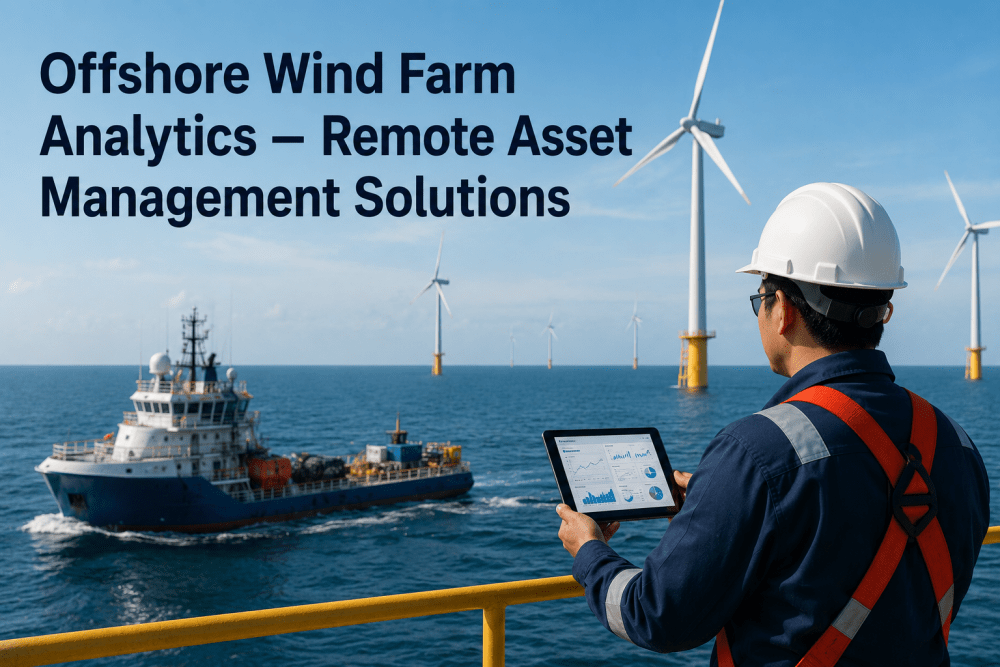
Offshore wind farm O&M costs run $65,000 to $85,000 per MW per year — 50 to 80 percent higher than onshore — and the single largest driver of that premium is not the turbine hardware but the logistics of getting technicians and parts to turbines surrounded by open ocean. Vessel mobilization costs $50,000 to $150,000 per campaign, weather windows in the North Sea allow turbine access only 50 to 60 percent of the year, and every day a turbine sits faulted while crews wait for safe sea conditions is a day of lost generation revenue stacked on top of idle vessel charter costs. iFactory's AI platform optimizes the entire offshore maintenance chain — predicting weather windows days in advance, scheduling vessel routes across turbine clusters, and sequencing maintenance tasks to maximize the work completed in every accessible hour — so your crews spend less time waiting on weather and more time inside turbines. Book a demo to see AI-powered offshore logistics optimization on your wind farm data.
OFFSHORE LOGISTICS · VESSEL SCHEDULING · WEATHER WINDOWS · AI OPTIMIZATION
The Most Expensive Thing in Offshore Wind Is Not the Turbine — It Is the Time Your Crew Spends Waiting for Weather
iFactory's AI predicts weather windows, optimizes vessel dispatch, batches maintenance tasks by turbine cluster, and sequences work to extract maximum productivity from every hour of safe offshore access.
THE COST OF WAITING
Where Offshore Maintenance Money Actually Goes — and How Much Weather Wastes
Offshore wind O&M budgets are dominated by logistics costs that have nothing to do with the actual repair work. Research consistently shows that logistics — vessel charter, fuel, crew transit, and weather-related delays — accounts for over 70% of total O&M expenditure. The turbine repair itself is often the smallest cost component in an offshore maintenance event.
30-35%
Vessel Charter and Mobilization
CTV day rates, SOV charter, jack-up vessel mobilization, and fuel costs that accumulate whether turbines are being worked on or not
20-25%
Weather Waiting and Access Delays
Crew and vessel idle time during periods when sea state exceeds safe transfer limits, consuming charter costs with zero productive work
15-20%
Technician Labor and Transit
Technician salaries, offshore allowances, travel to port, and transit time from port to turbine that reduces productive wrench time
10-15%
Parts, Materials, and Crane Support
Replacement components, consumables, crane vessel hire for major replacements, and logistics for getting parts to the right turbine
10-15%
Actual Repair and Maintenance Work
The hands-on repair, inspection, and preventive maintenance activity that keeps the turbine generating — often the smallest slice of total cost
VESSEL FLEET INTELLIGENCE
AI Scheduling Across Three Vessel Types With Different Capabilities and Costs
Offshore wind farms use multiple vessel types with fundamentally different operating characteristics, cost structures, and weather limitations. AI must schedule the right vessel for each task based on weather forecast, task duration, turbine location, and cost trade-off — dispatching the cheapest vessel that can safely complete the required work within the predicted weather window.
Wave Limit
1.5-2.0m significant wave height
Crew Capacity
12-24 technicians per trip
Day Rate
$5,000-15,000 per day
Best For
Daily transfers for minor repairs and inspections at near-shore sites
AI optimizes CTV departure timing to match tide and weather windows, routes across multiple turbines per trip, and batches tasks to maximize technician utilization during limited access hours
Wave Limit
2.5-3.0m with motion-compensated gangway
Crew Capacity
40-80 technicians with offshore accommodation
Day Rate
$30,000-80,000 per day
Best For
Extended campaigns for planned maintenance at far-shore sites
AI schedules SOV deployment for multi-day maintenance campaigns, sequences turbine visits to minimize repositioning, and coordinates walk-to-work gangway operations with real-time sea state data
Wave Limit
Stable platform once jacked, but transit limited to 1.5-2.0m
Crew Capacity
Variable — typically 20-60 technicians plus crane crew
Day Rate
$100,000-250,000+ per day
Best For
Major component replacements requiring heavy-lift crane access
AI identifies the optimal weather window for jack-up mobilization and jacking operations, sequences multiple turbine lifts into a single campaign, and coordinates crane scheduling with component delivery logistics
Every Hour Your Vessel Sits at Port Waiting for Weather Is a Turbine Sitting Faulted and Not Generating Revenue
iFactory's AI platform predicts weather windows with multi-day lead time, schedules the right vessel for each task, and batches maintenance across turbine clusters to maximize the productive work completed in every hour of safe offshore access.
WEATHER WINDOW INTELLIGENCE
How AI Turns a 7-Day Forecast Into an Optimized Maintenance Schedule
Traditional offshore maintenance scheduling treats weather forecasts as a go or no-go decision made the morning of the planned operation. AI transforms the forecast into a dynamic scheduling input that continuously adjusts the maintenance plan to extract maximum work from every accessible period.
01
Multi-Model Forecast Aggregation
AI ingests wave height, wind speed, tidal, and visibility forecasts from multiple meteorological models and generates a probabilistic access prediction for each turbine location — not a single-point forecast but a confidence range that accounts for model uncertainty and local sea state variation.
02
Task Duration Matching
Each maintenance task has a minimum duration requirement — two hours for a minor inspection, eight hours for a gearbox oil change, three days for a blade repair. AI matches each pending task against the predicted weather window length at the target turbine to ensure only tasks that can be safely completed within the window are dispatched.
03
Opportunistic Task Bundling
When AI predicts a weather window at a turbine cluster, it bundles all pending maintenance tasks at nearby turbines into a single vessel dispatch — converting a corrective repair trip into an opportunistic campaign that completes preventive work on neighboring turbines during the same access window.
04
Dynamic Rescheduling
As weather forecasts update throughout the day, AI automatically adjusts the maintenance schedule — advancing high-priority tasks into emerging windows, deferring low-priority work from closing windows, and rerouting vessels to alternative turbine clusters where conditions remain favorable.
HEAD TO HEAD
Manual Scheduling vs AI-Optimized Offshore Logistics — Full Comparison
The table below compares manual and AI-optimized approaches across the logistics dimensions that determine offshore wind farm maintenance cost, turbine availability, and crew safety.
| Logistics Dimension |
Manual / Experience-Based Scheduling |
iFactory AI-Optimized Logistics |
| Weather Decision Making |
Go/no-go decision based on morning forecast; conservative cancellations to avoid safety risk |
Probabilistic access windows with confidence ranges; tasks matched to window duration and conditions |
| Vessel Utilization |
CTVs dispatched for individual turbine visits; SOVs underutilized between planned campaigns |
Multi-turbine routing per dispatch; opportunistic task bundling maximizes work per vessel day |
| Task Prioritization |
Corrective tasks prioritized by age; preventive tasks scheduled by calendar regardless of access |
Tasks ranked by revenue impact, weather window fit, and geographic proximity for batched execution |
| Crew Productivity |
Technicians deployed to single turbine per trip; significant transit and transfer time per repair |
Multi-turbine work plans per crew shift; transit minimized through cluster-based routing |
| Schedule Adaptability |
Weekly schedule set in advance; reactive changes when weather deviates from forecast |
Continuous rescheduling as forecasts update; tasks shift dynamically to capture emerging windows |
| Fuel and Transit Cost |
Each maintenance task generates an independent vessel dispatch and round trip |
Optimized routing reduces total vessel distance by 25-36% through clustered multi-stop trips |
MEASURED OUTCOMES
Results From AI-Optimized Offshore Wind Maintenance Operations
These figures reflect measured outcomes from offshore wind farms where iFactory's AI platform was deployed to optimize vessel scheduling, weather window utilization, and maintenance logistics across the fleet.
36%
Reduction
Vessel Fuel Consumption Through Optimized Routing
AI-optimized multi-turbine routing and cluster-based maintenance scheduling reduced total vessel distance traveled, cutting fuel consumption and associated emissions compared to conventional single-turbine dispatch patterns across the same maintenance workload.
2.3x
More Tasks
Completed Per Vessel Day Through Task Bundling
Opportunistic task bundling and multi-turbine crew work plans increased the number of maintenance tasks completed per vessel day by combining corrective repairs with preventive work at nearby turbines during the same weather window access period.
41%
Reduction
Waiting-on-Weather Hours per Quarter
AI weather window prediction with multi-day lead time enabled proactive schedule adjustment that dispatched crews during accessible periods and stood down operations before forecast closures, reducing unproductive vessel idle time at port.
97.1%
Turbine
Availability Across AI-Managed Offshore Fleet
Faster fault response, reduced time from failure detection to vessel dispatch, and higher first-visit fix rates from pre-diagnosed faults combined to achieve fleet-wide turbine availability exceeding 97%, reducing lost generation revenue.
The Difference Between a Profitable Offshore Wind Farm and a Struggling One Is Not the Wind Resource — It Is How Efficiently You Use Every Hour of Safe Access
iFactory's AI platform transforms offshore maintenance logistics from weather-reactive manual scheduling into a continuously optimized operation that matches the right vessel, crew, and task to every predicted weather window across your wind farm.
FREQUENTLY ASKED QUESTIONS
Questions From Maintenance Managers About AI Offshore Logistics Optimization
How accurately can AI predict weather windows compared to standard meteorological forecasts that crews already use?
The AI does not replace your meteorological forecast provider — it enhances the raw forecast by aggregating multiple weather models, applying site-specific correction factors learned from historical forecast accuracy at your wind farm location, and translating the meteorological data into operational access predictions for each vessel type based on their specific wave height, wind speed, and visibility limits. Standard forecasts give you wave height and wind speed at a regional level. AI translates that into a per-turbine, per-vessel-type access probability with confidence ranges that account for forecast uncertainty at different lead times. The result is more nuanced go/no-go decisions that avoid both unnecessary cancellations and unsafe dispatches.
Book a demo to see weather window prediction accuracy on your wind farm's historical metocean data.
Does the AI platform integrate with our existing vessel management and SCADA systems?
Yes. The platform connects to your existing turbine SCADA system for fault detection and work order generation, your vessel management system for fleet availability and scheduling, your meteorological data feeds for weather forecasting, and your CMMS for maintenance history and task backlog. Integration uses standard APIs and data protocols — the AI platform operates as a scheduling and optimization layer on top of your existing operational systems rather than replacing them. Most integrations complete within four to six weeks, with the AI operating in parallel advisory mode alongside manual scheduling before transitioning to primary scheduling authority.
Contact our support team to discuss integration requirements for your specific operational technology stack.
How does AI handle the trade-off between dispatching to the highest-priority fault and waiting for a longer weather window to batch more work?
The AI evaluates this trade-off explicitly by computing the cost of delayed repair — lost generation revenue per hour of downtime for each faulted turbine — against the cost savings from batching additional tasks into a combined dispatch. For high-revenue turbines or safety-critical faults, the AI dispatches immediately during the first available window. For lower-priority tasks, it identifies the next multi-day window where bundling multiple turbine visits produces a lower total cost than individual dispatches. The optimization also considers the marginal cost of adding one more turbine stop to an already-planned vessel route, which is often very low compared to the cost of a separate trip.
Book a demo to see the cost-based dispatch optimization running on your wind farm's fault and generation data.
Can AI logistics optimization work for floating offshore wind farms that are farther from shore?
Floating offshore wind farms benefit even more from AI logistics optimization because the greater distance from shore amplifies every inefficiency in vessel scheduling. Transit times are longer, weather window constraints are more severe in deeper water locations, and the cost penalty for an unproductive vessel dispatch is higher. AI optimization addresses these challenges by extending forecast lead times to account for longer transit, pre-positioning SOV vessels within the wind farm for multi-day campaigns, and coordinating tow-to-shore logistics for major repairs where on-site intervention is not practical. The platform's routing algorithms adapt to the specific mooring configurations of floating turbines and the vessel approaches required for walk-to-work access on floating foundations.
Contact our support team to discuss AI logistics for your floating wind project's unique access and distance challenges.
What is the ROI timeline for deploying AI logistics optimization on an offshore wind farm?
Most offshore deployments achieve payback within three to six months because the savings from reduced vessel idle time, fewer unproductive dispatches, and higher technician utilization are immediate and substantial. A single avoided unnecessary CTV dispatch saves $5,000-15,000 in day rate and fuel costs. A single additional turbine repaired per SOV campaign day recovers $3,000-8,000 in generation revenue. Over a quarter, these incremental gains across hundreds of maintenance events compound into six-figure savings that far exceed the platform cost. The pre-deployment assessment models your specific vessel charter costs, historical weather accessibility data, and maintenance backlog to project site-specific ROI before commitment.
Book a demo to request an ROI projection based on your wind farm's operational data and vessel costs.
Your Vessels, Crews, and Turbines Exist in the Same Ocean — AI Makes Sure They Meet at the Right Time, at the Right Turbine, in the Right Weather
iFactory's AI platform turns offshore wind maintenance from a weather-constrained reactive operation into a predictive, continuously optimized logistics system that maximizes turbine availability, crew productivity, and vessel utilization across every weather window your site provides. Book a demo to see AI-powered offshore logistics optimization on your wind farm data.

.png)