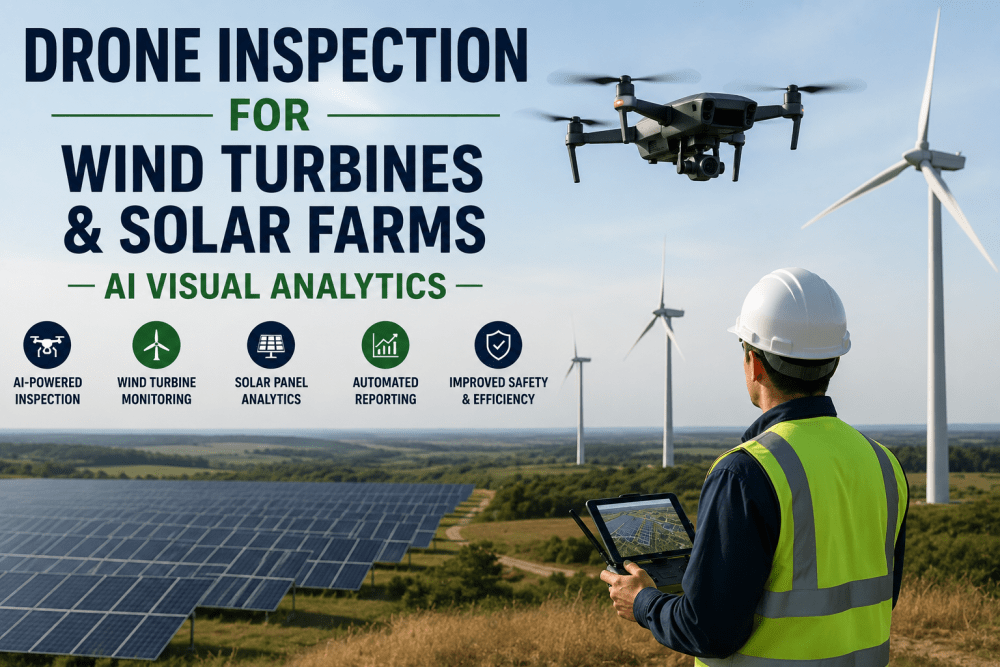
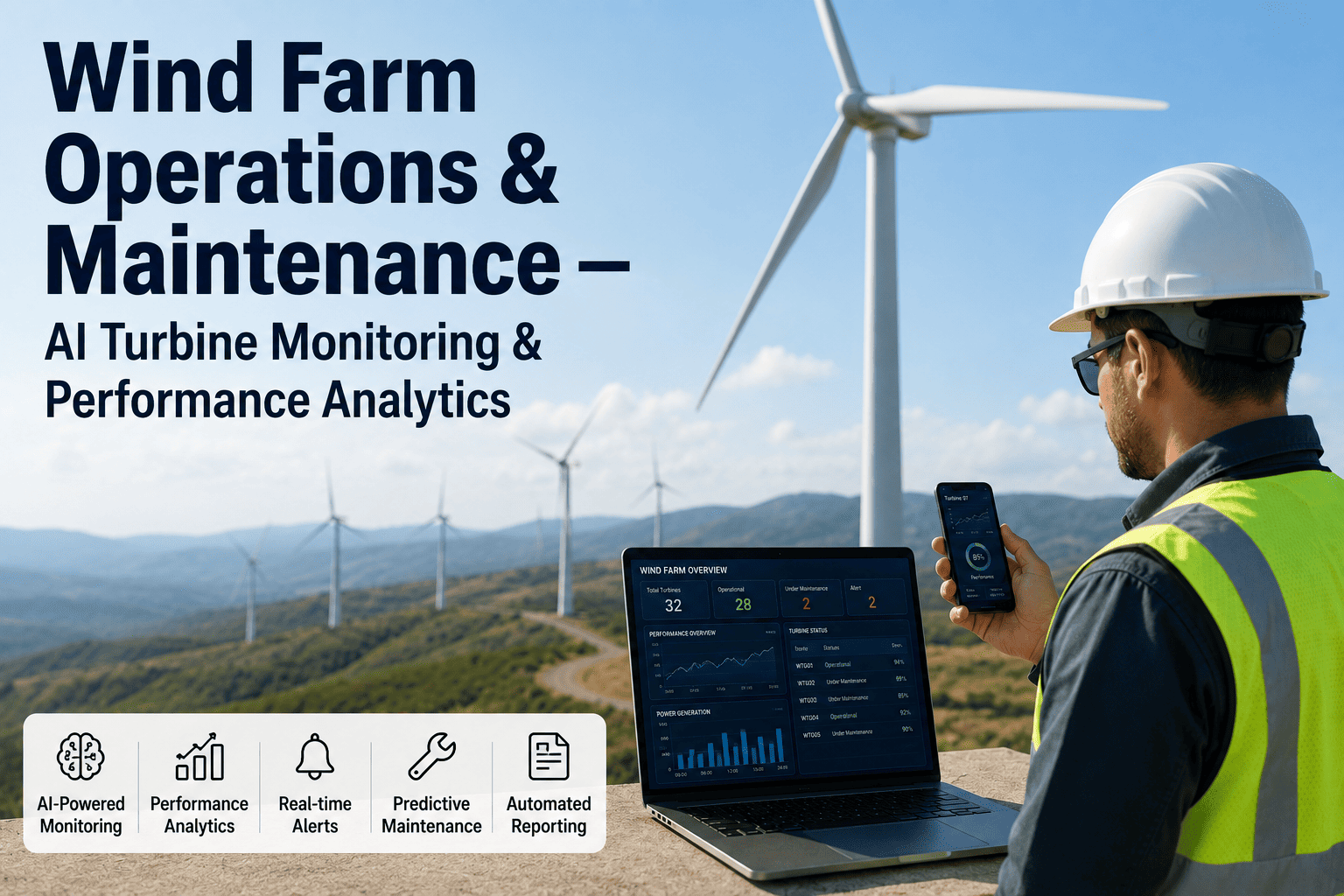
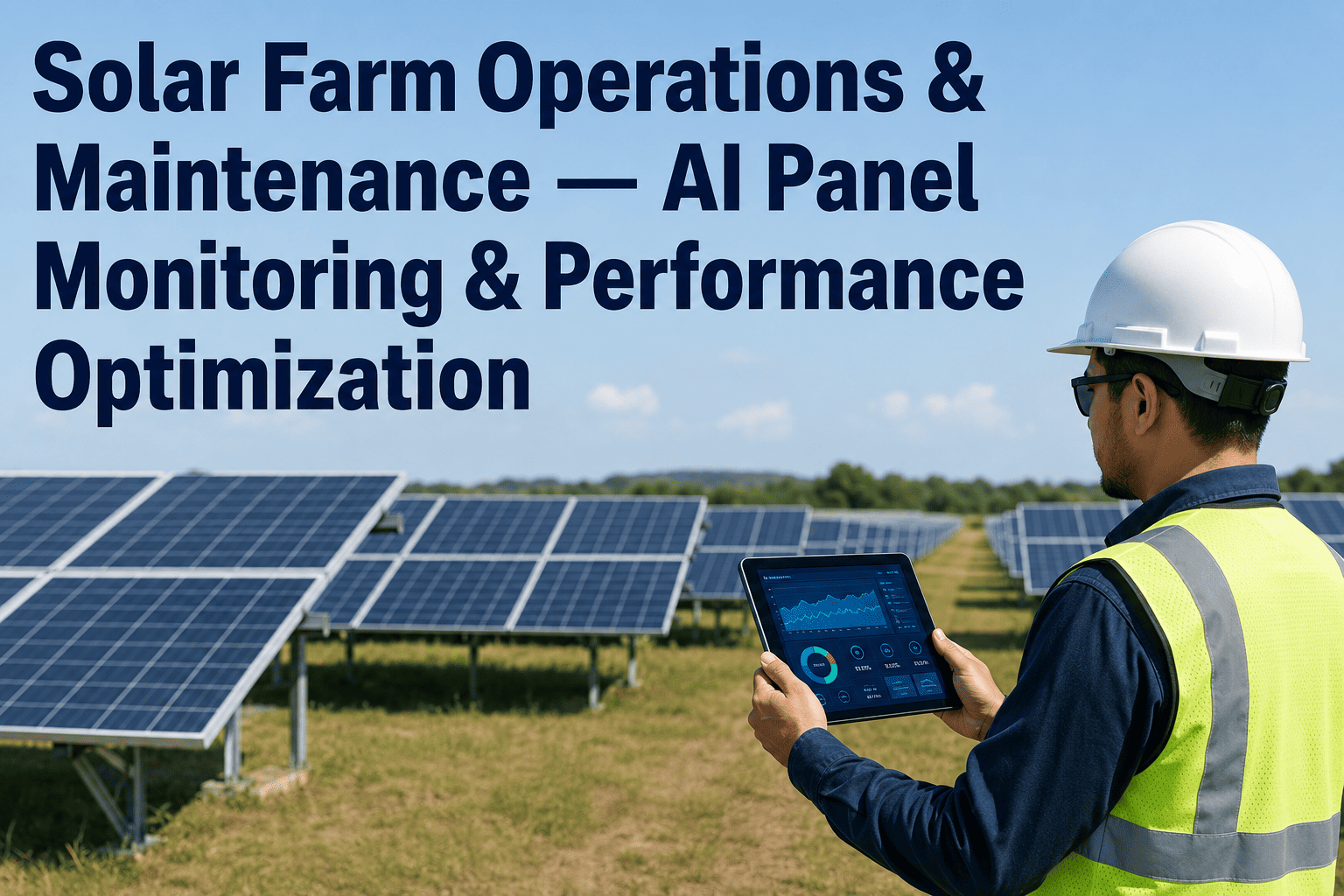
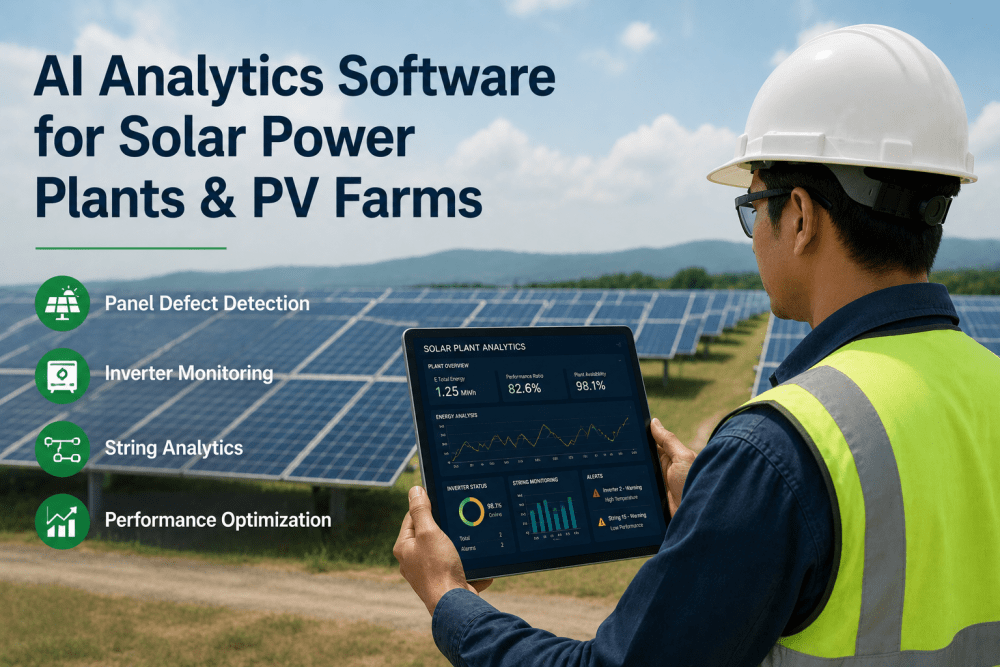
Drone Inspection for Wind Turbines & Solar Farms – AI Visual Analytics
By Juliet Anderson on June 8, 2026
Drone-based aerial inspection combined with AI-powered visual analytics is fundamentally transforming how renewable energy operators assess asset health across wind turbine and solar farm portfolios. Traditional ground-based and manual inspection methods — rope access for wind turbine blades, thermographic walk-downs for photovoltaic panels, and spotter-guided visual checks — are labor-intensive, infrequent, and inconsistent in quality. AI-driven drone inspection changes this paradigm entirely, delivering comprehensive asset condition data at a fraction of the time and cost while enabling predictive maintenance strategies that prevent minor defects from escalating into catastrophic failures and unplanned outages. iFactory AI's integrated platform — spanning AI vision analytics, drone orchestration, predictive maintenance, CMMS, energy monitoring, and automated reporting — provides wind and solar operators with a unified technology stack purpose-built for the unique inspection requirements of distributed renewable energy assets. Book a Demo to see the platform configured for your specific renewable energy asset portfolio.
Technical Analysis · Renewable Energy · 2026
Drone Inspection for Wind Turbines & Solar Farms – AI Visual Analytics
AI-powered drone inspection with automated visual analytics is transforming how wind turbine blades and solar photovoltaic panels are inspected, classified, and maintained. Real-time defect detection, thermal anomaly mapping, and predictive health scoring enable renewable energy operators to reduce inspection time by over 80%, improve defect detection accuracy beyond 92%, and transition from reactive repairs to condition-based maintenance across their entire asset portfolio. iFactory AI connects every data stream — from drone sensor payloads to CMMS work orders — in a single unified platform.
Across wind turbine and solar farm asset portfolios
92%
Defect detection accuracy
60%
O&M cost reduction
10x
More assets inspected per day
<8 mo
Typical payback period
The Renewable Energy Inspection Challenge — Why Traditional Methods Fall Short
Wind turbines and solar farms present unique inspection challenges that conventional methods are poorly equipped to address at the scale required by modern renewable energy portfolios. Solar farms spanning hundreds of acres with tens of thousands of photovoltaic panels require inspectors to cover vast areas on foot, manually scanning panels for defects that are often invisible to the naked eye. These approaches are not only slow and expensive but fundamentally limited in the quality and consistency of data they produce, leaving asset owners blind to developing defects until they result in significant energy production losses or catastrophic failures. Book a Demo to see how iFactory AI addresses these inspection challenges with an integrated drone and AI platform.
01
Manual Inspection Safety & Access Risks
Wind turbine blade inspection requires rope access technicians suspended at heights exceeding 100 meters, operating in variable wind conditions that create serious fall hazards. Solar farm inspection requires ground personnel to walk long distances across uneven terrain in extreme heat conditions. Both approaches expose workers to injury risks that automated drone inspection completely eliminates by keeping operators at a safe distance while the drone collects high-resolution data from every asset.
02
Data Volume & Analysis Bottleneck
A single high-resolution drone flight over a 50 MW solar farm generates thousands of thermal and RGB images containing millions of individual panel data points. Human analysts cannot process this volume of data at the required speed or consistency — fatigue, attention lapses, and subjective judgment introduce significant variability in defect identification. AI computer vision processes every image pixel with consistent accuracy, classifying defects by type and severity in real time without the bottleneck of manual review.
03
Inconsistent Inspection Quality & Coverage
Manual inspection quality varies dramatically between technicians, shifts, and inspection cycles. Rope access teams may miss defects on trailing blade edges or internal surfaces. Ground-based solar inspectors may skip panels in hard-to-reach rows or fail to detect subsurface defects not visible from ground level. Drone-based inspection follows programmed flight paths that ensure 100% consistent coverage with the same sensor configuration every cycle, producing comparable, repeatable data for trend analysis.
04
Delayed Defect Detection & Lost Production
Annual or semi-annual inspection cycles in wind and solar operations mean that a blade crack or solar panel hot spot can go undetected for six to twelve months, during which time the defect progresses from a minor repair to a major replacement event involving significant turbine downtime or panel replacement cost. AI-driven drone inspection enables operators to conduct inspections at higher frequency — quarterly, monthly, or even on-demand after extreme weather events — catching defects early when repairs are fastest and cheapest.
How AI Transforms Drone Inspection for Wind and Solar Assets
Artificial intelligence elevates drone inspection from a data collection exercise to a comprehensive asset intelligence system through four interconnected capabilities. iFactory AI's platform integrates all four into a unified operational system spanning flight planning, automated image capture, real-time AI analysis, CMMS integration, and portfolio-wide reporting. Book a Demo to see these capabilities configured for your renewable energy portfolio.
Capability 01
AI-Powered Defect Classification
Deep learning computer vision models trained on hundreds of thousands of labeled wind turbine blade and solar panel defect images automatically classify anomalies by type — leading edge erosion, trailing edge cracks, delamination, lightning strike damage for turbines; hot spots, micro-cracks, snail trails, PID effects, bypass diode failures, and glass breakage for solar panels. Models achieve 92%+ classification accuracy and improve over time as they are exposed to more defect variations from real-world inspection data. Each detected defect is tagged with GPS coordinates and severity classification (critical, major, minor, informational) for prioritized maintenance planning.
Impact:92%+ defect classification accuracy vs. 65-75% with manual review
Radiometric thermal cameras mounted on drones capture precise panel-level temperature data across entire solar farms in a single flight, with AI models automatically identifying temperature differentials that indicate hot spots, bypass diode activation, string-level failures, and soiling patterns. For wind turbines, thermal imaging detects blade internal structural defects that are invisible to RGB cameras — trailing edge disbonding, internal shear web cracking, and lightning path damage. AI generates geo-referenced thermal maps of the entire facility overlaid with defect classifications for intuitive visualization.
Impact:Sub-degree temperature resolution across 100% of panels or blades
Capability 03
Predictive Health Scoring & Degradation Modeling
AI models combine inspection data with operational SCADA data — power output, wind speed, ambient temperature, vibration, and historical maintenance records — to generate predictive health scores for each turbine and solar inverter string. The models identify degradation rates that indicate impending failure, enabling operators to schedule maintenance before failure occurs. For wind turbines, blade health scores incorporate leading edge erosion progression models. For solar farms, panel degradation curves predict power output decline and identify underperforming strings requiring intervention.
Impact:Predictive maintenance scheduling with 30+ day advance warning for critical defects
Centralized inspection management platform orchestrates flight scheduling across multiple wind farms and solar sites, automatically generating optimized flight paths for each site based on asset geography, weather conditions, and inspection priority. Defect data flows directly into iFactory CMMS, automatically generating work orders with defect location, type, severity, and recommended repair procedure. Portfolio-level dashboards provide executives with real-time visibility into fleet health, inspection coverage, maintenance backlog, and defect trends across all renewable assets.
Impact:Automated work order generation from inspection data, no manual triage required
AI Drone Inspection Across Asset Types — CSS-Only Tab View
Different renewable energy asset types require different inspection approaches and AI model configurations. The tabs below show how iFactory AI adapts its drone inspection platform to the specific requirements of each asset class.
Blade Surface & Subsurface Inspection
High-resolution RGB cameras with 20+ MP sensors capture every square centimeter of each blade surface at 2-5 mm per pixel resolution. AI models trained on over 100,000 labeled blade images detect and classify leading edge erosion, trailing edge cracks, gelcoat damage, delamination, lightning strike entry and exit points, and repair patch condition. Thermal imaging reveals subsurface defects including shear web disbonding and internal cracking not visible on the surface.
Automated Flight Path Planning
AI-optimized flight paths account for turbine geometry, prevailing wind direction, and obstacle avoidance to ensure full blade coverage in a single automated flight of 15-25 minutes per turbine. The drone positions itself at optimal perpendicular angle to each blade surface, maintaining consistent distance and overlap for photogrammetric stitching and comparison across inspection cycles.
Degradation Trend Analysis
Sequential inspection data is spatially registered so that each defect can be tracked across inspection cycles. AI models calculate annualized progression rates for leading edge erosion, crack propagation, and other degradation mechanisms. Operators receive automated alerts when progression rates accelerate beyond predefined thresholds, enabling proactive intervention before blade structural integrity is compromised.
Panel-Level Thermal Anomaly Detection
Radiometric thermal drone surveys capture panel-level temperature data across the entire solar farm at optimal irradiance conditions. AI models automatically identify hot spot temperature differentials as small as 2°C, classifying anomalies by root cause — bypass diode failure, cell micro-crack, PID effect, soiling patterns, or string-level disconnection. Each anomaly is geo-tagged and linked to the specific panel in the asset registry.
High-Speed RGB & Near-Infrared Imaging
Dual-sensor payloads capture simultaneous RGB and near-infrared imagery at speeds covering up to 500 panels per minute. AI models trained on multi-spectral data detect visible defects — glass breakage, frame corrosion, delamination, snail trails — alongside NIR-visible defects such as micro-cracks and cell-level degradation that are invisible in standard RGB imagery. Geo-referenced orthomosaics provide a complete visual record of the entire site.
String-Level Performance Correlation
AI correlates thermal and visual inspection data with inverter-level SCADA data to identify underperforming strings and map performance losses to specific panel defects. The platform generates string-level efficiency reports that rank maintenance priorities by expected energy recovery — enabling operators to focus repair resources on the defects that impact production the most, not just the defects that are easiest to see.
Unified Fleet Inspection Scheduling
iFactory AI's platform manages inspection scheduling across mixed wind and solar portfolios from a single interface. AI-optimized flight routing minimizes transit time between turbine and solar sites, schedules flights based on site-specific weather windows, and coordinates drone and pilot availability across the fleet. Portfolio-wide inspection calendars ensure all assets receive required inspection frequency while maximizing drone utilization.
Cross-Asset Defect Trend Analytics
Portfolio-level AI analytics identify defect patterns across different turbine models, blade designs, and panel manufacturers — revealing fleet-wide quality issues, design vulnerabilities, or environmental degradation factors that site-by-site analysis would miss. Operators use these insights to negotiate warranty claims, adjust procurement specifications, and implement design modifications that reduce defect incidence across the entire fleet.
Integrated Financial & Operational Reporting
Executive dashboards provide unified visibility into fleet health, inspection coverage, maintenance backlog, and production impact across all wind and solar assets. AI models calculate the production loss associated with each detected defect and the avoided loss from early intervention, enabling operators to quantify the ROI of their drone inspection program in terms of actual energy production recovered and maintenance cost avoided.
Performance Comparison — Manual vs. AI-Driven Drone Inspection
The table below compares conventional manual inspection methods with AI-driven drone inspection across the key operational functions that determine asset health management effectiveness in wind and solar operations. Data reflects deployment results across multiple wind farms and solar facilities operating with iFactory AI's integrated platform.
Inspection Function
Conventional Approach
AI Drone Approach
Improvement
iFactory Module
Blade / Panel Coverage
Rope access or ground walk-down covering 30-50% of assets per day
Automated drone flight covering 100% of assets in a single mission
300-500% coverage improvement
AI Vision + Drone Orchestration
Defect Classification
Visual inspection by trained technician with subjective judgment
AI computer vision classifying defects by type, severity, and GPS location
92% accuracy vs. 65-75% manual
AI Vision Camera
Thermal Anomaly Detection
Handheld thermal camera walk-down, limited to accessible panels
Radiometric drone survey covering 100% of panels with sub-degree precision
100% coverage vs. 20-30% manual
AI Vision + Predictive Maintenance
Inspection Frequency
Annual or semi-annual cycles due to cost and labor constraints
Quarterly or monthly cycles enabled by automated drone operations
2-4x more frequent inspections
Production Monitoring
Data Processing Time
2-4 weeks for manual image review and report generation
Real-time AI analysis with reports generated within hours of flight completion
95% reduction in processing time
Analytics & Reporting
Defect Trend Analysis
Manual comparison of spreadsheets and PDF reports across inspection cycles
Automated spatial registration and degradation rate calculation across cycles
From weeks to real-time trend visibility
Digital Twin AI + Analytics
Maintenance Work Order Generation
Manual defect triage, prioritization, and data entry into CMMS
Automatic CMMS work order creation with defect data, location, and severity
80% reduction in admin labor
CMMS + Work Order Management
Compliance & Reporting
Manual compilation of inspection data for lender, insurer, and regulatory reports
Automated report generation with standardized defect metrics and trend charts
Report preparation time reduced 85%
Safety & Compliance + Analytics
Deployment Roadmap — From Assessment to Autonomous Inspection
Deploying AI-driven drone inspection for wind turbine and solar farm assets follows a structured five-phase timeline that delivers measurable operational value at each stage. iFactory's unified platform and pre-built drone integration connectors accelerate the deployment to 8-16 weeks for a typical renewable energy portfolio.
01
Asset Assessment & Data Foundation (Weeks 1-3)
Complete asset inventory and condition assessment across all wind turbine and solar PV sites — documenting turbine models, blade types and lengths, panel manufacturers, site geography, and existing SCADA and CMMS infrastructure. Establish data ingestion pipelines connecting drone sensor data, SCADA telemetry, weather data, and maintenance history into the iFactory platform. Deploy edge computing gateways at remote sites where needed for real-time drone data processing.
Deliverable: Complete asset registry with connected data streams and site-specific flight parameters
02
AI Model Configuration & Training (Weeks 3-6)
Configure and train site-specific defect classification models using existing inspection imagery and historical defect data. For wind turbines, models are trained to recognize blade-specific defect patterns for each turbine model and blade design in the fleet. For solar farms, thermal and RGB models are calibrated to site-specific panel types, array configurations, and environmental conditions. iFactory's transfer learning approach reduces training data requirements by 60% compared to training models from scratch.
Configure automated flight plan generation for each site — optimized flight paths for wind turbine blade inspection accounting for turbine orientation, blade pitch, and prevailing wind; solar farm grid patterns optimized for panel coverage at optimal irradiance conditions. Integrate drone operations platform with iFactory AI Vision for real-time image analysis during flight, enabling immediate re-flight if coverage gaps are detected. Establish automated data upload and processing pipeline from drone to cloud analytics platform.
Deliverable: Fully automated drone inspection workflow from flight launch to completed data analysis
Configure unified operations dashboards with renewable energy-specific KPIs — fleet health scores, defect density trends, inspection coverage maps, maintenance ROI tracking, and production loss impact calculations. Integrate defect classification and severity data with iFactory CMMS for automatic work order generation. Configure automated notification workflows for critical defects requiring immediate action. Deploy portfolio rolling dashboard for executive visibility across all wind and solar assets.
Deliverable: Live dashboards with automated CMMS integration and defect-driven work order creation
Defect classification models continuously improve through active learning — each new inspection cycle generates additional labeled training data that the AI uses to refine its detection and classification accuracy. The platform scales to additional wind farms and solar sites using model transfer learning and standardized flight plan templates, reducing deployment time for each subsequent site by 40-50%. Fleet-level analytics uncover cross-site defect patterns and optimization opportunities that individual site analysis cannot reveal.
Deliverable: Self-improving AI platform with multi-site fleet management and cross-portfolio analytics
Plan Your AI Drone Inspection Deployment
A deployment consultation maps the five-phase roadmap to your specific wind and solar asset portfolio, fleet size, and operational requirements. Output includes a documented deployment plan with timeline, drone sensor specifications, and integration requirements for your renewable energy sites.
Industry Expert Perspective on AI Drone Inspection
"Over my nineteen years in renewable energy operations and asset management, I have overseen inspection programs across more than two gigawatts of installed wind and solar capacity spanning five countries. For the majority of that career, we relied on rope access teams for wind turbine blade inspection and ground-based thermography for solar farms — methods that were slow, expensive, and fundamentally limited in data quality. A full blade inspection of a single 80-meter turbine required a two-person rope access team working a full day, covering roughly sixty percent of the blade surface due to access limitations. A 100-megawatt solar farm thermographic inspection required a six-person team walking every row for ten to fourteen days. The automated CMMS integration eliminated the two-week manual data entry backlog that had previously separated inspection from maintenance action. The financial impact was immediate and measurable — our first-year unplanned outage hours dropped by fifty-five percent across the wind fleet and our solar performance ratio improved by two point four percent from proactive defect remediation alone."
— Director of Renewable Asset Management, Independent Power Producer — 19 Years Industry Experience — 2+ GW Installed Capacity — 5 Country Portfolios
55%
Reduction in unplanned wind turbine outages
2.4%
Solar performance ratio improvement
47
Critical blade defects missed by manual inspection
Conclusion
AI-powered drone inspection represents a fundamental shift in how renewable energy operators manage asset health across wind turbine and solar farm portfolios. Operators deploying iFactory AI's integrated platform achieve 85% faster inspection cycles, 92% defect detection accuracy, 60% reduction in O&M costs, and the ability to inspect ten times more assets per day than conventional methods allow. The platform's seamless integration with CMMS work order management, predictive maintenance scheduling, and portfolio-wide analytics ensures that inspection data drives immediate operational action rather than sitting in reports that are reviewed weeks after the inspection flight. Each inspection cycle generates higher quality training data that improves model accuracy, which drives better defect detection, which enables earlier maintenance intervention, which in turn reduces unplanned downtime and extends asset operating life — a continuous improvement loop that manual inspection methods cannot replicate. iFactory AI provides the unified platform — AI vision analytics, drone orchestration, predictive maintenance, CMMS, energy monitoring, digital twin integration, and automated compliance reporting — that delivers this integrated capability across wind turbine and solar farm assets of any scale. Book a Demo to discuss your drone inspection requirements and see the platform configured for your renewable energy portfolio.
Deploy AI Drone Inspection for Your Renewable Assets
iFactory AI provides the integrated platform that transforms wind turbine and solar farm inspection management. Schedule a 30-minute demo to see the platform configured for your specific renewable energy portfolio and inspection requirements.
How does AI-powered drone inspection improve defect detection compared to manual inspection methods?
AI-powered drone inspection improves defect detection by combining high-resolution aerial imagery with deep learning computer vision models that analyze every pixel of every image with consistent accuracy, eliminating the subjectivity, fatigue, and attention limitations inherent in human visual inspection. AI models detect subtle defects — micro-cracks in solar cells, early-stage leading edge erosion on turbine blades, sub-degree thermal anomalies — that human inspectors routinely miss. Drone-based inspection also provides 100% asset coverage, including hard-to-reach areas that rope access or ground-based inspection cannot fully cover. The result is 92%+ defect detection accuracy compared to 65-75% for manual inspection, with defects classified by type, severity, and GPS location for prioritized maintenance planning.
What types of wind turbine blade defects can AI drone inspection detect?
AI drone inspection detects a comprehensive range of wind turbine blade defects including leading edge erosion (classification by severity from gelcoat wear through fiber exposure to core damage), trailing edge cracks and splits, delamination between blade skin and core, lightning strike entry and exit points with damage assessment, gelcoat blistering and cracking, surface contamination and leading edge contamination buildup, repair patch condition monitoring, shear web disbonding (detected via thermal imaging), and internal structural cracking not visible on the blade surface. Thermal imaging additionally detects subsurface defects such as internal trailing edge disbonding and core moisture ingress that are invisible to standard RGB cameras.
What solar panel defects can AI drone inspection detect?
AI drone inspection detects solar panel defects across multiple categories. Thermal defects include hot spots from bypass diode failure, cell micro-crack heating, PID-affected cells, and string-level disconnection. Visible defects detected by RGB imaging include glass breakage and cracks, snail trails (micro-cracks with discoloration), delamination and bubble formation, frame corrosion and damage, junction box issues, and soiling patterns
How long does it take to deploy an AI drone inspection platform for a wind and solar portfolio?
A structured five-phase deployment typically takes 8-16 weeks from project initiation to full operational integration across an initial renewable energy portfolio. Phase 1 (asset assessment and data foundation) takes 2-3 weeks. Phase 2 (AI model configuration and training) takes 3-5 weeks using iFactory's transfer learning approach. Phase 3 (drone workflow automation and integration) takes 3-5 weeks depending on the number of sites and existing drone infrastructure. Phase 4 (dashboard configuration and CMMS integration) takes 3-4 weeks. Phase 5 (continuous learning and portfolio scaling) begins at week 13 and continues indefinitely. Additional sites can be onboarded in 3-4 weeks each using standardized flight plans and model transfer learning.
What is the typical ROI and payback period for implementing AI drone inspection?
Operators deploying iFactory AI's drone inspection platform across wind and solar portfolios report payback periods of under 8 months, with ROI driven by four primary sources. First, O&M cost reduction of 50-60% through elimination of rope access teams, reduction in ground inspection labor, and automated data processing that replaces manual image review. Second, energy production recovery of 2-5% through early defect detection and remediation — particularly critical solar hot spot repair and blade defect intervention before propagation. Third, avoided unplanned outage costs through predictive maintenance scheduling.