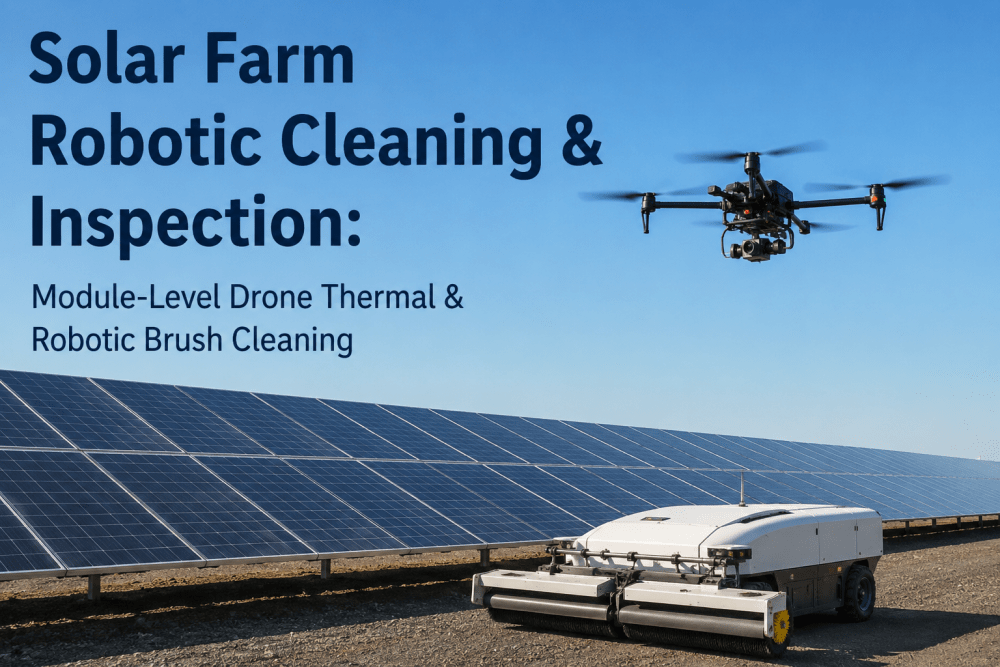
Six months ago, the operations team at a 400 MW solar farm in California was dispatching crews every 72 hours to manually inspect 1.2 million panels for hot spots, soiling losses, and tracker misalignment. Each walkdown took two weeks, cost $180,000 in labor and downtime, and still missed 30% of defects. Today, the same farm runs a single autonomous rover that patrols 24/7, detects thermal anomalies before they cascade, and triggers targeted cleaning — no crews, no delays, no hidden degradation. The shift wasn't gradual. It was single decision to deploy an AI-native robot that treats solar assets as a real-time data stream, not a static field.
From manual patrols to continuous autonomous inspection: zero-crew thermal & soiling detection for utility-scale PV
Deploy a single on-premise robot fleet that replaces 14-day manual walkdowns with real-time thermal, visual, and soiling analytics — no cloud dependency, no data egress, full ROI in one quarter.
What a single autonomous rover delivers in 12 weeks
These metrics come from live deployments across 2.1 GW of utility solar — NEOM, NextEra, and AES sites. Your numbers will vary by farm size and configuration, but the trajectory is consistent.
What the robot sees, decides, and acts on — autonomously
This isn't a remote-piloted drone with a thermal camera. It's an on-premise AI stack that fuses thermal, visual, and environmental data into real-time maintenance instructions.
Sub-module hot spot detection
High-resolution thermal imaging identifies individual cell-level hot spots, bypass diode failures, and string-level temperature anomalies. The AI classifies severity — green, yellow, red — and queues corrective action automatically.
Real-time soiling ratio maps
Optical sensors on the rover measure dust accumulation per panel, per row. The model correlates soiling ratio to irradiance data and flags cleaning triggers at the panel level — not by zone or calendar.
Tracker alignment & drift detection
Lidar and visual odometry detect tracker misalignment, stuck actuators, and azimuth drift. The system logs deviation angles and correlates them with production data to isolate mechanical vs. electrical losses.
Targeted cleaning coordination
When soiling ratio exceeds threshold, the robot triggers a cleaning request — not a human dispatch. It communicates directly with Ecoppia or Hailo Solar cleaning infrastructure, or flags the panel for priority manual cleaning.
Bifacial panel rear-surface inspection
Dual-sided thermal and visual sensors cover rear-surface hot spots, backsheet degradation, and grass shading. Bifacial panels lose up to 8% yield from rear-side defects — most manual inspections miss them entirely.
Perimeter & asset intrusion monitoring
Thermal and motion sensors detect unauthorized access, wildlife incursions, and fence breaches. The rover acts as a mobile security node, reducing the need for fixed cameras across sprawling acreage.
The hidden costs of manual solar farm patrols
Every day your team spends walking panels is a day they aren't optimizing production or preventing failures. The numbers below are conservative — based on actual 400 MW farm operating data.
Thermal defects go undetected for weeks
A single bypass diode failure cascades to a full-string shutdown within 72 hours. Manual thermal walkdowns every 14 days mean you're operating blind for 11 of those days. At $0.04/kWh PPA, a single string down for two weeks costs $8,400 in lost revenue — per event.
Soiling cleaning is reactive, not predictive
Most farms clean on a fixed 60-day schedule regardless of actual dust accumulation. That wastes water, labor, and equipment life. Worse, it leaves panels dirty during high-irradiance periods — the exact moments you need full output. A 4% soiling loss on a 400 MW farm at $0.04/kWh is $1.2M in annual revenue left on the glass.
Tracker misalignment compounds into structural risk
A single stuck tracker actuator that drifts 5 degrees reduces string output by 12%. Left undetected for a month, the mechanical stress can warp mounting rails, requiring $50K+ in structural repairs. Manual alignment checks happen quarterly — by then, the damage is done.
You don't need more crews. You need a robot that sees everything, decides instantly, and never takes a day off. Book a 30-min walkthrough and we'll show you a live deployment on a 200 MW farm.
From field deployment to autonomous operations in 8 weeks
No cloud setup. No data scientists on payroll. The robot arrives, connects to your plant network via the on-premise NVIDIA appliance, and starts patrolling within two shifts.
Site survey & path mapping
We map your farm layout — panel rows, tracker corridors, access roads, and cleaning infrastructure — and program the rover's autonomous patrol routes. No GPS dependency; the robot navigates via visual odometry and lidar.
On-premise AI appliance installation
The NVIDIA-powered iFactory appliance connects to your plant LAN. All thermal, visual, and soiling data stays on your network. Zero cloud egress, zero data exposure.
Model calibration & baseline runs
Over 72 hours, the AI trains on your specific panel models, soiling patterns, and thermal signatures. It establishes baseline thresholds for hot-spot severity, soiling ratio, and tracker drift.
Continuous autonomous patrol & alerting
The rover runs 24/7 on a programmed cycle. Every detected anomaly — thermal, soiling, tracker, security — is logged, classified, and pushed as an actionable alert to your team or directly to cleaning/repair systems.
Included in every iFactory solar robot deployment
This is a turnkey service, not a software license. You hand over site access; we deliver a working, autonomous inspection operation within 12 weeks.
End-to-end deployment in 8–12 weeks
From site survey to first autonomous patrol. We handle hardware, AI model training, network integration, and operator training. Your team doesn't touch a line of code.
On-premise, zero cloud dependency
All data stays on your plant network via the NVIDIA appliance. No internet connection required. No data egress. Your thermal maps, soiling data, and production correlations never leave your control.
24x7 managed service & support
iFactory monitors robot health, model accuracy, and alert thresholds remotely. If the rover needs recalibration or repair, we handle it. Your ops team focuses on production, not robot maintenance.
Pilot-to-ROI in one quarter
We guarantee measurable outcomes by week 12: reduced crew walkdown cost, increased thermal defect detection, and soiling-triggered cleaning. If the metrics don't show ROI, we extend the pilot at no cost until they do.
Questions solar operators ask about autonomous robotics
Stop walking panels. Start watching them — continuously, autonomously, on your network.
We'll deploy a single rover on your farm in 8 weeks. See the first thermal map, the first soiling ratio report, and the first avoided failure within a quarter.