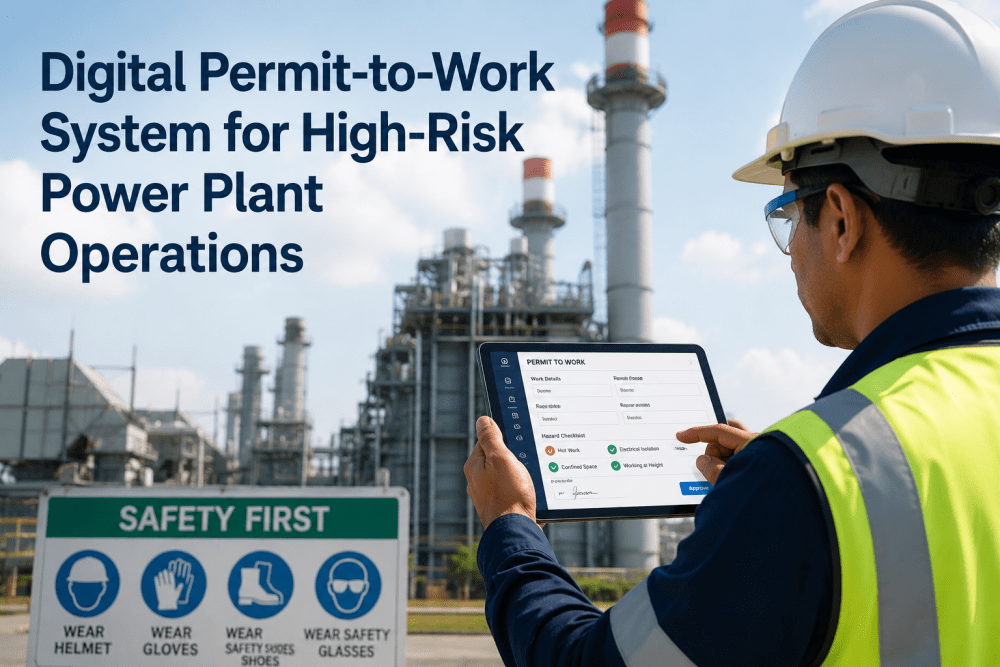
Managing safety permits at a power plant isn't a paperwork exercise—it's the last line of defense before a confined space entry turns fatal or an energized line gets touched by a technician who didn't know it was live. With OSHA recording over 2,000 serious power-generation injuries annually and regulatory agencies tightening digital recordkeeping requirements, U.S. power plant operators need permitto work systems that do more than issue paper forms. This guide breaks down exactly how modern digital PTW software works, what it should include, and why the right system can reduce permit-related incidents by up to 60% while cutting approval cycle time in half.
Permit to Work Software
for Power Plant Safety
Digitize hot work, confined space, and high-voltage permits with automated approval workflows, real-time compliance tracking, and AI-driven safety enforcement—built for U.S. power generation facilities.
What Permit to Work Software Actually Does in a Power Plant
A permit-to-work (PTW) system is a formal documented process that authorizes specific high-risk work, controls the hazards involved, and ensures the right people have verified conditions before work begins. In a power plant context—whether coal, gas, nuclear, or utility-scale renewables—this includes work types like hot work near fuel systems, confined space entry into boiler drums or underground vaults, electrical isolation on high-voltage switchgear, and work at height on turbine decks.
Paper-based PTW processes fail in predictable ways: permits get lost, isolation points don't get verified, shift handovers miss active permits, and auditors can't reconstruct what happened after an incident. Digital PTW software eliminates each of these failure modes by centralizing permit creation, routing approvals electronically, enforcing prerequisite checklists before sign-off, and maintaining tamper-proof audit logs.
Core Permit Types Managed by Digital PTW Systems
Hot Work Permits
Welding, cutting, grinding near flammable materials. Requires fire watch assignment, fire suppression verification, and shift-based reissuance.
Confined Space Entry
Boiler drums, ash hoppers, underground conduit vaults. Atmospheric testing, attendant assignment, and rescue plan mandatory before entry.
Electrical Isolation (LOTO)
High-voltage switchgear, transformer work, bus bar maintenance. Lockout/tagout verification with single-line diagram references required.
Work at Height
Turbine deck access, cooling tower inspections, chimney maintenance. Fall arrest verification and equipment inspection pre-approval required.
Radiological Work (Nuclear)
Controlled area access, dose tracking, contamination boundaries. Integrated with dosimetry data and area radiation monitoring systems.
Chemical Handling
Fuel oil, ammonia (SCR systems), hydrogen for generators. SDS linkage, PPE verification, and spill containment confirmation pre-work.
How the Digital Approval Workflow Replaces Paper Chaos
Traditional paper permit workflows at power plants follow an informal chain: the worker requests a permit, a supervisor signs off, a safety officer reviews it, and the operations team issues the isolation. Each handoff is a potential gap. Permits get lost between shifts, signatures are forged or skipped under production pressure, and there's no system-level enforcement preventing work from starting before prerequisites are complete.
Digital PTW software enforces the workflow as a hard gate—no step can be skipped, no permit issued without verified upstream completion. Here's how the structured approval chain works in practice:
Permit Request Initiation
Worker or supervisor submits a digital permit request from mobile app or workstation. Job description, work location, equipment tag numbers, planned start/end times, and crew list entered. System checks for conflicting active permits on the same equipment.
Hazard Assessment & Risk Classification
System auto-populates a hazard checklist based on permit type. Workers confirm or add site-specific hazards. Risk score is calculated—high-risk permits trigger additional approver tiers automatically. No manual routing decisions needed.
Isolation & LOTO Verification
Operations team confirms energy isolation points are locked out using the digital isolation register. For electrical work, the system cross-references the equipment's single-line diagram. Physical LOTO tags are logged with technician ID and timestamp. Work cannot proceed without this step complete.
Multi-Tier Digital Authorization
Permit routes to required approvers based on risk level and permit type. Area supervisor, safety officer, and for high-risk work, plant manager e-sign via authenticated login. Each signature is timestamped with IP and device ID for legal defensibility. Approvers can reject with mandatory comments.
Active Work Monitoring & Permit Extensions
Issued permits show real-time status on the control room dashboard. Permits auto-expire at end of shift or defined period. Extensions require re-authorization. IoT sensor integrations can flag permit violations—e.g., atmospheric readings outside safe range triggering automatic permit suspension.
Clearance & Isolation Reinstatement
Work supervisor confirms job complete, all crew accounted for, all tools removed. Operations team removes isolations in reverse order per the isolation register. Final sign-off closes the permit and archives the complete record—immediately available for audit within 15 seconds.
Ready to replace paper permits with a digital system that enforces every step? Book a workflow walkthrough with iFactory's power plant safety specialists.
Compliance Standards Digital PTW Must Address
Power plant PTW software in the U.S. doesn't operate in a regulatory vacuum. Depending on plant type, fuel source, and work category, facilities face overlapping federal and state requirements. A compliant digital system needs to enforce rules across all of them simultaneously—not as separate modules but as an integrated compliance engine.
Key Features That Separate Enterprise-Grade PTW Software from Basic Digital Forms
Not every digital PTW solution is built for the complexity of power generation. A form-builder that digitizes a paper permit solves exactly one problem—legibility. What power plants actually need is a system that enforces process, integrates with existing plant data, and gives management real-time visibility into permit status across the entire facility. Here's the feature set that separates genuine PTW platforms from dressed-up PDFs.
Live Permit Board (Control Room View)
A real-time dashboard showing every active permit across the plant—organized by work area, permit type, and authorization status. Control room operators see at a glance what's active, what's pending, and what's expired. No phone calls to find out if the boiler room permit is still open.
Simultaneous Work Conflict Detection
When two permits reference the same equipment or overlapping work areas, the system flags the conflict before either is issued. This prevents the classic scenario where one crew is welding while another is working in a confined space connected to the same gas line—a combination that's caused fatal incidents at U.S. power plants.
IoT & Sensor Integration
Atmospheric monitors, temperature sensors, and gas detectors feed live readings directly into active permits. If oxygen levels drop in a confined space, the system flags the permit, notifies the attendant, and can trigger automatic suspension—all without a human having to check a gauge and decide whether to act.
Digital Isolation Register
Every isolation point—breaker, valve, spectacle blind—is logged with its plant tag number, isolation state, device used, and the name of the person who applied it. The register prevents reinstatement unless all associated permits are closed, eliminating the single biggest cause of maintenance-related electrical fatalities.
Shift Handover Integration
At shift change, all active permits transfer automatically to the incoming shift supervisor with a mandatory review step. The incoming supervisor confirms they've reviewed permit status before accepting handover. Permits active across multiple shifts are flagged for heightened review—a pattern associated with higher risk.
Audit-Ready Reporting in 15 Seconds
When OSHA, the NRC, or a state PUC inspector arrives, every permit record—who approved it, when, what conditions were verified, and what happened at closure—is available as a formatted report in under 15 seconds. Compliance audits that used to require two days of document retrieval become a 10-minute process.
Before vs. After: Digital PTW Transformation at Power Plants
The operational difference between paper-based and digital PTW systems isn't incremental—it's structural. Here's a direct comparison of how each approach performs across the metrics that matter most to power plant safety managers:
ROI and Safety Metrics: What Power Plants Measure After Implementation
Safety software investments are scrutinized by plant managers who need to show concrete returns to ownership and board-level risk committees. Fortunately, digital PTW systems produce measurable outcomes across both safety and operational efficiency dimensions—and those outcomes compound over time as the system learns from permit data and near-miss reports.
Expert Review: What Power Plant Safety Directors Look for in a PTW System
After reviewing PTW implementations across more than a dozen U.S. power facilities—gas peakers, coal plants, and combined-cycle stations—a consistent pattern emerges in what separates high-performing deployments from ones that get abandoned within a year.
Conclusion
Paper-based permit-to-work systems were designed for a simpler era of power plant operations—smaller crews, slower processes, and fewer regulatory requirements. Today's U.S. power facilities operate with tighter margins, more contract workers, more complex equipment interactions, and regulatory scrutiny that can cost over $1 million per day in NERC CIP violations alone. The business case for digital PTW software isn't about convenience; it's about operational resilience and legal defensibility.
The facilities that pass their first post-implementation OSHA inspection with zero findings share a common characteristic: they treated the PTW system as operational infrastructure, not a compliance checkbox. They configured it to match their approved procedures, trained both employees and contractors on it, and gave control room operators the live visibility they needed to make real-time decisions. iFactory's PTW system is built to support exactly that approach—from initial configuration through ongoing optimization based on permit data and near-miss analytics.
Ready to build audit-ready, enforcement-grade permit management into your power plant operations? Schedule your personalized assessment with iFactory's power plant safety team.
Frequently Asked Questions
Build Compliant, Audit-Ready Permit Management into Your Power Plant
From hot work and confined space to high-voltage LOTO and radiological permits, iFactory provides the digital PTW infrastructure U.S. power plants need to protect workers, satisfy regulators, and operate with confidence.