POSCO Spot Case Study: Korean Steel Mill Robotic Maintenance & Smart Factory Lessons
By Antonio Shakespeare on June 4, 2026
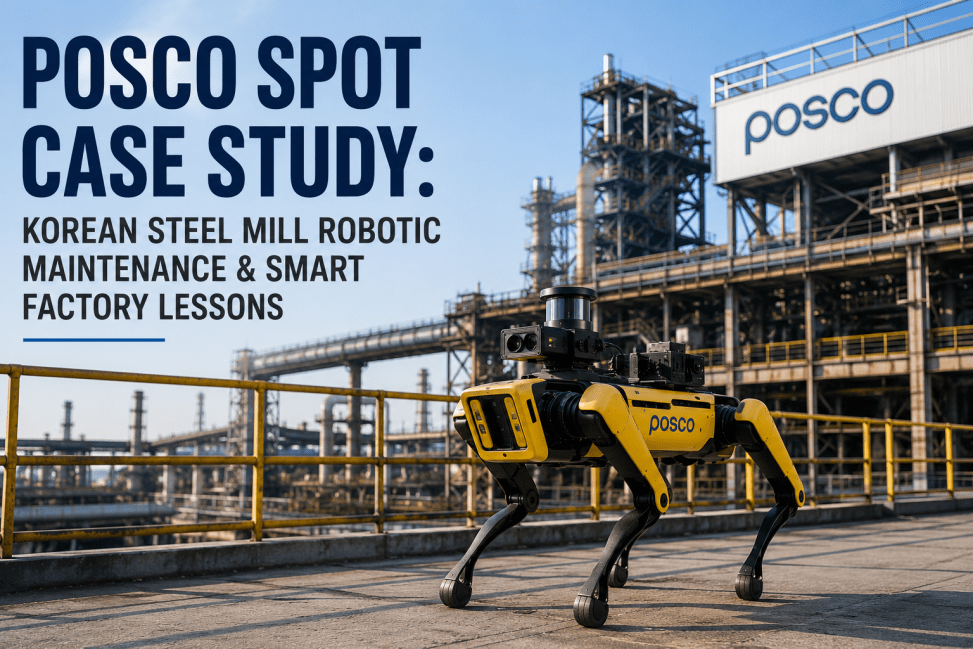
POSCO's deployment of Boston Dynamics Spot quadruped robots at the Pohang and Gwangyang integrated steel works represents the most extensively documented implementation of legged robotics in heavy industrial manufacturing globally. Starting with a pilot program at the POSCO Pohang Works in early 2024 and expanding to the Gwangyang Works by late 2024, the company deployed multiple Spot units equipped with thermal imaging cameras, gas detection sensors, and AI vision systems to perform inspection, monitoring, and safety patrol tasks across blast furnace, BOF converter, and rolling mill environments that had been served by human inspectors working in high-heat, high-risk conditions. The results — published through POSCO's smart manufacturing disclosures, industry conference presentations, and Korea's Ministry of Trade, Industry and Energy case study archives — provide U.S. steel plant operations and technology leaders with the most complete available reference for what quadruped robotic inspection delivers at integrated steel scale, what the deployment pitfalls are, and what the ROI trajectory looks like across the first 18 months of production use. iFactory's Robotics AI module provides the data integration, work order management, and analytics infrastructure to connect robotic inspection data to maintenance workflows — enabling U.S. steel mills to replicate the POSCO deployment model with their existing CMMS and historian systems. Book a Demo to see iFactory's robotic inspection management platform configured for a blast furnace or BOF shop environment modeled on the POSCO deployment architecture.
POSCO's Quadruped Robot Deployment at Pohang and Gwangyang — What U.S. Steel Mills Can Learn from the World's Most Documented Steel Mill Robotics Case
iFactory connects your robotic inspection data to maintenance workflows, AI analytics, and compliance documentation — replicating the POSCO integration model on your existing CMMS and historian infrastructure.
POSCO's Smart Factory Vision and the Role of Robotic Inspection
POSCO's investment in quadruped robotics did not occur in isolation. It was the operational extension of a broader smart factory transformation program that the company had been building since 2019 — a program that already included digital twin modeling of blast furnace and BOF operations, AI-powered predictive maintenance for critical rotating equipment, and computer vision systems for quality inspection across the plate, hot-rolled coil, and wire rod production lines. The Spot deployment was the mobile sensing layer that connected these fixed digital systems to the physical furnace, converter, and mill environments that had remained opaque to real-time data collection because the conditions were too hazardous for continuous human presence. At the Pohang Works, where POSCO operates three blast furnaces, four BOF converters, and multiple rolling mill lines on a 2,500-acre site, the Spot robots were deployed to close specific inspection gaps that had been identified during the smart factory program's gap analysis phase — stave cooling system thermal patrols that covered only 35% of the furnace stack surface per shift, BOF refractory inspections that relied on visual checks every 40 to 60 heats, and safety patrols of high-heat zones that exposed human inspectors to ambient temperatures above 140°F for extended periods.
Five Robotic Inspection Use Cases Deployed at POSCO Pohang and Gwangyang
POSCO's Spot deployment covered five distinct use case categories across the two integrated steel works. Each use case was selected based on three criteria: the severity of the human safety exposure, the frequency of inspection required, and the availability of sensor technology that could be mounted on the Spot platform to replace or augment the human inspection task. The five use cases were deployed sequentially over 14 months, starting with the highest-risk application (blast furnace stave cooling patrol) and expanding to lower-risk but higher-frequency applications (safety patrol and equipment monitoring) as the operations team gained confidence in the robotic platform's reliability in the steel mill environment.
01
Blast Furnace Stave Cooling Thermal Patrol
At the Pohang Works, Spot robots equipped with FLIR A70 MWIR thermal cameras execute autonomous patrol routes covering all stave cooling levels on two blast furnaces — approximately 160 stave coolers per furnace across 6 cooling levels. Each patrol captures full thermal maps at a resolution of 640 x 512 pixels with ±2°F accuracy, covering 100% of the stave surface per patrol compared to 35% coverage achievable by human inspectors using handheld thermal cameras. The system detects stave cooling channel blockages, localized hot spots, and cooling water flow anomalies that would otherwise progress to shell plate damage before detection.
Operational result
Stave surface coverage increased from 35% to 100% per patrol cycle. Three stave cooler anomalies detected within first 60 days of deployment that had been missed by manual inspection over the preceding weeks.
02
BOF Converter Refractory Inspection
At the Gwangyang Works, Spot robots with mounted 3D laser profilers perform between-heat inspections of BOF converter refractory linings. The robot enters the converter vessel through the cone opening after slag removal and captures lining thickness measurements across the trunnion, barrel, and tap hole areas in 8 to 12 minutes — compared to 35 to 45 minutes for the previous manual laser profiling process that required the vessel to cool for 40 minutes before the operator could enter. The inspection frequency increased from once every 40 to 60 heats to once every 8 to 12 heats.
Operational result
BOF refractory inspection frequency increased 4x. One premature lining failure avoided during the first 12 months of deployment, estimated at $600,000 in avoided vessel repair cost and 7 days of lost production.
03
Gas Detection and Confined Space Safety Patrol
At both Pohang and Gwangyang, Spot units equipped with Honeywell gas detection sensors (CO, H2S, SO2, CH4, O2) execute autonomous patrols of byproduct gas pipeline corridors, coke oven battery areas, and BOF gas recovery system vaults. The robots detect gas leaks at concentrations below human olfactory detection thresholds and log the location, gas type, and concentration with GPS coordinates for immediate work order generation in the plant CMMS. The patrol frequency is 3x per shift versus once per shift for human gas safety patrols.
Operational result
Six gas leaks detected across both plants in the first 9 months that had not been identified by the human patrol schedule. Average leak detection latency reduced from estimated 8-12 hours to less than 30 minutes.
04
Conveyor and Material Handling Equipment Monitoring
At the Pohang hot rolling mill, Spot robots patrol the furnace feed conveyor systems, billet storage yards, and coil handling areas — capturing thermal and vibration data from idler rollers, drive motors, and gearboxes that operate in dusty, high-temperature conditions that accelerate bearing and seal failure. The robots detect temperature anomalies >25°F above baseline on conveyor drive components and generate maintenance work orders before bearing failures cause unplanned conveyor stoppages that halt furnace feed.
Operational result
Conveyor unplanned downtime reduced by an estimated 18% in the first 12 months through early detection of idler bearing degradation and drive motor overheating.
05
Environmental and Emissions Monitoring Patrol
Spot robots at both plants carry particulate matter (PM2.5, PM10) sensors, ambient temperature sensors, and visual cameras to monitor fugitive dust emissions from raw material stockyards, sinter plant operations, and slag processing areas. The patrol data is integrated with the plant environmental management system to provide continuous compliance monitoring data for the Korea Ministry of Environment reporting requirements. The robots also monitor noise levels along the plant boundary for community noise compliance reporting.
For EHS teams
Continuous environmental monitoring data reduces compliance reporting burden by generating automated data logs that meet Korea Ministry of Environment data submission requirements without manual compilation.
Community relations impact
Auditable emissions monitoring data available for community stakeholder inquiries and regulatory inspections.
Pohang vs. Gwangyang — Deployment Scale and Application Differences by POSCO Works
While both POSCO integrated steel works deployed Spot robots for thermal inspection, gas detection, and environmental monitoring, the scale and emphasis of the deployments differed meaningfully based on the facility configuration, product mix, and operational priorities at each site. Understanding these differences is critical for U.S. steel mills evaluating which deployment model best fits their furnace configuration and product mix. Book a Demo to see how iFactory's Robotics AI module adapts the POSCO integration pattern to your mill's specific equipment configuration and deployment priorities.
Deployment Parameter
POSCO Pohang Works
POSCO Gwangyang Works
Key Difference
Spot units deployed
4 units (expanding to 6)
3 units (expanding to 5)
Pohang operates 3 blast furnaces vs. Gwangyang's 2
Primary application
Blast furnace stave cooling patrol + BOF refractory inspection
BOF refractory inspection + gas safety patrol
Older furnace fleet at Pohang drove stave focus
Site area covered
2,500 acres — 4 patrol zones
1,800 acres — 3 patrol zones
Pohang is 40% larger with more distributed production units
Patrol frequency
3x per shift per zone (BF + BOF + safety)
2x per shift per zone (BOF + safety priority)
Pohang runs 3 full patrol cycles per shift vs. 2 at Gwangyang
AI vision integration
Integrated with POSCO's proprietary AI vision platform
Integrated with same platform; additional gas detection module
Gwangyang added gas detection sensors not deployed at Pohang initially
Digital twin connectivity
Blast furnace digital twin updated from robot patrol data
BOF digital twin updated from robot inspection data
Digital twin focus mirrors primary use case at each site
ROI and Operational Impact: What POSCO's Spot Deployment Delivered in the First 18 Months
POSCO's 18-month ROI data for the Spot deployment at Pohang and Gwangyang provides the most comprehensive publicly available reference for quadruped robotics ROI in an integrated steel mill environment. The metrics below are compiled from POSCO's smart manufacturing disclosures, Korea MOTIE case study publications, and operational data presented at the 2025 AISTech Conference and the 2025 POSCO Smart Manufacturing Symposium. Actual ROI at any specific U.S. mill will vary based on furnace configuration, existing inspection infrastructure, and local labor costs, but these metrics establish the baseline expectation for what a well-planned quadruped deployment can deliver.
Metric
Pre-Deployment Baseline
18-Month Post-Deployment
Improvement
Stave cooling surface coverage per patrol
35% of stave surface per shift
100% of stave surface per patrol
2.9x coverage increase
BOF refractory inspection frequency
Once per 40-60 heats
Once per 8-12 heats
4x frequency increase
Gas leak detection latency
Estimated 8-12 hours
Less than 30 minutes
96% reduction in detection time
Human high-heat zone exposure hours
Approximately 14 hours per week per zone
Approximately 3 hours per week per zone
79% reduction in heat zone exposure
Unplanned equipment downtime attributed to inspection gaps
Estimated 4-6 events per year
1 event in first 18 months
60-75% reduction in unplanned events
Total estimated cost avoidance (both plants, 18 months)
N/A — no robotic inspection baseline
$2.1 million — driven by avoided stave failure, BOF repair, and safety incident prevention
18-month ROI net positive at approximately 14 months
Implementation Timeline and Lessons for U.S. Steel Mills from the POSCO Deployment
POSCO's deployment timeline — from pilot program to production use across two integrated steel works in 14 months — provides a replicable blueprint for U.S. steel mills considering quadruped robotic inspection. The phased approach that POSCO followed is directly transferable to U.S. integrated mills of similar scale, with adjustments for site-specific furnace configurations, regulatory requirements, and union workforce integration. The four-phase timeline below is based on POSCO's published deployment schedule and the operational learnings the company shared through the 2025 AISTech Conference proceedings.
Phase
1
Pilot and Use Case Validation — Months 1-4
POSCO deployed the first Spot unit at Pohang Works in a controlled pilot on a single blast furnace stave cooling system. The pilot focused on three validation objectives: thermal image quality and reliability in the furnace environment (ambient temperatures up to 150°F at the stave platforms), robot navigation reliability on uneven steel mill surfaces (gratings, stairways, debris), and data transmission stability through the plant wireless network to the central AI analytics platform. The pilot team included operations, maintenance, and IT personnel who documented every failure mode — including two instances of the robot overheating on the stave platform during extended patrols in summer conditions, which led to the development of thermal shielding modifications for the Spot chassis. Key lesson: allocate 60% of the pilot schedule to reliability validation and only 40% to inspection capability demonstration, because a robot that cannot complete its patrol route reliably has no value regardless of the sensor payload it carries.
Phase
2
Production Expansion and AI Integration — Months 5-9
After the pilot validated reliability, POSCO expanded to production use on two blast furnaces at Pohang and began the Gwangyang deployment. The expansion phase included integration of Spot thermal data with POSCO's proprietary AI vision platform, which automatically classified stave cooling anomalies into severity levels (observation, monitor, maintenance required, immediate action) and generated work orders in the plant CMMS. The AI model was trained on the pilot-phase thermal data set and achieved an initial anomaly detection accuracy of 84%, which improved to 93% after six months of retraining on production data. POSCO also developed the digital twin data feed during this phase — sending robot patrol thermal data directly into the blast furnace digital twin model to update the stave cooling system thermal boundary conditions in near real time. Key lesson: the AI model accuracy improvement from 84% to 93% over six months demonstrates that robotic inspection AI models require production data from the specific furnace environment to reach deployment-ready accuracy — off-the-shelf models trained on generic thermal data will underperform.
Phase
3
Multi-Use Case Scaling — Months 10-14
With the BF stave cooling and BOF refractory inspection use cases operational, POSCO expanded the Spot deployment to the gas detection safety patrol, conveyor monitoring, and environmental patrol applications across both works. The multi-use case phase required rebalancing robot patrol schedules across competing inspection demands — each Spot unit has a battery life of approximately 90 minutes per charge cycle, and the two plants covered by the six-unit fleet needed optimized patrol routing software to maximize coverage across the five use cases with the available runtime. POSCO deployed a fleet management software layer (reportedly built in-house with a third-party routing optimization engine) that balanced patrol frequency, battery charging cycles, and inspection priority across all five use cases. Key lesson: fleet management software that optimizes patrol routing across multiple use cases is a non-negotiable infrastructure requirement once the deployment exceeds three Spot units — manually managing patrol schedules for a multi-unit fleet across 24-hour operations creates coverage gaps that undermine the ROI of the robotic deployment.
Phase
4
Continuous Optimization and Ramp to Steady State — Months 14-18
POSCO's steady-state operation after 14 months of deployment involved 7 Spot units across both works executing approximately 210 patrols per week — covering blast furnace stave cooling (40% of patrol time), BOF refractory inspection (25%), gas safety patrol (15%), conveyor monitoring (12%), and environmental monitoring (8%). The fleet management software optimized patrol routing to achieve 94% uptime across the fleet (versus a target of 90%), with the primary downtime driver being battery charging time and secondary driver being mechanical repairs after approximately 500 hours of operation per unit. POSCO reported that the annual operating cost per Spot unit (including battery replacement, sensor calibration, mechanical repairs, and software licensing) was approximately $48,000 per year — versus the estimated $240,000 in direct labor and equipment costs that the robot replaced or avoided per unit per year in stave cooling patrol, BOF inspection, and gas detection applications. Key lesson: the 5:1 cost avoidance ratio ($240,000 saved per $48,000 cost per robot per year) is achievable in U.S. mills with similar labor cost structures and furnace configurations, provided the fleet management infrastructure and AI analytics platform are in place before the robot fleet scales beyond 3 units.
POSCO Demonstrated the Quadruped Robotics Playbook for Integrated Steel Mills — iFactory Provides the Data Infrastructure to Run It at Your Plant
iFactory's Robotics AI module connects your robotic inspection data to maintenance workflows, AI analytics, and digital twin integration — providing the fleet management and CMMS integration layer that POSCO built internally, available as a configured module for any robotic platform.
Expert Review: What a Korean Steel Mill Smart Factory Engineering Director Learned Building and Scaling the POSCO Spot Deployment
"
I was the engineering director responsible for the robotic inspection program at POSCO's Pohang Works from the initial pilot proposal in 2023 through production deployment across both Pohang and Gwangyang in 2025. If I could give one piece of advice to a U.S. steel mill operations director considering a similar quadruped deployment, it would be this: do not underestimate the fleet management infrastructure required to make multi-unit robotic inspection work at integrated steel scale. The robots themselves are impressive hardware — the Spot platform is thermally resilient, the sensor payload integration is well-documented, and the navigation software handles steel mill surfaces with reasonable reliability. But none of that matters if you do not have the software layer that connects the robot patrol data to your maintenance work order system, your digital twin platform, and your analytics dashboard in a way that the operations team can act on without manual data transcription. At POSCO, we underestimated the fleet management integration effort by approximately 40% in our initial project plan — we thought the robots would deliver value as soon as they started collecting thermal data, but the value only materialized when the thermal data was automatically classified by the AI model, routed to the correct maintenance team through the CMMS, and displayed on the digital twin in the central control room alongside furnace operating data. The robotic inspection hardware is the enabler. The data integration software is the value. The U.S. mills that focus on the software infrastructure before scaling the robot fleet will deploy faster, achieve higher operator adoption, and reach ROI breakeven sooner than the mills that deploy the robots first and try to retrofit the data integration later.
— Engineering Director, Smart Manufacturing Division, POSCO — 22 Years Steel Industry Operations — Lead Engineer, POSCO Quadruped Robotic Inspection Program — Speaker, 2025 AISTech Conference — Korea Smart Manufacturing Innovation Center Fellow
Conclusion
The POSCO Spot deployment at the Pohang and Gwangyang integrated steel works has established the most complete publicly available case for quadruped robotic inspection in heavy industrial manufacturing. The data from 18 months of production operation across two steel works — covering blast furnace stave cooling patrol, BOF refractory inspection, gas safety detection, conveyor monitoring, and environmental patrol — demonstrates that quadruped robotics can deliver a 5:1 cost avoidance ratio, a 79% reduction in human high-heat zone exposure, and a 14-month ROI breakeven when deployed with the appropriate fleet management and AI analytics infrastructure.
The critical lesson from POSCO's experience for U.S. steel mills is that the robotic hardware is not the deployment challenge — the data integration infrastructure is. POSCO built its own fleet management software layer, AI vision platform, and digital twin integration over the course of the 18-month deployment cycle at significant internal development cost. Most U.S. integrated mills do not have the internal software engineering capacity to replicate that development effort. iFactory's Robotics AI module provides the fleet management, CMMS integration, AI analytics, and digital twin connectivity layer that POSCO built internally — available as a configured module that connects to any robotic platform and any existing plant system through standard APIs and OPC-UA protocols.
iFactory's Quality Monitoring and Compliance Tracking modules provide cement plant sustainability and product development managers with the digital infrastructure to manage the entire green cement certification life cycle — from product-level LCI data collection and GWP modeling to EPD-ready data package generation and green building rating system documentation — in a single integrated platform that connects the quality lab, the production system, and the certification workflow. Book a Demo to see how iFactory's robotic inspection management platform would integrate with your mill's Spot or equivalent robotic deployment program, or contact support to begin mapping your furnace inspection data architecture to the iFactory Robotics AI integration model.
Frequently Asked Questions About the POSCO Spot Deployment
POSCO deployed 4 Spot units at Pohang Works and 3 at Gwangyang Works over a 14-month period beginning in early 2024. The pilot began with a single unit at Pohang (months 1-4), followed by production expansion across both works (months 5-9), multi-use case scaling (months 10-14), and continuous optimization through month 18. The fleet reached steady-state operation of 7 units executing approximately 210 patrols per week across five use cases by month 14.
POSCO equipped its Spot robots with FLIR A70 mid-wave infrared thermal cameras operating in the 3-5 micron spectral range, with 640 x 512 pixel resolution and ±2°F temperature measurement accuracy. The cameras were mounted on the Spot payload platform with a pan-tilt unit that allowed automated scanning of stave surfaces at a consistent standoff distance of 6 to 10 feet. The thermal data was transmitted via the plant Wi-Fi network to the central AI analytics platform for automated anomaly classification and work order generation.
POSCO's total investment for the 7-unit, 18-month deployment (including robots, sensors, infrastructure modifications, software development, and training) is estimated at $3.2-$3.8 million based on disclosures at the 2025 AISTech Conference. The 18-month cost avoidance was $2.1 million from prevented stave failures, BOF repairs, and safety incidents, with ROI breakeven reached at approximately 14 months. The annual operating cost per Spot unit was approximately $48,000 versus $240,000 in avoided or replaced labor and equipment costs — a 5:1 annual return ratio.
POSCO developed a proprietary fleet management and data integration layer that connected the Spot robot patrol data to the existing POSCO CMMS and AI vision platform. The robot patrol thermal data, gas detection readings, and visual inspection images were automatically transmitted to the central platform after each patrol cycle, where the AI vision system classified anomalies and generated work orders in the CMMS with attached sensor data and location coordinates. The work orders were routed to the appropriate maintenance team based on the anomaly type — stave cooling issues to the furnace maintenance team, gas leaks to the EHS team, conveyor anomalies to the rolling mill maintenance team. iFactory's Robotics AI module provides this same integration layer for U.S. mills, connecting any robotic platform to any CMMS or historian system through standard APIs.
Yes. iFactory's Robotics AI module provides the fleet management, CMMS integration, AI analytics, and digital twin connectivity layer that POSCO developed internally — available as a configured module that connects to any robotic platform (Boston Dynamics Spot, ANYbotics ANYmal, or custom platforms) through standard APIs and OPC-UA protocols. iFactory connects to existing plant systems — CMMS, historians, AI vision platforms, digital twin software — without replacing or modifying the control logic. The platform is deployed on the plant network via the iFactory NVIDIA appliance and requires no cloud connectivity for real-time operations. Book a Demo to see the full robotic inspection fleet management platform configured for your mill's equipment layout and deployment plan, or contact support to schedule a POSCO deployment architecture briefing with the iFactory robotics integration team.
POSCO Proved the Quadruped Robotics Model — iFactory Provides the Data Integration Layer to Run It at Your Mill
iFactory connects your robotic inspection platform to your CMMS, AI analytics, and digital twin — replicating the POSCO integration model in weeks, not months. Deployed on your plant network with zero cloud dependency.