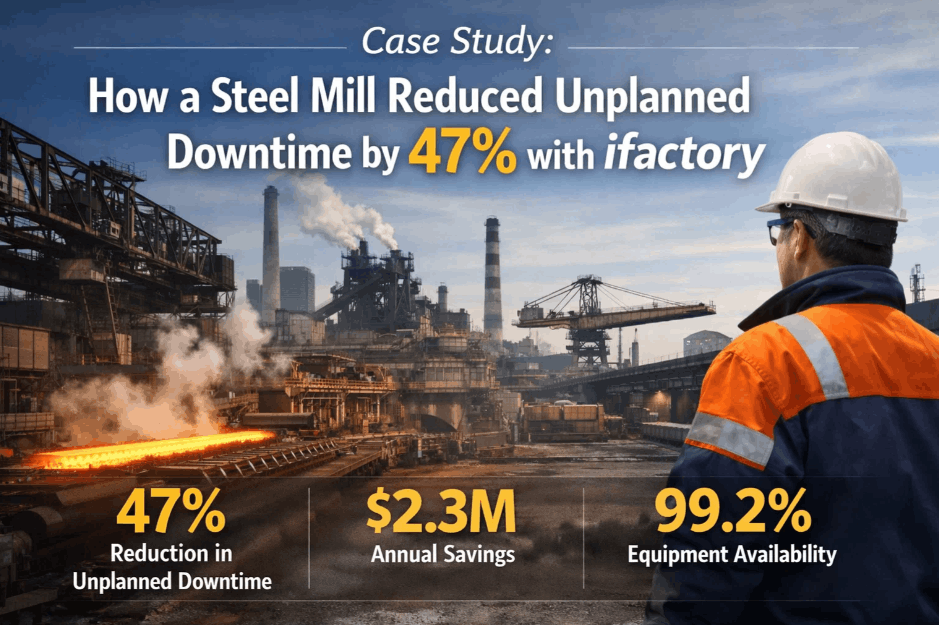
A mid-sized integrated steel mill struggled with the "data graveyard" paradox — they had over 1,200 sensors across their caster and rolling lines, yet unplanned downtime remained at 14% because sensor data lived in isolated silos. Maintenance teams were overwhelmed by conflicting dashboards from three different PLC vendors, leading to missed "early-warning" vibration signals in critical ladle turret bearings. When a cooling water blockage went undetected for four hours, it caused a ladle breakout that cost $1.8M in equipment damage and two weeks of lost production. This case study explores how iFactory unified these disconnected streams into a single AI-powered decision layer. Within 12 months, the facility achieved a 47% reduction in unplanned downtime, improved equipment availability to 99.2%, and delivered $2.3M in verified annual maintenance savings. The transition from "having data" to "having intelligence" allowed the mill to move from reactive fire-fighting to a surgical, predictive maintenance culture where 95% of repairs are now scheduled 4 weeks in advance.
Steel Industry Case Study
47% Less Downtime.
$2.3M Annual Savings.
Zero Breakouts.
How an iFactory AI-driven transformation turned a reactive steel mill into a 99.2% uptime leader.
View the Implementation Roadmap
47%
Direct Reduction in Unplanned Breakdown Frequency
$2.3M
Verified Annual Maintenance & Repair Cost Savings
99.2%
Final Critical Asset Availability After 12 Months
4 Weeks
Avg Lead Time for Predicted Bearing & Motor Failures
The Multi-Layered Sensor Map: Connectivity Simplified
Success in this steel mill started with a unified architecture. iFactory integrated data from vibration, thermal, and electrical sensors across the melt shop and rolling floor into a single, high-visibility dashboard for the first time in the plant's history.
High-Temp Vibration
Caster Roller Bearings & Ladle Turrets
Detects inner-race defects 6 weeks before ISO alarm limits.
Continuous Thermal
Caster Mold & Motor Windings
Identifies cooling plate anomalies to prevent breakouts.
Electrical Current
Mill Drives & EOT Cranes
Flags winding insulation degradation before motor burnouts.
Oil Quality (Auto)
Main Mill Gearboxes
Real-time particle count alerts for gearbox wear protection.
Flow & Pressure
Stave Cooling Systems
Detects micro-clogs that lead to overheating downtime.
Critical Asset Prioritization: The Core Transformation
The implementation focused on the four asset classes that caused 82% of the mill's historical downtime. By targeting these first, the plant achieved full payback on the iFactory investment in just 10 months.
Continuous Caster
Priority 1 — High Breakout Risk
Vibration on turrets, Mold thermal mapping, Cooling water flow trending.
AI prevented 3 breakout events by flagging mold heat imbalances 12 hours ahead.
Hot Rolling Mill
Priority 2 — Production Bottle-neck
Mill drive current, Gearbox vibration, Roller bearing temperature.
Detected main motor winding degradation 5 weeks early; avoided a $900K snap.
Overhead (EOT) Cranes
Priority 3 — Safety & Logistics
Hoist motor vibration, Load cells, Electrical signature monitoring.
Reduced unplanned crane stops by 62% through predictive hoist cable wear checks.
Secondary Cooling Pumps
Priority 4 — Quality Control
Pump cavitation sensors, Discharge pressure, Motor vibration.
AI identifies pump wear patterns that lead to inconsistent cooling and off-spec steel.
AI Analytics: Turning "Noise" into Maintenance Actions
The plant didn't need more data; it needed better interpretation. iFactory's AI layer sits between the mill floor and the supervisor, and prioritizes only valid failure signals.
Deep Anomaly Detection
Identifies "invisible" vibration patterns that standard SCADA alarms miss.
Life Expectancy (RUL)
Predicts exactly how many hours remain before a bearing fails.
Automated WO Creation
Triggers SAP Work Orders automatically with part numbers included.
ROI Dashboard
Real-time quantification of downtime dollars saved per event prevented.
-$1.4M
Reduction in Annual Spare Parts Procurement Costs
$850K
Energy Savings from Optimized Rolling Mill Drive Cycles
95%
Maintenance Tasks are now Planned vs Reactive
10 months
Full Payback Period for iFactory Platform Deployment
Frequently Asked Questions
How did the mill handle sensor failure in the high-heat Melt Shop zone?
We deployed stainless-steel, double-shielded sensors and remote transmitter nodes. iFactory's AI also uses "Virtual Sensors" to cross-calculate heat data from nearby assets if a primary sensor goes offline, ensuring no data gaps.
What was the biggest hurdle during the initial implementation phase?
Data siloing was the primary challenge. Bridging the gap between legacy Siemens S7 PLCs and modern AWS cloud layers required iFactory's specialized edge gateways, which were deployed and operational within 48 hours without halting production.
Did the plant have to hire specialist AI data scientists to run the platform?
No. iFactory is designed for mill-floor reliability engineers. All AI reasoning is presented in plain engineering terms (e.g., "Outer race defect on Roller 4"), allowing the existing maintenance team to take immediate action without a data science degree.
Turn Your Mill Data into Uptime Profit.
This 47% downtime reduction is a replicable roadmap. iFactory provides the unified sensor, AI analytics, and maintenance workflow layer required to transform any steel manufacturing facility into an availability leader.