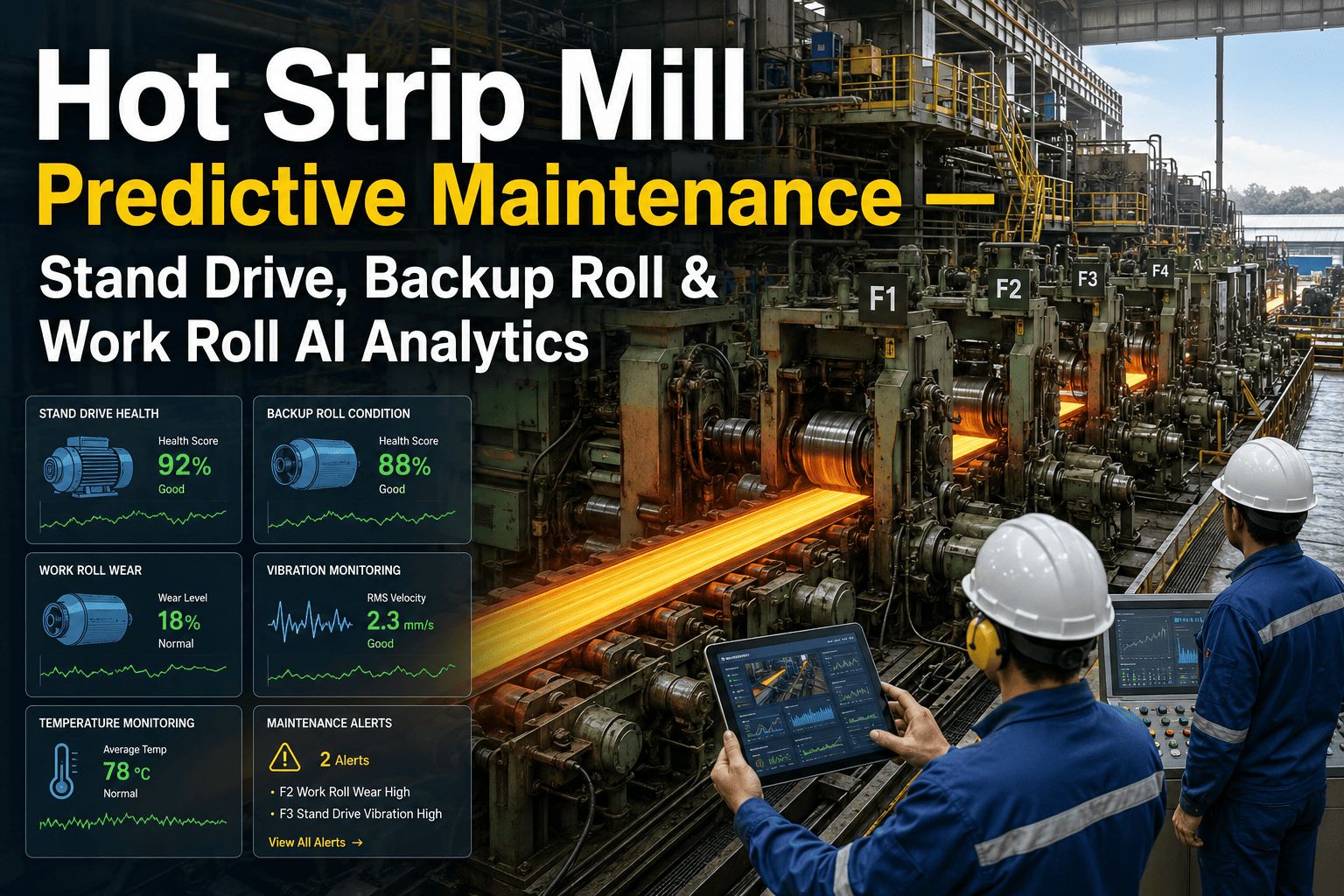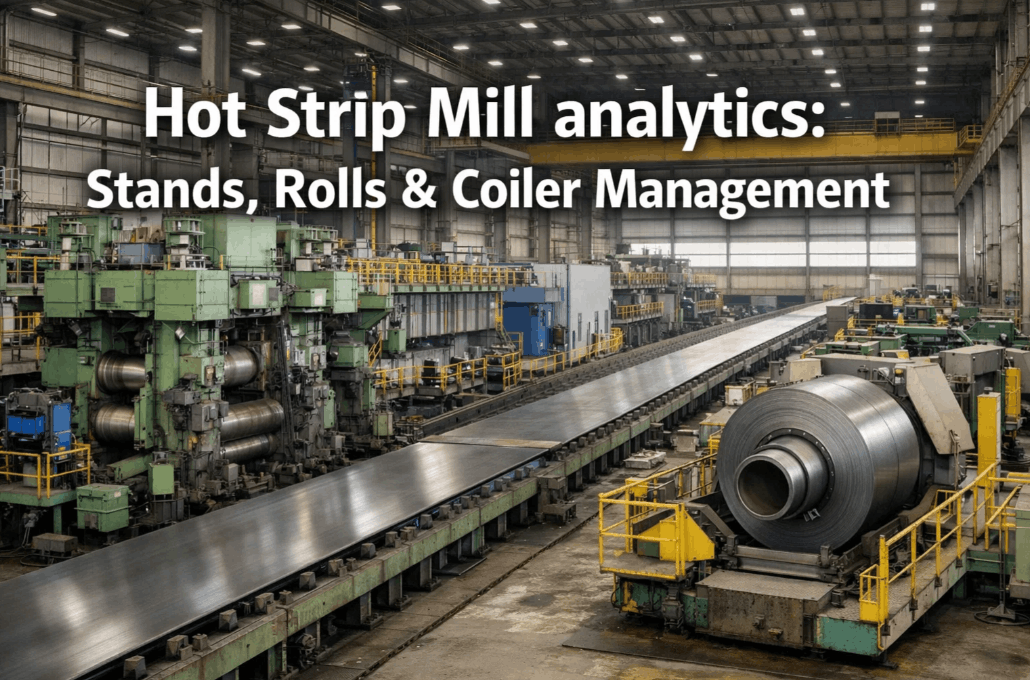
The hot strip mill is the undisputed heartbeat of downstream steel production. Converting massive 200mm slabs into 1.2mm precision steel coils at speeds exceeding 1,200 meters per minute exposes mechanical assets to extreme torque, intense thermal shock, and catastrophic hydraulic pressures. When a roughing mill bearing fails or third-octave chatter vibrates through the finishing stands, the resulting gauge deviations and cobbles can destroy thousands of tons of high-grade automotive or electrical steel in hours. Upgrading to a comprehensive hot strip mill analytics system shifts operators from reactive fire-fighting to predictive strip control. By integrating high-frequency vibration data, roll force sensors, and coiler analytics directly into AI-driven dashboards, modern rolling facilities are extending campaign schedules and virtually eliminating third-party quality claims. Book a Strategy Session to discover how HSM AI-driven tracking revolutionizes operational uptime and gauge precision.
Optimize Roll Change Intervals & Neutralize Chatter
Harness predictive rolling mill analytics to track work roll wear perfectly, monitor AGC cylinder integrity, and identify harmful hot mill bearing harmonics before they scar the strip surface.
The Urgency of Rolling Mill Analytics
In continuous hot rolling operations, there is no buffer. If the F1 through F7 finishing stands experience a mechanical defect—such as spindle wear or failing looper hydraulics—the entire melt shop pipeline backs up, choking the continuous caster and ladles. Traditional strip mill software only flags defects *after* out-of-tolerance steel has been wrapped on the mandrel. Modern hot rolling analytics intercepts issues much earlier. By evaluating edge micro-vibrations, torque imbalances, and hydraulic actuator health simultaneously, the AI model issues early warnings before the product gauge breaches tolerances, facilitating dynamic roll change optimization rather than fixed, arbitrary scheduling.
HSM Stand Analytics: The 6 Pillars of Strip Mill AI
Total hot strip mill observability extends beyond single-stand monitoring. It requires analyzing the cascading effect that tension, cooling, and roll wear have as the strip travels from the rougher to the coiling mandrel.
Stand Vibration & Chatter Detection
Continuous tracking of hot mill bearings and gearbox acoustics using edge devices. Detects deadly third-octave chatter and bearing cage cage degradation weeks before they imprint tiger-stripes onto the steel surface.
Prevent Gauge BandingDynamic Work Roll Tracking
Models thermal expansion and abrasive mechanical wear across the work roll barrel dynamically. Optimizes exact roll change sequencing based on actual strip surface roughness limits, rather than rigid tonnage quotas.
Roll Change OptimizationAGC Hydraulic Cylinder Analytics
Monitors the servo valves and absolute hydraulic pressures powering the Automatic Gauge Control systems. Identifies piston friction, internal fluid leaking, and lagging valve response times that cause head-end thickness errors.
99.9% AGC AccuracyLooper & Tension Control
Tracks standard looper torque limits and angular feedback to ensure perfect mass flow. AI detects looper hunting and tension oscillations that frequently lead to width necking and catastrophic strip tears.
Eliminate Mass Flow TearsRunout Table Cooling Maps
Fuses water header pressure efficiency with pyrometer temperature drops. Maps exact laminal cooling profiles to guarantee precise metallurgical phase transformations (martensitic vs ferritic) for the desired steel grade.
Exact Tensile ComplianceDowncoiler Analytics
Monitors pinch roll load cells, wrapper roll synchronization, and mandrel expansion pressures. Coiler analytics perfectly prevent telescoping coils and scratched inner wraps that ruin downstream yield.
Zero Telescoping RejectsThe AI-Driven Roll Change Optimization Workflow
Manually tracking roll history leads to excessive grinding costs and dangerous in-mill surface failures. For a deep-dive demonstration on how to unify your roll shop data with your Level 2 automation feeds, Book a Demo to see our HSM modeling in action.
Roll Ingestion & Campaign Profiling
When a new set of work rolls and backup rolls traverse from the roll shop to the mill, the AI absorbs their exact grinding profile, hardness rating, and historical fatigue limits—linking them instantly to the upcoming product mix sequence.
Zero-State ProfilingReal-Time Wear Simulation
As slabs enter the mill, the AI calculates thermal crowning and abrasive stripping against the rolls. Instead of guessing, operators view a live digital thermal map of the roll barrel, ensuring strip crown and flatness targets remain pristine.
Live Thermal Crowning ArrayChatter Matrix Interception
If the mill encounters localized hard spots in a slab, vibrations spike. The system's edge analytics classify the harmonics—distinguishing between harmless rumble and fatal fifth-octave bearing chatter—issuing immediate slow-down interlocks.
Millisecond Fast InterlockDynamic Roll Extraction Command
The software predicts exactly when the roll will breach acceptable surface roughness thresholds based on live gauge feedback. It alerts the pulpit to execute a roll change optimization exactly at the statistical end-of-life, saving 22% of total roll campaign limits.
Data-Driven ExtractionRolling Mill Condition Monitoring: Upgrading and Sustaining
Running HSM stands blind guarantees millions inherently lost to cobble cleanups, bearing seizures, and coil rerouting. Evaluate your telemetry maturity to discover exactly where your mill stands in our predictive index.
Fixed Tonnage Schedules
Work rolls are swapped strictly based on km or tons rolled, regardless of actual surface degradation. Bearings are greased manually; degradation is only detected when parts are audibly screaming.
Offline Handheld Vibration Logs
Maintenance routes manually record hot mill bearing profiles once per month using walk-around data collectors. Rapidly propagating defects easily slip through between inspection windows.
Hardwired Alarms without Context
Bearings and coilers feature continuous vibration limits, but warnings lack context regarding steel grades, operating speed, or thickness—driving massive false-alarm nuisance in the pulpit.
HSM AI-Driven Continuous Analytics
Vibration, process torque, and strip gauge are natively fused via machine learning. The AI adjusts alarm thresholds dynamically based strictly on the specific steel grade and thickness currently entering the mill.
Hardware & Embedded SCADA Yielding Superior Strips
Transitioning legacy mechanical drives to modern predictive diagnostics is extremely straightforward. The required data usually already resides trapped inside Level 1 PLCs. Our platform unleashes it. Learn how fast integration operates by contacting our automation team.
| Source Integration Layer | Application in Strip Rolling | Analytical Output |
|---|---|---|
| High-Frequency Accelerometers | Mounted to backup roll chocks, pinion gearboxes, and coilers | Isolating deadly low-octave chatter vs gear meshing issues |
| Level-2 Gauge Thickness X-Rays | Cross-referenced against hydraulic AGC positional data | Identifies valve lagging and servo friction delays |
| Spindle Torque Feedback | Motor current and absolute load cell monitoring | Prevents catastrophic spindle and cobble shattering |
| Laser Profilometry | Inline strip shape scanning mapped exactly to the work rolls | Actively tracks remaining mechanical roll crown |
Eradicating HSM Cobbles and Rejects
A single massive cobble event inside the finishing train destroys high-value flat steel, forces immediate roll changes, damages edge guide sensors, and requires dangerous manual torch cutting inside the mill stands.
Mass Flow Stability
The primary cause of cobbles is a severe loss of inter-stand tension. Strip mill software correlates looper angles against cascading motor speeds. If F4 slows marginally against F3, AI intervenes before the loop balloons upwards into the guides.
Closed-Loop Cobble DefenseStrip Tail-End Tracking
As the strip tail leaves the roughing stand, extreme transient torque shifts hit the finishing stands. AI profiles these impact drops, tuning the hydraulic load cells perfectly to avoid tail-end pinching and subsequent mill crashes.
Zero Tail PinchingWrapper Roll Synchronization
In the downcoilers, if wrapper rolls actuate unevenly or pinch roll pressures deviate, the head end fails to grip the rotating mandrel, violently firing red-hot steel upwards out of the pit. Coiler analytics tracks this precise hydraulic timing.
Synchronized Mandrel Capture12-Month Hot Mill Analytics ROI Matrix
Integrating a dedicated HSM stand analytics umbrella immediately corrects lingering quality issues. Observe the reduction in delays and yield loss across a typical 3.5 Million Ton hot rolling setup over one year. Calculate your mill's exact ROI projection here.
Equipment Domain Deep Dive
Rolling mill analytics span hundreds of meters across highly specialized domains. We configure distinct, customized algorithms based strictly on where the metal is inside the pass line.
Roughing Mill Analytics
Focuses on immense impact pressures, edger roll hydraulic performance, massive spindle torque feedback, and predicting drive shaft coupling fatigue due to reversing passes.
Finishing Train (F1 - F7)
Tracks micrometer-level hydraulic AGC precision, perfectly tuned mass-flow tension between stands, work roll tracking for strip crown, and fatal bearing chatter mitigation.
Descaling & Cooling Headers
Monitoring high-pressure multi-stage descaler pumps for cavitation and tracking laminar cooling valve response matrices to ensure 100% phase-metallurgy compliance.
Downcoiler System
Optimizing mandrel torque retention, side guide parallel hydraulic positioning, and wrapper roll sequencing preventing skewed wraps, telescoping defects, and loose finishing coils.
Direct Financial Returns of HSM Stand Diagnostics
The immediate business metrics from stabilizing the hot mill are dramatic. Yield directly impacts the most profitable segments of enterprise manufacturing margins.
Decreased Grinding Overheads
Leaving work rolls in the stands exactly until their true abrasive limit is reached saves millions in premature grinding cycles and raw high-chrome/HSS roll steel purchasing.
Gauge Performance Yield
AI-backed AGC and tension mapping virtually eliminate internal material rejections caused by thickness banding, ensuring maximum output qualifies as prime flat rolled coils.
Rapid Downtime Resolution
When an obscure mechanical issue arises, instead of 10 hours of line stoppage while technicians trace hydraulics, our system instantly flags the exact friction-locked valve triggering the delay.
Avoiding Wrecked Drivelines
Massive roughing mill spindles and driveshafts can literally explode under unmonitored torque feedback loops. High-frequency AI sensing instantly unloads the main drives if critical stress is sensed.
What Flat-Rolled Mill Directors Are Saying
"Before we deployed the HSM AI-driven platform, our chatter issues on F5 and F6 were crippling our ability to run thin-gauge AHSS steel. Coils were being downgraded daily. iFactory isolated a degrading backup-roll bearing frequency that only expressed itself under specific metallurgical forces. We mapped it, changed the limits, and completely cured the band defect within 48 hours."
Frequently Asked Questions: Rolling Mill Analytics
How do we connect the coiler analytics if our downcoilers run on isolated PLCs?
Our edge-gateways aggregate data seamlessly. We simply drop a dedicated AI edge processor inside your coiler pulpit electrical room to ingest position sensors, mandrel currents, and wrapper load cells without interfering with Level 2 traffic.
Will the roll change optimization feature integrate with our Roll Shop Software?
Absolutely. The Hot Strip Mill platform integrates seamlessly via API with your roll shop grinding systems. It pulls grinding profiles when the rolls are placed in the mill, and feeds exact wear metrics back to the grinding models after extraction.
How does the system distinguish between normal mechanical rumble and fatal chatter?
Hot mill bearing and stand dynamics are processed using Fast Fourier Transform (FFT) analysis paired directly against machine learning baselines mapped precisely to individual steel grades, speeds, and forces. This ignores background rumble and isolates the specific third and fifth octave frequencies indicative of severe structural resonance.
Can this system help prevent cobbles?
Yes. Strip mill software tracking looper tension deviations and hydraulic AGC pressure anomalies instantly identifies the asymmetrical load imbalances that usually precede the strip slipping offline and cobbling. Book a cobble prevention review here.
Take Absolute Control Over Your Hot Strip Mill Setup
Guarantee perfect strip gauge, completely neutralize roll chatter, and eradicate unpredictable breakdowns and cobbles utilizing the industry's most advanced AI-driven stand diagnostics.