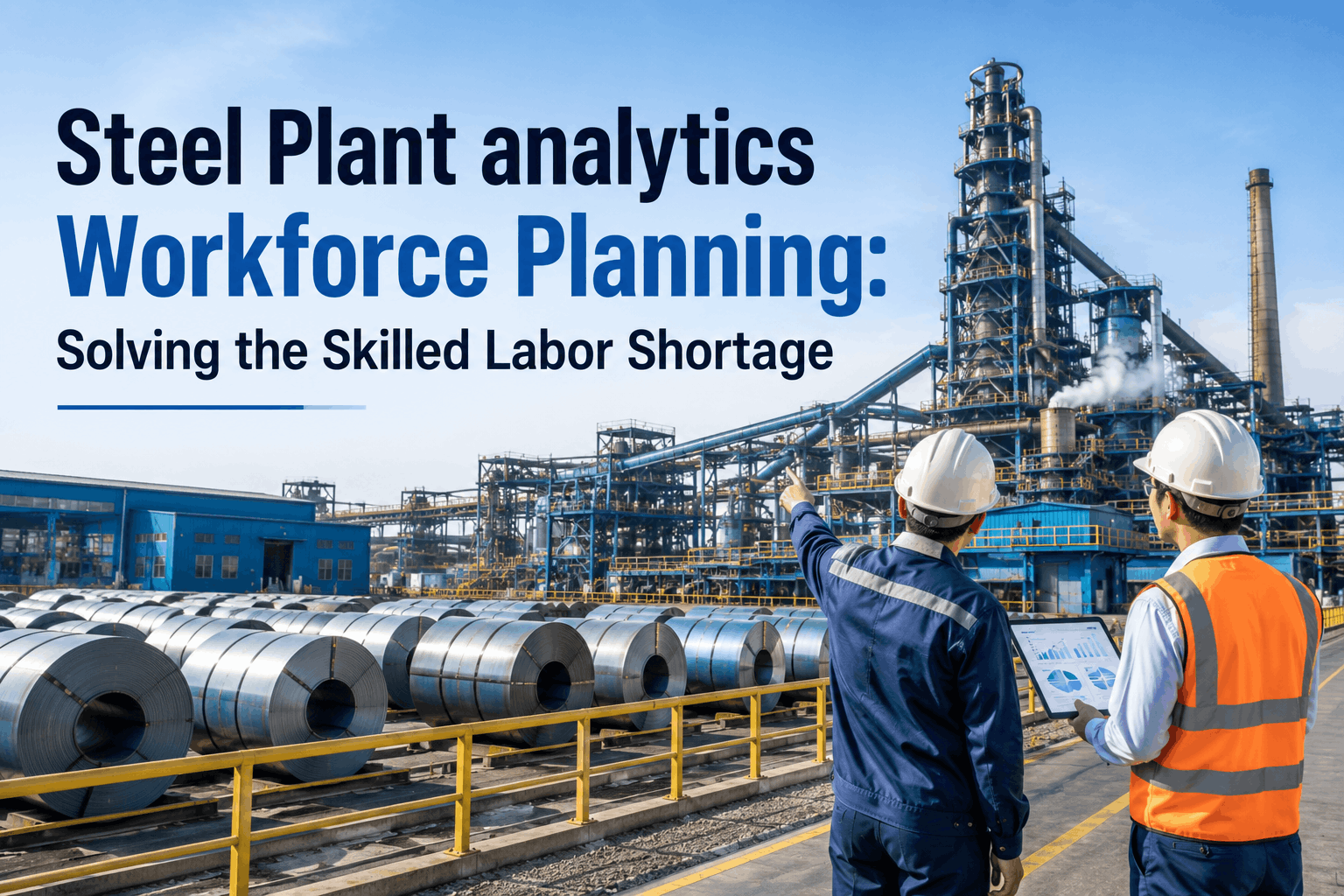
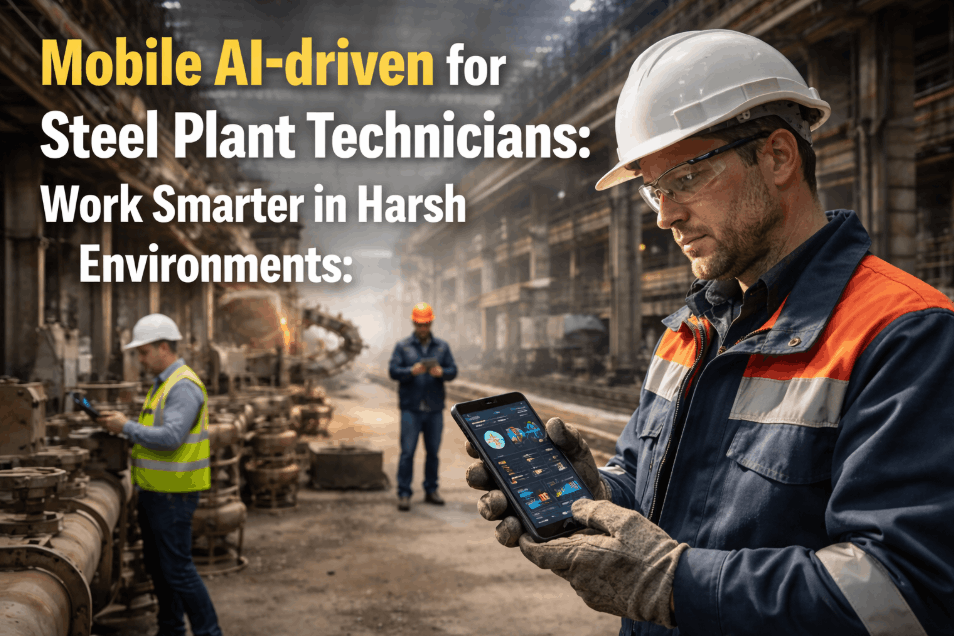
The average maintenance technician in a U.S. steel plant is 54 years old. Forty-nine percent of steel plant operations managers report that recruiting qualified analytics and maintenance professionals is their most persistent operational challenge — more difficult than capital access, more difficult than raw material costs, and more difficult than any other workforce category. Over the next eight years, the Bureau of Labor Statistics projects that 38% of the current steel industry maintenance workforce will reach retirement eligibility — taking with them decades of asset-specific knowledge about furnace behavior, caster quirks, rolling mill drive characteristics, and equipment failure signatures that was never written down anywhere. It exists in the heads of technicians who have been running the same equipment for 20 or 25 years, and when those technicians retire, it leaves with them. The facilities that survive the labor shortage and the knowledge exodus are the ones that treat the problem as an operations technology challenge rather than a human resources challenge — using iFactory's mobile AI-driven platform, structured knowledge capture tools, and AI assist capabilities to enable lean maintenance teams to perform at the level that larger, more experienced crews once achieved. Facilities deploying iFactory's workforce productivity platform report 41% reduction in time-to-competency for new technicians, 37% improvement in first-time fix rate on complex assets, and the ability to operate effective maintenance programs with 22% fewer technicians than comparable facilities running without AI assistance — not by cutting corners on maintenance quality, but by eliminating the information retrieval and knowledge dependency that inflates the crew size requirement for any given maintenance task load.
The Labor Shortage Numbers Steel Plant Operations Cannot Ignore
The skilled labor crisis in U.S. steel plant maintenance is not a future threat — it is a current operational reality that is already degrading maintenance program execution quality at facilities across every production segment. The data points that matter to operations and maintenance leadership are not the macro workforce statistics from industry associations. They are the specific, facility-level consequences that show up in maintenance program metrics when the technician population shrinks faster than the work order volume: longer mean time to repair because fewer experienced technicians are available per shift, higher repeat failure rates because newer technicians do not have the asset-specific pattern recognition that prevents missed root causes, and increasing PM deferrals because the available crew cannot execute the planned maintenance load during regular shifts without overtime.
The structural cause of these consequences is not a shortage of people willing to work in a steel plant. It is a shortage of people who know how to diagnose a continuous caster segment seal failure from vibration data, how to differentiate a roll bearing defect from a chatter mark on a hot strip mill drive, or how to interpret a tundish temperature drift as a tapping practice problem rather than a cooling water flow issue. That knowledge took the retiring generation 15 to 20 years to accumulate, and the incoming generation has neither the time nor the apprenticeship structure to build it the same way. The only viable path to closing the knowledge gap at the speed that the retirement wave requires is technology-assisted knowledge transfer — and that is precisely what iFactory's platform is built to enable. Book a Demo to see how iFactory's knowledge capture and AI assist capabilities apply to your facility's specific maintenance workforce challenge.
Four Ways the Labor Shortage Shows Up in Steel Plant Maintenance Performance — and What iFactory Does About Each One
The labor shortage does not produce a single, uniform maintenance performance failure. It produces four distinct capability gaps that each require a different operational response. iFactory's platform addresses all four within a single integrated deployment — mobile access, knowledge base, AI assist, and guided workflows operating as connected capabilities rather than separate tools that each require their own implementation and adoption cycle.
iFactory vs. Standard Practice: How Technology Closes the Gap a Smaller Crew Creates
The comparison below reflects the specific workflow and capability differences between a steel plant maintenance organization running on paper work orders and undocumented tribal knowledge versus one equipped with iFactory's mobile platform, knowledge base, and AI assist. The gap is not theoretical — it is measured in MTTR, first-time fix rate, and PM compliance data from comparable facilities. Book a Demo to see iFactory's workforce productivity platform applied to your facility's current crew size and maintenance task load.
- New technicians require 18 to 36 months to reach full competency — during which error rates and rework frequency remain elevated
- Complex task execution depends on senior technician availability — deferred when senior technicians are unavailable or on another job
- Asset-specific diagnostic knowledge exists only in senior technicians' memory — lost permanently at retirement
- PM prioritization based on schedule dates rather than condition data — most critical assets not always serviced first
- Work order closure data incomplete — failure codes missing, root cause fields blank, parts data not entered at close
- Training delivered in classroom or shadowing format — slow, inconsistent, and impossible to scale at retirement wave pace
- New technicians reach effective competency in 8 to 12 months via guided workflows and asset-linked knowledge base access
- Guided procedure modules deliver step-by-step complex task execution on the field device — no senior supervisor required at every step
- Knowledge capture tools convert expert experience into permanent asset records before technician retirement removes it forever
- AI assist generates condition-aware daily work order priority list — highest-risk assets serviced first regardless of schedule sequence
- Mobile work order closure captures failure codes, root cause, and parts at the asset — CMMS data quality maintained without clerk intervention
- Guided workflow training happens on the job, at the asset, on the device — scalable to any crew size at any experience level
Knowledge Capture Before the Retirement Wave — The One Workforce Investment That Pays Forever
Most steel plant maintenance organizations understand that the retirement wave is coming and that experienced technicians are taking irreplaceable knowledge with them — but the typical response is to plan for replacement hiring, which addresses the headcount gap without addressing the knowledge gap. A new hire replacing a retiring 28-year technician can run a work order, follow a procedure, and execute a standard PM. What the new hire cannot do — for several years — is know from a brief observation that the hot strip mill drive noise pattern on Stand 4 means the intermediate bearing is failing, not the output bearing, and that the correct repair sequence is different from what the procedure shows because this particular stand was rebuilt in 2019 with a non-standard bearing arrangement. That knowledge is worth tens of thousands of dollars in avoided misdiagnosis and repeat repair — and it disappears the day the retiring technician walks out.
iFactory's knowledge capture module provides the structured tools to convert that knowledge into permanent institutional records before the departure happens — and the urgency of starting that conversion now, while the experts are still present and available to contribute, cannot be overstated. A knowledge capture program that begins 18 months before a critical technician's retirement produces a comprehensive asset intelligence library. A program that begins two weeks before the retirement date produces a partial record that is better than nothing but misses the depth that makes it actionable for a new technician working alone on a critical asset at 3 AM.
| Knowledge Type | Where It Currently Lives | Risk If Not Captured | iFactory Capture Method | Value to New Technician |
|---|---|---|---|---|
| Asset-Specific Failure Patterns | Senior technician memory — 15–25 years of observed failure signatures on specific equipment | New technician misdiagnoses same failure mode; repeat repairs, higher MTTR | Structured failure pattern entries linked to asset record — searchable by symptom and equipment type | Correct diagnosis on first visit; reduced diagnostic time by 40–60% |
| Non-Standard Repair Procedures | Printed annotations on OEM manuals; informal crew knowledge; planner memory | New technician follows standard procedure on non-standard equipment; rework or failure | Technician-authored procedure variants linked to specific asset serial numbers with photo documentation | Correct procedure executed first time without senior supervision |
| Vendor and Contractor Intelligence | Maintenance supervisor relationships; undocumented vendor quality history | New maintenance leadership selects poor-performing vendors; repeat quality issues | Vendor performance records in CMMS with technician-annotated quality notes per job | Informed vendor selection without requiring institutional memory from departing staff |
| Operational Workarounds | Informal crew knowledge — "the way we do it here" that is never documented | New technician uses standard approach on equipment that requires site-specific handling; damage or injury risk | Guided workflow hold points flagged with site-specific cautions authored by experienced technicians | Site-specific safety and operational constraints surfaced at the relevant step, not discovered the hard way |
| Predictive Observation Thresholds | Senior technician calibrated judgment — "that bearing sounds like it has about three weeks left" | New technician cannot make same predictive assessment; unexpected failures from missed early-stage indicators | Condition alert thresholds calibrated with senior technician input during knowledge capture sessions | Platform replicates the early-warning judgment with sensor data — predictive capability survives retirement |
Expert Perspective: What Steel Plant Maintenance Leaders Say About the Labor Shortage and Technology Response
I have been the maintenance manager at this integrated steel facility for fourteen years and I have watched the workforce demographics shift in a way that I genuinely did not anticipate ten years ago. When I started in this role, my senior technicians averaged about 48 years old. Today they average 57. I have lost eleven of my most experienced people to retirement in the last four years and I have eight more who will be eligible in the next three. The ones I am losing were not just doing jobs — they were carrying the diagnostic intelligence for their entire equipment section. The guy who ran our continuous caster maintenance for nineteen years knew every quirk of every segment in that machine. He knew which segments ran hot, which ones needed more frequent roll gap checks, which tundish configurations were most likely to produce solidification irregularities in our specific steel grades. None of that was in any document. It was in his head, and most of it left when he retired. We started a structured knowledge capture program with iFactory eight months before his retirement, and we got probably 60% of what he knew into documented form before he left. The 40% we missed is showing up as longer diagnostic times and higher repeat repair rates on that caster section from technicians who are capable but do not have his twenty-year asset model to draw from. The lesson I learned is that knowledge capture has to start years before the retirement, not months. The AI assist capability and the guided workflows have been essential for keeping our lean crew executing at a level that would not have been possible without the technology — but the knowledge base is the foundation that makes both of those tools effective. If the knowledge is not in the system, the AI has nothing to work with and the guided workflows are generic rather than asset-specific."
Conclusion
The skilled labor shortage in U.S. steel plant maintenance is a structural demographic shift that no amount of recruitment investment can fully reverse on the timescale that the retirement wave requires. The facilities that maintain maintenance program quality through this transition are the ones that treat knowledge capture, guided workflow execution, and AI-assisted prioritization as operational imperatives — not future technology projects — starting now, while experienced technicians are still present to contribute to the knowledge base that will enable their replacements to perform.
iFactory's mobile platform, knowledge base, and AI assist capabilities provide the specific tools that lean maintenance teams need to perform at the level that larger, more experienced crews previously achieved: 41% reduction in time-to-competency for new technicians, 37% improvement in first-time fix rate on complex assets, and effective maintenance program execution with 22% fewer technicians than comparable facilities operating without technology assistance. The knowledge that your senior technicians carry is your most valuable and most time-limited maintenance asset — and the window to capture it is open right now, not after the next retirement announcement. Book a Demo to see how iFactory's workforce productivity platform applies to your facility's specific labor demographic and maintenance program requirements.
Frequently Asked Questions
iFactory provides structured knowledge capture templates linked directly to asset records — covering failure pattern entries, non-standard procedure variations, site-specific cautions, and predictive observation thresholds. Technicians contribute via the mobile device during or after jobs, and supervisors conduct structured debriefs that are recorded and linked to the relevant asset hierarchy. The best results come from starting the program 12 to 18 months before a critical technician's planned retirement date.
Facilities deploying iFactory's guided workflow module report 41% reduction in time-to-competency — compressing the typical 18 to 36 month ramp-up to 8 to 12 months for complex asset categories. The workflows deliver step-by-step interactive procedures on the mobile device with hold points and measurement checkpoints, allowing new technicians to execute procedures correctly without senior supervision from their first weeks on the job.
iFactory's AI assist module analyzes real-time condition monitoring data, asset criticality rankings, PM backlog status, and production schedule constraints to generate a daily recommended work order priority list for each shift. The prioritization ensures that the most critical assets and highest-risk deferrals are addressed first — maximizing maintenance value per available technician-hour when crew size limits what the team can accomplish in a shift.
Yes — iFactory's AI-assisted prioritization, mobile work order management, and condition-based scheduling work together to maximize PM execution from a reduced crew. Facilities using iFactory have maintained effective maintenance program quality with 22% fewer technicians than comparable facilities without technology assistance, by eliminating information retrieval overhead and directing available labor at the highest-risk maintenance items first.
Full deployment — CMMS integration, knowledge base population from existing records, guided workflow configuration for priority assets, and mobile onboarding for the technician crew — typically completes in five to eight weeks. Knowledge capture from senior technicians is an ongoing process that begins at deployment and builds over the months before planned retirements. Book a Demo to review the deployment plan for your facility's crew size and asset population.