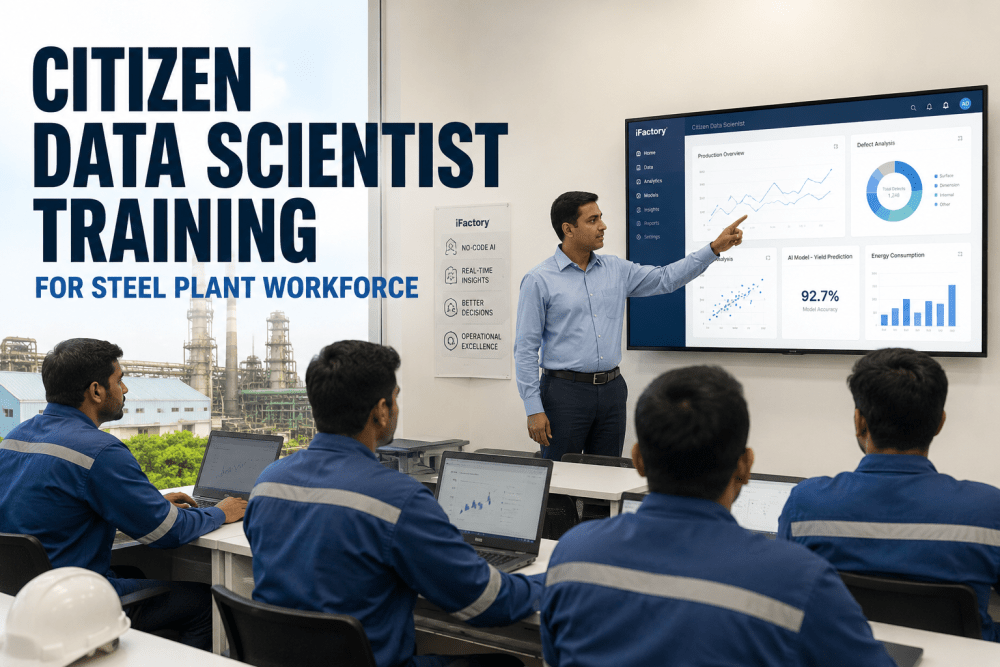
The steel industry faces its most severe skilled labour shortage in a generation. Across India, 43% of integrated steel plant maintenance departments report critical vacancies in instrumentation, PLC programming, and predictive maintenance analytics — roles that take 5–8 years to develop through apprenticeship and on-the-job learning. Meanwhile, the engineers who built the industry's institutional knowledge are retiring at accelerating rates, taking decades of undocumented equipment knowledge with them. A blast furnace tapping crew leader who has watched 12,000 heats over 28 years carries knowledge that no manual captures. When that person retires, the plant does not just lose a worker — it loses a library. iFactory's Workforce Management and Training platform digitises this knowledge, maps competency gaps by role and shift, tracks training completion, and uses AI to match each technician's skill development path to the specific equipment they maintain.
Steel Plant Maintenance Workforce Planning: Solving the Skilled Labour Shortage
Competency mapping, apprenticeship programme design, knowledge capture from retiring experts & AI-tracked skill development — the complete workforce strategy for steel plant maintenance.
The Skill Gap Crisis in Steel Plant Maintenance — By the Numbers
Steel plant maintenance departments face a compound crisis: experienced people leaving faster than replacements can be trained, in roles that require years of plant-specific knowledge. The gap is not just a headcount problem — it is a knowledge problem. Schedule a workforce gap assessment to see where your plant's most critical knowledge risks are concentrated.
Retirement Wave
28% of senior maintenance technicians across Indian integrated steel plants will reach retirement age by 2027. In specialised roles — BF operators, continuous caster technicians — the figure exceeds 35%.
Knowledge Not Captured
Industry surveys show 78% of critical equipment knowledge in steel plants exists only in the heads of experienced operators — not in SOPs, not in manuals, not in any digital system.
Training Takes Too Long
A fully competent PLC maintenance technician for a continuous casting line requires 5–8 years of guided development. Standard industry training programmes produce a basic-competency technician in 18 months — leaving a 4–6 year performance gap.
Skill Gap = Downtime Risk
Plants with high skill gap ratios (vacancies / total headcount >15%) report 2.3× higher unplanned downtime than plants with adequate staffing — directly linking workforce capability to production reliability.
Skill Gap Map — Current Coverage vs Minimum Required Across 6 Disciplines
iFactory measures your team's average competency across every critical maintenance discipline and shows exactly how far each skill area is from the minimum safe operating level. The red gap is your training investment target — ranked by operational risk.
iFactory Competency Matrix — Mapping Every Skill to Every Role
iFactory's competency framework maps 6 skill levels (0 = no knowledge → 5 = expert/trainer) against every maintenance role and equipment type in the plant. This matrix becomes the foundation for training plans, shift coverage decisions, and succession planning. Schedule a competency mapping demo for your specific maintenance roles.
| Skill Area | Level 1 Awareness |
Level 2 Basic |
Level 3 Competent |
Level 4 Proficient |
Level 5 Expert/Trainer |
|---|---|---|---|---|---|
| Vibration Analysis | Knows what it is | Runs routes | Interprets spectra | RCA from data | Trains others, validates models |
| PLC / SCADA | Reads HMI only | Basic fault reset | Program read/edit | Full commissioning | System architecture, training |
| Hydraulics | Basic safety | Filter/fluid change | Circuit diagnosis | Proportional valves | High-pressure systems |
| Electrical / MCC | Basic safety | Switching ops | Drive diagnosis | Protection relay | Power systems engineering |
| Predictive Analytics | Knows concept | Reads dashboards | Interprets alerts | Tunes models | Builds new models |
| Lubrication | Top-up only | Route execution | Oil analysis | Contamination RCA | Tribology / system design |
iFactory Apprenticeship Programme Structure — 4 Phases Over 24 Months
A structured apprenticeship programme tracked in iFactory reduces time-to-competency by 30–40% vs unstructured on-the-job learning — because every learning milestone is planned, supervised, assessed, and recorded. iFactory tracks progress through all four phases and flags when an apprentice is falling behind schedule.
Plant safety induction, permit-to-work system, LOTO procedures, basic equipment identification, safety data sheets, emergency procedures. Minimum 60 assessed hours before progression.
Rotating placements across mechanical, electrical, instrumentation, and hydraulics. Supervised by L4/L5 mentor. Weekly task assessments in iFactory — progression gated on demonstrated competency, not calendar time.
Deep assignment to primary equipment area — BF, continuous caster, rolling mill, or utility. Works alongside dedicated mentor on all planned and predictive maintenance tasks. Fault diagnosis under supervision.
Independent maintenance execution with competency assessor sign-off on 30 assessed tasks across the equipment area. iFactory generates completion certificate and updates the plant workforce competency dashboard.
How iFactory Captures Retiring Expert Knowledge Before It Walks Out the Door
The most dangerous workforce transition is not a resignation — it is an unplanned retirement. iFactory's Knowledge Capture module structures the extraction of tacit equipment knowledge from experienced technicians into searchable, AI-indexed digital records — making that knowledge available to every technician on every shift, indefinitely. Schedule a knowledge capture assessment to identify your highest retirement risk roles.
Video Knowledge Records
Structured video interviews with expert technicians — iFactory's AI transcribes, tags by equipment type, failure mode, and procedure, and makes the content searchable from the technician's mobile app during a job.
Failure Mode Libraries
Expert interviews structured around specific failure scenarios — "what do you do when this bearing fails at night with no spare?" — build equipment-specific failure mode libraries that juniors can query during incidents.
On-Premise LLM Knowledge Base
All captured knowledge feeds iFactory's on-premise AI assistant — technicians ask natural language questions ("what causes the No.3 caster mould level oscillation at high speed?") and get answers drawn from expert knowledge records.
Mentorship Tracking
Formal mentorship assignments between retiring experts and designated successors — tracked in iFactory with weekly task logs, knowledge transfer assessments, and a countdown to the mentor's last working day.
Succession Readiness Score
For every critical role, iFactory calculates a succession readiness score — comparing the highest-ranked successor's competency profile against the minimum requirement for the role, and showing the training gap in months.
Critical Role Risk Alerts
iFactory flags roles where the primary incumbent is within 18 months of retirement with no successor at Level 3 or above — giving plant leadership 18 months of advance warning to accelerate succession training.
What a Maintenance Training Manager Said
Our senior BF foreman retired in March. We had done the iFactory knowledge capture programme with him for 8 months before — 47 video records, 312 failure scenarios documented, all indexed. Six months after he left, a night shift team used his knowledge base to diagnose and resolve a tuyere erosion problem in 40 minutes. The same problem took 4 hours the last time we dealt with it — before his knowledge was captured. That single incident is worth more than the entire programme cost.
Frequently Asked Questions
How does iFactory's competency matrix connect to actual maintenance assignments?
iFactory's work order system checks the competency level required for each task type against the assigned technician's current competency score. Tasks requiring Level 3 or above are blocked from assignment to Level 1–2 technicians, with supervisor override available and logged for compliance. This prevents unsafe assignment of complex tasks to undertrained staff.
How long does the expert knowledge capture process take per retiring technician?
A comprehensive knowledge capture programme for a senior technician takes 6–12 months of weekly structured sessions — typically 2 hours per week. iFactory's AI handles transcription, tagging, and indexing automatically, so the structured interview time is the only significant time investment from the expert.
Can iFactory track apprenticeship progress against IS or ITI standards?
Yes — iFactory's training framework can be configured against ITI trade competency standards, NSQF level descriptors, or plant-specific competency frameworks. Assessment records generated in iFactory can be exported in formats compatible with NCVT and sector skill council reporting requirements.
How does iFactory identify which roles are at highest retirement risk?
iFactory analyses each role's criticality score (based on equipment criticality, shift coverage minimum, and unique skill dependency), the age and retirement proximity of the primary incumbent, and the succession readiness gap — ranking all roles by composite risk score so plant leadership can prioritise knowledge capture and succession investment.
See iFactory Workforce Planning Live for Your Plant
Demo built around your workforce structure, retirement risks, and competency gaps.