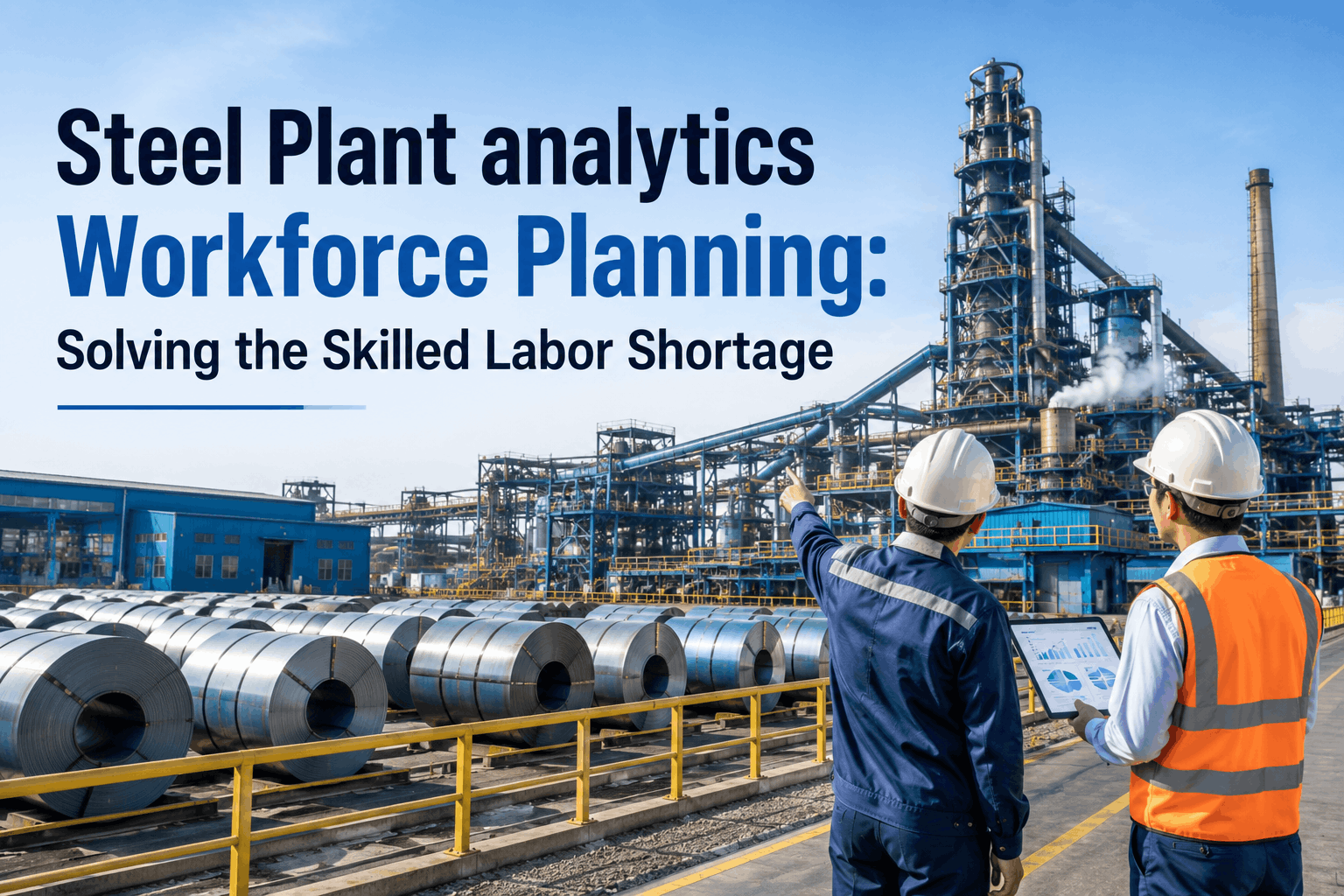
Steel Plant analytics Budget Planning: Cost Estimation, Allocation & ROI Tracking

By Friar Lawrence on May 22, 2026

steel-plant-analytics-budget-planning-cost-estimation

Steel plants allocate between 2% and 5% of total operating costs to analytics and maintenance technology programs—yet fewer than one in three facilities can demonstrate a documented return on that investment within 18 months. The gap between analytics spend and measurable outcomes is not a technology problem; it is a planning problem. When cost estimation is disconnected from operational realities, when capital and expense classifications are handled inconsistently, and when budget variance is tracked annually instead of monthly, analytics programs drift from strategic assets into cost centers that invite cuts at the next budget cycle. This article provides U.S. steel plant finance, operations and maintenance leaders with a practical framework for estimating, allocating, trackingand defending analytics budgets—from initial project scoping through lifecycle ROI documentation.


Steel Plant Analytics Budget Planning

Cost Estimation. Smart Allocation.
Proven ROI.

A field-tested framework for U.S. steel manufacturers to plan, allocate, and justify analytics budgets—from capital classification to per-tonne cost benchmarking and live variance tracking.

Why Analytics Budget Planning Fails in Steel Manufacturing

Most steel facilities approach analytics budgeting the same way they approach capital equipment purchases: a single annual estimate, reviewed once, approved or cut, and largely forgotten until the next budget cycle. This model fails because analytics programs are not static assets—they are living systems with variable cost drivers, expanding scope, and compounding returns that require active financial management throughout the year.

68%
of analytics projects exceed initial budget by year two
14 mo.
Average time to first measurable ROI in steel analytics programs
$0.38
Median analytics cost per tonne for integrated steel facilities
3.2x
Average ROI for predictive analytics within 36 months

Three structural problems drive most analytics budget failures. First, cost estimation is done at the platform level without accounting for implementation, integration, training, and ongoing data management labor. Second, capital versus operating expense classification is handled inconsistently, creating tax and depreciation inefficiencies that inflate the apparent cost of programs. Third, variance tracking happens at the annual review rather than monthly, meaning cost overruns are discovered after they have compounded rather than when they can be corrected.

Cost Estimation by Department: Building a Realistic Budget Model

Accurate analytics cost estimation in steel manufacturing requires a bottom-up approach that accounts for platform licensing, integration engineering, sensor infrastructure, internal labor allocation, and ongoing support costs by department. The most common mistake is using a single facility-wide license cost as the budget—without modeling the true cost of deployment and sustained operation in each functional area.

CMMS platform license (per seat, annual)
$1,200 – $3,500
Varies by vendor; enterprise tiers typically $2,800+
PLC/sensor integration engineering (one-time)
$45,000 – $120,000
Per major asset class; EAF/rolling mill integration at upper end
Vibration/thermal sensor hardware (per machine)
$800 – $4,500
Online continuous monitoring vs. portable route-based systems
Internal labor: data analyst / reliability engineer
$95,000 – $140,000
Annual fully-loaded cost; often shared across departments
Annual maintenance & support (platform)
18% – 22% of license
Include in Year 2+ budget; often underestimated in Year 1
MES/production analytics module (annual)
$28,000 – $85,000
Facility-wide; integrated with rolling mill and casting lines
Quality control analytics (SPC + AI vision)
$18,000 – $55,000
Camera hardware additional $12,000–$40,000 per inspection point
OEE analytics implementation (one-time)
$15,000 – $38,000
Includes data historian integration and dashboard configuration
Production data engineer (internal labor)
$88,000 – $125,000
Annual fully-loaded; typically 60% allocated to production analytics
Training & change management
$8,000 – $22,000
Per department; multi-shift facilities require additional sessions
Energy monitoring platform (facility-wide)
$22,000 – $60,000
Annual SaaS; includes substation and major load monitoring
Smart metering hardware (per metering point)
$350 – $1,200
Mid-tier steel plant typically needs 80–200 metering points
Integration with utility billing systems
$8,000 – $25,000
One-time engineering; critical for demand charge management analytics
Compressed air / water / gas sub-metering
$18,000 – $45,000
Hardware + installation; often phased across 2–3 budget cycles
Annual utilities analytics reporting
$6,000 – $18,000
External consulting for ISO 50001 / EPA reporting support
EHS management platform (annual)
$14,000 – $42,000
Incident reporting, inspection management, compliance tracking
AI vision safety monitoring (per camera zone)
$3,500 – $9,000
PPE detection, restricted area monitoring; hardware additional
Regulatory compliance reporting module
$8,000 – $24,000
OSHA, EPA, state-level reporting; reduces external audit prep costs
Arc flash / electrical safety analytics integration
$12,000 – $35,000
Links arc flash study data to work orders and PPE requirements
Safety training records & certification tracking
$4,000 – $12,000
Annual module cost; integrated with HR systems where available

Capital vs. Operating Expense Classification: Getting It Right

Misclassifying analytics expenditures between capital (CapEx) and operating (OpEx) categories is one of the most consequential—and most common—budget planning errors in industrial technology programs. The classification determines depreciation schedules, tax treatment, budget approval thresholds, and how the investment appears in financial statements. For steel manufacturers, where analytics programs often involve both software subscriptions and significant hardware and integration work, a systematic classification framework is essential. Schedule a 30 min Session

CapEx Classification

Capitalized Asset
Sensor hardware and monitoring devices permanently installed on equipment
Network infrastructure (cables, switches, servers) dedicated to analytics
On-premise analytics servers and NVIDIA GPU hardware
Custom software development with useful life exceeding 2 years
One-time perpetual software licenses meeting capitalization threshold
Integration engineering that creates a long-lived connective asset

OpEx Classification

Period Expense
Annual SaaS/cloud analytics platform subscription fees
Software maintenance and annual support contracts
Internal labor: data analysts, reliability engineers allocated to analytics
Training, change management, and user adoption programs
Third-party consulting for ongoing analytics optimization
Cloud storage and data processing fees (consumption-based)
IRS Guidance Note: Under ASC 350-40 (Internal-Use Software), implementation costs for cloud-based analytics platforms follow a three-stage model: preliminary project stage costs are expensed; application development stage costs may be capitalized; post-implementation costs are expensed. Consult your tax advisor for facility-specific treatment—misclassification can trigger audit risk and restatement requirements.

Unsure how to classify your analytics investment mix for the current budget cycle? Schedule a session with our implementation team to build a classification framework aligned to your accounting policies.

Analytics Budget Allocation Framework: Department Weighting and Phasing

Once total analytics budget is established, allocation across departments requires a structured weighting methodology that reflects both strategic priority and operational impact potential. Steel plants that allocate analytics spend proportionally to headcount or department size consistently underperform those that weight allocation by risk-adjusted ROI potential. The following framework provides a starting allocation model that can be adjusted to reflect facility-specific priorities.

Analytics Budget Allocation Model — Mid-Tier Integrated Steel Plant ($8M–$15M Annual Revenue per Department)
Department Recommended Allocation Primary Analytics Use Case Typical Annual Spend ROI Timeline Priority Tier
Maintenance & Reliability 28–35% Predictive maintenance, CMMS, asset health $180,000 – $420,000 12–18 months Tier 1
Production Operations 20–28% OEE, yield analytics, downtime tracking $130,000 – $330,000 8–14 months Tier 1
Quality Control 14–20% SPC, AI vision inspection, scrap analytics $90,000 – $240,000 10–16 months Tier 2
Energy & Utilities 12–18% Demand management, consumption analytics $78,000 – $215,000 14–24 months Tier 2
Safety & Compliance 8–14% EHS analytics, incident tracking, PPE compliance $52,000 – $168,000 18–30 months Tier 3
Inventory & Supply Chain 5–10% Parts optimization, vendor analytics $32,000 – $120,000 20–36 months Tier 3

Ready to Build a Defensible Analytics Budget?

iFactory's cost modeling tools help steel plant finance and operations teams structure analytics spend by department, classify CapEx versus OpEx correctly, and generate audit-ready ROI documentation from day one.

Variance Analysis and Budget vs. Actual Tracking

Budget variance in analytics programs compounds faster than in traditional capital projects because the cost drivers—API consumption, data storage, user seat expansion, and integration scope creep—are invisible until they appear on invoices. Effective variance management requires monthly tracking cadences, defined variance thresholds that trigger review, and root cause categorization that distinguishes structural budget errors from temporary timing differences.

01

Monthly Actuals Capture

Pull actual analytics spend from accounts payable by cost center no later than day 10 of the following month. Include platform invoices, labor time allocations, hardware purchases, and consulting fees. Partial-period accruals are required for multi-month contracts.

Monthly — Day 10
02

Variance Calculation and Threshold Flagging

Calculate budget vs. actual variance by department and cost category. Flag any line item showing greater than 10% unfavorable variance for immediate review. Flag cumulative YTD variance exceeding 8% for escalation to operations leadership.

Monthly — Day 12
03

Root Cause Categorization

Categorize each flagged variance as: scope change (new requirements added post-budget), timing difference (spend shifted between periods), estimation error (original budget was wrong), or consumption overage (usage-based costs exceeded model). Each category demands a different corrective response.

Monthly — Day 14
04

Forecast Revision and Reallocation

Update the full-year forecast based on confirmed run-rate actuals. Identify reallocation opportunities from underspending departments to cover confirmed overages. Submit revised forecast to finance by day 20 of each month with written variance commentary.

Monthly — Day 20
05

Quarterly ROI Reconciliation

Quarterly, reconcile analytics spend against documented savings: maintenance cost reductions, downtime hours avoided, scrap reduction, energy savings, and compliance penalty avoidance. Express results as cost per tonne, percentage of operating cost, and total program ROI. This documentation is the primary defense against budget cuts.

Quarterly

ROI Tracking: Connecting Analytics Spend to Operational Outcomes

Return on investment calculation for steel plant analytics programs requires a defined measurement methodology established before deployment, not retroactively constructed to justify a completed project. The most credible ROI frameworks use a controlled comparison approach—establishing a pre-deployment baseline for each target metric, then measuring post-deployment performance against that baseline with statistical controls for production volume and mix changes. Book a Demo to know how ROI is Calculated

Direct Cost Avoidance Metrics


Unplanned downtime reduction: Calculate avoided production loss at contribution margin per hour. A rolling mill with $85,000/hour contribution margin and 40 hours of avoided downtime annually generates $3.4M in direct ROI—often more than the entire analytics program cost.

Maintenance cost reduction: Track reactive vs. planned maintenance ratio monthly. Shifting 20% of spend from reactive to planned typically reduces total maintenance cost by 12–18% through parts optimization and labor efficiency.

Scrap and rework reduction: Measure scrap rate in pounds per heat or per coil before and after quality analytics deployment. At $420/tonne scrap premium to prime, even 0.5% yield improvement on 500,000 tonnes annual output is $1.05M.

Energy cost savings: Document demand charge reductions and consumption efficiency gains monthly. Steel plants spending $8M–$15M annually on electricity commonly achieve 4–8% reduction through analytics-driven load management.

Indirect Value and Risk Reduction


OSHA penalty avoidance: Quantify compliance improvement by tracking near-miss incidents, inspection findings closed on time, and training completion rates. Model avoided penalty exposure using OSHA's published penalty schedule ($16,131 per serious violation).

Insurance premium impact: Analytics-documented safety and maintenance programs are increasingly recognized by industrial insurers. Track premium negotiations annually; documented programs commonly yield 3–7% premium reduction on equipment breakdown coverage.

Inventory carrying cost reduction: Predictive maintenance enables right-sizing of spare parts inventory. A 15% reduction in safety stock for a facility carrying $2M in parts inventory saves $90,000–$120,000 in carrying costs annually.

Labor productivity improvement: Measure maintenance technician wrench time before and after CMMS deployment. Industry benchmarks show wrench time improvement from 25–30% to 40–45% with digital work order management—equivalent to adding 0.5 FTE per 10 technicians without headcount increase.

Expert Review: What Budget Planning Leaders Are Getting Wrong

"The single most common failure I see in steel plant analytics budgeting is treating the platform license as the budget. A facility will approve $180,000 for a CMMS platform and then discover they need another $95,000 for integration engineering, $40,000 for sensor hardware, and $110,000 of internal labor they never accounted for. The program ends up costing 2.4 times the approved budget, the CFO loses confidence in the analytics team's financial credibility, and suddenly every future request gets scrutinized at a level that kills innovation. The second failure is the absence of a pre-deployment baseline. If you don't measure your unplanned downtime rate, your maintenance cost per tonne, and your scrap rate before you turn on the system, you have no credible way to demonstrate ROI 18 months later. Finance will not accept 'we believe the system helped'—they want a before-and-after comparison with documented methodology. Build the measurement framework before the first dollar is spent, not after the first invoice is paid."

Director of Operations Finance Integrated Steel Manufacturing Facility — U.S. Great Lakes Region

Conclusion

Analytics budget planning in steel manufacturing is not a one-time financial exercise—it is a continuous management discipline that determines whether analytics programs survive their second and third budget cycles or get cut when commodity prices soften and cost reduction pressures intensify. The facilities that sustain analytics investment through market cycles share three characteristics: their budgets are built bottom-up with full cost visibility across platform, integration, labor, and support categories; their CapEx and OpEx classifications are defensible and consistently applied; and their ROI documentation is continuous, not retrospective.

When a plant manager can walk into a budget review and show monthly variance tracking with root cause analysis, a cost-per-tonne trend line moving in the right direction, and a documented ROI calculation that finance has already reviewed—analytics spend becomes a business case, not a cost to be minimized. That is the difference between analytics programs that scale and programs that stall. The framework in this article provides the foundation; the discipline to execute it month after month is what converts the investment into durable competitive advantage.

Build Your Analytics Budget on a Digital Foundation

From department-level cost modeling to real-time variance tracking and ROI documentation, iFactory gives steel manufacturers the financial visibility to justify, defend, and grow analytics investment at every budget cycle.

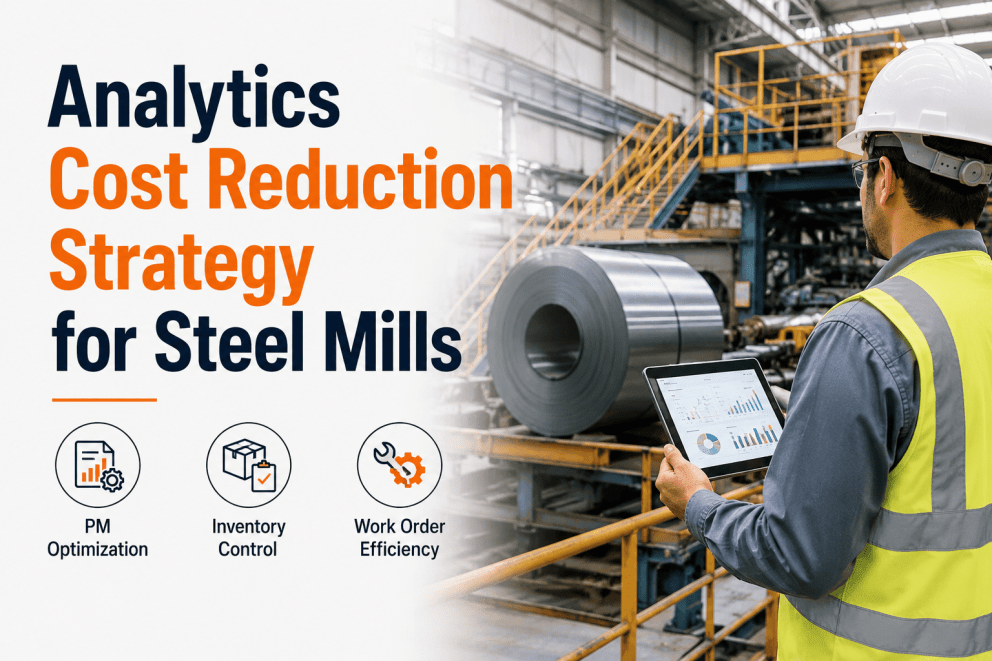
Frequently Asked Questions

A mid-tier integrated steel facility producing 500,000–1,500,000 tonnes annually should plan for a total analytics program cost of $600,000–$1,800,000 in Year 1 (including one-time implementation costs) and $380,000–$1,100,000 in ongoing annual spend from Year 2 forward. These figures include platform licensing, hardware, integration engineering, internal labor allocation, training, and support. Facilities that budget only the platform license—typically $80,000–$250,000—routinely encounter 2x–3x cost overruns when full program costs are realized. The cost-per-tonne benchmark for analytics spend at well-managed facilities is $0.28–$0.52 per tonne; programs above $0.65 per tonne should be reviewed for scope optimization.
The classification follows ASC 350-40 for cloud-based software and ASC 360 for tangible assets. As a general framework: hardware permanently installed on assets (sensors, servers, network infrastructure) is capitalized and depreciated over 3–7 years; SaaS platform subscriptions are expensed as incurred; one-time implementation and integration engineering costs are generally expensed under ASC 350-40 unless they directly create a separately identifiable intangible asset with a useful life exceeding two years; internal labor during the application development stage may be capitalized. The critical practical point is that SaaS-delivered analytics—the most common model today—results in the majority of analytics spend being OpEx, which has full P&L impact in the current period and requires different budget management than traditional CapEx projects. Coordinate with your tax advisor and auditors before finalizing classification policy, as incorrect treatment creates restatement risk.
Industry practice for analytics program variance management in industrial facilities uses a two-tier threshold system. Tier 1 (operational review): any monthly line-item variance exceeding 10% unfavorable, or any cumulative YTD variance exceeding 8% unfavorable, triggers a documented root cause analysis and corrective action plan within 10 business days. Tier 2 (leadership escalation): cumulative YTD variance exceeding 15% unfavorable, or any single event creating a variance above $50,000, requires escalation to VP-level operations and finance leadership with a revised full-year forecast and formal remediation plan. Favorable variances of more than 15% should also be reviewed—consistent underspending often indicates scope that was planned but not executed, which has implications for expected ROI.
Finance-credible ROI documentation for steel analytics programs requires four elements: a pre-deployment baseline measured for a minimum of 6 months before go-live; a defined measurement methodology approved by finance before deployment (not constructed post-hoc); post-deployment performance data covering the same metrics at the same production volume baseline; and statistical controls for production mix changes, commodity price fluctuations, and seasonality. The ROI calculation should isolate analytics-attributable savings from other operational improvements occurring in the same period. Common metrics include: unplanned downtime hours (dollar value at contribution margin per hour), maintenance cost per tonne (tracked monthly), scrap rate per heat or per coil, and energy cost per tonne of steel produced. Present ROI quarterly as a running total against cumulative program spend, expressed as both dollar return and percentage return on investment. A payback period of 12–24 months is considered strong for steel analytics programs; 24–36 months is acceptable for programs with significant safety or compliance components.
Analytics programs that lack documented ROI are almost always the first casualty of a steel market downturn—and almost always the wrong decision to make. The facilities that cut analytics spend when prices fall are the same facilities that face the highest maintenance costs and longest downtime events when demand recovers. The correct response to cost pressure is a structured portfolio review, not across-the-board cuts. Evaluate each analytics module on a return-on-investment basis: programs generating documented savings above their cost should be protected; programs that have not yet reached measurable ROI milestones should be reviewed for timeline acceleration, not cancellation. In practice, maintenance analytics and energy analytics typically survive market pressure reviews because their ROI is direct and measurable; safety compliance analytics should be protected for regulatory risk reasons regardless of ROI status. Negotiate with vendors for temporary pricing relief, pause non-critical implementation phases, and reduce consulting spend before cutting operational analytics that are delivering documented savings.

Share This Story, Choose Your Platform!