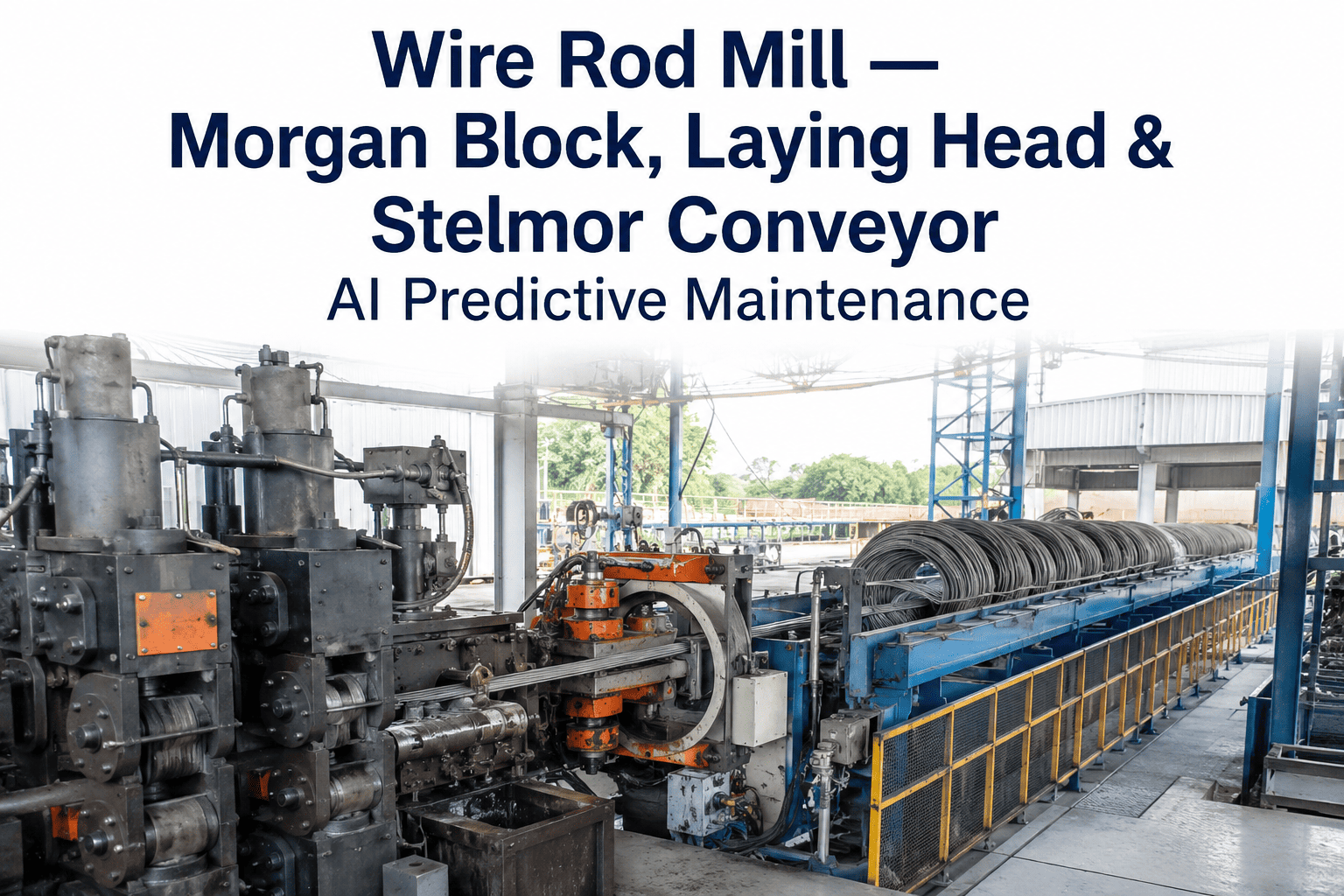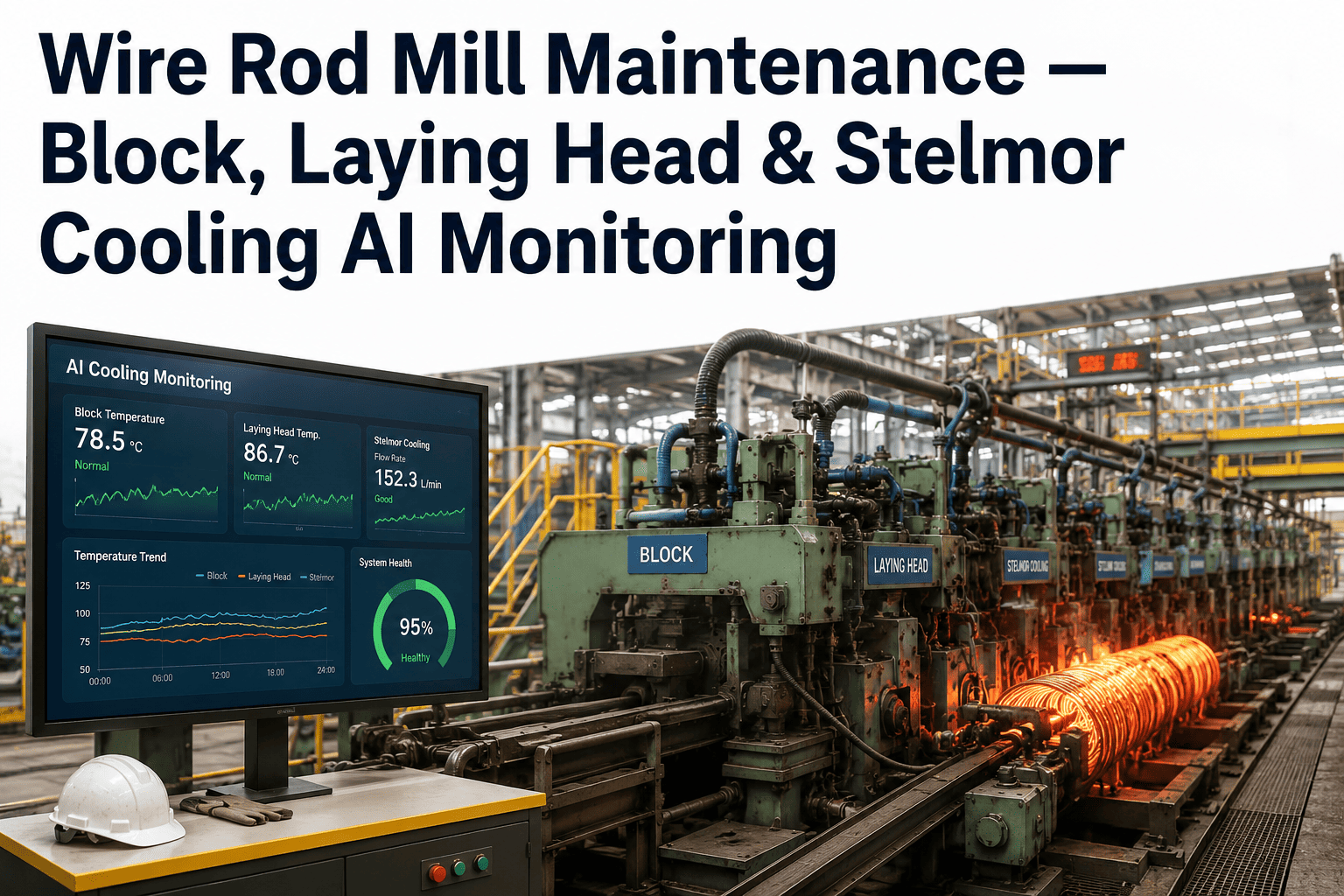
A wire rod mill is among the most speed-intensive and quality-sensitive long product operations in the steel industry — with Morgan finishing blocks rotating at surface speeds above 120 m/s, laying heads depositing rod coils at frequencies that leave no margin for mechanical hesitation, and Stelmor conveyor cooling systems that must deliver a consistent thermal profile across every ring of every coil to meet the mechanical property windows required for wire drawing, cold heading, and prestressed strand applications. Running a wire rod mill without structured analytics is how mills accumulate surface defect claims from rod that passed dimensional inspection but failed downstream wire drawing due to undetected seam formation in the finishing block, coil-to-coil weight variation from laying head timing drift, and Stelmor cooling nonuniformity that shifts tensile strength distribution beyond the tolerance band of cold heading customers. Wire Rod Mill Analytics — structured by process area, equipment health, and quality parameter — give U.S. rod mill operations the systematic framework to monitor Morgan block health, laying head performance, Stelmor conveyor uniformity, and coil handling accuracy as an integrated production intelligence program rather than a series of operator observations. This guide covers analytics architecture, KPI structure, equipment monitoring, and quality control integration for wire rod operations from billet entry to finished coil dispatch. Book a Wire Rod Mill Analytics Review.
Why Wire Rod Analytics Demands Equipment-Area Separation — Not a Single Production Dashboard
Most wire rod mills that implement production monitoring start with a speed, tons-per-hour, and downtime dashboard and consider the analytics requirement satisfied. That single-layer approach captures output but misses the three categories of quality and equipment risk that generate the largest cost in wire rod operations: Morgan finishing block bearing and roll degradation that accumulates over a campaign until it produces surface defects invisible to exit diameter gauges; laying head mechanical wear that causes ring placement irregularity detectable only through coil geometry analysis; and Stelmor conveyor zone temperature nonuniformity that shifts tensile and hardness distribution within a coil beyond the tolerance of downstream wire drawing operations.
These three failure mechanisms operate on fundamentally different time constants and require different analytics architectures. Morgan block analytics operate on sub-minute vibration and bearing temperature cycles because block bearing failure can progress from early-stage to catastrophic in fewer than four hours at operating speed. Laying head analytics operate on per-coil ring geometry statistics because ring placement error is a population characteristic that becomes visible only when analyzed across a sequence of coils, not from a single coil measurement. Stelmor analytics operate on zone-by-zone thermal trending because cooling nonuniformity is a spatial problem — a blocked air plenum in zone 4 affects only the rings passing through that zone, and a single average conveyor temperature reading cannot locate it.
Morgan Block Risk
Finishing block bearing failure at operating speed is the highest consequence unplanned event in a wire rod mill — recovery times of 8 to 16 hours are typical for a catastrophic block failure, with roll and guide damage adding $180,000 to $400,000 in replacement parts cost per event beyond the downtime value.
Laying Head Quality Risk
Ring placement irregularity from laying head wear produces coil geometry defects — tight rings, open rings, and figure-eight coil shapes — that cause wire breaks during high-speed wire drawing and generate customer claims that are disproportionately expensive relative to the tonnage involved.
Stelmor Cooling Risk
Stelmor zone nonuniformity that shifts tensile strength by more than 30 MPa within a single coil — entirely achievable with one partially blocked air plenum — produces coils that fail cold heading or spring wire property specifications at the wire drawing customer, generating claims and return shipments.
Coil Handling Accuracy Risk
Reform station and coil compactor performance directly determines coil density, dimensional conformance, and tie wire integrity — all customer-visible quality attributes that generate claims when the reform station wear state drifts without detection between planned maintenance intervals.
Morgan Finishing Block Analytics: Protecting the Highest-Speed Component in the Mill
The Morgan finishing block is the most technically complex and highest-consequence piece of equipment in a wire rod mill. Operating at surface speeds above 120 m/s with oil-film bearing lubrication systems that must maintain continuous film integrity across 10 or more reduction passes, the finishing block requires analytics that can distinguish between normal operating variation and the early-stage mechanical changes that precede a bearing failure event. At 120 m/s surface speed, the time from detectable bearing degradation to catastrophic failure is measured in hours, not days — which makes response-after-alarm insufficient as the sole protection strategy.
Oil film bearing supply pressure and temperature at each reduction stand within the Morgan block are the primary continuous health indicators for block bearing condition. Supply pressure below 85% of design for the current speed and load combination indicates either pump wear, filter restriction, or bearing clearance increase from wear — each of which requires a different corrective response. Oil temperature above design by more than 8°C at any bearing location, sustained for more than 5 minutes, indicates the onset of film breakdown at that location and requires immediate speed reduction followed by block inspection at the next available campaign stop. Mills that monitor oil film parameters at individual bearing locations — not just block inlet header pressure — catch bearing-specific degradation 3 to 6 hours earlier than header-only monitoring systems.
Accelerometer-based vibration monitoring on the Morgan block housings, analyzed with rolling baseline FFT comparison, provides a complementary early-warning signal to lubrication analytics. The primary failure modes detectable through vibration analysis on finishing blocks are roll surface spalling (produces broadband vibration increase with a characteristic frequency component at roll rotation frequency), bearing cage wear (produces sub-harmonic components at fraction of rotational frequency), and gear mesh degradation in spiral bevel drives (produces gear mesh frequency harmonics). A 3-tier alarm architecture — advisory at 1.5× baseline amplitude, warning at 2.5× baseline triggering speed reduction protocol, and shutdown at 4× baseline — provides actionable intervention windows without generating the alarm fatigue that single-threshold systems produce in high-vibration rolling environments.
Laser diameter gauges at the finishing block exit provide real-time dimensional feedback that integrates rod geometry conformance with block health analytics. A rod diameter trending toward the upper or lower tolerance limit over the course of a campaign indicates progressive roll wear or roll thermal expansion — both of which are manageable through pass schedule adjustment if detected early. Diameter variation within a single bar — measured as the standard deviation of diameter readings over the bar length — is the most sensitive indicator of roll surface condition: a worn or pitted roll surface produces diameter variation that appears before any visible surface defect develops. Mills that trend within-bar diameter standard deviation by roll campaign hour can predict the campaign change-out point that maintains specification conformance rather than discovering it at the first customer claim.
Drive motor current per reduction stand in the Morgan block, trended against the pass schedule design current for each rod size and grade, provides an integrated load signal that captures roll wear, bearing friction increase, and guide resistance in a single measurable parameter. Current above design by more than 12% sustained for more than 10 minutes is the operational threshold for triggering a block inspection protocol at the next campaign stop — the 10-minute filter eliminates transient overloads from cold bar sections or scale buildup that produce temporary current spikes without indicating progressive degradation. Speed regulation quality — the stability of block speed under varying inter-stand tension — is an additional analytics parameter that degrades as block mechanical condition deteriorates, providing a system-level confirmation signal when lubrication and vibration indicators are borderline.
| Morgan Block Parameter | Monitoring Method | Normal Operating Range | Advisory Threshold | Action Required |
|---|---|---|---|---|
| Oil film bearing pressure (per stand) | Pressure transducer, 100 ms cycle | Design ± 5% | < 85% of design | Check pump, filter, bearing clearance |
| Bearing oil temperature (per location) | RTD at each bearing housing | Design + 0 to +5°C | > +8°C above design | Reduce speed; inspect at next stop |
| Block housing vibration (overall) | Accelerometer, FFT analysis | Within 1.5× rolling baseline | > 2.5× baseline amplitude | Initiate speed reduction protocol |
| Exit rod diameter (mean) | Laser gauge, per-bar statistics | Nominal ± 0.05 mm | > ± 0.08 mm deviation trend | Adjust pass schedule; plan roll change |
| Within-bar diameter std. deviation | Laser gauge, per-bar calculation | < 0.03 mm per bar | > 0.05 mm sustained | Inspect roll surface condition |
| Drive motor current (per stand) | Drive feedback, 1 s average | Design ± 8% | > +12% above design | Block inspection at next campaign stop |
Laying Head Analytics: Ring Geometry, Placement Accuracy & Wear Monitoring
The laying head converts the linear rod from the finishing block into a series of overlapping rings deposited on the Stelmor conveyor. Ring diameter, ring pitch, and ring placement uniformity are the three geometric parameters that determine whether the resulting coil has the density, interlocking geometry, and dimensional consistency that allows it to reformat into a tight, transportable coil at the reform station. Laying head wear — primarily at the laying pipe, the laying head bearings, and the drive shaft coupling — degrades all three parameters simultaneously and progressively, making laying head analytics both a quality control function and a maintenance scheduling function.
Stelmor Conveyor Analytics: Cooling Uniformity and Mechanical Performance
The Stelmor conveyor is the thermal processing stage that determines the final mechanical properties of the finished wire rod. Air cooling through a sequence of 8 to 12 zones with individually controlled fan speed and cover position converts the metallurgical state of the rod from the austenite condition at laying head delivery to the pearlite, ferrite-pearlite, or bainite microstructure required by the customer specification. Zone-level analytics that track fan performance, cover position, rod temperature at zone transitions, and ring-to-ring temperature uniformity are the difference between a Stelmor conveyor that delivers consistent properties across the full coil and one that produces a property gradient from coil head to tail and from coil inner to outer diameter.
Reform Station and Coil Compactor Analytics: Finished Product Quality and Dimensional Conformance
The reform station and coil compactor are the final process stages before the finished coil enters the finished goods yard, and their performance directly determines the coil geometry, density, and tie wire integrity that customers evaluate on receipt. Reform station and compactor analytics differ from upstream process analytics in one fundamental respect: the failure mode is not a catastrophic equipment event or a metallurgical excursion — it is a gradual dimensional drift that produces coils within the visual acceptance range but at the edge of the weight, diameter, and density specifications that determine whether the coil can be handled and processed efficiently at the wire drawing plant.
| Equipment | Primary Analytics Parameter | Monitoring Method | Target KPI | Failure Mode Detected | Corrective Trigger |
|---|---|---|---|---|---|
| Reform Station Funnel | Funnel wear — inner diameter growth | Laser measurement at roll change | < 3 mm from nominal ID | Ring scatter, open coil formation | Funnel replacement at wear threshold |
| Reform Station Drive | Drive torque and speed uniformity | Drive current, encoder feedback | Speed ± 1% of design | Coil density variation, layer misplacement | Drive tuning or gearbox inspection |
| Coil Compactor | Compaction force per coil | Hydraulic pressure transducer | Design ± 5% | Inconsistent coil density, loose coils | Hydraulic seal check; cylinder calibration |
| Coil Weight Scale | Bundle weight vs. theoretical | Loadcell, per-coil record | ± 2% of calculated weight | Weight deviation, length error | Scale calibration; cutting length verify |
| Coil OD/ID Measurement | Finished coil outer and inner diameter | Laser gauge or contact gauge | OD ± 30 mm; ID ± 20 mm | Reform station wear, funnel mis-set | Reform station adjustment or maintenance |
| Tie Wire Station | Tie tension and position per tie | Torque sensor at each head | Tension ± 10% of spec | Wire break, loose ties, head wear | Head replacement at tension drift threshold |
Expert Review: What Top-Performing U.S. Wire Rod Mills Do Differently with Analytics
Wire rod mills achieving first-pass conformance above 99% for cold heading and spring wire grades — the specification categories with the tightest property windows in the U.S. rod market — share four analytics practices that the majority of U.S. operations have not yet systematized. First, they treat the Morgan block and the Stelmor conveyor as a single quality system, not two independent process areas. The finishing block delivery temperature and the Stelmor zone 1 entry temperature are analyzed together against the cooling recipe model, with the predicted transformation temperature calculated in real time from both inputs. This joint model detects 50 to 70% more pre-specification excursions than single-area monitoring because most wire rod property failures are the result of a finishing temperature deviation compounding with a Stelmor cooling rate deviation — neither of which would trigger an alarm individually. Second, they have eliminated fixed-interval laying pipe replacement and campaign change schedules entirely. Every laying pipe and every block roll change is now triggered by measured wear rate models — laying pipe bore measurement versus tons-rolled trend, Morgan block roll surface diameter measurement versus campaign hours. The result is 20 to 35% longer average campaign lengths with a simultaneous reduction in ring geometry failures, because the change happens when the wear state reaches the predictive threshold rather than after a geometry failure has already affected a production run. Third, their Stelmor analytics are coupled to the cooling recipe management system — when a zone fan performance degradation is detected, the recipe management system automatically compensates by adjusting adjacent zone fan speeds to maintain the target rod temperature profile at each zone transition. This automatic compensation eliminates the property drift window between detecting a fan degradation and manually adjusting the recipe. Fourth, their coil geometry and weight data is integrated into the quality management system at the coil level, linked to the specific Morgan block roll campaign, laying head pipe, and Stelmor recipe that produced it. When a customer reports a property or geometry issue with a specific coil, the root cause analysis can locate the exact process state at the time of production in under 30 minutes — which is the capability that separates mills that resolve customer claims quickly from mills that dispute them at length.
— Industry Benchmark Review, U.S. Wire Rod Mill Analytics Programs, iFactory Analytics Reference 2026Conclusion
Wire rod mill analytics are not an instrumentation exercise — they are the operational framework by which a rod mill closes the gap between what the process is capable of producing and what it actually delivers at 120 m/s production speed across a full rolling campaign. The four-area framework — Morgan block analytics for equipment protection and dimensional quality, laying head analytics for ring geometry conformance, Stelmor analytics for mechanical property control, and reform station and compactor analytics for finished product dimensional accuracy — addresses every category of value loss that is structurally invisible to production rate dashboards but measurable, predictable, and controllable with the right sensor integration and data architecture.
The discipline that separates wire rod mills achieving 99%+ first-pass conformance for high-specification grades from the industry average is not more sensors — it is the coupling between analytics outputs and operational decisions. A Morgan block bearing alarm that triggers a speed reduction protocol, a laying head geometry trend that triggers a pipe change before it produces a ring scatter failure, and a Stelmor zone performance alert that triggers automatic recipe compensation are the differences between an analytics program that reduces cost and one that adds reporting overhead. Building these couplings requires a platform that integrates process data, quality decisions, maintenance triggers, and customer traceability into a single operational environment — and that is the architectural design target for any wire rod analytics investment with genuine return.
Frequently Asked Questions
The five parameters that provide the most diagnostic value for Morgan finishing block condition are: oil film bearing supply pressure and temperature at each individual bearing location (not just block inlet header), which are the primary continuous indicators of bearing film integrity; block housing vibration analyzed with rolling FFT baseline comparison, which provides the earliest detectable signal of bearing cage wear, roll spalling, and spiral bevel gear degradation; rod exit diameter standard deviation per bar, which is more sensitive to roll surface condition than mean diameter deviation because a worn or pitted roll surface produces within-bar diameter variation before any visible surface defect develops; drive motor current per reduction stand trended against the pass schedule design current, which integrates roll wear, bearing friction, and guide resistance into a single measurable load signal; and oil contamination monitoring through regular particle count analysis of the lubrication return flow, which detects metallic wear debris from bearing surfaces 6 to 12 hours before vibration or temperature analytics detect the same degradation. Mills that monitor only block inlet pressure and exit diameter — the two most commonly instrumented parameters in older installations — are missing the individual bearing location signal and the within-bar diameter variation signal that provide the earliest reliable warning of block degradation at operating speed.
Stelmor conveyor analytics reduce mechanical property variation through three specific mechanisms. The first is zone performance fault detection — identifying individual fans operating below design efficiency, covers drifting from commanded position, and air plenum pressure drops indicating blockage, before these faults accumulate enough cooling rate deviation to push rod properties outside specification. A single partially blocked air plenum in zone 4 can shift tensile strength by 25 to 40 MPa for the rings passing through that zone without affecting any other zone's measurements — and it is invisible to a monitoring system that tracks only average conveyor temperature or total fan power draw. The second mechanism is cooling recipe model comparison — cross-validating actual zone-by-zone rod temperature against the model prediction for the current rolling recipe and ambient temperature, which allows the system to detect when actual cooling performance is deviating from the model before the rod exits the conveyor. The third mechanism is cross-conveyor ring temperature uniformity monitoring, which detects the inner-to-outer ring temperature gradient that produces tensile strength variation within a single coil. Coils with significant inner-to-outer property gradients — typically caused by conveyor edge fan performance asymmetry or ring overlap density variation from laying head wear — fail the uniformity requirements of cold heading wire and spring wire applications, which require consistent properties across the full wire drawing sequence. Monitoring ring temperature uniformity at the conveyor exit provides a per-coil quality gate for these critical grade requirements before the coil reaches the reform station.
Preventing ring geometry failures at wire drawing customers requires a three-layer laying head analytics program. The first layer is per-coil ring geometry measurement using a camera-based system at the Stelmor conveyor entry — measuring ring diameter, ring pitch, and ring overlap pattern for every coil at production speed, with statistical control limits by rod size and grade. This layer provides the quality release gate: coils whose ring geometry statistics fall outside specification are flagged before they reach the reform station rather than after a ring break or wire break at the customer's wire drawing block. The second layer is laying pipe bore wear monitoring — measuring pipe internal bore at each pipe change, calculating actual wear rate in mm per ton, and comparing against the design wear rate model for the current rod size and grade. Pipes wearing faster than design rate indicate abrasive scale issues or incorrect pipe material selection; pipes reaching the maximum allowable bore before the scheduled change interval indicate that the fixed-interval pipe change schedule is too long for the actual operating conditions. The third layer is laying head bearing condition monitoring — vibration analysis and bearing temperature trending that predicts bearing replacement need 8 to 12 hours before failure, enabling planned replacement at a shift boundary rather than a coil dump event during production. The combination of these three layers — per-coil geometry quality gate, wear-rate-based pipe change scheduling, and condition-based bearing replacement — eliminates the geometry failure modes that reach wire drawing customers in mills operating without analytical visibility into laying head condition.
Morgan finishing block campaign length optimization using analytics follows a three-stage process. In stage one, establish the analytics baseline: roll all available block health data — bearing temperatures, vibration trends, motor currents, oil contamination particle counts, and exit diameter statistics — for the preceding 12 to 18 months of campaigns and correlate each dataset against the campaign endpoint event. Campaign endpoint events fall into three categories: planned roll change at a fixed hour or tonnage interval, roll change triggered by a quality parameter breach (diameter or surface), and emergency stop from a bearing or mechanical event. This correlation analysis identifies which analytics parameters are leading indicators — they change significantly before the campaign endpoint event — and which are lagging indicators or non-predictive. In stage two, build a campaign health index: a weighted composite of the leading indicator parameters that produces a single 0-to-100 score updated every 15 minutes during production, with a campaign change-out threshold set at the score value that has historically corresponded to 2 to 4 hours before a quality or mechanical event. In stage three, replace the fixed-interval campaign schedule with the health index trigger and measure the result over 6 to 12 months. Top-performing U.S. wire rod mills report 20 to 35% longer average campaign lengths after implementing condition-based campaign scheduling, with simultaneous reductions in emergency block stops — because the health index detects degradation at a point where a planned stop is still possible rather than after the degradation has reached the failure threshold.
Yes — and for wire rod operations supplying cold heading, spring wire, and prestressed strand customers, the quality traceability integration is not optional — it is a customer requirement. The integration architecture for wire rod mill analytics has three components. The CMMS integration generates maintenance work orders automatically from analytics threshold breaches — a Morgan block bearing temperature alarm creates a CMMS work order with the bearing location, current temperature trend, and estimated time to exceed the next threshold, pre-populated and assigned to the rolling maintenance team. This eliminates the information loss between an operator observation and a maintenance record that causes repeat failures at the same block location. The quality system integration links every finished coil to the specific Morgan block roll campaign number, laying head pipe serial number, and Stelmor cooling recipe that produced it — creating a coil-level quality record that can be retrieved and reviewed when a customer reports a property or geometry issue. The traceability record for cold heading wire customers, for example, must typically include rod diameter statistics, ring geometry statistics, and Stelmor zone temperatures for each coil in the shipment — all of which are available from the analytics platform without manual data assembly if the integration is correctly configured. For prestressed strand applications, the traceability requirement extends to heat chemistry and mechanical test results linked to the specific rolling campaign. iFactory's platform supports this full integration with pre-built connectors for CMMS work order generation, quality test record linkage at the coil level, and heat-level traceability across the Morgan block, laying head, and Stelmor process stages.