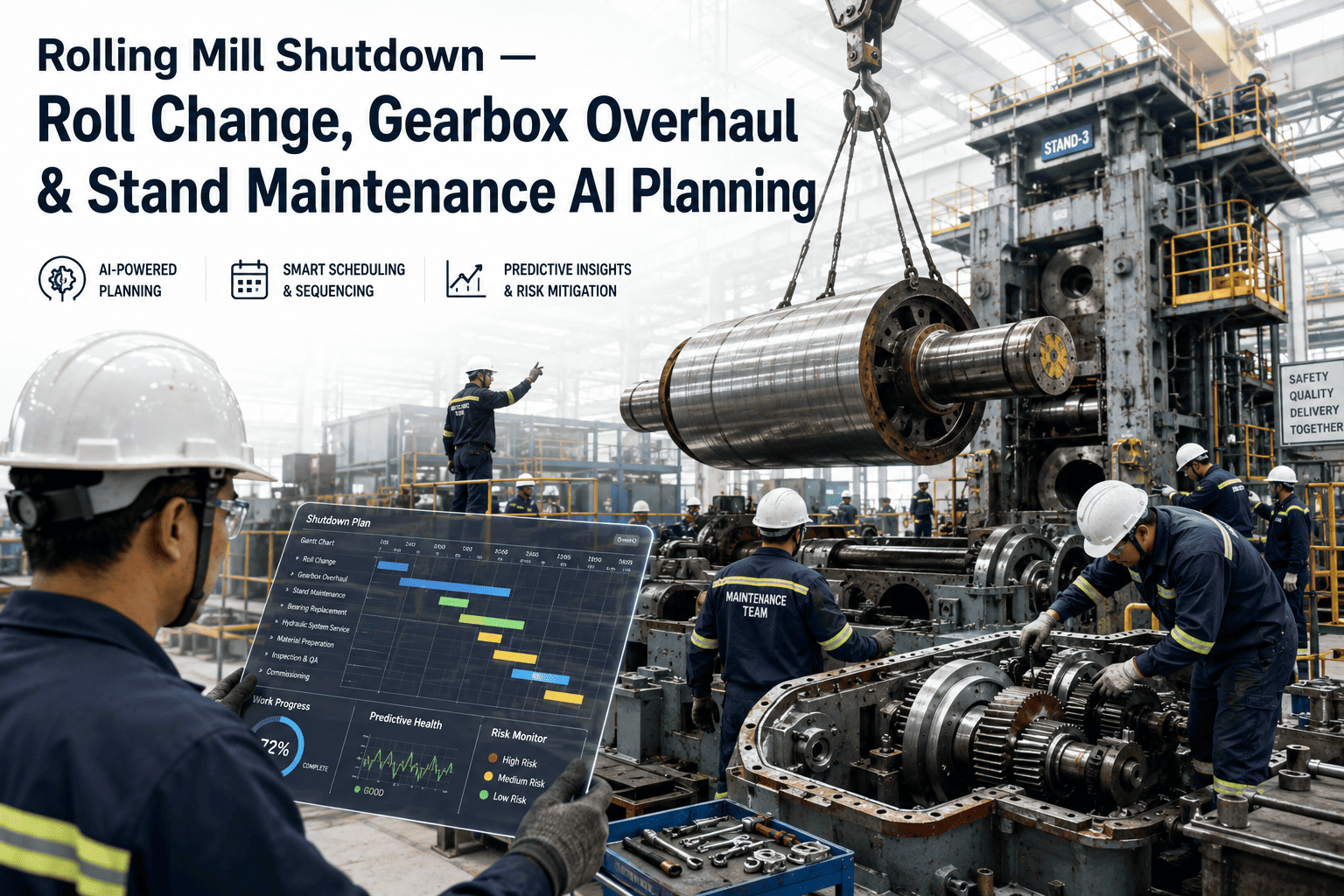
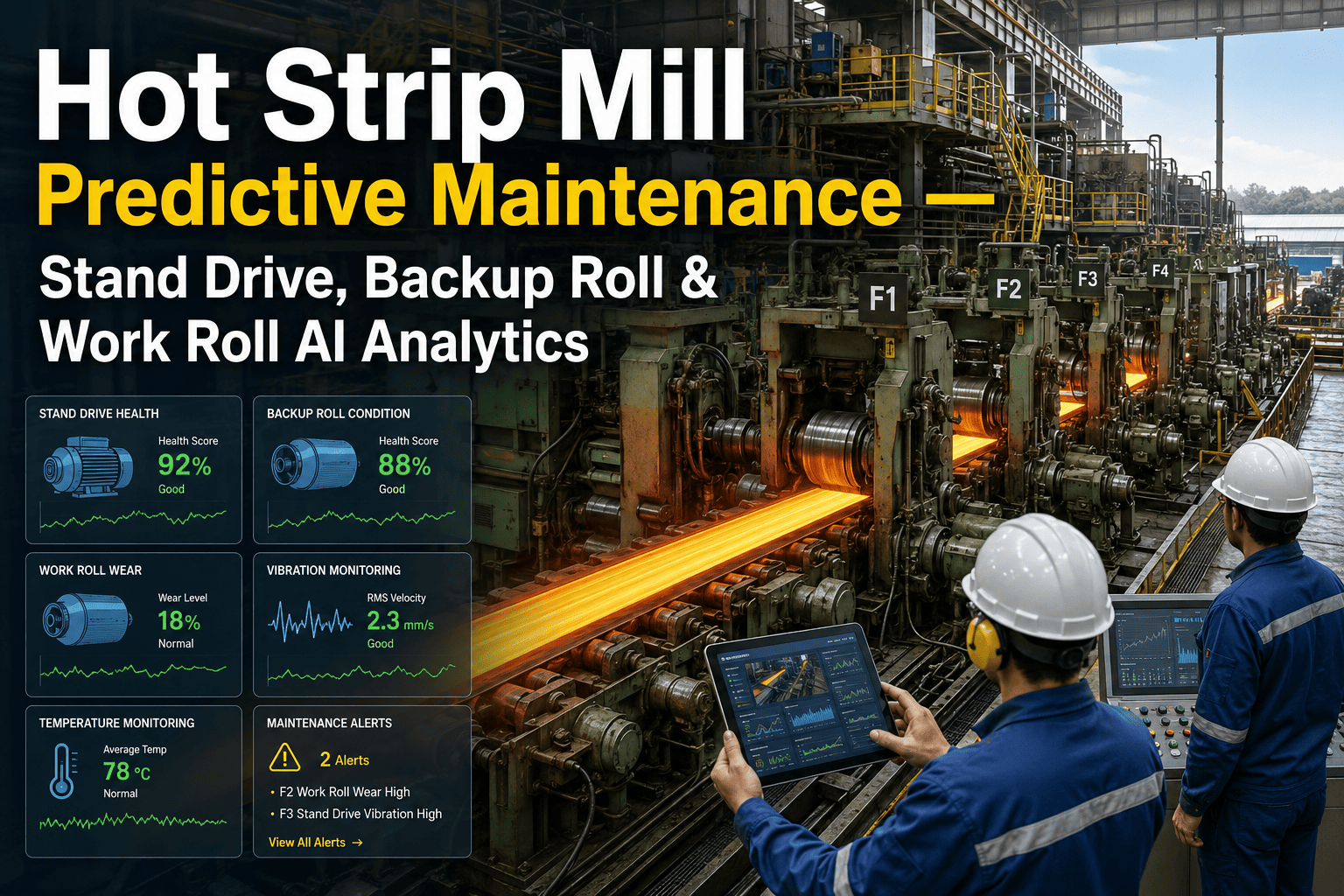
Hot strip mills are among the most asset-intensive environments in steelmaking — roughing stands, finishing mills, run-out tables, coilers, and AGC systems all operating under extreme thermal and mechanical stress, often 24 hours a day. Without real-time analytics, maintenance teams are forced to rely on fixed schedules and reactive responses that result in costly unplanned stoppages, roll failures, and strip quality defects. iFactory's PM Scheduling and Asset Management platform brings AI-driven monitoring and predictive intelligence across every sub-system of the hot strip mill — from slab entry to coil exit — enabling steel plants to dramatically reduce downtime, extend roll campaign life, and maintain strip gauge consistency at scale.
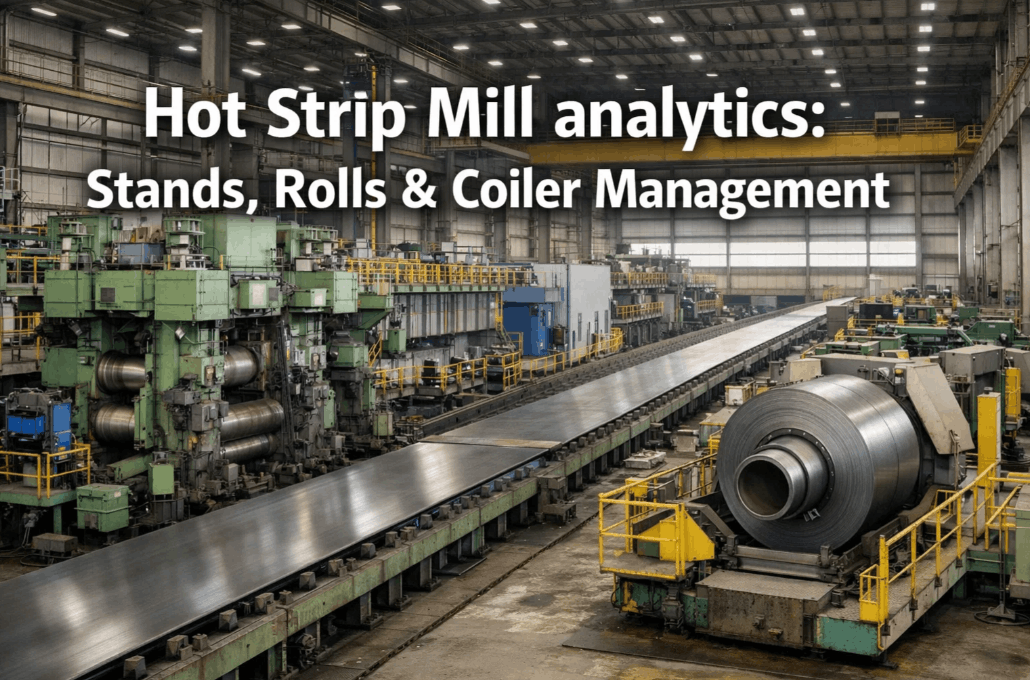
Hot Strip Mill Analytics: Roughing, Finishing & Coiler Systems
AI-driven PM scheduling and asset tracking across every HSM sub-system — from slab entry to coil exit.
The Hidden Cost of Running a Hot Strip Mill Without Analytics
A hot strip mill processes thousands of tonnes of steel daily. Every unplanned stoppage — whether from a failed work roll, a coiler mandrel fault, or an AGC hydraulic issue — costs between $80,000 and $350,000 per hour. Yet most mills still rely on fixed-interval maintenance schedules that ignore the actual condition of equipment. iFactory's asset analytics changes this by connecting real-time sensor data, PLC signals, and AI models to give maintenance engineers a live view of every critical asset.
Analytics Coverage Across Every HSM Sub-System
iFactory tracks condition, performance, and PM status across all five major hot strip mill zones. Each zone has distinct failure modes — and distinct analytics logic to match.
Roughing Stand
Work roll wear, spindle torque trending, edger roll gap deviation, slab temperature tracking through primary reduction passes. AI models detect roll surface degradation 6–8 passes before campaign end.
Finishing Mill (F1–F7)
Per-stand roll force, inter-stand tension, strip speed cascade, work roll thermal crown, and backup roll bearing vibration. AGC hydraulic cylinder response tracked against setpoint for each finishing stand independently.
Run-Out Table & Laminar Cooling
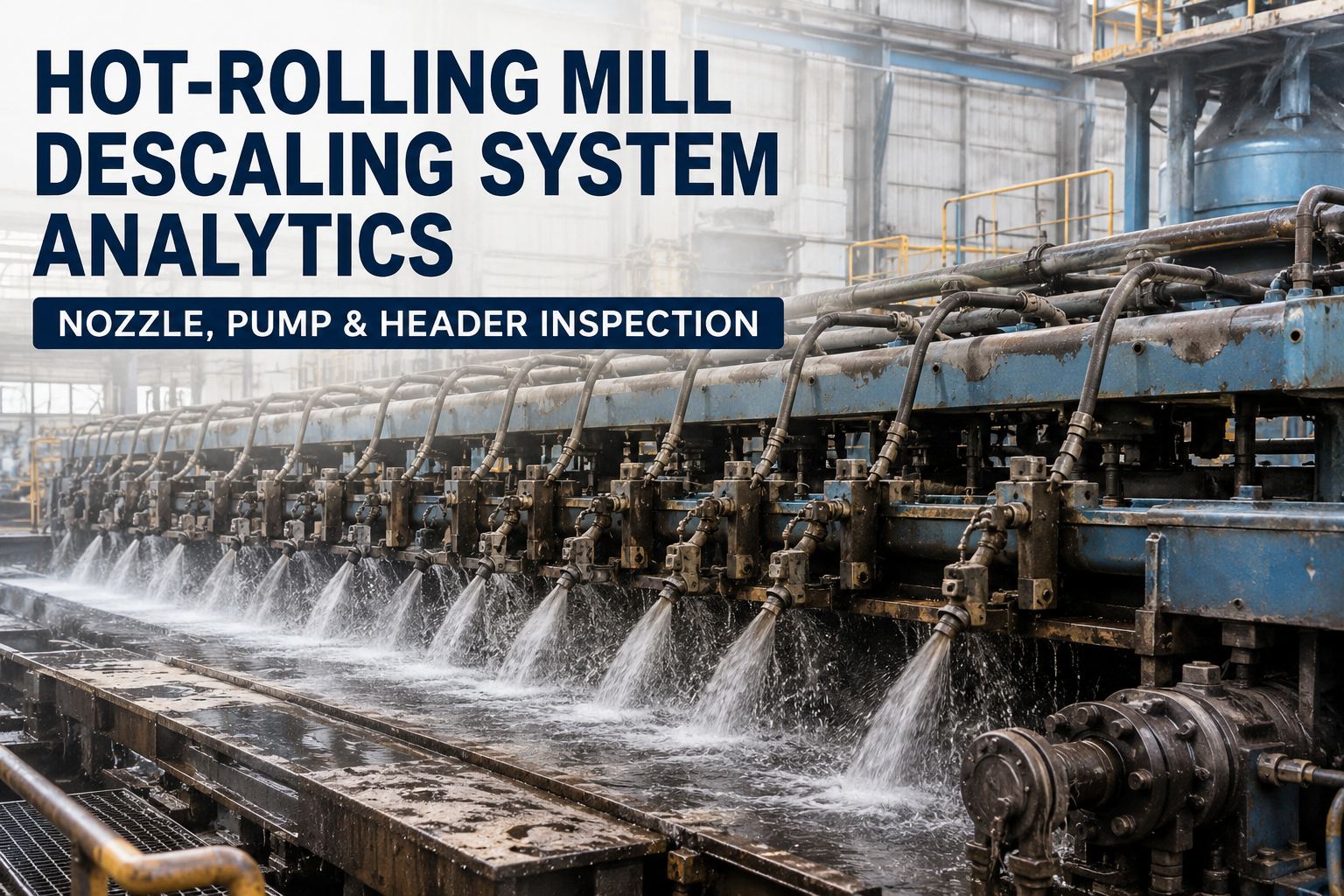
Roller table drive motor health, laminar cooling header flow uniformity, strip temperature drop profile tracking. Cooling header blockages detected via AI camera vision and flow deviation algorithms before strip quality is affected.
Coiler & Mandrel System
Mandrel wear and eccentricity tracking, pinch roll force monitoring, coil weight and diameter verification, wrapper roll pressure uniformity. Mandrel bearing degradation detected 3–5 coils before failure through vibration signature AI.
AGC & Hydraulic Systems
Hydraulic cylinder position accuracy, servo valve response time, AGC loop stability, pressure relief valve health. SAP-integrated PM work orders auto-triggered when hydraulic contamination or cylinder drift exceeds threshold.
The AI Technologies Powering HSM Analytics
iFactory deploys four interconnected technology layers across the hot strip mill. Each layer addresses a specific data gap — and together they create a complete asset intelligence system integrated directly with your existing SAP and PLC infrastructure.
AI Camera Vision
Overhead and side-mounted cameras monitor roll surface condition, strip edge quality, scale buildup, and cooling header spray patterns — every coil, every pass.
AI Digital Twin
A live virtual replica of the entire HSM line — simulating roll force distribution, thermal crown, and strip tension in real time against actual process data.
Predictive Maintenance AI
Vibration, temperature, and force signature analysis scores asset health across all HSM sub-systems. Work roll change recommendations generated automatically per-stand, per-campaign.
SAP + PLC Integration
Bidirectional integration with SAP PM auto-creates work orders from AI alerts. PLC data ingested in real time — no manual data entry, no lag between detection and action.
Hot Strip Mill PM Checklist — iFactory Tracked & Scheduled
Every item below is tracked, scheduled, and auto-escalated by iFactory — replacing manual logs with a live PM intelligence layer visible to maintenance, operations, and management simultaneously.
- Work roll surface inspection & campaign tonnage tracking
- Spindle universal joint wear check
- Edger hydraulic cylinder seal inspection
- Backup roll bearing vibration baseline
- Mill housing liner clearance measurement
- Per-stand work roll change interval & grind tracking
- AGC hydraulic cylinder position calibration
- Backup roll bearing temperature & vibration check
- Inter-stand coolant spray nozzle inspection
- Servo valve response time verification
- Mandrel eccentricity and bearing wear measurement
- Pinch roll pressure and surface condition check
- Laminar cooling header flow uniformity test
- Run-out table roller drive motor current trending
- Wrapper roll hydraulic pressure uniformity check
Before vs. After iFactory — HSM Performance Comparison
Results from an integrated 4 MTPA hot strip mill after 12 months on iFactory PM Scheduling and Asset Management. All figures independently verified by plant operations and finance leadership.
What a Rolling Mill Manager Said
We used to replace work rolls on a fixed tonnage schedule — and still had surprise failures. iFactory told us exactly which stand was degrading and when to change. Our roll shop costs dropped 22% in the first year and we haven't had an unplanned finishing mill stoppage in eight months.
Frequently Asked Questions
Can iFactory monitor individual finishing stands separately?
Yes. iFactory tracks every stand (F1–F7) independently — roll force, bearing vibration, AGC response, and thermal crown are all monitored per-stand with individual health scores and PM schedules.
How does iFactory integrate with our existing SAP PM system?
Bidirectional SAP PM integration auto-generates work orders from AI alerts and syncs completion status back to iFactory. No manual data entry required at any stage.
Does the platform cover coiler mandrel predictive maintenance?
Yes. Mandrel bearing vibration signatures are analysed by AI to detect degradation 3–5 coils before failure — giving the team time to plan a controlled change instead of an emergency stop.
How long does deployment take on a live HSM?
Most HSM deployments are complete within 8–12 weeks. PLC data integration begins in Week 1; AI model calibration completes by Week 8; full PM scheduling goes live by Week 10–12.
Can iFactory track work roll grind history and campaign tonnage?
Yes. Roll genealogy tracking — grind history, campaign tonnage, surface condition, and predicted remaining life — is a core feature of the iFactory Asset Management module.
See iFactory Live on Your Hot Strip Mill
Get a demo configured around your actual mill layout — roughing, finishing, coiler, and all.