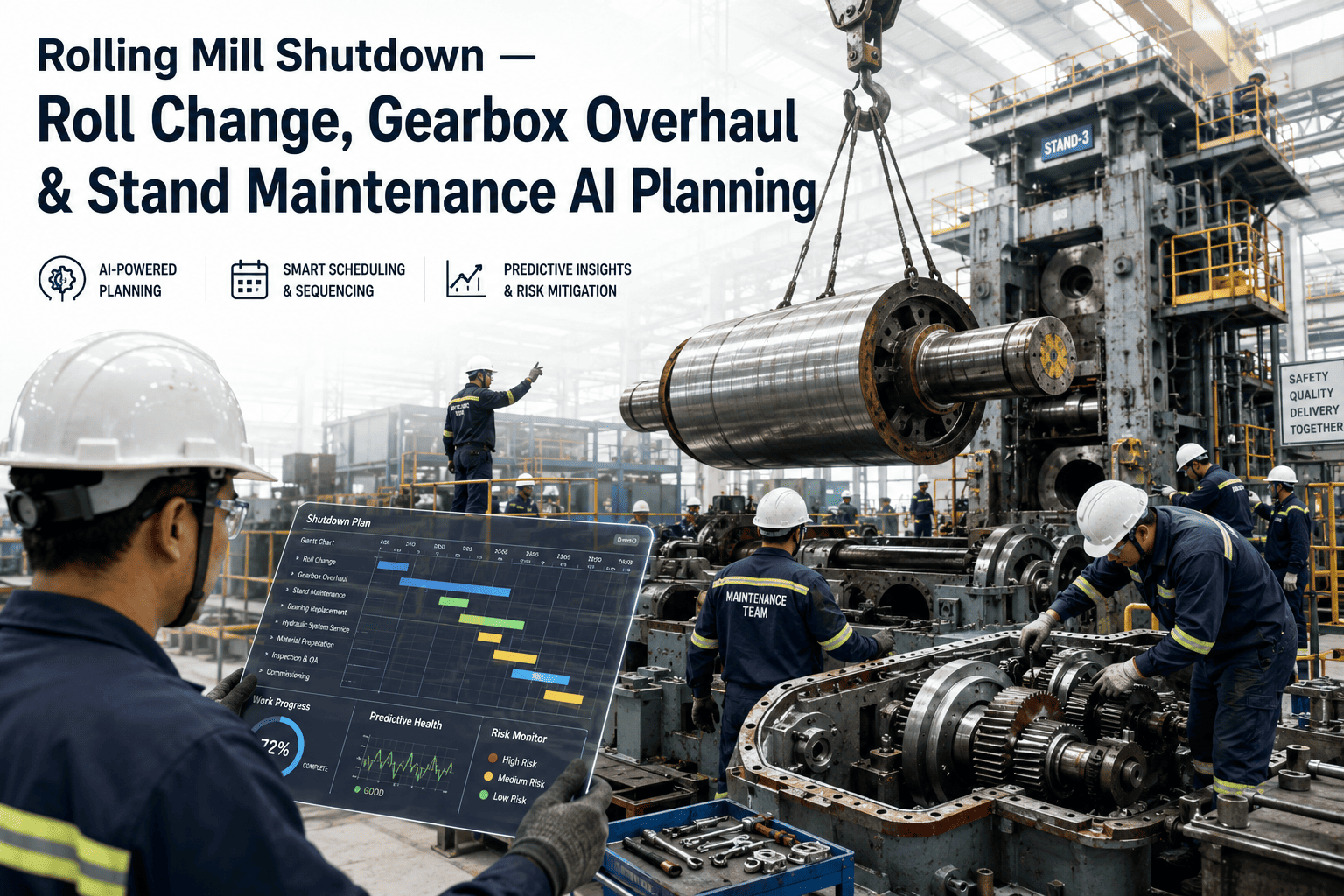
In the high-stakes environment of a rolling mill, planned shutdowns are the most critical events for asset integrity and operational continuity. Every minute of downtime directly impacts throughput, revenue, and customer commitments. Traditional shutdown planning relies on static schedules and tribal knowledge, often leading to scope creep, extended durations, and missed opportunities for deeper maintenance. For maintenance managers, the challenge is to define a precise, risk-optimized scope that balances roll changes, gearbox overhauls, and stand maintenance without compromising post-restart reliability. This is where AI-driven predictive planning transforms the game. By analyzing historical data, real-time sensor feeds, and degradation models, AI enables a dynamic, data-backed scope definition that minimizes shutdown duration while maximizing work quality. The result is a leaner, smarter outage that delivers higher equipment reliability and lower total cost of ownership. Book a Demo to see how iFactory can revolutionize your mill shutdown planning.
Transform Your Mill Outage Strategy
Leverage AI to cut shutdown duration by 30% and boost post-restart reliability. Schedule a personalized demo today.
Why Traditional Shutdown Planning Fails in Modern Rolling Mills
Conventional shutdown planning relies heavily on historical schedules and manual expert judgment. This approach suffers from several critical flaws: scope is often inflated to avoid surprises, leading to unnecessary work and extended downtime. Conversely, critical tasks may be missed due to incomplete data on equipment condition. The lack of real-time visibility into asset health means maintenance managers cannot prioritize tasks based on actual degradation. This results in reactive repairs during the shutdown, causing delays and quality issues. Furthermore, static plans cannot adapt to unexpected findings, forcing teams to make rushed decisions without data support. The financial impact is substantial—each hour of unplanned extension can cost tens of thousands of dollars in lost production. AI-driven planning addresses these gaps by providing a dynamic, risk-based scope that evolves with real-time data, ensuring every maintenance action is justified and scheduled precisely.
35%
Average reduction in shutdown duration using AI-optimized scope
50%
Decrease in unplanned work during outage with predictive insights
40%
Improvement in post-restart reliability index
2x
Return on investment from optimized shutdown planning
AI-Driven Scope Definition: The Core of Modern Shutdown Planning
At the heart of every successful mill shutdown is a well-defined scope that precisely targets the most critical maintenance needs. AI algorithms analyze vast datasets—including vibration analysis, oil debris monitoring, thermal imaging, and historical failure records—to generate a prioritized list of tasks. For roll changes, the AI predicts optimal replacement intervals based on wear patterns, surface defects, and throughput metrics. Gearbox overhauls are scheduled using remaining useful life models that factor in load cycles, temperature profiles, and lubrication condition. Stand maintenance tasks are identified from structural fatigue analysis and alignment drift trends. The AI continuously updates the scope as new data streams in, allowing planners to adapt to emerging issues. This dynamic approach eliminates guesswork, reduces unnecessary work, and ensures that every maintenance action delivers maximum value. The result is a shutdown plan that is both lean and comprehensive, balancing risk and cost.
Data Aggregation & Fusion
Collect and integrate data from CMMS, SCADA, IoT sensors, and inspection reports into a unified digital twin of the mill.
Predictive Analytics
Apply machine learning models to forecast remaining useful life, failure probability, and degradation trends for each asset.
Risk-Based Prioritization
Rank maintenance tasks by criticality, combining safety, production impact, and cost to define the optimal scope.
Dynamic Scheduling
Generate a phased shutdown schedule that minimizes duration by parallelizing tasks and optimizing resource allocation.
Real-Time Adaptation
Monitor progress during shutdown and adjust scope dynamically based on findings, using AI to re-prioritize remaining tasks.
Post-Shutdown Validation
Analyze performance data after restart to validate AI predictions and refine models for future shutdowns.
Traditional vs. AI-Driven Shutdown Planning
| Aspect | Traditional Approach | AI-Driven Approach |
|---|---|---|
| Scope Definition | Based on historical schedules and expert opinion | Data-driven from real-time asset health and predictive models |
| Duration | Often inflated to cover unknowns | Optimized to minimum required time |
| Risk Management | Reactive, with surprises during shutdown | Proactive, with continuous risk assessment and adaptation |
| Resource Allocation | Fixed, often leading to idle time or bottlenecks | Dynamic, adjusting to real-time needs |
| Post-Restart Reliability | Uncertain, with potential for early failures | Predictable, with validated performance improvements |
Ready to Streamline Your Next Mill Outage?
Experience the power of AI in shutdown planning. Our experts will show you how to reduce downtime and boost reliability.
Key Components of an AI-Optimized Shutdown Scope
- Roll Change Optimization: AI predicts wear patterns and optimal replacement timing, reducing unnecessary roll changes and ensuring surface quality.
- Gearbox Overhaul Precision: Remaining useful life models schedule overhauls exactly when needed, preventing catastrophic failures while avoiding premature maintenance.
- Stand Maintenance Targeting: Structural analysis and alignment data pinpoint specific stands requiring intervention, eliminating blanket overhauls.
- Lubrication System Review: Oil analysis and filter condition data guide flushing and replacement tasks, extending component life.
- Electrical & Control System Check: AI identifies drift in sensors and actuators, scheduling calibration and replacement to prevent process variability.
- Safety System Validation: Predictive models assess the reliability of safety interlocks and emergency stops, ensuring compliance without over-testing.
Roll Change
AI-driven wear analysis reduces roll change frequency by 20% while improving surface finish quality. Dynamic scheduling ensures minimal impact on shutdown timeline.
Gearbox Overhaul
Predictive models detect early gear wear and bearing degradation, enabling targeted overhauls that extend gearbox life by 30% and reduce unplanned downtime.
Stand Maintenance
Structural health monitoring identifies misalignment and fatigue cracks, allowing precise stand repairs that improve product consistency and reduce scrap.
Lubrication System
Oil analysis and filter condition data guide optimized flushing schedules, reducing lubricant consumption by 15% and preventing contamination-related failures.
Electrical Systems
AI-driven diagnostics predict motor winding degradation and drive faults, enabling proactive replacements that eliminate electrical failures during production.
Safety Systems
Predictive reliability models for safety circuits ensure full compliance without excessive testing, reducing shutdown duration by 10% while maintaining safety integrity.
Post-Restart Reliability: The Ultimate Metric of Shutdown Success
The true measure of a successful shutdown is not just completing tasks on time, but the sustained performance of the mill after restart. Traditional approaches often see a spike in early failures due to improper re-assembly or undetected issues. AI-driven planning directly addresses this by using predictive models to validate that all critical parameters—such as alignment, vibration levels, and temperature profiles—fall within acceptable ranges before the mill resumes operation. Post-restart, the AI continues to monitor asset health, comparing real-time data against baseline models to detect any anomalies. This closed-loop feedback system continuously improves future shutdown plans. For maintenance managers, this means fewer unplanned outages, higher throughput, and lower maintenance costs over the long term. The financial impact is substantial: a 1% improvement in overall equipment effectiveness (OEE) can translate to millions in additional revenue annually.
Frequently Asked Questions
How does AI define the scope for a roll change during a shutdown?
AI analyzes historical data on roll wear, surface defects, and throughput to predict the optimal replacement interval. During shutdown planning, it considers current roll condition from sensors and inspection reports to determine if a change is necessary. This data-driven approach eliminates unnecessary roll changes, saving time and cost. For more details, visit our support page for case studies.
Can AI help in planning gearbox overhauls for different mill stands?
Yes, AI uses remaining useful life models that factor in load cycles, temperature, and lubrication condition for each gearbox. It prioritizes overhauls based on criticality and risk, ensuring that only gearboxes needing immediate attention are included in the shutdown scope. This targeted approach reduces downtime and extends overall gearbox life. Learn more by booking a demo.
What data is needed to implement AI-driven shutdown planning?
AI requires historical maintenance records, real-time sensor data (vibration, temperature, oil condition), and production metrics. Integration with existing CMMS and SCADA systems is straightforward. iFactory provides pre-built connectors for most industrial platforms. For a detailed data requirements checklist, refer to our documentation.
How does AI handle unexpected findings during the shutdown?
AI dynamically re-prioritizes remaining tasks based on real-time data from inspections and sensor readings. If a critical issue is discovered, the model recalculates the optimal scope and schedule, ensuring that the most impactful tasks are completed within the available time. This adaptability minimizes delays and maximizes reliability. Contact us at support for more information.
What is the typical ROI from implementing AI in shutdown planning?
Customers typically see a 30% reduction in shutdown duration, a 50% decrease in unplanned work, and a 40% improvement in post-restart reliability. These gains translate to significant cost savings and increased production capacity. For a personalized ROI analysis, book a demo with our team.
Optimize Your Next Mill Shutdown with AI
Join industry leaders who have transformed their outage planning. Get a customized demo and see the results for yourself.