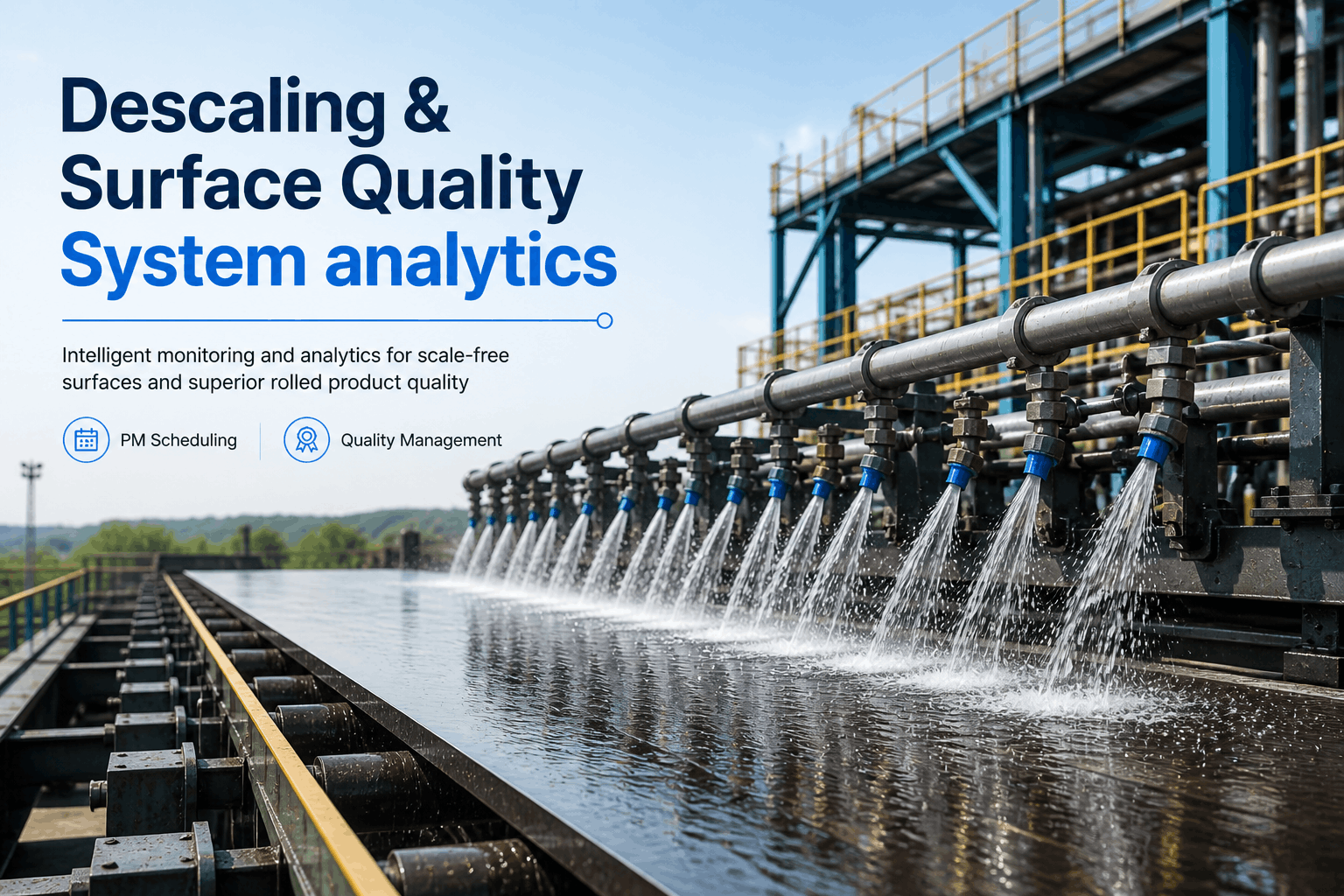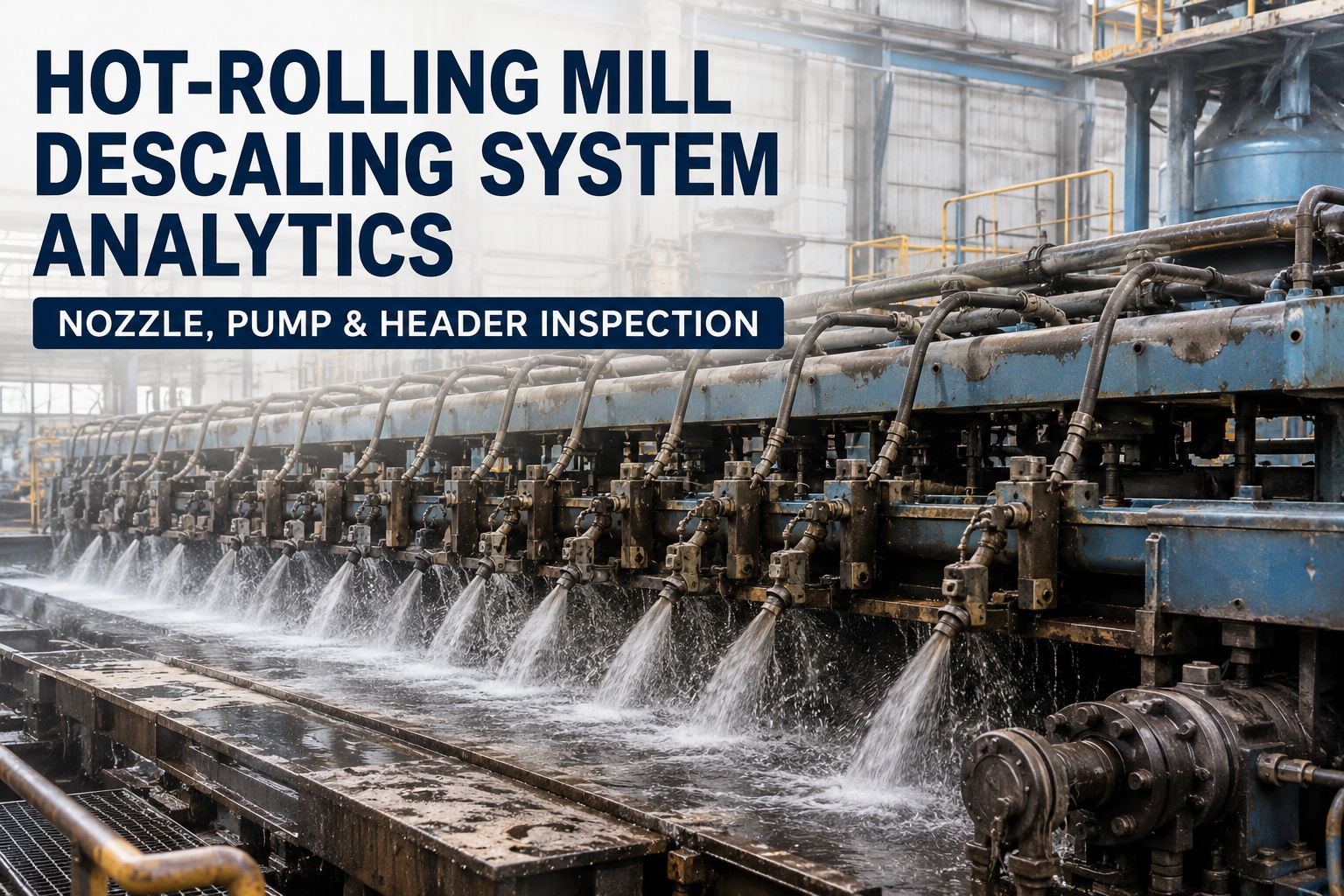
Hot rolling mills live and die on surface quality. The descaling system — that high-pressure water curtain that blasts mill scale off heated slabs before and between rolling stands — is one of the most mechanically punishing, operationally critical, and analytically underserved subsystems in the entire hot strip mill. When it works, nobody notices. When it fails, you see scale-in defects, customer rejections, and downstream finishing line shutdowns that trace back to a $12 nozzle that wore out three weeks before the coil was rolled.
This guide is structured as an operational analytics reference for maintenance engineers, process engineers, and reliability teams in U.S. hot strip mills. It covers nozzle inspection analytics, high-pressure pump performance tracking, header alignment diagnostics, descaling water treatment parameters, the scale pit management loop — with specific threshold values, decision logic, and the KPI structure needed to run descaling as a data-driven operation rather than a reactive one.
Hot Rolling Mill Descaling System Analytics: Nozzle, Pump & Header Inspection
Why Descaling Analytics Is Not Optional in 2026
Scale-in surface defects are the leading cause of hot-rolled coil rejections at U.S. flat-rolled mills. A 2024 AIST survey found that 38% of surface quality non-conformances traced directly to descaling system failures — nozzle wear, header misalignment, pump pressure dropout, or contaminated descaling water. These are not random failures. They are predictable, measurable, and preventable with the right analytics framework in place.
The fundamental problem is that descaling systems are designed to be robust enough to survive a brutal environment — 1,100°C slab surfaces, high-pressure water hammer, scale abrasion — which means they are often over-engineered to the point where failure is gradual and invisible until it lands in a surface defect. Analytics converts that gradual degradation into a visible and trended signal that maintenance can act on before the strip is rolled.
Nozzle Inspection Analytics — The Foundation of Descaling Performance
The flat-fan nozzle is the terminal point of the descaling system and the component most sensitive to wear. High-pressure water at 2,500–3,200 PSI exits through a precision-machined orifice, generating a flat fan that strikes the strip surface at a defined angle and impact pressure. As the orifice erodes — due to water velocity, suspended abrasives, and scale backwash — fan angle widens, impact pressure drops, coverage uniformity degrades. The table below defines the key nozzle inspection parameters, their measurement methodsand the action thresholds used by leading hot strip mill operations. Reserve a demo for Nozzle inspection analytics
| Parameter | Nominal Value | Warning Threshold | Replace Threshold | Measurement Method | Inspection Interval |
|---|---|---|---|---|---|
| Orifice Diameter Wear | Baseline ± 0.1 mm | +0.25 mm over baseline | +0.40 mm over baseline | Go/no-go gauge or optical CMM | Every 72 hr at campaign |
| Fan Angle Deviation | ±2° of spec angle | ±3° deviation | ±5° deviation | Stroboscopic spray test bench | Every 72 hr at campaign |
| Impact Pressure at Strip | Per design chart | −10% of design | −18% of design | Pressure mapping pad (static) | Weekly or per campaign |
| Coverage Width Uniformity | ±5% of spec width | ±8% deviation | ±12% deviation | Thermal imaging or strip surface audit | Per campaign start |
| Nozzle Plug / Blockage | 0% plugged | Any partial block detected | Full plug or 50% flow loss | Flow meter per header zone | Continuous (real-time) |
| Nozzle Angle Alignment | Design angle ±1° | ±2° misalignment | ±3° misalignment | Laser alignment tool | Per campaign or after impact |
| Nozzle Body Corrosion | No visible pitting | Surface pitting only | Thread or seat corrosion | Visual + dye penetrant | Monthly or at replacement |
The single highest-value nozzle analytics practice is tracking orifice wear against coil count — not calendar time. Wear rate varies significantly by steel grade, slab temperature, and water quality. Building a wear-per-coil trend for each nozzle position gives maintenance a predictive replacement trigger that eliminates both premature replacement waste and over-run defect risk.
High-Pressure Pump Analytics — Performance Tracking & Failure Modes
The high-pressure pump package — typically triplex or quintuplex plunger pumps rated 3,000–4,000 PSI at 400–800 gpm — is the hydraulic heart of the descaling system. Pump analytics focuses on three measurable degradation vectors: volumetric efficiency (flow loss due to valve or plunger wear), pressure ripple (pulsation signatures that reveal valve timing issues), and drive power consumption (efficiency drop preceding mechanical failure). The workflow below maps the pump analytics process from data acquisition to maintenance action. Predict the failured before downtime happens
Header Alignment & Structural Inspection Analytics
The descaling header — the manifold that distributes high-pressure water to individual nozzle positions across the strip width — is subject to thermal fatigue, impact damage from scale rebound, and gravitational sag over successive campaigns. Header analytics combines periodic laser alignment surveys, structural inspection data, and process data correlation to detect coverage degradation before it produces strip defects. The comparison below contrasts traditional header inspection practices against an analytics-driven approach.
Descaling Water Treatment Analytics & Scale Pit Management
Descaling water quality directly controls nozzle life, pump seal longevity, and descaling effectiveness. High-pressure water systems recirculate water through a scale pit, clarifier, and filtration train before returning to pump suction. As water quality degrades — suspended solids rise, pH drifts, dissolved iron increases — nozzle orifice wear accelerates and pump packing erodes faster and the hydraulic descaling efficiency drops. Water treatment analytics tracks the parameters that predict system degradation and not just the parameters that indicate it has already occurred.
| Water Parameter | Target Range | Warning Limit | Control Action | Monitoring Frequency |
|---|---|---|---|---|
| pH | 7.0 – 8.5 | < 6.5 or > 9.5 | Dose acid or alkali — recheck in 2 hr | Continuous (inline probe) |
| Suspended Solids (TSS) | < 50 mg/L at pump suction | 50–100 mg/L | Increase clarifier blowdown rate; inspect filters | Every 4 hr (grab sample) |
| Total Dissolved Solids (TDS) | < 1,500 mg/L | 1,500–2,500 mg/L | Increase makeup water rate — reduce recirculation ratio | Daily (conductivity meter) |
| Iron (Dissolved Fe) | < 2 mg/L | 2–5 mg/L | Increase aeration; inspect clarifier weir — check pH control | Twice daily (colorimetric) |
| Turbidity | < 10 NTU at pump inlet | 10–25 NTU | Inspect and backwash filtration media — check clarifier polymer dosing | Continuous (inline turbidity) |
| Inlet Water Temperature | 15°C – 40°C | > 45°C | Increase cooling tower capacity — check heat exchanger | Continuous |
| Biocide / Microbiological | Biocide residual per spec | Residual below 20% of spec | Re-dose biocide — test for Legionella if temp > 35°C | Weekly (culture test) |
Expert Review — What Top-Performing Mills Do Differently
Best-in-class hot rolling mills achieving below 0.3% scale-in rejection rates follow four core descaling practices. They replace nozzles based on coil-count wear trends instead of fixed maintenance schedules, typically every 500–700 coils. Pump volumetric efficiency is continuously monitored as a real-time Level 2 KPI, with automatic alerts triggered below 90% efficiency. These mills also correlate downstream surface inspection data with live descaling parameters to directly link descaling performance with strip quality. In addition, inline turbidity and TSS sensors monitor water quality continuously at pump suction rather than relying on daily lab reports. All readings are logged into the historian at 1-minute intervals and integrated into nozzle wear analytics models. This data-driven approach improves surface quality consistency, reduces defects, and minimizes unplanned descaling failures.
Conclusion
Hot rolling mill descaling systems have predictable failure modes, but most mills struggle due to poor data visibility rather than equipment complexity. Critical issues like nozzle wear, pump degradation, header misalignment, and water quality drift are often not monitored frequently enough to prevent strip defects. Leading mills use real-time analytics frameworks including 72-hour nozzle inspections, pump efficiency KPIs, laser alignment surveys, and inline water quality monitoring. These practices are already helping top-performing U.S. mills maintain scale-in rejection rates below 0.3%. The investment in descaling analytics is relatively small compared to the savings from reduced defects, longer equipment life, and fewer production disruptions. Mills still relying on quarterly inspections and paper logs are likely already absorbing significant hidden operational costs.