Steel plants rank among the most hazardous industrial environments in the United States. Workers face simultaneous exposure to noise levels exceeding 110 dB near rolling mills, radiant heat loads that push wet-bulb globe temperatures past OSHA action thresholds, and a complex cocktail of airborne particulates ranging from iron oxide to manganese fumes. Managing these overlapping hazards is not a matter of annual compliance checks — it demands a continuous, data-driven occupational health program backed by digital monitoring infrastructure. Organizations that schedule an occupational health demo with iFactory are discovering how AI-integrated monitoring closes the gap between exposure event and intervention before regulatory limits are ever breached.
Real-Time Noise, Heat & Air Quality Monitoring — One Unified Dashboard
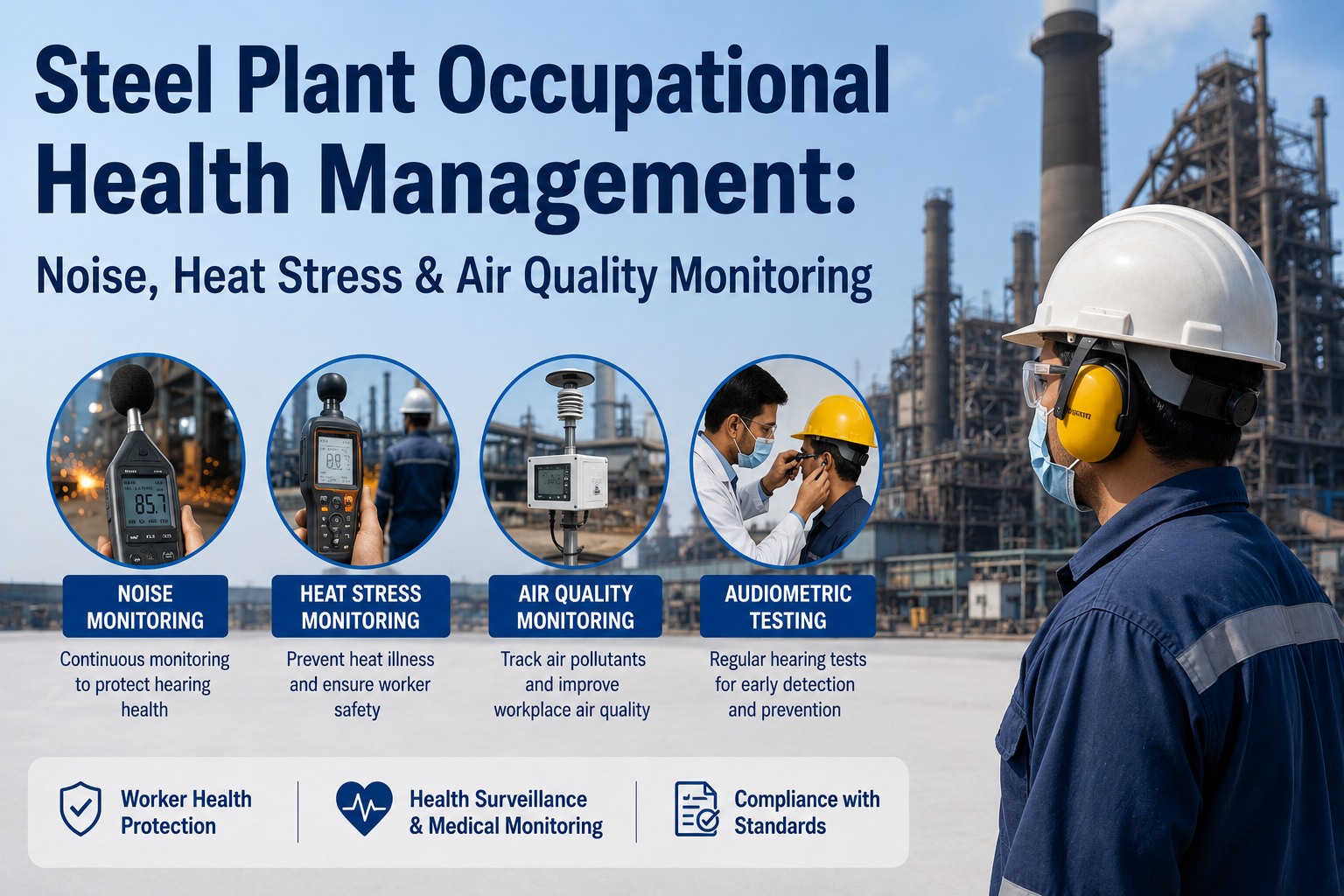
iFactory AI connects noise dosimetry, WBGT sensors, airborne particulate monitors, and audiometric records into a single compliance dashboard — so your EHS team acts on data, not guesswork.
Why Noise Is the Silent Crisis in American Steel Mills
Occupational noise-induced hearing loss (NIHL) remains the most prevalent occupational disease in U.S. manufacturing, and steel plants are its primary incubator. EAF shops, rolling mills, and descaling stations routinely generate 100–115 dB — well above OSHA's 90 dB PEL and NIOSH's recommended 85 dB exposure limit. The problem is not that plants lack noise data; it is that noise data sits in disconnected dosimeter downloads reviewed weekly rather than triggering real-time interventions when an individual's dose crosses the action threshold mid-shift.
iFactory's noise monitoring module integrates fixed-point sound level meters and personal noise dosimeters into a single live dashboard. When a worker's cumulative noise dose reaches 50% of the permissible daily exposure (the OSHA action level), the system triggers an automated alert to the shift supervisor — not a weekly email attachment. The result is a measurable shift from reactive hearing loss documentation to proactive exposure control.
| Steel Plant Zone | Typical dB Level | OSHA Permissible Exposure | Required Control | iFactory Alert Trigger |
|---|---|---|---|---|
| Electric Arc Furnace (EAF) | 105–115 dB | 1 hour max | Engineering + PPE mandatory | 15-minute dose alert |
| Hot Rolling Mill | 100–108 dB | 2 hours max | Hearing protection required | 30-minute dose alert |
| Descaling / Water Jets | 98–105 dB | 2–4 hours | Hearing protection required | Shift-start dose baseline |
| Continuous Caster | 90–96 dB | 8 hours at 90 dB | Action level monitoring | 50% daily dose threshold |
| Control Rooms | 70–78 dB | No restriction | Routine survey only | Anomaly spike detection |
Heat Stress in Steel Plants: A $2.4 Billion Productivity Problem
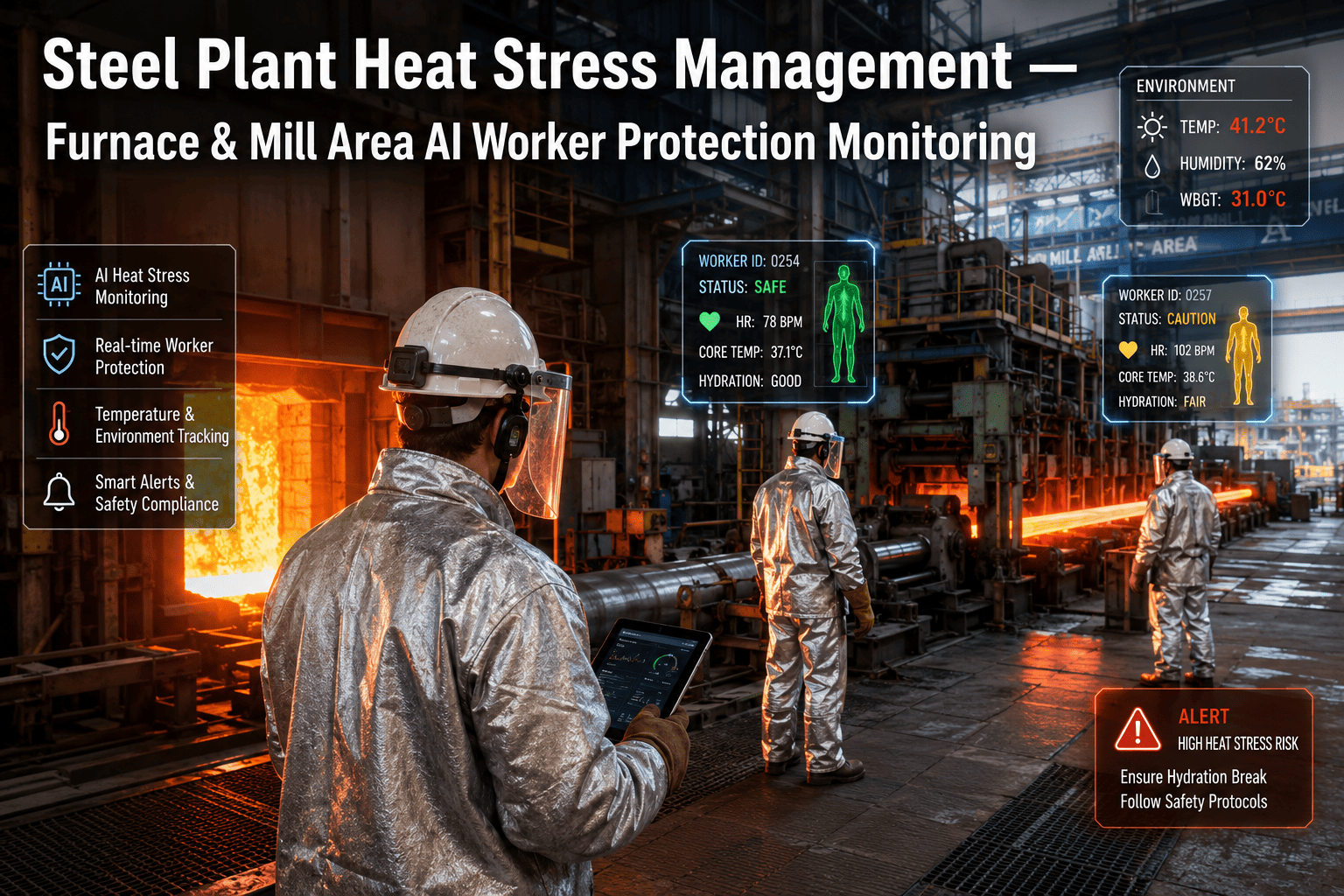
OSHA estimates that heat illness costs U.S. employers over $2.4 billion annually in lost productivity, workers' compensation, and OSHA penalties — and steel plants account for a disproportionate share. Radiant heat from molten steel, limited airflow in confined casting areas, and heavy PPE requirements create thermal environments that can push a worker's core body temperature toward dangerous levels within 20 minutes of physical exertion. The Wet Bulb Globe Temperature (WBGT) index is the industry-standard metric, but less than 30% of U.S. steel facilities monitor it continuously at the work level.
Airborne Hazard Monitoring: Beyond the Compliance Minimum
Steel manufacturing generates a complex airborne hazard profile — iron oxide fume, manganese (Mn) dust, crystalline silica, carbon monoxide, sulfur dioxide, and polycyclic aromatic hydrocarbons (PAHs) from coke operations. OSHA's permissible exposure limits for manganese fume (1 mg/m³ ceiling) and crystalline silica (50 µg/m³ respirable) are among the most stringent in industrial hygiene. Yet most steel plants still rely on quarterly grab sampling — a method that misses acute exposure spikes during tapping, oxygen lancing, or scarfing operations. Book A Demo for Airborne Hazard Monitoring
Iron Oxide Fume
Generated during EAF tapping and oxygen lancing. OSHA PEL: 10 mg/m³. iFactory correlates fume spikes with specific process events for engineering control targeting.
Manganese Dust & Fume
Neurological hazard with no safe floor. OSHA ceiling: 5 mg/m³. Continuous real-time Mn monitoring in EAF shops is now an industry best practice under OSHA's National Emphasis Program.
Crystalline Silica
Present in refractory lining dust and scarfing operations. OSHA's 2016 silica standard mandates action at 25 µg/m³ respirable. Engineering controls and continuous monitoring are required.
Carbon Monoxide
Invisible acute hazard in blast furnace casthouse and coke oven gas systems. OSHA PEL: 50 ppm. IDLH: 1,200 ppm. Fixed CO detectors with emergency response workflow integration are mandatory.
iFactory integrates with fixed-point electrochemical and photoionization detectors positioned at breathing zone height throughout the plant. Continuous data streams at 1-minute intervals provide a real-time air quality map of every production bay, triggering zone-specific alerts when any contaminant approaches 50% of its OSHA PEL.
- Multi-gas detector integration (CO, SO₂, H₂S, VOC) via Modbus/OPC-UA
- Real-time spatial air quality map with zone-level hazard heat mapping
- Automatic ventilation system interlock triggers on threshold breach
- Shift-based exceedance log for OSHA recordkeeping compliance
- Trend analysis identifying gradual PEL creep before it becomes a citation
Personal sampling remains the gold standard for regulatory compliance because it captures actual worker breathing-zone concentrations during specific tasks. iFactory digitizes the full personal sampling lifecycle — from sample assignment and pump calibration through laboratory results upload and individual exposure profile management — creating a permanent, auditable exposure history for every worker.
- Digital sample assignment linked to job classification and task code
- Chain-of-custody records for accredited laboratory submission
- Automatic comparison of lab results against PEL, TLV, and REL benchmarks
- Individual cumulative exposure trending across job rotations and years
- OSHA 1910.1000 Table Z compliance report generation
For heavy metals like lead and manganese, air sampling alone is insufficient to confirm body burden. OSHA's lead standard (29 CFR 1910.1025) mandates blood lead level (BLL) monitoring when air lead exceeds 30 µg/m³. iFactory links biological monitoring results — BLL, urinary manganese, pulmonary function tests — to air exposure records, satisfying OSHA, NIOSH, and state OSHA requirements simultaneously.
- BLL trigger tracking linked to area and personal air lead data
- Medical removal protection (MRP) workflow with return-to-work clearance
- Spirometry trending for silica-exposed worker cohorts
- Urinary manganese correlation with EAF zone exposure history
- Physician-review-ready exposure summary reports per worker per exam cycle
The most powerful capability in iFactory's occupational health module links specific production events — heat charge, oxygen blow, tapping, ladle preheating — to documented air quality exceedances. By identifying which process sequences generate the highest worker exposures, the platform moves the EHS program from compliance documentation to genuine exposure source elimination.
- Production event log integration with real-time air quality time-series
- Automatic identification of top-5 exposure-generating process events per month
- Engineering control ROI model — quantifies PEL reduction per control investment
- Substitution analysis for process chemistry changes that reduce fume generation
- Regulatory trend reporting showing year-over-year exposure reduction by contaminant
Audiometric Testing: Building a Defensible Hearing Conservation Program
OSHA's Hearing Conservation Amendment (29 CFR 1910.95) requires annual audiometric testing for all workers exposed at or above the 85 dB(A) action level — a threshold crossed daily by the majority of steel plant workers. Yet OSHA's own enforcement data shows that hearing conservation violations consistently rank in the top-10 most-cited standards for the steel NAICS sector, with penalties averaging $8,400 per citation in 2024.
The failure is almost always procedural: missed annual test windows, lost baseline records, undocumented standard threshold shift (STS) notifications, and absent follow-up medical referrals. iFactory's hearing conservation module automates the full administrative cycle — from test scheduling and mobile audiogram result capture through STS calculation, worker notification, and OSHA 300 entry generation. Schedule a Audiometric Testing Assesment
Baseline Audiogram within 6 Months of First Exposure
iFactory generates onboarding audiogram appointments automatically upon assignment of a new employee to a noise-exposed job classification. Digital records link directly to the individual's occupational health profile.
Annual Audiogram with Automated Scheduling & Reminder Cascade
The platform tracks each worker's last test date and generates supervisor reminders at 11 months, 12 months, and 13 months — with automatic escalation if the annual window is missed — eliminating the single most common OSHA hearing conservation citation.
Automatic Standard Threshold Shift Calculation & OSHA 300 Flag
A 10 dB shift at 2,000, 3,000, or 4,000 Hz in either ear triggers automatic STS classification, worker notification letter generation, and a conditional OSHA 300 recordable flag pending physician work-relatedness determination.
Medical Referral Workflow & PPE Upgrade Protocol
Confirmed STS cases trigger a structured follow-up workflow: audiologist referral, hearing protector attenuation upgrade, retraining documentation, and a 90-day re-test schedule — all tracked to closure within iFactory's compliance dashboard.
Unified vs. Fragmented: The Real Cost of Disconnected Health Programs
Most steel plant occupational health programs are structurally fragmented — audiometric records in one system, air sampling in another, heat illness logs on paper, and biological monitoring results in a physician's filing cabinet. OSHA's Multi-Employer Citation Policy means that a contractor worker's undocumented exposure in your plant becomes your recordable. iFactory's unified approach connects every data stream into a single regulatory-grade compliance record that survives any OSHA inspection or NIOSH study.
Replace Five Disconnected Systems with One Audit-Ready Platform
iFactory connects noise dosimetry, WBGT monitoring, air sampling, audiometric records, and biological monitoring into a single occupational health dashboard — OSHA-compliant, real-time, and inspector-ready on demand.
Occupational Health Is Not a Program — It Is a Data Infrastructure Problem
Steel plant workers face noise, heat, and airborne chemical exposures simultaneously — often in the same shift, in the same zone. Managing these hazards in isolation through disconnected systems and periodic sampling campaigns is the structural reason that OSHA's steel sector enforcement data shows persistent citation rates in hearing conservation, respiratory protection, and heat illness prevention year over year. The exposures are predictable. The illnesses are preventable. The compliance failures are administrative.
iFactory's occupational health platform reframes the problem as a data infrastructure investment: connect the monitoring devices that already exist, correlate the data streams that are already being collected, and automate the administrative workflows that consume EHS staff time that should be spent on engineering controls. For steel facilities operating under OSHA's National Emphasis Programs on silica and heat, this is not an optimization — it is a risk management imperative.
Steel Plant Occupational Health — Frequently Asked Questions
Build a Unified, OSHA-Ready Occupational Health Program with iFactory AI
iFactory connects every occupational health data stream in your steel plant — noise dosimetry, WBGT monitoring, air sampling, audiometric records, and biological monitoring — into a single real-time compliance dashboard that survives any OSHA inspection.