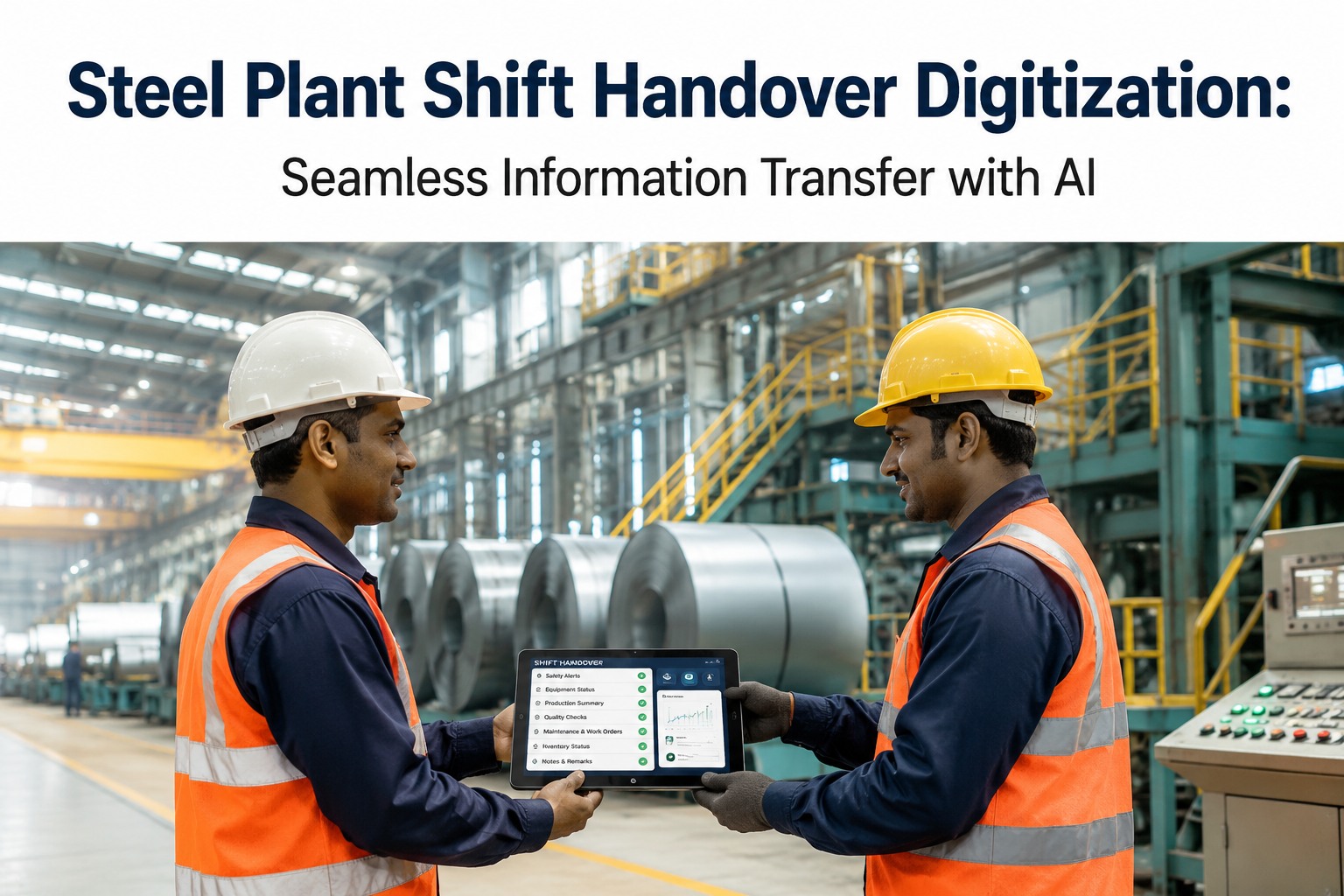
Steel plant shift handover is one of the most information-dense, highest-stakes transitions in industrial operations — and in most facilities, it still happens the same way it did in 1987. A paper logbook. A verbal briefing in a noisy control room. A whiteboard with half-erased equipment status notes. When the outgoing crew walks out and the incoming crew walks in, the organizational intelligence that drives safe, productive operations transfers on a wing and a prayer. Digital shift handover for steel plants eliminates this structural information loss — replacing paper logs, verbal briefings, and siloed operator notes with a structured, real-time digital record that gives every incoming shift supervisor the complete operational picture from the moment they log in. If your shift transition process still depends on institutional memory and manual logbooks, Book a Demo to see how iFactory's AI shift management platform transforms handover from a liability into a competitive operational advantage.
Why Shift Handover Is the Biggest Unaddressed Risk in Steel Operations
The steel plant operates 24 hours a day across three rotating shifts. Every 8 hours, operational responsibility transfers from one crew to another — and with it, the entire situational awareness of what the plant has been doing, what equipment is degraded, what work orders are pending, what alarms have been acknowledged and why, and what the next 4 hours of production schedule look like. In a manual handover system, this transfer happens imperfectly, every single time.
Research consistently shows that shift changeover is disproportionately represented in industrial incident data. The incoming operator who doesn't know that the secondary dedusting system on EAF #2 has been running at reduced capacity for the last 90 minutes makes decisions with incomplete information — decisions that, in a steel plant environment, can have immediate safety and quality consequences. The cost of this information gap is not theoretical. It is measurable in incident rates, in off-spec heat sequences, in emergency work orders triggered by conditions that the outgoing crew knew about but failed to document with sufficient clarity for the incoming supervisor to act on.
The Five Components of a Complete Digital Steel Plant Shift Handover
Effective digital shift handover is not a single form or a checklist — it is a structured information architecture that captures five distinct categories of operational knowledge at each shift transition. iFactory's shift logbook module organizes handover data across all five categories, presenting them in a unified dashboard that the incoming shift supervisor reviews, confirms, and signs off before taking operational responsibility.
Production Status Transfer
The production status section of the digital handover record captures the shift's complete production performance — heats completed, tonnes produced, yield metrics, current schedule position, and any deviations from the planned production sequence with documented rationale. In a steel plant context, this includes EAF heat cycle status, continuous caster sequence position, rolling mill throughput, and any quality holds or grade deviations that are pending metallurgical disposition at shift change.
iFactory's AI layer auto-populates the production status fields from the L2 process data historian — eliminating manual data entry from the outgoing supervisor's checklist and ensuring that the numbers the incoming shift sees match the actual system data, not a manually transcribed estimate from a logbook entry written 20 minutes before shift change.
Equipment Condition Reporting
Equipment condition reporting is the most consequential and most poorly executed component of manual shift handovers. When a steel plant operator runs a piece of equipment on a workaround — reduced speed, bypassed interlock, manual flow control — that knowledge lives in their head and, if they're conscientious, in a paper logbook entry. When they walk out, that knowledge is at risk of not surviving the handover. The incoming operator, not knowing the equipment is degraded, applies it at full design capacity and either trips it or accelerates the failure mode that the outgoing operator had been managing.
iFactory's equipment condition module requires the outgoing operator to formally document every piece of equipment running outside its normal operating envelope — with the deviation type, the current operating parameters, the workaround in place, and the associated work order number for the underlying fault. This documentation is visible to the incoming supervisor on their handover dashboard before they accept responsibility for that equipment.
Safety Alert Transfer Protocol
Safety information transfer at shift change is governed by OSHA Process Safety Management requirements and, in unionized steel plants, often by collective bargaining agreement provisions that specify minimum handover standards. Despite this regulatory and contractual framework, safety-critical information — active near-miss reports, temporary safety measures, modified lock-out/tag-out procedures, active chemical spill containment — is routinely transferred verbally with no verifiable documentation of what was communicated and acknowledged.
iFactory's safety alert module enforces electronic acknowledgment of every active safety alert by the incoming shift supervisor before the handover can be completed and closed. Active safety alerts cannot be bypassed or carried forward without explicit supervisor acknowledgment — creating a documented chain of custody for safety-critical information that satisfies PSM documentation requirements and provides defensible evidence of proper safety communication in the event of an incident investigation.
Outstanding Work Order Status
Work order continuity across shift changes is one of the most operationally consequential and most poorly managed aspects of steel plant maintenance coordination. A work order initiated by the day shift for a recurring hydraulic leak on the ladle transfer car, partially diagnosed but awaiting parts confirmation, needs to transfer to the night shift maintenance supervisor with full context — what was found, what was done, what is still pending, what parts are on order, and what the interim operating restriction is. In a paper system, this transfer depends entirely on whoever wrote the most recent logbook entry and whether the incoming supervisor reads it carefully enough.
iFactory's shift handover module presents all open work orders on the incoming supervisor's dashboard, organized by priority — critical, high, standard — with full status history, current assignee, parts status, and any operating restrictions attached. Work orders cannot be left in ambiguous status at shift change: the outgoing supervisor must classify each open work order as transferred-active, transferred-pending-parts, or escalated-to-maintenance-supervisor before the handover record closes.
Alarm Log Review and Context Transfer
Alarm rationalization is an ongoing challenge in steel plant operations — large facilities may have 50,000 to 200,000 configured alarm points, with most control rooms managing hundreds of alarm events per shift. The alarm log at shift change is typically a dense list of events with timestamps and severity levels that means very little to an incoming operator without the context of why certain alarms were acknowledged and what action was taken or deferred. iFactory's alarm transfer module presents the outgoing shift's alarm log in a rationalized, annotated format — grouping related events, flagging repeat alarms that may indicate a developing equipment fault, and requiring the outgoing supervisor to add context notes to any alarm that was acknowledged and deferred without a corrective action being completed.
Digital Handover vs. Manual Handover: The Operational Performance Gap
The performance differential between steel plants using structured digital shift handover and those relying on paper logbooks and verbal briefings is not marginal — it is measurable across every key operational indicator. The comparison below is based on documented performance data from steel manufacturing operations that have transitioned from manual to digital handover systems.
The Steel Plant Shift Handover Digitization Process: Implementation Sequence
iFactory's shift handover digitization deployment follows a structured implementation sequence designed to reach full operational capability within 45 days — without disrupting ongoing production operations or requiring extended system downtime for integration configuration.
1–2
Data Source Integration & Logbook Architecture
API connections to the plant's L2 process historian, CMMS (SAP PM or Maximo), and alarm management system established and validated. Production data auto-population tested across all configured data fields. Handover logbook template configured to the plant's specific organizational structure — area-based, asset-class-based, or crew-based — by the iFactory implementation team working remotely.
3
Parallel Run & Supervisor Onboarding
Digital handover system runs in parallel with existing paper log for one week — shift supervisors complete both the paper and digital records simultaneously. Discrepancies between the two systems are documented and used to refine the auto-population logic and identify any data fields that require manual supervisor input. Supervisor onboarding sessions (2-hour structured training per shift) conducted at shift handover times to minimize production impact.
4
Safety Module Activation & LOTO Integration
Safety alert transfer module activated with mandatory acknowledgment workflow. LOTO procedure registry integrated — active lockout tags visible on handover dashboard with expiry dates and responsible persons. PSM documentation requirements reviewed with plant safety manager and electronic acknowledgment trail configured to satisfy applicable regulatory standards. Near-miss reporting workflow linked to handover record for automatic safety alert generation.
5–6
Full Digital Cutover & Performance Baselining
Paper logbook formally retired. Digital handover system goes live as the sole system of record for shift transition. iFactory's analytics module begins tracking handover completion time, information completeness scores, and post-handover incident correlation. 30-day performance baseline established for comparison against pre-digitization incident and downtime data. First monthly handover performance report generated and shared with plant management.
The Financial Case for Steel Plant Shift Handover Digitization
The ROI calculation for shift handover digitization is driven by three quantifiable financial streams: incident cost reduction, maintenance efficiency improvement, and production loss reduction from post-handover equipment mismanagement. Each stream is independently significant; together, they typically deliver full cost recovery within 6 to 9 months of deployment.
Expert Perspective: What Changes When Shift Handover Is Digital
Conclusion: Shift Handover Is Not an Administrative Task — It Is a Reliability Strategy
Steel plant shift handover digitization is not a technology project — it is a reliability and safety strategy that happens to be enabled by technology. Every paper logbook that a steel plant uses for shift transition is a structural reliability gap that generates incidents, equipment damage, maintenance inefficiency, and production losses at a rate that most plants have simply accepted as normal. It is not normal. It is a solvable problem, and the solution does not require a multi-year transformation program.
iFactory's digital shift handover platform deploys in 45 days, integrates with your existing CMMS and process historian without replacing them, and delivers measurable performance improvements — reduced post-handover incident rates, improved work order cycle times, eliminated workaround knowledge loss — before the end of the first quarter of operation. The organizational knowledge that your most experienced shift supervisors carry in their heads gets captured, structured, and transferred to every incoming shift through a system that enforces completeness, generates accountability, and provides the audit trail that paper never could.
The shift change happens every 8 hours. Every shift. Every day. The information gap that currently exists at every one of those transitions is costing your plant more than the platform costs to fix it. The data is already there — in your historian, in your CMMS, in your alarm management system. iFactory's shift handover module is the intelligence layer that organizes it, presents it, and ensures your incoming supervisors start every shift with the full operational picture they need to run the plant safely and efficiently from minute one.
Frequently Asked Questions: Steel Plant Shift Handover Digitization
iFactory connects to SAP PM and IBM Maximo via standard REST API and OData interfaces — requiring no custom ABAP development in SAP and no Maximo customization. The integration automatically pulls open work order status, work order priority classification, parts status, and maintenance notes into the handover dashboard. When the outgoing supervisor classifies an open work order as escalated, iFactory automatically updates the work order priority in SAP PM or Maximo and triggers a notification to the maintenance supervisor. The handover record's work order section stays synchronized with the CMMS in real time — when a technician closes a work order mid-shift, it disappears from the handover's open work order list without any manual update required. Integration configuration is typically completed in 8 to 12 hours of plant IT and CMMS administrator involvement.
iFactory's handover completion tracking triggers an automatic escalation sequence if the incoming supervisor's acknowledgment is not recorded within a configurable window after shift start — typically 15 to 30 minutes, set by the plant. The escalation sequence sends a push notification to the supervisor's mobile device, then escalates to the area manager or plant operations manager if not acknowledged within a secondary window. Critical safety alerts that have not been acknowledged trigger immediate escalation regardless of the handover completion time window. All escalation events are logged in the audit trail — giving the plant safety and operations management full visibility into handover compliance without requiring manual monitoring. The system does not allow the outgoing shift's handover record to close until the outgoing supervisor has completed all mandatory fields, preventing the most common source of incomplete handovers which is an outgoing supervisor leaving before finishing the record.
Yes. iFactory's handover architecture is built around a hierarchical area-crew-asset structure that accommodates any combination of shift schedules and organizational structures within a single plant. A typical integrated steel plant might have separate handover workflows for the melt shop, the continuous caster, the hot rolling mill, and the finishing areas — each with their own supervisor hierarchy, asset lists, and shift timing. The plant operations manager sees a consolidated handover dashboard that shows completion status across all areas simultaneously, while each area supervisor sees only their area's handover record. Cross-area information — a downstream quality issue traced to an upstream heat chemistry deviation, for example — can be flagged in one area's handover record and automatically surfaced in the downstream area's incoming shift dashboard. Multi-site plants can also be configured with a corporate-level view that shows handover completion rates and incident correlation across all facilities in the enterprise.
iFactory's AI layer contributes to the shift handover process in three distinct ways beyond digital record-keeping. First, auto-population: the AI pulls production data, alarm summaries, and work order status from connected systems and pre-populates the handover record fields automatically — reducing the outgoing supervisor's manual input requirement by approximately 70% and eliminating transcription errors. Second, anomaly flagging: the AI analyzes the current shift's process data and alarm history to identify patterns that warrant the incoming supervisor's attention — a bearing temperature that has been rising at 0.3°C per hour for the last 4 hours, a recurring sub-synchronous vibration that correlates with a known failure mode — and surfaces these as AI-generated notes in the handover record. Third, trend correlation: the AI correlates post-handover incident data with handover record completeness scores over time, identifying which handover information gaps most reliably predict post-handover incidents — allowing the plant to tighten mandatory fields for the specific information categories most correlated with risk.
Steel plants deploying iFactory's digital shift handover system typically achieve full platform cost recovery within 6 to 9 months. The primary ROI driver in most deployments is incident cost reduction — specifically, the reduction in post-handover incidents in the first 2 hours of each shift, which represent a disproportionate share of total incident costs at plants still using manual handover. At a 1M TPY integrated steel plant where the pre-digitization post-handover incident rate generates approximately $2.1M in annual incident costs, a 68% reduction from digital handover delivers $1.4M in annual savings — typically exceeding the platform's annual subscription cost by a factor of 4× to 6×. Secondary ROI streams from work order cycle time improvement and equipment damage avoidance from workaround knowledge transfer are additive and typically add another $400,000 to $700,000 in annual savings for facilities of similar scale. iFactory provides a site-specific ROI model using your plant's incident data, maintenance spend, and production economics at no cost during the evaluation process.



-for-steel-plants-digital-compliance-framework.png)


