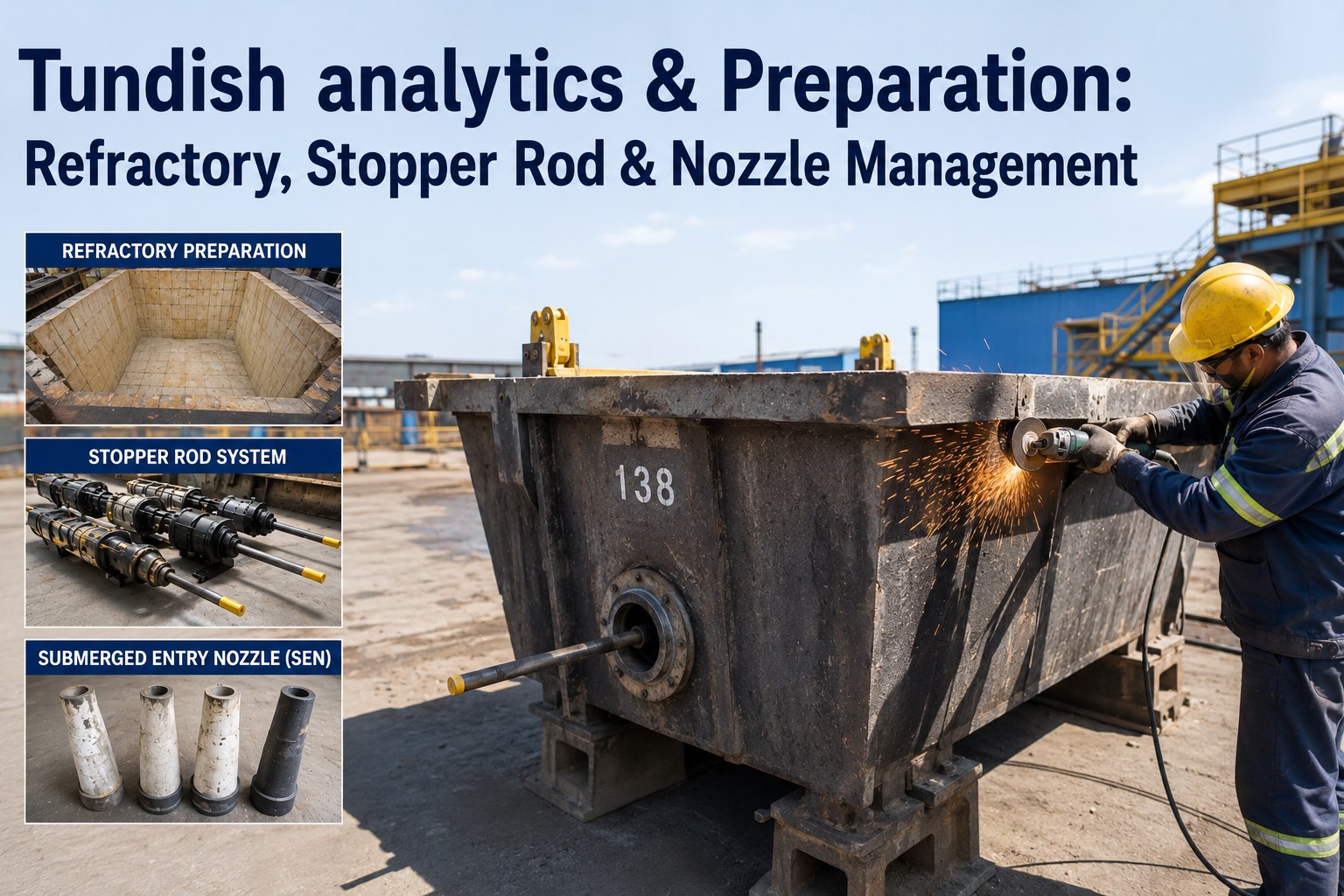
The tundish is the last line of defense in continuous casting quality control — a critical buffer vessel that governs steel flow, inclusion removal, and thermal stability before steel enters the mould. Yet in many meltshops, tundish preparation is still managed through paper logs, tribal knowledge, and reactive scheduling. A damaged stopper rod, a clogged submerged entry nozzle (SEN), or an improperly preheated tundish lining can trigger breakouts, sequence cuts and costly refractory replacements. Organizations that book a demo with iFactory are discovering how AI-driven tundish analytics, consumable tracking, and digital turnaround workflows can transform their caster reliability from reactive firefighting into predictive operational excellence.
The Cost of Tundish Preparation Without Analytics
Every untracked heat through an unmonitored tundish accumulates invisible risk. The metrics below represent the operational gap between plants running on manual inspection versus those using iFactory AI digital tundish analytics. Book a Demo to benchmark your plant's current performance against these benchmarks.
Four Gaps That Drive Tundish-Related Casting Failures
Designing an effective tundish analytics program requires a structured approach that bridges consumable lifecycle management with real-time casting performance. Caster supervisors building these programs for the first time often book a demo to see how platform analytics integrate directly into shift handover and turnaround planning workflows.
Stopper Rod Degradation
Erosion of the stopper rod tip creates uncontrolled steel flow and tundish level instability. Analytics track cumulative tonnage and leak-by frequency to predict end-of-campaign before a breakout occurs.
SEN Clogging & Blockage
Alumina buildup inside the submerged entry nozzle restricts flow, distorts the mould flow pattern, and drives inclusion entrapment. Analytics track SEN age, steel oxygen content, and argon purge effectiveness.
Refractory Lining Failure
Thermal shock from inadequate preheat or chemistry attack on the working lining accelerates wear, leading to skull formation or a catastrophic lining breach during casting.
Preheat Non-Compliance
Manual preheat logs are prone to gaps and falsification. Under-preheated tundishes suffer immediate thermal cracking, while over-heated units experience premature flux sintering and lining degradation.
The Digital Tundish Turnaround: From Campaign End to First Heat
In plants still running on manual processes, the tundish turnaround cycle is an unstructured handover zone where critical preparation steps get skipped under production pressure. iFactory's digital workflow enforces a gate-controlled sequence — no tundish proceeds to casting without verified completion at each milestone. The workflow below reflects best practice across integrated flat products and billet producers.
What a Comprehensive Tundish Analytics Program Must Cover
The most successful programs focus on four interconnected modules: refractory campaign tracking, stopper rod performance analytics, SEN management, and preheat procedure compliance. Each module reinforces the other — creating a tundish operation optimized for casting sequence length and consumable life.
The tundish working lining is the primary barrier between molten steel and the permanent backup lining. iFactory tracks every campaign from initial dry-out through to post-campaign skull removal. By correlating lining thickness measurements by zone with steel chemistry, casting temperature, and sequence length, the AI identifies early signs of accelerated wear in the impact pad zone and stopper rod block area — enabling predictive campaign length optimization.
- Digital campaign start/end with tonnage and heat tracking
- Zone-by-zone refractory wear rate modeling
- Chemistry attack index by grade (FeO, MnO, basicity)
- Impact pad integrity monitoring and replacement scheduling
- Post-campaign skull weight logging and lining performance scoring
The stopper rod system is the primary flow control mechanism and the most failure-critical consumable in the tundish. iFactory tracks cumulative campaign tonnage, leak-by event frequency, and stopper rod position deviation. By analyzing the correlation between stopper rod erosion patterns and steel grade calcium treatment levels, the AI predicts end-of-rod-campaign 2–4 heats in advance — allowing rod changes to be scheduled at sequence breaks.
- Per-rod campaign tonnage and heat sequence tracking
- Leak-by frequency and severity classification
- Rod tip erosion correlation with Ca/Al treatment ratios
- Automated rod change workflow with digital certification
- Argon purge flow rate monitoring through stopper bore
Submerged entry nozzle clogging is the leading cause of unplanned sequence cuts in slab and billet casters. iFactory tracks SEN age against grade-specific clogging risk scores derived from steel total oxygen content, alumina inclusion load, and argon purging effectiveness — ensuring nozzles are changed at the optimal point before restriction impacts mould flow symmetry.
- SEN age tracking by grade, heat, and argon purge rate
- Clogging Risk Score based on steel oxygen and inclusion data
- Mould flow asymmetry detection via thermocouple array analysis
- SEN change procedure digital checklist with safety certification
- Post-change strand quality correlation for SEN performance scoring
Tundish preheat is the most process-critical step in tundish preparation and the most frequently shortcut under production pressure. iFactory captures burner data directly from the preheat station PLC, generating an immutable digital record of the temperature-time curve for every tundish, compared against grade-specific targets.
- PLC-integrated burner temperature capture for immutable digital records
- Grade-specific preheat curve templates with tolerance bands
- Real-time deviation alerts during active preheat cycles
- Digital preheat completion certificate before tundish release
- Preheat compliance trending by shift and burner station
Traditional vs. iFactory AI Approach — Module by Module
Filter by module to compare the traditional and AI-driven approach side by side. Safety managers building these programs for the first time often find it valuable to book a demo to explore how platform analytics integrate into existing shift planning workflows.
| Analytics Module | Core Area | Traditional Approach | iFactory AI Approach | Outcome |
|---|---|---|---|---|
| Refractory Campaign | Working lining wear & skull management | Fixed campaign heats & visual post-mortem | Real-time wear modeling & chemistry attack index | Optimised campaign length & zero lining breach |
| Stopper Rod | Flow control & breakout prevention | Fixed tonnage limits & visual rod inspection | Leak-by frequency analysis & predictive rod life | Zero emergency flow loss events |
| SEN Management | Nozzle life & clogging prevention | Fixed heat limits & reactive nozzle change | Clogging Risk Score based on O₂ and inclusion load | Zero unplanned SEN-driven sequence cuts |
| Preheat Compliance | Lining temp & thermal shock prevention | Manual paper logs & operator sign-off | PLC-integrated burner capture & digital certificate | 100% verified preheat compliance per campaign |
| Dam & Weir Integrity | Inclusion flotation & flow pattern | Visual inspection at campaign end | Digital inspection workflow with photographic record | Verified tundish metallurgy zone effectiveness |
| Turnaround Scheduling | Tundish availability & lead time | Whiteboard scheduling & verbal handover | Digital turnaround timeline with milestone alerts | Zero start delays due to tundish readiness |
Designing a Scalable Tundish Analytics Implementation Framework
A structured tundish analytics implementation framework addresses three levels of operational competency — from foundational digital awareness for all caster staff, to applied analytics proficiency for tundish operators, to advanced consumable management lead capability for caster supervisors. Each tier maps directly to job role requirements, ensuring analytics capability is precisely calibrated to operational responsibilities.
Tundish Operations Awareness
For: All caster operators & shift staff
- Core tundish function & consumable lifecycle awareness
- Real-time tundish health dashboards — what they measure
- Basic mobile app navigation & turnaround alert handling
- How digital records support casting quality compliance
Tundish Analytics Technician
For: Tundish operators & refractory inspectors
- Refractory wear curve interpretation & campaign scoring
- Stopper rod leak-by analysis and rod change workflow
- SEN clogging risk triage and argon optimisation
- Data quality management for tundish compliance records
Consumable Management Lead
For: Caster supervisors & refractory engineers
- Facility-specific campaign optimisation methodology
- Consumable cost vs. quality risk framework development
- Network-wide turnaround schedule management strategies
- Refractory supplier integration & audit lead capability
How Tundish Analytics Strengthens Quality Compliance & Audit Readiness
International casting quality standards and customer steel specifications define specific requirements for tundish refractory qualification and consumable change-out procedures. iFactory analytics certification directly addresses this quality gap, creating documented evidence of qualified individual status that withstands customer quality audits and ISO casting compliance scrutiny.
| KPI | Result | Performance | Analytics Driver |
|---|---|---|---|
| Refractory Campaign Life | +40% longer | AI-driven wear modeling & chemistry attack index | |
| SEN Clogging Incidents | –72% reduction | Predictive clogging risk score & argon analytics | |
| Digital Preheat Completion | 100% verified | PLC-integrated burner capture workflows | |
| Stopper Rod Breakout Events | –89% fewer | Per-rod tonnage analytics & leak-by frequency scoring |
Tundish Analytics Impact · Measured across iFactory-supported programs in 15+ continuous casting facilities · Book a Demo
Before implementing iFactory, our tundish turnaround was managed entirely through verbal handover and paper refractory logs. We had no way to correlate stopper rod campaign length with steel grade chemistry until after a breakout had already occurred. The AI-driven rod life analytics and SEN clogging risk dashboard have given us a genuine predictive capability. We extended our average tundish campaign by 6 heats and eliminated three SEN-related sequence cuts in our first quarter of operation.
The tundish is chronically under-instrumented relative to its operational importance. Most plants measure tundish weight and casting speed at the mould level — but the early warning signals for stopper rod failure, SEN restriction, and lining breakthrough exist at the tundish itself, in data streams that are often collected but never correlated. What iFactory's platform does well is close the loop between ladle metallurgy records, preheat station data, and caster PLC streams — creating a unified consumable health model that no individual analyst could maintain manually across a multi-strand operation.
From a metallurgical standpoint, the Clogging Risk Score methodology reflects genuine process understanding. Alumina clogging is not simply a function of SEN age — it is a function of the steel's deoxidation practice, the argon flow history, and the grade's susceptibility to reoxidation during ladle transfer. Tracking these variables in combination, rather than applying a fixed heat limit, is exactly the right approach for a quality-driven casting operation.
Key capabilities validated in this platform:
- Multi-variable SEN clogging risk modeling
- Grade-specific preheat compliance enforcement
- Stopper rod predictive replacement — 2–4 heats ahead
- Zone-by-zone lining wear rate modeling
- OPC-UA integration with Siemens, Primetals, Danieli
- Digital audit trail for ISO casting compliance
Tundish Preparation Is a Process Decision, Not a Maintenance Task
The tundish does not fail randomly. It fails predictably — through accumulated wear that goes unmeasured, consumable limits applied without grade context, and preheat procedures cut short under production pressure. The common thread in every tundish-related casting failure is the absence of connected data: data that would have shown the stopper rod was approaching its erosion limit, that the SEN's clogging risk score had crossed its grade-specific threshold, or that the preheat curve deviated from specification at the 400°C stage and never recovered.
iFactory's tundish analytics platform closes these gaps at the system level — not by adding instrumentation, but by connecting the instrumentation that already exists. For plants operating multi-strand casters at high utilization, this is the difference between managing tundish campaigns with confidence and absorbing breakout costs that no monthly maintenance budget can rationalize.