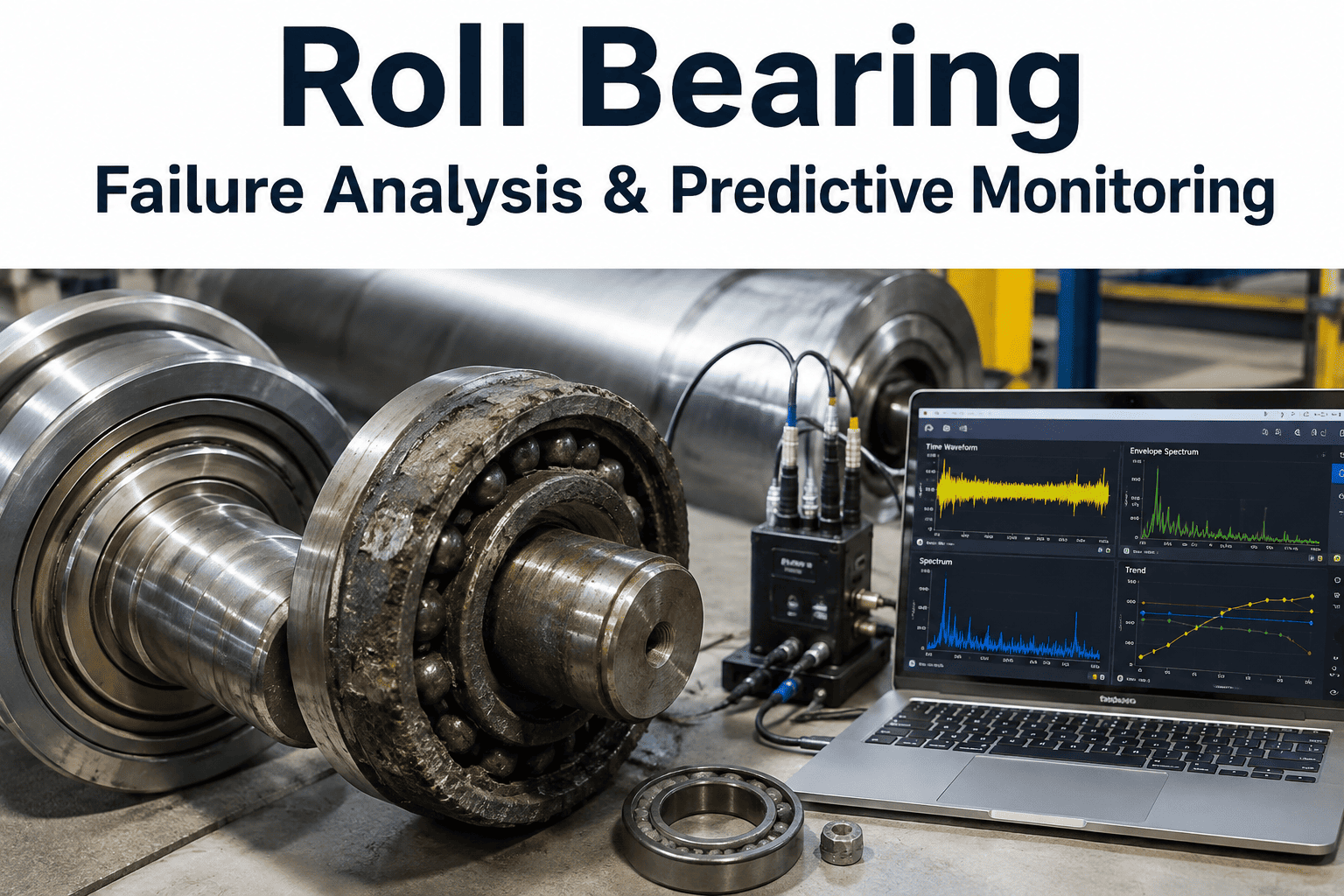
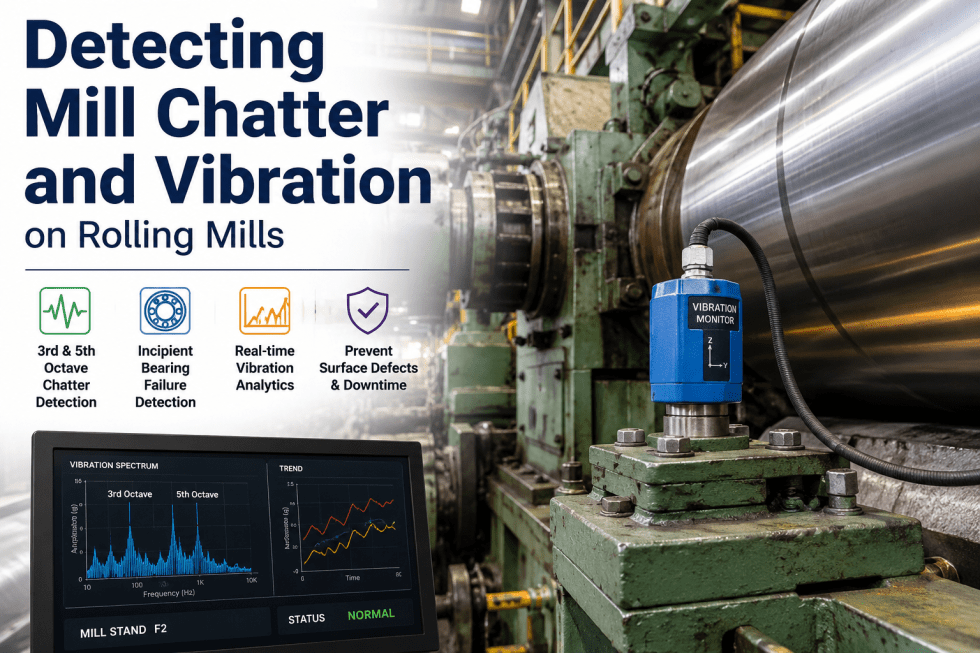
Rolling mill bearings are among the most failure-prone and financially consequential components in any steel plant. A single undetected backup roll bearing failure on a hot strip mill finishing stand can take a mill offline for 12–36 hours, costing $1.5M or more in lost production, emergency parts, and crane time. Yet most plants still rely on fixed greasing intervals, manual vibration checks with handheld probes, and reactive replacement driven by audible noise or visible damage. iFactory's Vibration Analysis and Predictive AI platform changes this entirely — continuously monitoring BPFO, BPFI, BSF, and FTF fault frequencies across every critical bearing in the mill, automatically scoring condition, and triggering SAP work orders before failure becomes inevitable.
Rolling Mill Bearing Analytics: Vibration Monitoring & Predictive Failure Detection
From BPFO/BPFI frequency detection to AI-automated work orders — complete bearing intelligence for rolling mills.
Why Rolling Mill Bearings Fail Without Warning — And What Changes With Analytics
Rolling mill bearings operate under extreme radial and axial loads, high temperatures, and contaminated lubrication environments. Conventional monitoring — weekly handheld readings or fixed greasing schedules — misses the critical degradation window that occurs 3–6 weeks before catastrophic failure. By the time vibration is audible, the bearing has already entered Stage 3 or 4 degradation. iFactory's continuous vibration AI monitors every bearing in real time — detecting BPFO, BPFI, BSF, and cage fault frequencies the moment they emerge in the spectrum, weeks before failure.
What iFactory Detects — The Four Critical Bearing Fault Frequencies
Every rolling mill bearing failure generates characteristic vibration frequencies before visible damage appears. iFactory's AI continuously analyses the full vibration spectrum for all four fault signatures — automatically, on every chock, every shift.
Outer race spalling — most common rolling mill bearing fault. Detected in high-frequency envelope spectrum 4–8 weeks before failure.
Inner race defects — often load-zone related in backup roll chock bearings under heavy rolling force. Amplitude modulated by shaft rotation.
Rolling element (ball/roller) damage — detected via sub-harmonic frequency sidebands. Accelerates rapidly under contaminated lubrication.
Cage defects — often an early indicator of lubricant starvation or cage fracture. Low frequency, easily missed by handheld instruments.
How iFactory Bearing Analytics Works — The Technology Stack
Four interconnected AI layers give rolling mill teams complete bearing intelligence — from raw vibration signal to SAP work order, without manual analysis or data entry.
The AI Digital Twin layer is critical for rolling mills — where load variation between rolling and idling creates vibration changes that would trigger false alarms in simpler threshold-based systems.
Every Mill Bearing — Monitored, Scored, Scheduled
iFactory covers all bearing types and locations across the rolling mill. Each asset gets its own health score, trending history, and automatic PM scheduling — visible to maintenance, production, and management in a single dashboard.
Before vs. After — Bearing Analytics Impact on a 4-Stand Mill
Measured results from a 4-stand cold rolling mill after 12 months on iFactory Vibration Analysis and Predictive AI. Verified by plant maintenance and finance leadership.
What a Chief Maintenance Engineer Said
iFactory caught an outer race defect on our F4 backup roll bearing six weeks before it would have caused a full chock failure. We planned the change during a scheduled roll campaign — total cost was $28,000. The alternative would have been an emergency strip-down mid-campaign costing over $400,000.
Frequently Asked Questions
How does iFactory eliminate false positives from rolling load variation?
The AI Digital Twin cross-references vibration signatures with real-time rolling force and speed data from the PLC — separating load-induced vibration changes from genuine bearing defect patterns.
Does iFactory work with existing vibration sensors or does it require new hardware?
iFactory integrates with most standard ICP accelerometers already installed. New sensor installation is only needed for bearing locations not yet covered by existing hardware.
How are bearing fault alerts sent to the maintenance team?
Alerts appear on the iFactory dashboard, are sent via email/SMS, and automatically generate SAP PM work orders with bearing ID, fault type, urgency level, and recommended spare parts.
Can iFactory track bearing lubrication condition as well as vibration?
Yes. Lubrication degradation is inferred from combined temperature rise, vibration kurtosis increase, and cage frequency changes — giving early warning of lubricant starvation before friction damage occurs.
How quickly can bearing analytics go live on an operating mill?
Data integration with existing sensors typically takes 2–3 weeks. AI model calibration completes by Week 6. Full predictive alerting with SAP integration is live within 8 weeks of project start.
See Bearing Analytics Live on Your Rolling Mill
Get a demo configured around your specific bearing locations and mill layout.