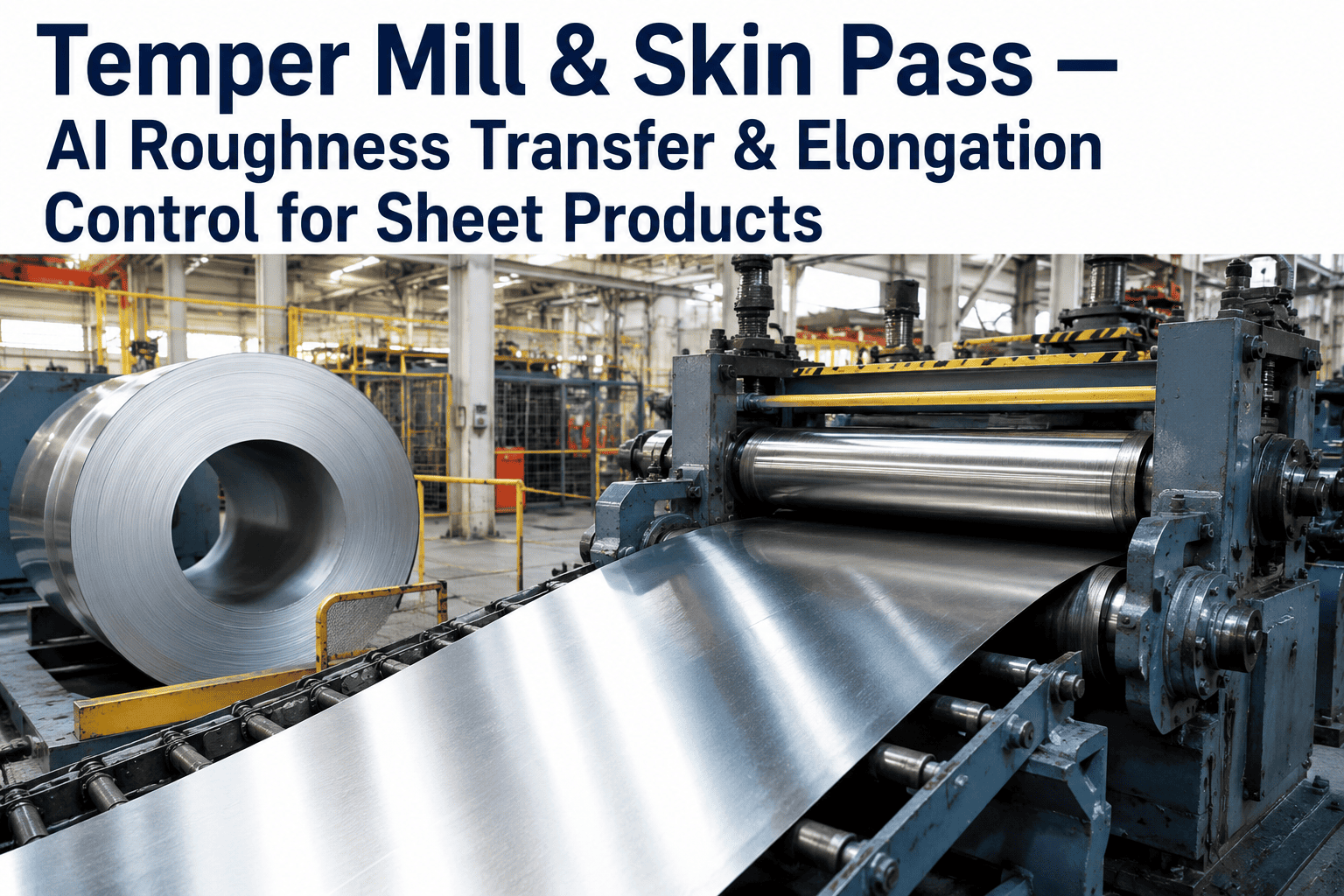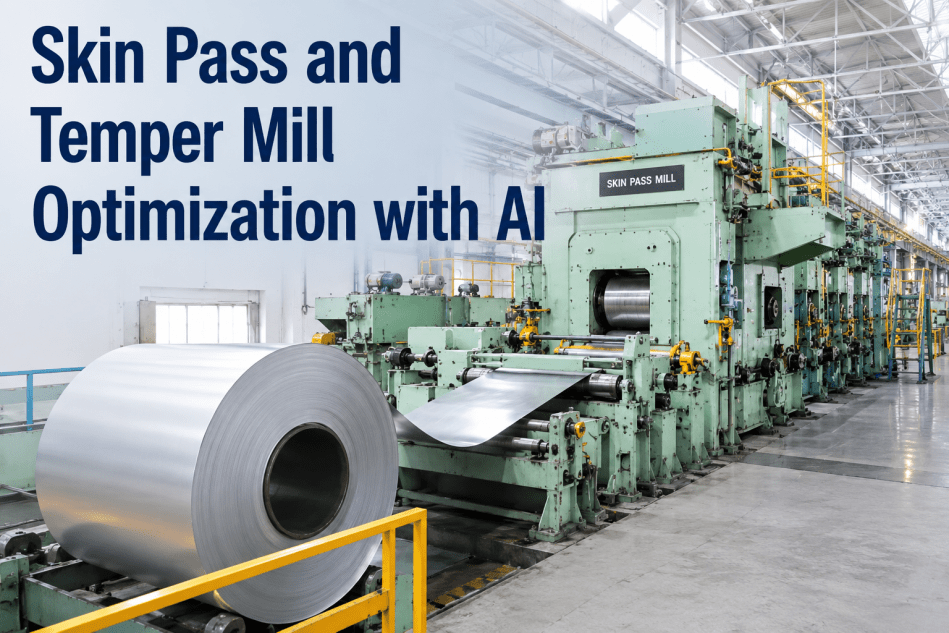
Skin pass mills and temper mills are the final rolling operation in the cold mill processing chain, where sheet surface roughness, elongation (0.5-3%), and mechanical properties are precisely calibrated to customer specifications. Every coil of automotive outer panel, appliance wrapper, or tinplate can stock passes through the skin pass mill for a reduction typically under 3% that determines whether the formed part exhibits Lüders bands during stamping, whether the paint finish reveals roll-bite surface texture, and whether the forming operation produces consistent springback across every panel in a production run. Despite the modest reduction, the skin pass mill is one of the most consequential process stages for downstream quality — and one of the most under-optimized in terms of real-time control. Most skin pass mills still operate with fixed elongation setpoints per product family that are manually adjusted based on offline roughness measurements taken once per coil and periodic tensile tests performed every 10-20 coils. iFactory's Temper Mill AI platform replaces this static approach with continuously learning AI models that optimize elongation, surface roughness transfer, and roll bite conditions in real time — improving elongation tolerance by 40%, eliminating yield point elongation defects, and reducing surface roughness variability by 50% across the full product mix. Book a Demo to see iFactory's Temper Mill AI configured for your skin pass mill configuration, product grades, and quality targets.
Skin Pass Mill AI Optimization: Elongation, Roughness, and Yield Point Control
A comprehensive technical framework for deploying AI-driven elongation control, surface roughness optimization, and yield point elimination across skin pass and temper mill operations for automotive, appliance, and tinplate applications.
Critical Optimization Challenges in Skin Pass and Temper Mill Rolling
Skin pass mill operations involve a balanced interplay of elongation, surface roughness transfer, roll force distribution, and lubricant application — all within a reduction window so narrow that a deviation of 0.1% in elongation or 0.1 microns in roughness can push a coil from prime to downgrade. Temper mill AI analytics addresses each of these challenges by learning the mill's specific response characteristics and recommending adjustments in real time. Schedule a mill audit to identify your skin pass operation's highest-value optimization opportunities.
Precision Elongation Control
Automotive outer panels require elongation tolerance of ±0.1% to ensure consistent dent resistance and springback characteristics. iFactory's AI model predicts the optimal roll force and tension combination for each coil based on entry gauge, yield strength, and target elongation — maintaining tolerance across full coil length despite roll speed and tension variations.
Surface Roughness Transfer
Roughness transfer from the work roll to the strip surface determines paint appearance and tribological behavior in downstream forming operations. AI models predict the roughness transfer coefficient for each combination of roll roughness, reduction, and lubricant condition — enabling operators to select the optimal roll pair for each production order.
Yield Point Elimination
Lüders bands and stretcher strains occur when the skin pass reduction is insufficient to eliminate the yield point elongation in batch-annealed or continuous-annealed strip. The AI model predicts the minimum elongation required to suppress yield point extension based on actual yield strength and prior annealing conditions — eliminating the surface defects that cause automotive stamping rejections.
Shape and Flatness Control
Light reductions in the skin pass mill amplify any incoming shape defects from the tandem mill — a coil with a 5 I-unit center buckle entering the skin pass can exit with a 15 I-unit buckle after incorrect roll gap or tension settings. AI models predict the flatness outcome for each combination of incoming shape, reduction, and tension distribution.
Roll Bite Lubrication Management
Lubricant type, concentration, and flow rate affect friction in the roll bite — which directly influences elongation, surface roughness transfer, and roll wear rate. iFactory's AI recommends optimal lubricant parameters for each product-grade combination based on historical surface quality outcomes and roll condition data.
Work Roll Surface Management
Work roll roughness degrades progressively during a campaign, altering the roughness transfer characteristics for every subsequent coil. iFactory tracks cumulative tonnage per roll pair and predicts when roughness transfer will drift outside tolerance for the scheduled product — enabling proactive roll changes that prevent surface quality excursions.
AI Impact: Skin Pass Mill Performance Benchmarks
Quantifying the impact of AI-driven elongation control, surface roughness optimization, and yield point elimination across the four most critical skin pass mill KPIs.
Skin Pass Mill AI Core Capabilities
iFactory's Temper Mill AI platform targets the four most impactful control domains in the skin pass mill — precision elongation control, surface roughness optimization, yield point elimination, and roll condition management — integrating each into a unified optimization framework that adapts to every coil, every grade change, and every roll campaign. Book a demo to see how dynamic skin pass control adapts to your specific mill configuration and product mix.
Precision Elongation Control with Force-Feedback
AI model calculates the optimal roll force and tension distribution for each coil segment based on entry gauge profile, yield strength variation, and target elongation. Force-feedback from the load cells is compared against the predicted force in real time, and the model adjusts tension or roll gap within the coil to maintain elongation within ±0.1% of target.
Surface Roughness Optimization Model
AI predicts the transferred roughness on the strip surface for each combination of work roll roughness, reduction percentage, elongation, and lubricant condition. When the predicted roughness deviates from the target, the model recommends lubricant adjustments or roll changes — preventing surface quality excursions before they produce non-conforming coils.
Yield Point Elimination via Adaptive Reduction
The AI model predicts the minimum elongation required to suppress yield point extension based on actual yield strength, prior annealing cycle, and strip temperature. Coils with predicted yield point behavior below the threshold receive a recommended elongation increase — ensuring every coil exits the skin pass mill with fully eliminated yield point elongation.
Campaign-Learning Roll Management
AI models track cumulative tonnage, peak load events, and roughness degradation for each work roll pair across its campaign life. When the model predicts that roll roughness has degraded beyond the transfer capability required for the next scheduled order, it generates a roll change recommendation with predicted quality impact — enabling proactive roll changes rather than reactive ones after defect detection.
Skin Pass Mill Control Approaches — Manual Operation vs Traditional Automation vs AI Real-Time Optimization
The table below compares three approaches to skin pass mill control. Traditional manual operation depends on operator experience and offline quality measurements. Traditional automation uses fixed setpoint models per product family. AI real-time optimization continuously adapts elongation, roll force, and lubricant parameters to every coil and every roll condition change.
| Control Parameter | Manual Operation | Traditional Automation | iFactory Temper Mill AI |
|---|---|---|---|
| Elongation setpoint | Operator sets fixed elongation per product family | Pre-calculated elongation per grade and gauge band | AI-optimized elongation per coil segment with force-feedback correction in real time |
| Surface roughness control | Offline roughness measurement at coil ends — roll change triggered by limit samples | Roughness transfer assumed constant per roll pair | AI predicts roughness transfer per coil based on roll wear state, reduction, and lubricant conditions |
| Yield point management | Fixed minimum elongation applied to all coils in a grade | Elongation floor per grade — no adaptation for incoming yield strength | AI predicts minimum elongation to eliminate yield point based on actual yield strength and prior annealing history |
| Roll force distribution | Even distribution — no crown or bending adjustment per coil | Fixed bending setpoint per width range | AI-optimized bending and shifting based on incoming shape, target flatness, and roll crown condition |
| Lubrication management | Fixed flow rate per mill — manually adjusted for surface defects | Flow rate per product type — no adaptation for roll condition | AI-optimized flow rate and concentration based on predicted roughness transfer and roll wear state |
"I managed the skin pass mill and finishing operations at a cold rolling complex supplying automotive outer panels to three major OEM assembly plants. Our most persistent quality issue was stretcher strain rejections from the automotive stamping plants — we were running at a 2.5% rejection rate on exposed panels, and each rejected coil triggered a containment, inspection, and replacement process that cost us an average of $4,200 per incident. The root cause was inconsistent yield point elimination: our fixed elongation setpoint of 1.2% was adequate for most coils but insufficient for coils with higher yield strength from annealing furnace temperature variation. The operators had no visibility into whether a given coil's elongation was sufficient because the tensile test results came back from the lab hours after the coil had passed the skin pass mill. iFactory's Temper Mill AI eliminated this by predicting the minimum elongation requirement for each coil from the end-of-anneal temperature data and yield strength measurement. Within 60 days of deployment, the stretcher strain rejection rate dropped to 0.3%, and our automotive customers removed us from their containment inspection list — a change that saved us $600,000 per year in inspection costs alone."
Three Business Outcomes Delivered by Temper Mill AI Deployment
Beyond process optimization and defect reduction, Temper Mill AI creates measurable business outcomes across production quality, material cost, and customer satisfaction.
Zero Stretcher Strain Claims from Automotive Customers
Every coil receives the minimum elongation required to eliminate yield point extension based on its actual yield strength and annealing history — not a blanket setpoint that under-eliminates on stronger coils. Automotive stamping plants receive coils that consistently produce defect-free formed parts, eliminating containment inspection requirements and customer claims.
Surface Roughness Reject Rate Reduced by 60%
Real-time roughness transfer prediction enables proactive roll changes when the model detects that roll roughness has degraded below the transfer capability required for the next scheduled order. Roll changes are executed based on predicted quality impact rather than after defective coils have accumulated.
$300K–$800K Annual Savings from Material and Energy
Precision elongation control reduces material waste from over-elongated coils that exceed gauge tolerance. Optimized roll force distribution reduces energy consumption per ton. Reduced rework and downgrade rates recover production capacity equivalent to 5-8% additional throughput on the skin pass mill.
Skin Pass Mill AI Optimization — Frequently Asked Questions
How does Temper Mill AI differ from existing skin pass mill elongation control systems?
Existing systems use fixed elongation setpoints per product family with manual force adjustment based on offline tensile test results. Temper Mill AI continuously adapts elongation and roll force per coil segment based on actual yield strength, incoming gauge profile, and roll condition — maintaining ±0.1% elongation tolerance across the full coil length.
Does the system require changes to existing mill PLC or automation infrastructure?
No. Temper Mill AI connects to existing mill PLCs and automation systems through read-only OPC-UA or database connectors. Model recommendations are presented to operators through the existing HMI or a companion display with manual override always available. No modifications to existing control loops are required.
How much historical data is required to train the Temper Mill AI models?
A minimum of 3 months of historical coil data covering all major grades, gauges, and surface finish requirements is required for initial model training, with elongation and roll force data recorded at each coil. The model improves continuously as new production data and surface quality measurements are incorporated.
Can the system handle both dry skin pass and wet skin pass operating modes?
Yes. The AI maintains separate process models for dry and wet skin pass modes, with different elongation response curves, roughness transfer coefficients, and lubricant optimization parameters for each mode. The platform automatically selects the appropriate model based on the operating mode at any time.
What is the typical ROI and payback period for Temper Mill AI deployment?
ROI is driven by defect reduction ($200K–$600K/year from eliminated stretcher strain claims), material savings ($100K–$300K/year from reduced over-elongation), and yield improvement. Typical payback is 6-12 months depending on mill tonnage, product mix, and current defect rate. Book an ROI assessment for your mill.
The Decision That Determines Your Skin Pass Mill Quality Trajectory — Fixed Setpoints or Continuously Learning AI
The difference between skin pass mills operating with fixed elongation setpoints per product family and mills operating with continuously learning AI models compounds with every coil processed. Each coil that exits with insufficient elongation to eliminate yield point extension generates a downstream stamping rejection that costs thousands of dollars and erodes customer confidence. Each coil that carries excess elongation consumes material margin that cannot be recovered and risks gauge deviation that affects downstream forming operations. Each roll change that is triggered by a surface quality defect rather than a predicted degradation point produces 15-30 minutes of unplanned downtime and multiple non-conforming coils. AI-driven skin pass mill optimization eliminates these losses by learning from every coil, every grade change, and every roll condition — continuously refining the operating parameters toward maximum quality consistency at minimum material cost.