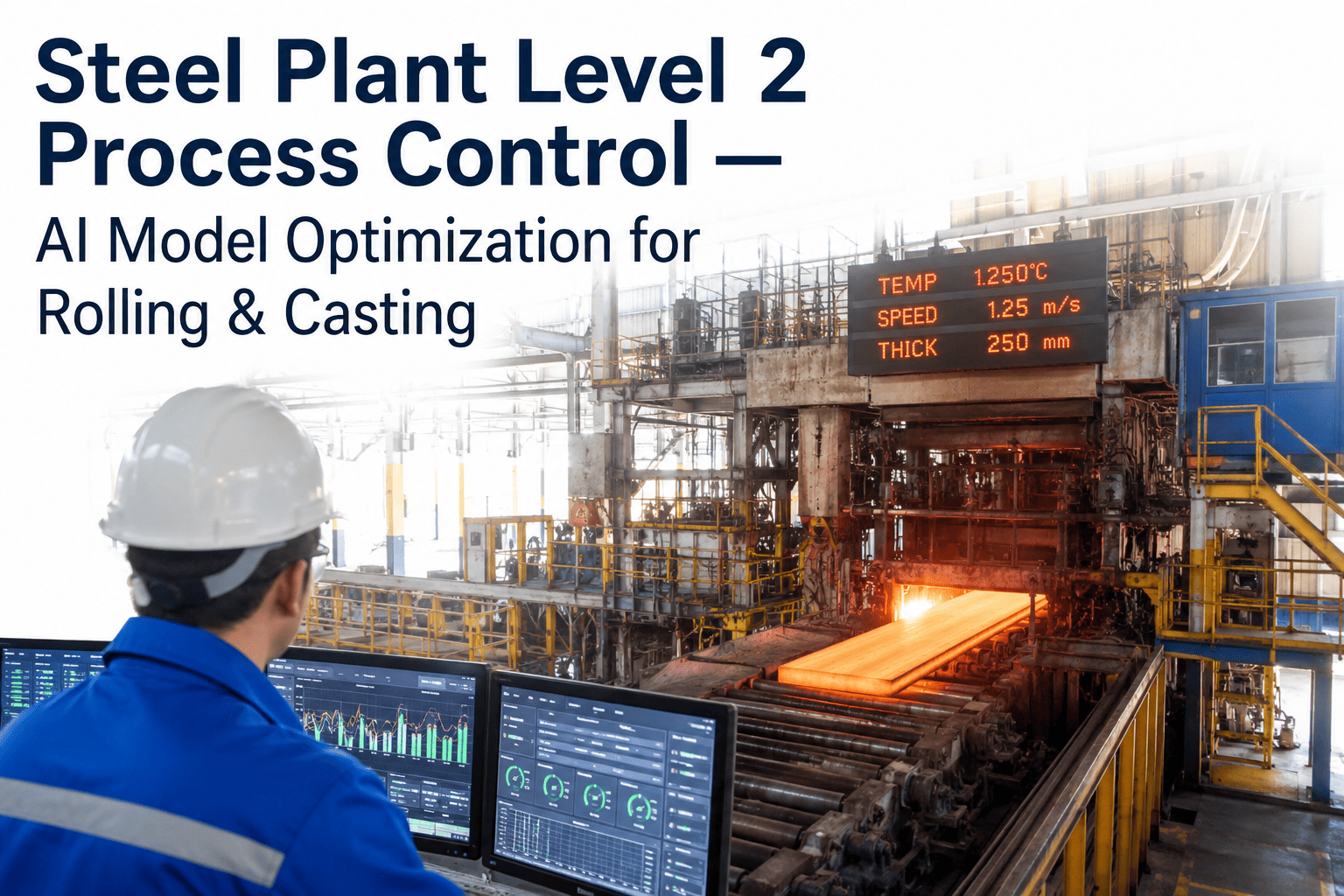
In the modern steel plant, Level 2 process control systems serve as the computational backbone for rolling mills and continuous casters. These systems host sophisticated mathematical models that predict and regulate key quality attributes such as strip gauge, temperature profiles, and microstructural properties. However, traditional L2 models rely on static parameters calibrated during commissioning, which gradually drift as equipment wears, raw material properties shift, and production schedules change. This drift leads to suboptimal first-pass accuracy, increased scrap, and costly manual interventions. The integration of artificial intelligence into Level 2 model parameter adaptation offers a transformative solution. By continuously learning from real-time process data, AI-driven adaptation engines can dynamically tune model coefficients to maintain peak performance. This article explores the architecture, benefits, and implementation strategies for AI-enhanced L2 model optimization in steel rolling and casting operations. Book a Demo to see how our platform can transform your Level 2 control performance.
AI-Powered Level 2 Model Adaptation
Achieve 95% first-pass accuracy in gauge and temperature predictions with dynamic parameter tuning.
Real-Time Data Ingestion
Our AI agent collects streaming data from pyrometers, thickness gauges, speed sensors, and hydraulic position transducers at millisecond intervals. This continuous data feed forms the foundation for model adaptation, capturing transient phenomena such as roll thermal expansion and strip tension variations. The ingestion pipeline normalizes and validates all signals before feeding them into the adaptation engine.
Parameter Drift Detection
Using statistical process control and machine learning anomaly detection, the system identifies when model predictions deviate from actual measurements beyond acceptable thresholds. Early detection of drift in parameters like heat transfer coefficients, friction factors, and material flow stress enables proactive re-tuning before quality issues arise.
Automated Coefficient Tuning
An optimization algorithm, based on gradient-free Bayesian methods, adjusts model coefficients to minimize the error between predicted and measured outputs. The tuning respects physical constraints, ensuring that adapted parameters remain within physically plausible ranges. This automation eliminates the need for manual recalibration by process engineers.
Implementation Roadmap
Data Pipeline Setup
Deploy edge data collectors on PLCs and DCS systems to capture high-frequency process data. Configure data validation rules and storage in a time-series database.
Baseline Model Calibration
Run a two-week baseline period where the AI system learns the existing model behavior without making changes. This establishes performance benchmarks and drift patterns.
Adaptation Engine Integration
Deploy the AI adaptation module as a sidecar service to the existing Level 2 system. The engine receives prediction outputs and measurement feedback via OPC-UA or REST API.
Closed-Loop Validation
Enable adaptation in a shadow mode for one week, comparing adapted vs. non-adapted model predictions. After validation, switch to closed-loop control with safety limits.
Transform Your Rolling Mill Performance
Reduce off-gauge coils by 30% and extend model calibration intervals from weeks to months. Our AI adaptation engine integrates seamlessly with existing Level 2 systems.
Model Performance Comparison
| Parameter | Static Model | AI-Adapted Model | Improvement |
|---|---|---|---|
| Gauge Prediction Error (mm) | 0.12 | 0.04 | 67% |
| Temperature Prediction Error (C) | 15 | 5 | 67% |
| First-Pass Yield (%) | 78 | 95 | 22% |
| Manual Tuning Frequency (days) | 14 | 60 | 329% |
Caster Mold Level Control
AI adaptation of mold level control models reduces level fluctuations by 40%, improving slab surface quality and reducing breakout risks. The system learns from stopper rod position, argon flow, and casting speed signals.
Finishing Mill Temperature
Dynamic adaptation of finishing mill temperature models compensates for roll wear and cooling water temperature variations. Achieve target coiling temperature within 5 degrees consistently.
Runout Table Cooling
Optimize laminar cooling header activation patterns using AI-driven model adaptation. Reduce ferrite grain size variability and improve mechanical property compliance across the strip length.
Frequently Asked Questions
How does AI adaptation affect existing Level 2 system stability?
AI adaptation is designed with multiple safety layers to ensure system stability. The adaptation engine operates within bounded parameter ranges defined by process engineers. Any proposed coefficient change outside these bounds triggers an alert and is rejected. Additionally, the system runs in shadow mode for a validation period before closed-loop activation. This ensures that only proven, stable adaptations are applied. For more details on safety protocols, visit our support page or book a demo to discuss your specific setup.
What types of models can be optimized with this approach?
Our AI adaptation framework is model-agnostic and can optimize any Level 2 mathematical model that produces numerical predictions. This includes gauge control models, temperature models, microstructure evolution models, and roll force models. The system works with both physics-based models (e.g., finite difference) and empirical regression models. The only requirement is that the model exposes its input parameters and output predictions via an API or shared memory. For integration guidance, refer to our technical documentation or schedule a consultation.
How long does it take to see measurable improvements after deployment?
Typically, measurable improvements in first-pass accuracy become evident within 2 to 4 weeks of closed-loop adaptation. The initial two-week baseline period establishes current performance levels. Once adaptation is enabled, the system continuously improves model coefficients. Within the first month, most plants observe a 15-20% reduction in prediction error. Full optimization, where the model reaches its best possible accuracy, may take 2-3 months depending on process variability. For expected timelines tailored to your plant, book a demo with our experts.
What infrastructure is required to support AI adaptation?
The adaptation engine runs as a containerized microservice on a standard industrial server or cloud instance. It requires access to real-time process data via OPC-UA, Modbus, or MQTT. A minimum of 8 GB RAM and 4 CPU cores is recommended for typical rolling mill applications. The system also needs a time-series database (e.g., InfluxDB) for historical data storage. No changes to the existing Level 2 hardware are required. Our team handles all integration. For infrastructure requirements specific to your plant, visit our support page or book a demo.
Can AI adaptation handle multiple product grades and steel chemistries?
Yes, the adaptation engine maintains separate parameter sets for each product grade and steel chemistry. When a new coil or slab enters the mill, the system automatically loads the corresponding model coefficients. Over time, the AI learns transfer functions between different grades, enabling faster adaptation when switching between products. This multi-model capability ensures optimal performance across the entire product mix. For more information on multi-grade support, check our knowledge base or book a demo.
Ready to Optimize Your Level 2 Models?
Join leading steel producers who have improved first-pass yield by 22% and reduced scrap by 30%. Our AI adaptation engine is proven in rolling mills and casters worldwide.