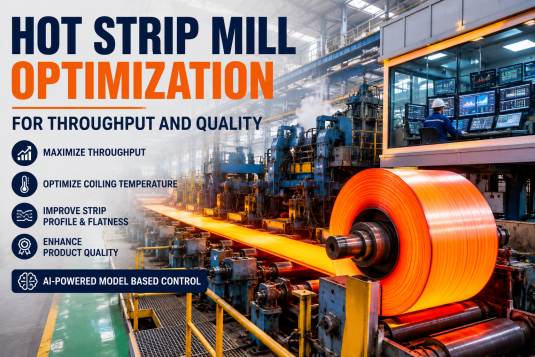
Hot Strip Mill Optimization for Throughput and Quality

By Antonio Shakespeare on June 11, 2026

ai-hot-strip-mill-optimization-steel

Hot strip mill operations — from reheat furnace discharge through finishing stands, laminar cooling, and down-coiler — involve dozens of interacting control parameters that determine final strip quality, mill throughput, and energy consumption. The finishing mill setup model, interstand tension control, work roll thermal camber, cooling pattern, and coiling temperature all influence strip profile, flatness, mechanical properties, and surface quality. Yet most mills still operate with static setup models calibrated during roll campaigns and adjusted manually by operators based on trial coils, resulting in significant scrap generation during grade changes, suboptimal throughput due to conservative speed profiles, and inconsistent quality across the length of every coil. iFactory's HSM Model AI replaces static setup models with continuously learning AI models that optimize finishing mill pass schedules, interstand tension, laminar cooling patterns, and coiling temperature in real time — reducing grade change scrap by 40–60%, increasing mill throughput by 5–12%, and improving strip profile and flatness consistency to within ±5 microns across 95% of coil length. Book a Demo to see iFactory's HSM Model AI configured for your mill configuration, product mix, and throughput targets.

HSM MODEL AI · FINISHING MILL CONTROL · STRIP PROFILE · HOT ROLLING OPTIMIZATION
Optimize Finishing Mill Setup, Tension, and Cooling in Real Time with AI-Powered HSM Control
iFactory's HSM Model AI continuously learns from every coil produced — optimizing finishing mill pass schedules, interstand tension, laminar cooling patterns, and coiling temperature to reduce grade change scrap by 40–60% and increase mill throughput by 5–12% with turnkey deployment in 6–12 weeks.

Why HSM Optimization Delivers the Highest ROI of Any Digital Investment in Hot Rolling

The gap between mills running static setup models and mills running AI-optimized dynamic models is visible in every performance metric: scrap rate during grade changes, throughput tons per hour, strip profile consistency, and energy consumption per ton. HSM Model AI targets the four levers that drive 80% of the value in hot strip mill optimization — grade change scrap, throughput limiting, quality variability, and energy efficiency — delivering measurable improvement in each within weeks of deployment. Book a Demo to model the optimization potential for your HSM product mix and annual tonnage.

40–60%
Reduction in grade change and cobble scrap through AI-optimized pass schedule transitions
5–12%
Mill throughput increase from optimized speed profiles and reduced setup time between coils
±5 µm
Strip profile and flatness consistency improvement across 95% of coil length
6–12 Wk
Turnkey AI deployment timeline including sensor integration, model training, and go-live

HSM Model AI Core Capabilities

iFactory's HSM Model AI platform targets the three most impactful control domains in the hot strip mill — finishing mill setup, interstand tension and profile, and cooling/coiling temperature — integrating each into a unified optimization framework that adapts to every grade change, width transition, and gauge target in real time.

Finishing Mill Setup Optimization
AI models predict optimal pass schedule, roll gap, speed profile, and stand force distribution for every grade change and width transition based on historical coil data, current roll condition, and pyrometer temperature readings. The model adapts to roll thermal camber evolution, work roll wear progression, and backup roll condition — reducing trial coils from 3–5 per grade change to zero.
Interstand Tension and Profile Control
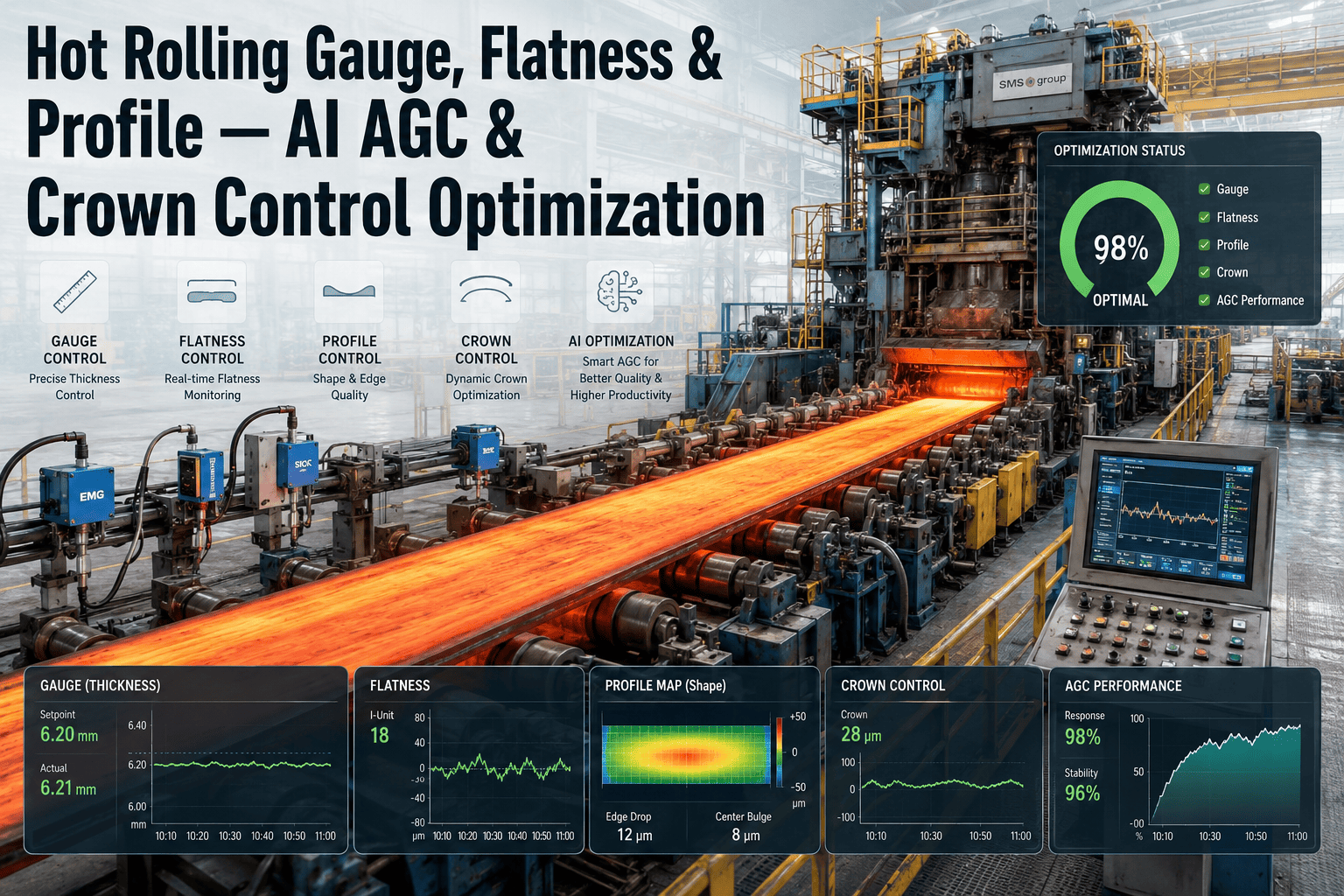
Real-time interstand tension optimization using pyrometer, width gauge, profile meter, and roll force data fused at sub-second intervals. The AI model detects tension deviations before they produce center-buckle or edge-wave flatness defects, adjusting looper height and stand speed differentials within the control window. Strip profile crown targets are maintained within ±5 microns.
Cooling and Coiling Temperature Optimization
Laminar cooling header patterns are optimized per coil segment to achieve target coiling temperature and cooling rate within ±5°C, eliminating the thermal variability that causes inconsistent mechanical properties across the coil length. The AI model adjusts cooling patterns dynamically for speed changes, strip thickness transitions, and pyrometer drift — reducing coiling temperature spread by 60%.

HSM Control Approaches — Traditional Manual Setup vs Model-Based Control vs AI Real-Time Optimization

The table below compares three approaches to hot strip mill control. Traditional manual setup depends on operator experience and trial coils. Model-based control uses physics models calibrated during roll campaigns. AI real-time optimization continuously adapts to every coil and every condition change across the full operating envelope.

Control Parameter Traditional Manual Setup Model-Based Control iFactory HSM Model AI
Pass schedule generation Operator experience + handbook tables Physics-based rolling model (offline) AI-optimized per grade change with continuous learning
Grade change adaptation 3–5 trial coils with manual adjustment Pre-calculated schedule with fixed offsets Zero trial coils — model predicts optimal setup from historical data
Roll thermal camber compensation Manual offset based on coil count Fixed thermal model Real-time thermal camber tracking with adaptive compensation
Interstand tension control Fixed looper angle setpoints PID control with preset gains AI-predictive tension control with sub-second adaptation
Profile and flatness control Manual roll bend and shift adjustments Preset work roll bending schedules Closed-loop profile optimization with ±5 micron crown accuracy
Cooling pattern adjustment Manual header selection by grade family Fixed cooling pattern per product group Segment-by-segment cooling optimization with ±5°C coiling temp accuracy
Coiling temperature control Operator adjusts last stand speed Feedforward pyrometer control AI-predictive multi-variable control with 60% spread reduction
Update frequency Per roll campaign or grade group Per product change Continuous per-coil learning with sub-second inference

Industry Expert Perspective: Why AI Model Control Is the Next Frontier in Hot Strip Mill Performance

"
I spent 20 years managing hot strip mill operations across three integrated mills — 72-inch, 80-inch, and 66-inch configurations producing everything from 0.040-inch tinplate through 0.500-inch API pipe grades. The single most persistent frustration was that our setup model was calibrated during roll changes and then drifted over the campaign as rolls wore, thermal conditions changed, and product mix shifted. We would run 5 to 15 trial coils per grade change, scrapping 1 to 3 of them before we hit the target gauge, profile, and flatness. That was accepted as normal — the cost of doing business in a hot strip mill. An AI model that learns from every coil, every roll campaign, every grade change — and continuously improves its predictions without manual recalibration — changes the operating paradigm completely. The trial coils disappear. The throughput increases because you are not slowing down for setup verification. The quality becomes consistent across the entire campaign instead of degrading as rolls wear. I have seen mills gain 8–12% throughput within three months of deployment with zero capital expenditure on mechanical upgrades.
— Former Hot Strip Mill Operations Manager, Integrated Steel Producer — 20 Years Managing 66-inch to 80-inch HSM Operations — iFactory HSM Model AI Reference 2026

Three Business Outcomes Delivered by HSM Model AI Deployment

Beyond setup optimization and quality improvement, HSM Model AI creates measurable business outcomes across operations, maintenance, and commercial performance.

Outcome 01
Grade Change Scrap Reduced by 40–60%
Eliminating trial coils and optimizing pass schedule transitions reduces grade change scrap from 2–5 tons per change to near zero. For a mill running 8–15 grade changes per day, this translates to 500–3,000 tons of annual scrap reduction valued at $200,000–$1,200,000 depending on product mix and market conditions.
Outcome 02
Mill Throughput Increased by 5–12% Without Capital Investment
Optimized speed profiles, reduced setup time between coils, and fewer slowdowns for manual adjustments increase effective rolling hours per shift. Mills that were throughput-limited by cobble risk or operator conservatism see the largest gains — up to 12% additional tons per month with no mechanical upgrades.
Outcome 03
Strip Profile and Flatness Consistency Within ±5 Microns Across 95% of Coil Length
Closed-loop profile optimization and real-time tension control reduce crown variability from ±15–25 microns to ±5 microns, enabling mills to qualify for demanding automotive exposed and critical structural applications that require superior shape consistency and tight profile tolerances.

Critical HSM AI Implementation Pitfalls to Avoid

HSM AI projects fail or underperform when implementation mistakes create gaps between model predictions and mill reality. These failure patterns are preventable with a structured approach to data infrastructure, model training, and change management. Book a Demo to review iFactory's HSM AI deployment methodology for your mill configuration.

Pitfall 01
Inadequate Sensor Data Quality and Coverage
AI models are only as good as the training data. Mills with missing, uncalibrated, or low-resolution sensors for roll force, pyrometer temperature, width gauge, and profile meter produce models with high prediction uncertainty. Sensor audit and upgrade must precede model deployment — or model accuracy will never meet operational requirements.
Pitfall 02
Insufficient Training Data for Edge Cases
AI models trained only on normal operating conditions fail during edge cases — grade changes, width transitions, roll changes, and equipment upsets. Training datasets must include at least six months of data covering the full range of grades, gauges, widths, and operating conditions the mill encounters to ensure model robustness.
Pitfall 03
Model Predictions Not Integrated with Operator Displays
An AI model that generates optimal setup parameters but does not present them in the operator HMI in an actionable format will be ignored. Model recommendations must be integrated directly into the existing operator display with clear override capability and confidence indicators to drive adoption and trust.
Pitfall 04
No Continuous Model Retraining Workflow
AI models that are deployed and not continuously retrained degrade as mill conditions change — new grades, modified roll compositions, equipment wear, and seasonal ambient temperature effects. A model update workflow with automated retraining triggers based on prediction error thresholds is essential to maintain accuracy over time.
Pitfall 05
Roll Thermal Camber Not Modeled in Real Time
Work roll thermal camber changes continuously during a rolling campaign — expanding during rolling and contracting during gaps. Models that use a fixed thermal camber assumption produce incorrect profile predictions. Real-time thermal camber modeling using pyrometer data and rolling history is critical for profile control accuracy.
Pitfall 06
Insufficient Edge Computing Capacity for Sub-Second Inference
AI model inference at sub-second latency requires edge computing hardware matched to model complexity. Mills deploying complex deep learning models on underpowered edge servers experience inference latency of 2–5 seconds — too slow for interstand tension control and cooling pattern adjustments that require sub-second response.

The Decision That Determines Your HSM Performance Trajectory — Static Setup or Continuously Learning AI

The difference between mills operating with static setup models and mills operating with continuously learning AI models compounds with every coil produced. Each coil that runs with suboptimal setup generates scrap, consumes extra energy, reduces throughput, and produces variable quality that limits the mill's ability to serve demanding markets. Over a year of production, the cumulative cost of static setup optimization is measurable in millions of dollars of lost margin. AI-driven setup optimization eliminates this waste by learning from every coil, every campaign, and every condition change — continuously pushing the operating envelope toward optimal performance across all dimensions simultaneously.
HSM Model AI — Frequently Asked Questions

Existing setup models use physics-based algorithms calibrated during roll campaigns and updated infrequently. HSM Model AI continuously learns from every coil's actual results — adapting to roll wear, thermal conditions, and material variation in real time rather than waiting for scheduled recalibration. Book a Demo
No. HSM Model AI connects to existing PLCs and automation systems through read-only OPC-UA or database connectors — no modifications to control loops or automation code are required. Model recommendations are presented to operators through the existing HMI or a companion display, with manual override always available.
A minimum of six months of historical coil data covering all major grades, gauges, and widths is required for initial model training. The model improves continuously as new data is incorporated, with accuracy typically reaching steady-state within 2,000–5,000 coils after deployment depending on grade variety and operating range.
iFactory's HSM Model AI runs on an NVIDIA edge server appliance with a dedicated GPU for model inference. The standard configuration supports sub-500-millisecond inference latency for all three control domains — finishing setup, tension control, and cooling optimization — with capacity for up to four finishing stands per appliance.
ROI is driven by scrap reduction ($200,000–$1,200,000/year), throughput increase ($500,000–$3,000,000/year at $50–$100/ton margin), and quality premium capture. Typical payback is 3–8 months depending on mill size, product mix, and current performance baseline. Book an ROI modeling session.
HSM MODEL AI · FINISHING MILL CONTROL · STRIP PROFILE · HOT ROLLING OPTIMIZATION
Deploy HSM Model AI Across Your Hot Strip Mill Operations with iFactory
iFactory's HSM Model AI replaces static setup models with continuously learning AI optimization — reducing grade change scrap by 40–60%, increasing mill throughput by 5–12%, and delivering ±5 micron strip profile consistency. Turnkey deployment in 6–12 weeks on an on-premise NVIDIA edge server appliance with read-only PLC connectivity.

Share This Story, Choose Your Platform!