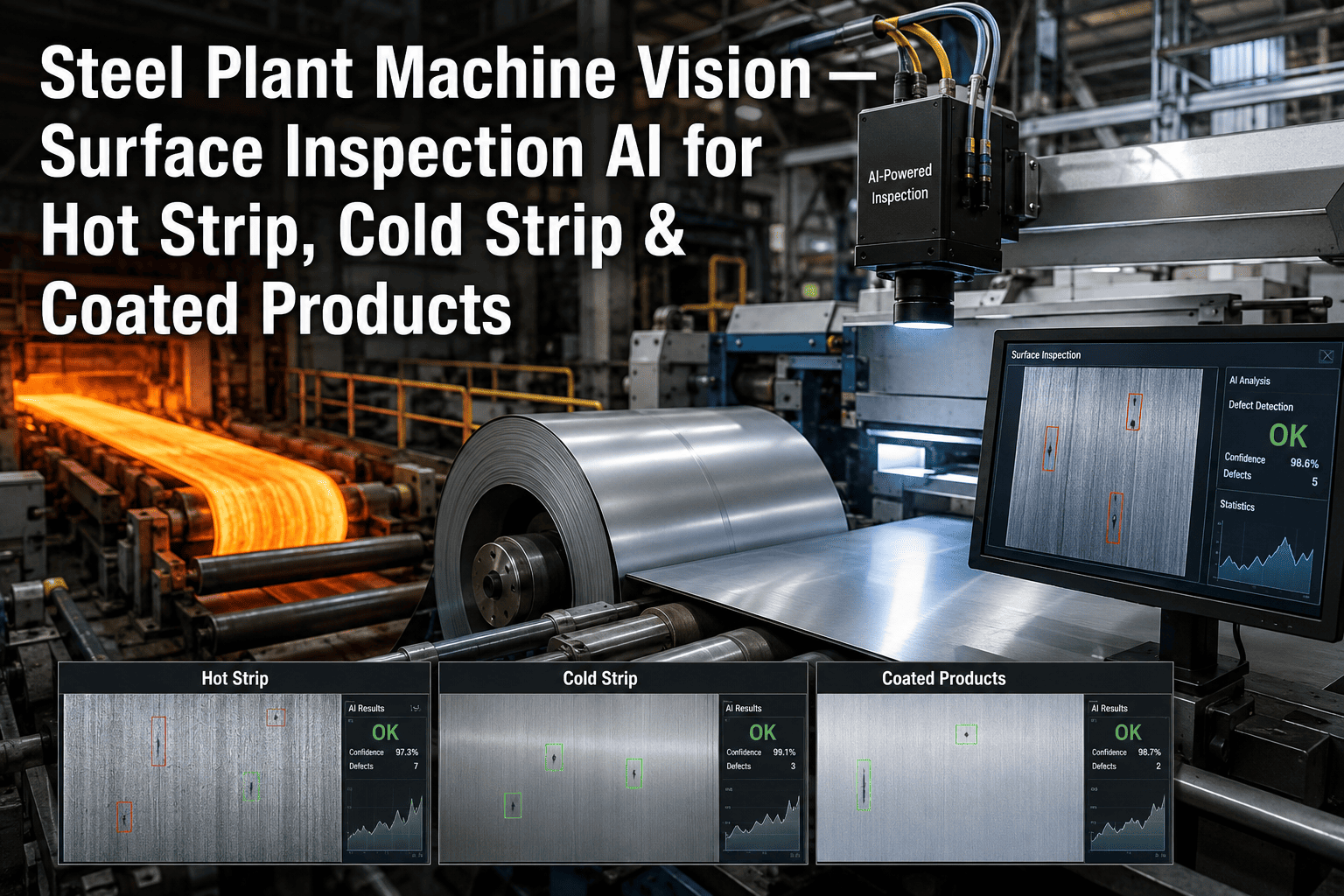
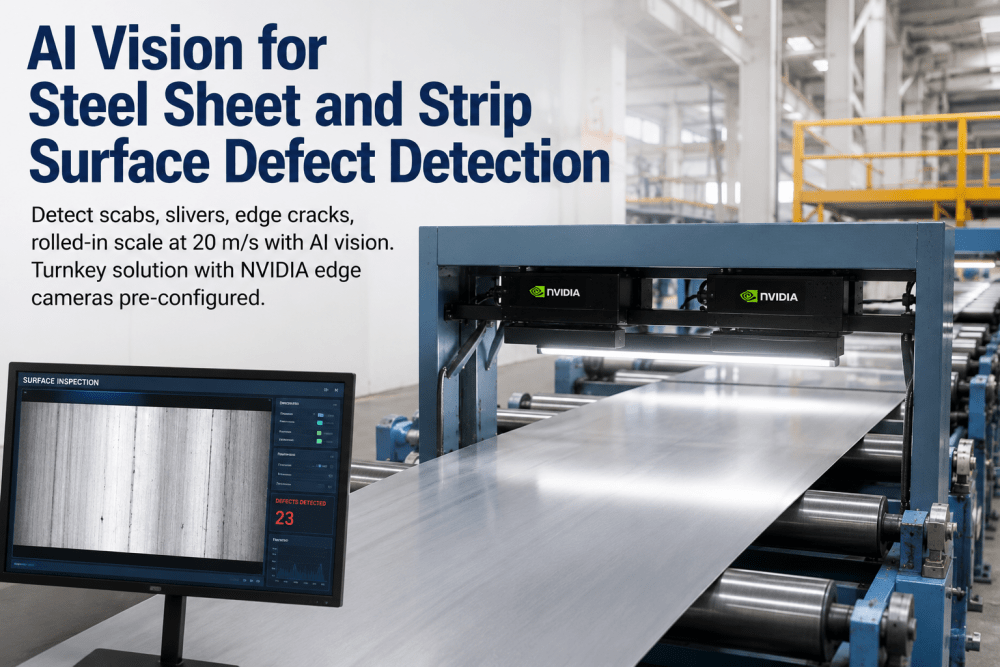
A flat-rolled steel producer shipped 14,200 tonnes of coil to an automotive stamping customer over six months before a pattern of press-shop cracking revealed a systematic surface inclusion defect that had been present since the caster. The root cause was a tundish nozzle erosion issue that created alumina streaks on the slab surface — defects that were technically visible on the hot strip mill exit but occurred at a contrast level that human inspectors could not reliably detect at 900 metres per minute. The cost: millions in claims, rework, and a customer relationship that took years to rebuild. Every steel mill has a version of this story. AI vision ensures it doesn't happen again.
AI-Powered Quality Control
AI Vision-Based Defect Detection in Steel Rolling Mills
How deep learning vision systems catch the defects your inspectors can't — at full production speed
60–70%
Defects caught by human inspectors
Current Reality
95–99%
Defects caught by AI vision systems
With AI Vision
The Problem With Human Inspection
Your quality inspectors aren't bad at their job — they're human at a job that exceeds human capability. A strip moving at 15 metres per second through a finishing mill produces a new metre of surface every 67 milliseconds. At that speed, across a 1,600mm-wide strip radiating heat at 900°C, even the best inspector misses the subtle defects that matter most to your customers.
How Inspection Gaps Compound Into Quality Escapes
1
The Visibility Gap
Human eyes cannot resolve defects below 0.5mm at line speeds above 300 m/min. This means 25–40% of surface anomalies on hot strip and cold rolling exit lines pass through undetected on every coil.
2
The Fatigue Factor
Inspector accuracy degrades 15–25% after 2 hours of continuous observation. Miss rates peak in the final hours of each shift — exactly when attention is most critical.
3
The Accumulation Effect
Missed defects don't just cost you one coil. A developing roll mark or recurring inclusion pattern can propagate across hundreds of tonnes before anyone notices — turning a minor process issue into a major quality event.
4
The Cost Multiplier
A defective coil caught at the mill costs you the downgrade margin. The same coil caught at the customer's stamping plant costs 10–50x more in claims, sorting, freight, and reputation damage.
How many defects are slipping through your inspection? Book a demo to see what AI vision reveals.
What AI Vision Actually Detects
Deep learning models trained on millions of labelled steel surface images can classify over 200 defect types by category, severity, and size — in real time, at full production speed, 24/7 without fatigue. Here are the most critical defect families that AI catches consistently where human inspection fails.
Longitudinal cracks
Transverse cracks
Edge cracks
Star cracks
Spider cracks
Root Causes
Thermal stress, mold oscillation, excessive edge cooling, composition issues
AI Accuracy
98%+ detection, distinguishes true cracks from scale lines
Periodic marks
Roll peel scale
Bruises
Chatter marks
Sink roll marks
Root Causes
Roll surface degradation, bearing damage, foreign material pickup on rolls
AI Accuracy
Matches defect periodicity to specific roll circumference for instant root cause
Rolled-in scale
Scale pits
Oxide patches
Red scale
Scale breaker marks
Root Causes
Descaler malfunction, insufficient water pressure, furnace atmosphere issues
AI Accuracy
Detects density trends that signal developing descaler problems
Alumina streaks
Slivers
Scabs
Seams
Laps
Root Causes
Mold oscillation issues, tundish erosion, copper pickup, slag inclusions
AI Accuracy
Catches subsurface indicators invisible at production speed to human eye
Roughness variation
Scratches
Sticker marks
Temper stains
Coating defects
Root Causes
Roll grinding patterns, lubrication issues, guide damage, cooling imbalances
AI Accuracy
Detects variations invisible to naked eye that cause downstream coating failures
Edge waves
Centre buckle
Camber
Wedge
Width deviation
Root Causes
Roll crown mismatch, thermal camber drift, uneven deformation across thickness
AI Accuracy
Real-time flatness and width monitoring triggers immediate process correction
From Detection to Prevention: The AI Quality Loop
Detection alone is valuable. Prevention is transformational. The real power of AI vision isn't just catching defects — it's correlating defect patterns with process parameters to stop them at the source before they propagate across the next 200 tonnes of production.
AI Defect-to-Action Pipeline
Detect
Real-Time Defect Identification
High-speed cameras capture 40,000+ lines per second. AI models classify defects in under 50 milliseconds — before the strip section leaves the inspection zone.
Classify
Severity Grading & Location Mapping
Each defect is tagged with type, severity grade, exact coil position, and surface (top/bottom). Quality disposition happens automatically — no manual sorting needed.
Correlate
Root Cause Pattern Matching
AI matches periodic scratch intervals to specific roll circumferences, links scale density spikes to descaler pressure drops, and traces inclusion patterns to upstream caster conditions.
Act
Automated Corrective Response
System triggers operator alerts, generates maintenance work orders, updates coil quality status, and adjusts process parameters — all before the next coil enters the mill.
Stop Finding Defects at Your Customer's Plant
iFactory's AI vision platform detects, classifies, and traces surface defects in real time — turning your quality control from reactive inspection into proactive prevention.
The Cost of Missed Defects
Surface quality defects typically drive 2–5% of total production to secondary or reject status. For a mid-size rolling mill, the financial impact is staggering — and most of it is preventable.
Downgrade Losses
Prime coil at $900/t downgraded to secondary at $600/t. At 2–5% downgrade rate on a 2M tonne/year mill, that's 40,000–100,000 tonnes annually.
$12M – $30M/year
Customer Claims
A single quality escape to an automotive customer triggers claims, emergency sorting, premium freight, and contract renegotiation.
$500K – $5M per event
Scrap & Rework
Defective material that cannot be downgraded must be scrapped or reprocessed — consuming energy, time, and furnace capacity.
$2M – $8M/year
Total Annual Quality Cost
Combined direct costs from inspection gaps — before accounting for reputation damage and lost contracts.
$15M – $43M/year
How the Technology Works
A production-grade AI vision system combines specialized hardware built for extreme mill environments with deep learning software trained specifically on steel surface defects. Here's the architecture behind the accuracy.
Layer 1
Image Capture
High-speed line-scan cameras with water-cooled housings and air purge systems capture images at 40,000+ lines per second. Thermal imaging monitors temperature profiles while visible-spectrum cameras detect surface features through scale and oxide layers.
Layer 2
Precision Lighting
Custom LED arrays using bright-field, dark-field, and multi-angle illumination maximise defect contrast. Different defect types require different lighting geometries — scratches need low-angle dark-field, inclusions require bright-field, and roll marks need structured light.
Layer 3
Edge Computing
GPU-accelerated edge servers process 2–8 GB of image data per second in real time. Inference latency under 50 milliseconds ensures classification occurs before the strip section exits the inspection zone. Redundant architecture prevents data loss.
Layer 4
Deep Learning Models
Convolutional neural networks trained on 5–10 million labelled steel surface images classify 200+ defect types. Transfer learning adapts models to your specific products and grades. Continuous learning improves accuracy with every coil inspected.
Layer 5
Process Integration
Direct connections to Level 2 automation and tracking systems correlate defects to exact coil positions, trigger operator alerts, generate maintenance work orders, and update quality disposition in real time.
See the full technology stack in action on live mill data. Schedule a live demonstration.
Proven Results from AI Vision Deployment
Where AI Vision Fits Across the Mill
Surface inspection on the hot strip mill is just the starting point. AI vision is transforming quality control across the entire steel production chain — from caster to shipping bay.
Continuous Casting
Detect surface cracks, corner cracks, and oscillation marks on slabs. Early detection prevents defects from propagating through rolling operations.
Catches defects 3–4 process stages before they reach customers
Hot Rolling
Monitor surface finish, detect cracks, scale patterns, and dimensional variations at full production speed through extreme heat and steam.
Largest impact zone — where most surface defects originate or become visible
Cold Rolling
Identify scratches, roll marks, embedded scale, and ultra-low-contrast surface variations that determine automotive and appliance grade compliance.
Premium quality gating — where grade classification determines revenue
Coating & Finishing
Verify galvanizing uniformity, detect bare spots, measure coating thickness consistency, and identify surface contamination before shipment.
Final quality gate — last chance to prevent customer-facing escapes
Frequently Asked Questions
Can AI vision systems work in the extreme environment of a hot rolling mill?
Yes. Industrial vision systems are specifically engineered for mill conditions — extreme temperatures, steam, dust, vibration, and moisture. Cameras use water-cooled protective housings with air purge systems, and edge computing eliminates dependence on network connectivity. These systems operate continuously in heat zones where human inspection is physically impossible.
How long does it take to train the AI for our specific products?
Modern AI platforms achieve production-ready accuracy with as few as 50–100 images per defect class using transfer learning — models pre-trained on millions of steel surface images adapt quickly to your specific grades and product mix. Initial deployment typically takes 2–4 weeks, with continuous improvement happening automatically as quality engineers validate edge cases.
What's the typical ROI for AI vision in steel manufacturing?
Most steel manufacturers achieve full ROI within 6–12 months. Documented results include $2.1 million in annual savings with 7-month payback at a major steel producer. ROI comes from reduced customer claims, lower scrap rates, decreased inspection labour, and premium customer retention enabled by superior quality consistency.
Does this replace our quality inspectors?
AI vision augments rather than replaces your quality team. Inspectors shift from the physically demanding and error-prone task of visual scanning to higher-value work: analysing defect trends, investigating root causes, and driving process improvements. The system handles 100% surface coverage at production speed — something no human team can achieve.
What happens when the system detects a critical defect mid-coil?
For critical defects exceeding rejection thresholds, the system triggers immediate operator alerts, automatically marks the defective section for downstream identification, and updates quality disposition in real time — reclassifying the coil before it reaches the shipping bay. For trending issues, it sends predictive alerts to both quality and maintenance teams to address the root cause.
See Every Defect. Trace Every Root Cause. Prevent Every Escape.
Your mill is producing defects right now that no one is seeing. AI vision catches them all — in real time, at full speed, 24/7. Find out what your current inspection is missing.