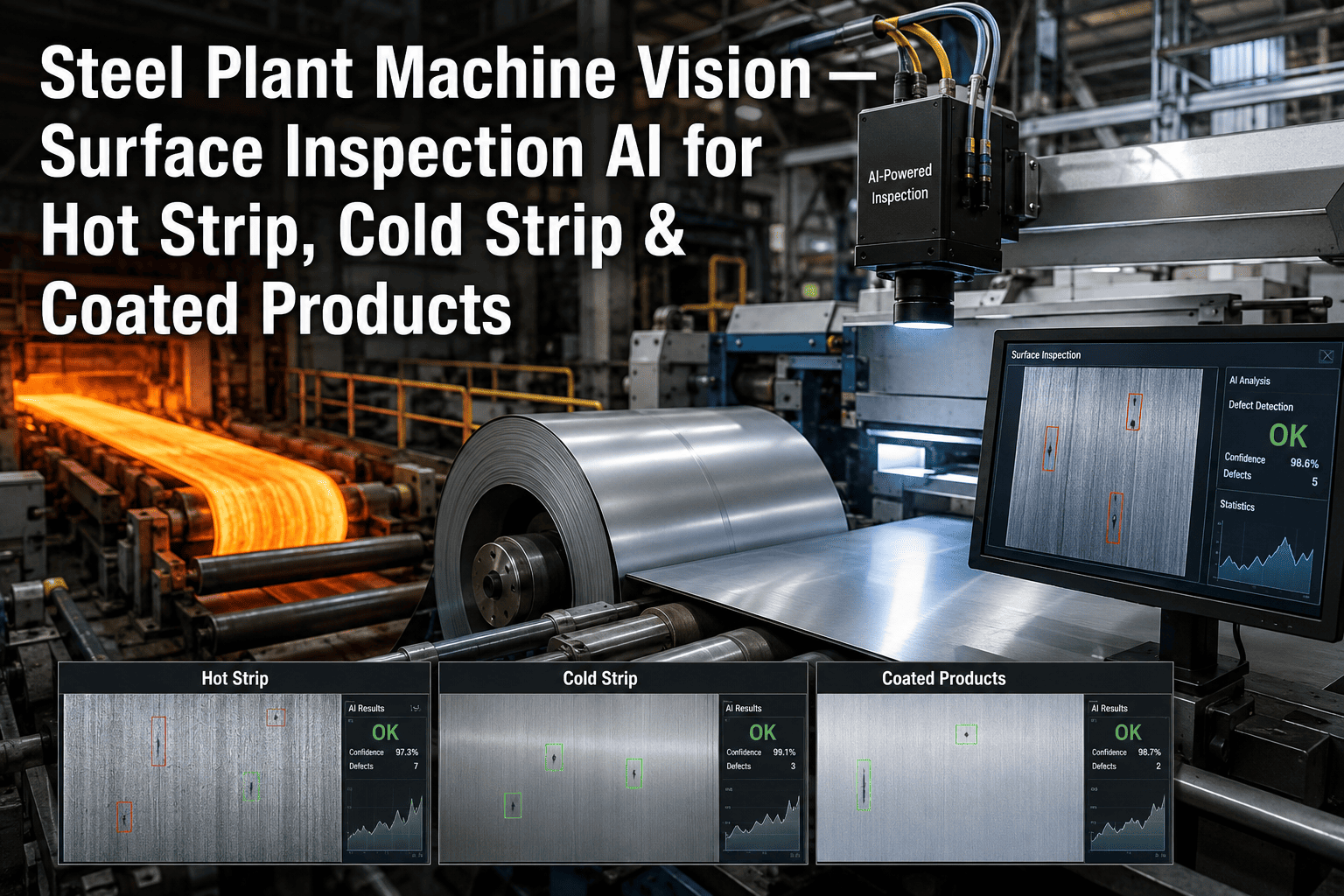
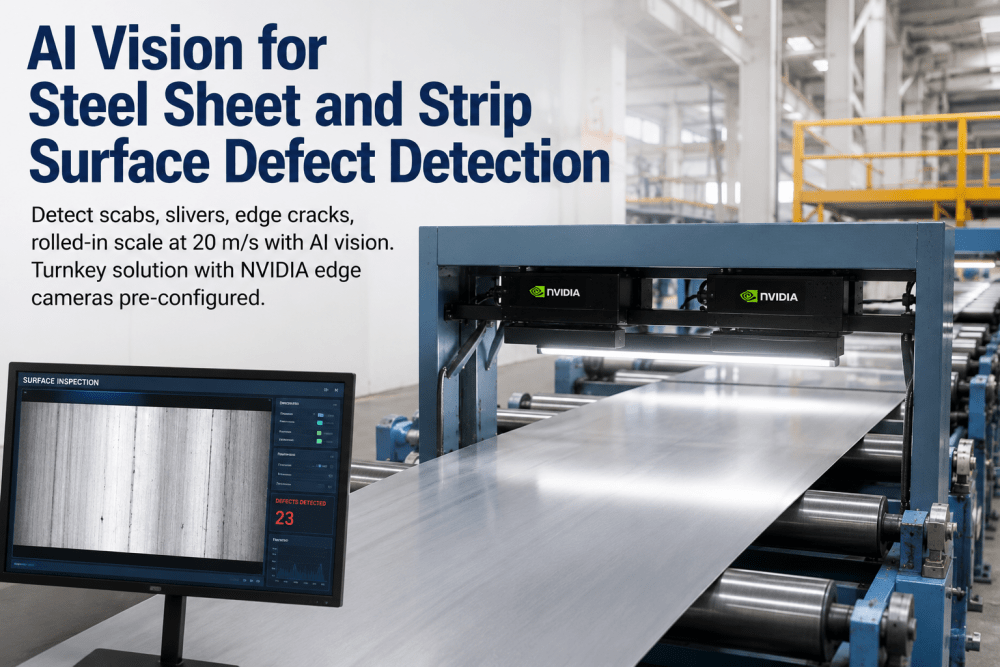
Steel surface quality determines whether a coil ships to automotive, construction, or gets downgraded to scrap — a difference of $80–220 per tonne for every tonne produced. Traditional human visual inspection, even at its best, misses 18–34% of surface defects when inspectors are fatigued in the third hour of a shift, working with strip speeds exceeding 800 metres per minute, in ambient temperatures above 45°C. A single missed defect on a 25-tonne automotive-grade coil can trigger a customer quality incident that costs $80,000–400,000 in rejection, rework, and contractual penalties — far exceeding the annual cost of the AI vision system that would have caught it. iFactory's AI Vision Inspection platform deploys deep learning camera systems directly on your hot rolling line, cold rolling line, or coating line — detecting 24 defect types at 99.7% accuracy, running at full production speed with zero human fatigue, and generating a complete per-coil defect map that feeds directly into your quality management system and downstream process improvement.
AI Vision Inspection for Steel Surface Defect Detection: Complete Technology Guide
Deep learning vision systems detect 24 steel surface defect types at 99.7% accuracy — at full production speed, on hot-rolled, cold-rolled, and coated steel, with zero operator fatigue.
Why Human Visual Inspection Fails at Steel Production Speed
At 800 m/min strip speed, one metre of strip passes an inspection point in 75 milliseconds. A human eye's visual processing time for defect recognition is 150–250ms — meaning every defect on a high-speed line exists for less time than human perception can process it. AI camera systems process up to 10,000 frames per second with sub-millisecond inference. See how AI catches what humans miss — live demo on your defect library.
24 Steel Surface Defect Types — What iFactory AI Detects & Classifies
iFactory's model is trained on 4.2 million labelled defect images from steel lines across hot rolling, cold rolling, galvanising, and coated product lines. Each defect type is classified, sized, located, and severity-rated in real time.
AI Vision vs Human Inspection — Capability Comparison
| Inspection Dimension | Human Inspector | iFactory AI Vision |
|---|---|---|
| Detection accuracy (fresh shift) | 71–82% | 99.7% |
| Detection accuracy (3+ hrs into shift) | 58–66% | 99.7% (no fatigue) |
| Max inspection speed | ~80 m/min | 1,200 m/min |
| Minimum detectable defect size | ~2mm visible | 0.1mm (20µm depth) |
| Defect categories classified | 4–6 broad grades | 24 named defect types |
| Per-coil defect map generated | No | Full position + severity map |
| Root cause traceback to process | Manual, subjective | Auto-correlated to PLC parameters |
| Cost per tonne inspected | ₹18–34/tonne | ₹2–4/tonne |
How iFactory AI Vision Works — From Camera to Quality Disposition
Camera & Lighting Installation
Line-scan cameras (up to 16,384 pixels wide) mounted across full strip width. Multi-spectral LED lighting — raking, specular, and diffuse — configured per defect type. Installed in 2–4 days during planned stop.
Deep Learning Inference
iFactory's CNN model classifies each defect in <2ms per image frame. Model trained on 4.2M labelled defect images. False positive rate <0.3% — eliminating operator alarm fatigue that plagues legacy systems.
Per-Coil Defect Map
Every defect tagged with position (distance from head/tail, width offset), size (mm²), type, and severity. Coil-level defect map generated automatically — no manual logging required. Attached to Q-record in SAP QM.
Root Cause Traceback
iFactory cross-references defect position and type with PLC parameters at that point in time — furnace temperature, roll force, casting speed. Root cause is identified automatically, enabling process correction before the next coil.
Before vs After — iFactory AI Vision at a 1.8 MTPA Cold Mill
Results from a 1.8 MTPA cold rolling complex in western India, 12 months post-deployment across 3 production lines. Validated by plant quality director and customer quality audit teams.
What a Quality Director Said
Our biggest automotive customer threatened to de-list us after three surface defect incidents in a single quarter. We had 14 inspectors on three shifts and a 66% catch rate. iFactory AI vision went live in 4 days. Six months later we have a 99.7% detection rate, zero customer claims, and we've redeployed 11 of those 14 inspectors to higher-value quality engineering roles. The system paid back in 7 months.
Frequently Asked Questions
How does iFactory AI handle the high temperatures and dust near the hot rolling mill inspection point?
Camera enclosures are IP67-rated with positive-pressure air purging and water-cooled housings rated to 75°C ambient. Optical systems use dust-excluding air curtains and auto-cleaning lens wipes on 4-hour cycles. The system operates continuously in direct proximity to the hot rolling runout table without performance degradation.
How is the AI model trained on our specific defect types — and can it learn new defects after deployment?
iFactory's model arrives pre-trained on 4.2M images covering all 24 standard defect types. Plant-specific defect variants are added via active learning — inspectors confirm or correct AI classifications on-screen, and those annotations retrain the model continuously. New defect types reach 95%+ accuracy within 200–400 labelled examples, typically achieved within the first 30 days of operation.
Can the system integrate with our existing SAP QM quality records?
Yes — full SAP QM integration via RFC/BAPI. Each coil's defect map writes to the Q-notification and usage decision record in SAP QM automatically. Defect data is also forwarded to the MES/L2 system for production parameter correlation. iFactory is SAP-certified for integration with SAP S/4HANA and ECC 6.0.
What is the false positive rate — and how does iFactory avoid alarm fatigue?
iFactory's false positive rate is <0.3% — compared to 8–15% for legacy threshold-based machine vision systems. Low false positives are achieved through ensemble deep learning (multiple model architectures voting on each detection) and plant-specific calibration. Alarm fatigue — the main reason operators disable legacy systems — is not a reported issue in any iFactory deployment.
99.7% Detection Accuracy — Live on Your Line in 4 Days
We'll map your current defect escape rate and show you the value AI vision recovers — free, in 5 days.