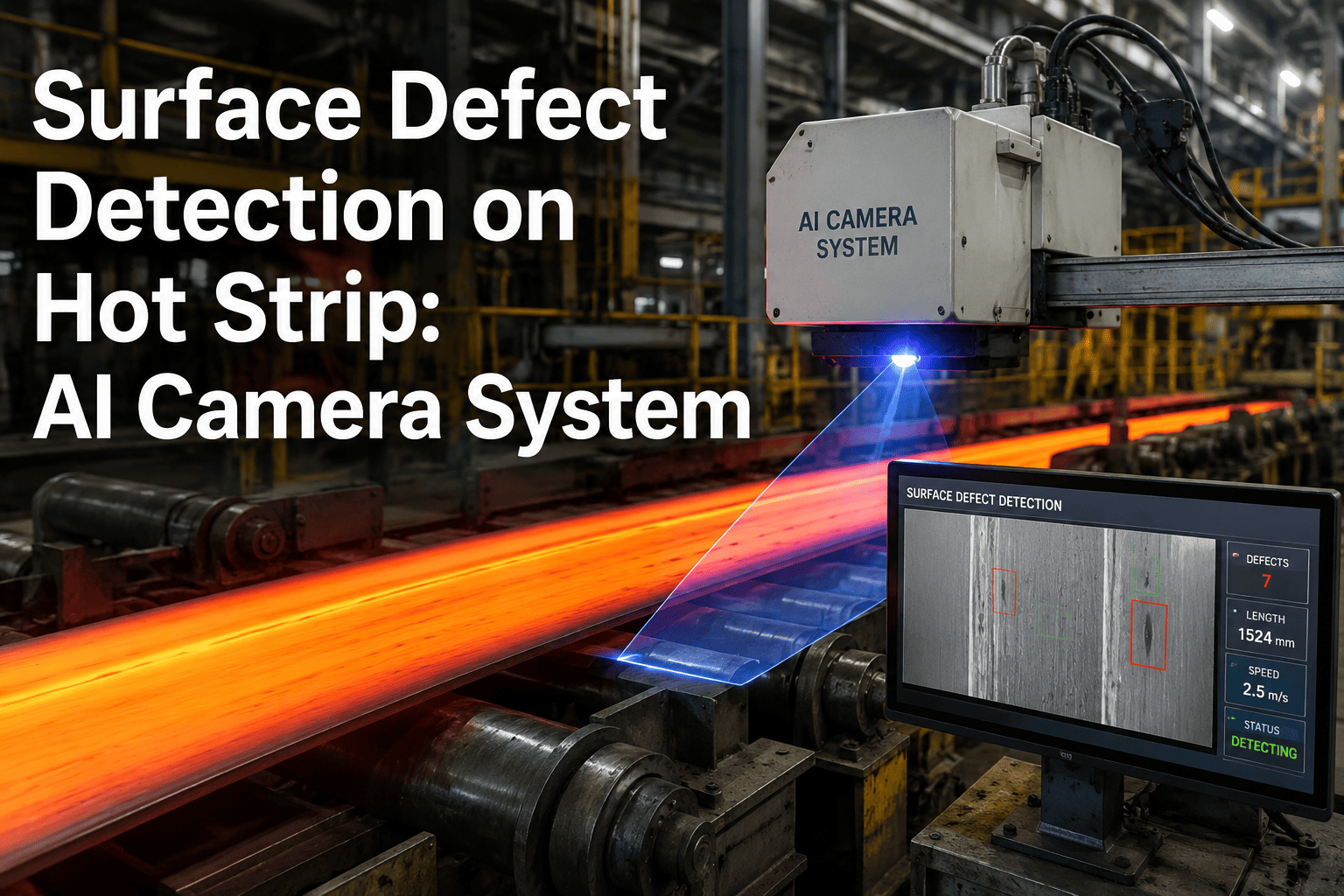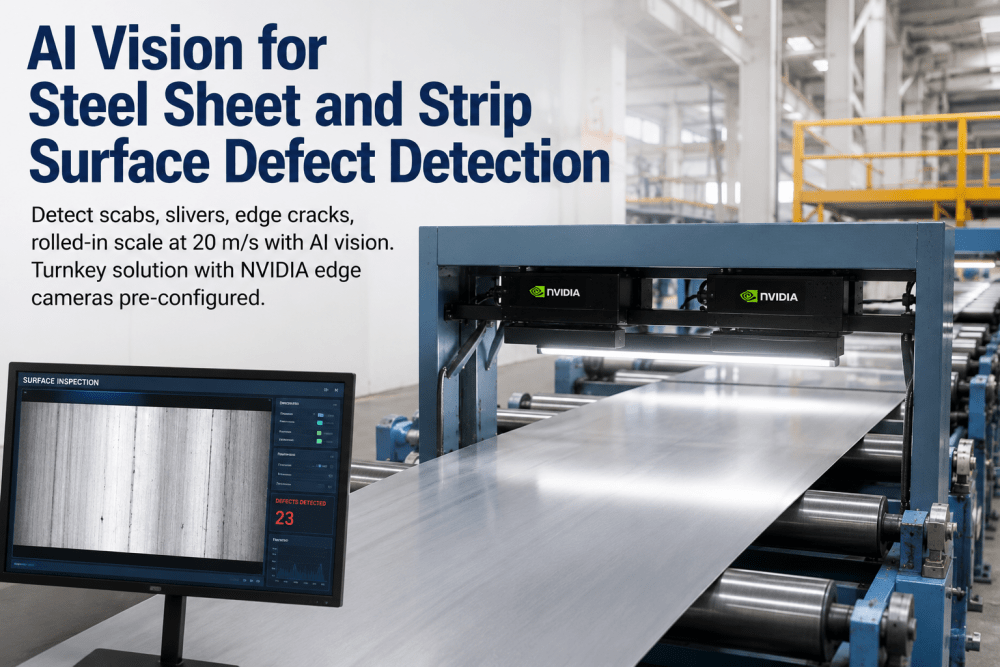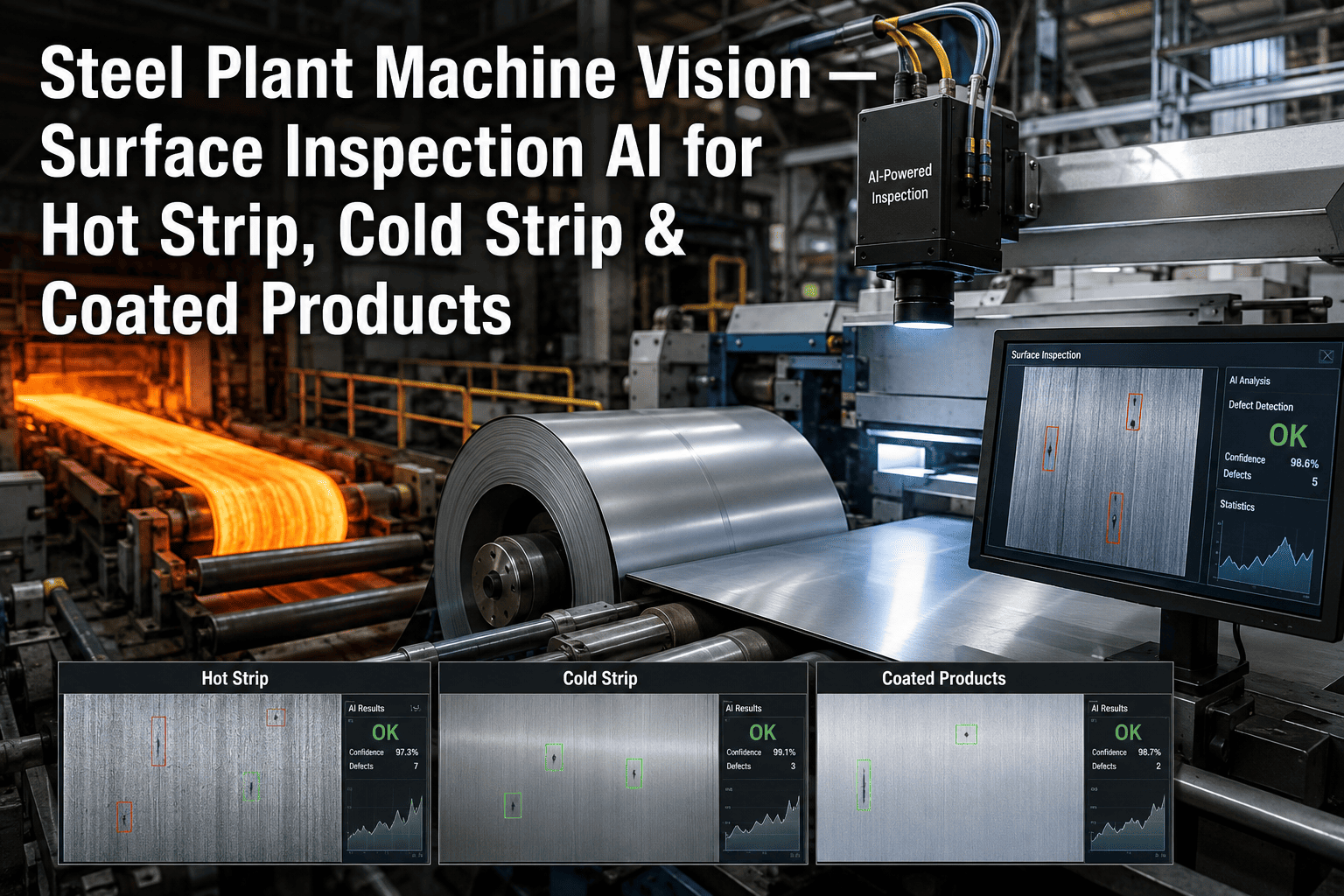
In the fiercely competitive steel industry, surface quality is the single most critical differentiator between premium and commodity products. Traditional manual inspection methods are no longer viable given modern line speeds exceeding 20 meters per second, where human operators miss up to 30% of defects. This is where machine vision powered by artificial intelligence (AI) transforms steel manufacturing. By deploying high-speed cameras and deep learning algorithms, steel plants can now inspect every millimeter of hot strip, cold strip, galvanized, and painted surfaces in real time, automatically detecting and classifying defects such as cracks, scale, scratches, and coating irregularities. This technology not only reduces scrap rates by up to 40% but also enables immediate process adjustments, saving millions annually. At iFactory, we specialize in deploying robust, industry-hardened vision systems that integrate seamlessly with existing mill automation. This comprehensive guide explores the architecture, benefits, and deployment strategies for AI-driven surface inspection across all steel product types, helping process engineers and quality managers achieve near-zero defect production.
AI-Powered Machine Vision for Steel Surface Inspection
Inspect hot strip, cold strip, and coated products at line speeds over 20 m/s with 99.5% defect detection accuracy. Reduce scrap by 40% and improve yield immediately.
Hot Strip Inspection: Detecting Scale, Cracks, and Edge Defects at High Temperature
Hot strip mills operate at extreme temperatures exceeding 1000°C, creating challenging conditions for any inspection system. AI-based machine vision overcomes this with specialized thermal imaging and high-speed visible light cameras that capture images through protective enclosures. The system detects primary scale, secondary scale, longitudinal cracks, transverse cracks, edge cracks, and roll marks in real time. Advanced deep learning models are trained on thousands of annotated images to distinguish between harmless surface variations and critical defects that could cause downstream failures. By integrating directly with the mill's PLC, the vision system can trigger alarms, mark defective coils, and even adjust descaling parameters automatically. This reduces the risk of shipping defective product to automotive or appliance customers, where zero-defect policies are mandatory.
Cold Strip Inspection: Sub-Micron Sensitivity for Premium Surface Grades
Cold rolled strip demands the highest surface quality, often requiring detection of defects as small as 10 microns. Traditional inspection methods struggle with the reflective, mirror-like surface of cold strip, which creates glare and reflections that confuse standard cameras. AI vision systems use structured lighting and polarization filters to eliminate glare, while convolutional neural networks (CNNs) are trained to identify pinholes, scratches, dents, and stains with sub-micron precision. The system can classify each defect by size, shape, and severity, allowing operators to prioritize rework or downgrade decisions. For automotive exposed panels and appliance grades, this level of inspection is not optional — it is a contractual requirement. Integrating machine vision at the cold mill exit ensures that only flawless material proceeds to downstream processes like annealing or galvanizing.
Galvanized and Painted Products: Coating Integrity and Uniformity
For galvanized, galvannealed, and painted steel, surface inspection must verify both the substrate and the coating layer. Common defects include zinc spangles, coating skips, orange peel, blisters, and color variations. AI vision systems use multispectral imaging — combining visible light, near-infrared, and ultraviolet — to analyze coating thickness and uniformity across the entire strip width. Deep learning models are trained to detect subtle variations in reflectance that indicate coating defects, even on textured or patterned surfaces. The system can also measure coating weight indirectly by correlating image features with laboratory XRF measurements. This real-time feedback enables operators to adjust coating parameters instantly, reducing waste and ensuring compliance with ASTM and ISO standards. For painted products, the vision system checks for color consistency, gloss level, and surface contamination before the final inspection.
Key Defect Categories Detected by AI Vision
Surface Cracks
Longitudinal, transverse, and star cracks detected on hot and cold strip. AI distinguishes crack depth and orientation.
Scale and Oxidation
Primary and secondary scale patterns identified on hot strip. System recommends descaling pressure adjustments.
Scratches and Gouges
Sub-micron scratches on cold strip and coated surfaces. Classified by length, width, and severity score.
Coating Defects
Zinc spangles, coating skips, orange peel, and blisters on galvanized and painted products.
Edge Defects
Edge cracks, wavy edges, and edge burrs detected using dedicated side-looking cameras.
Inclusions and Laminations
Internal defects that break the surface, detected by AI analysis of surface texture anomalies.
Step-by-Step Deployment Timeline for AI Vision in Steel Mills
Step 1: Site Audit and Line Characterization
Engineers assess line speed, temperature, lighting conditions, and available mounting positions. They identify critical defect types based on customer complaints and historical quality data.
Step 2: Camera and Lighting Selection
High-speed line scan cameras with resolution up to 4K are selected. Lighting systems (LED, laser, or structured) are designed to eliminate glare and maximize contrast for each product type.
Step 3: AI Model Training with Factory Data
Thousands of real defect images are collected and annotated by quality experts. Transfer learning from pre-trained models accelerates training to just 2-3 weeks.
Step 4: Integration with Mill Automation
The vision system connects to the PLC and MES via OPC UA or Modbus. Defect data is logged with coil ID, position, and timestamp for full traceability.
Step 5: Validation and Calibration
System is validated against manual inspection and laboratory analysis. Calibration is performed weekly using reference standards.
Step 6: Go-Live and Continuous Learning
After acceptance testing, the system goes live. AI models continue to learn from new defect patterns through active learning pipelines.
Ready to Transform Your Steel Inspection Process?
Deploy AI machine vision in your mill within 8 weeks. Achieve 99.5% defect detection and reduce scrap by 40%.
AI Vision vs. Traditional Inspection Methods
| Parameter | Manual Visual Inspection | Traditional Machine Vision | AI-Powered Vision (iFactory) |
|---|---|---|---|
| Detection Rate | 70-80% | 85-90% | 99.5% |
| Speed (m/s) | Up to 5 | Up to 15 | Over 20 |
| Defect Classification | Limited (5-10 types) | 10-20 types | 50+ types |
| False Positive Rate | High | Moderate (5-10%) | Below 1% |
| Real-time Feedback | No | Limited | Yes (milliseconds) |
| Integration with MES | Manual | Partial | Full (OPC UA, Modbus) |
| Continuous Learning | No | No | Yes (active learning) |
Frequently Asked Questions
What line speeds can iFactory's AI vision system handle?
Our system is designed to inspect at line speeds exceeding 20 meters per second, which covers virtually all hot strip, cold strip, and coated product lines in modern steel plants. The high-speed line scan cameras capture images at rates up to 100 kHz, and the AI inference engine processes each frame in under 5 milliseconds. This ensures that every square millimeter of the strip surface is analyzed in real time without slowing down production. For lines operating above 20 m/s, we can deploy multiple synchronized cameras and distribute the processing load across GPU clusters. The system has been successfully deployed on lines running at 25 m/s in several European mills. To discuss your specific line speed requirements, book a demo with our engineering team.
How does the AI handle surface variations like texture and color changes?
The AI models are trained on a diverse dataset that includes thousands of images representing the full range of surface textures, colors, and lighting conditions encountered in steel production. We use data augmentation techniques — such as rotation, scaling, and brightness adjustment — during training to make the model invariant to non-defect variations. Additionally, the system employs a two-stage architecture: first, a segmentation network identifies regions of interest (potential defects), then a classification network assigns a defect type and severity score. This approach allows the system to distinguish between a harmless oil stain and a critical scratch, even on textured or patterned surfaces. For coated products, we use multispectral imaging that captures data in multiple wavelengths, enabling the AI to differentiate between coating thickness variations and actual defects. Regular retraining with new data ensures the model adapts to any process changes over time.
What is the typical ROI for deploying AI vision in a steel mill?
Based on deployments across more than 20 steel plants worldwide, the typical return on investment (ROI) for an AI vision inspection system is achieved within 6 to 12 months. The primary savings come from three sources: (1) reduction in scrap and rework, which decreases material costs by 30-40%; (2) reduction in customer claims and returns, which can save millions annually in penalties and lost business; and (3) increased yield from the same input material, allowing higher throughput without additional raw material costs. For a medium-sized mill producing 2 million tons per year, a 1% reduction in scrap translates to savings of over $2 million annually. Additional benefits include reduced labor costs for inspection and improved process control through real-time feedback. Our team provides a detailed ROI analysis during the initial consultation. Contact support to start your ROI calculation.
How does the system integrate with existing mill automation and MES?
iFactory's AI vision system is designed for seamless integration with any modern mill automation infrastructure. We support industry-standard communication protocols including OPC UA, Modbus TCP/IP, and Profinet for direct connection to PLCs and SCADA systems. The system outputs defect data in a structured JSON format that can be ingested by any MES or quality management system. Each defect is tagged with a unique ID, coil number, position coordinates (length and width), defect type, severity score, and timestamp. This data can be used to generate real-time dashboards, historical quality reports, and even predictive maintenance alerts. For older mills with legacy systems, we provide a middleware gateway that translates data between protocols. Integration typically takes 2-4 weeks and is performed by our certified automation engineers. We also offer a REST API for custom integrations. To discuss your specific automation environment, schedule a demo.
What maintenance is required for the vision system in a harsh mill environment?
The hardware components — cameras, lenses, and lighting — are industrial-grade with IP65 or higher enclosures to withstand dust, moisture, and vibration. We recommend a preventive maintenance schedule that includes weekly cleaning of camera windows and light diffusers using compressed air and approved solvents. The AI models require minimal maintenance; we recommend retraining every 3 to 6 months using new defect images collected from production. This retraining can be done automatically through our active learning pipeline, which identifies uncertain predictions and requests human labeling. Our remote monitoring platform alerts the maintenance team if any camera or lighting component degrades. For mills in extreme environments (e.g., hot strip with high ambient temperatures), we offer optional water-cooled enclosures and air purge systems. Typical uptime for our systems exceeds 99.5%. Our support team is available 24/7 for critical issues. For maintenance contracts and support plans, visit our support page.
Achieve Zero-Defect Steel Production Today
Join industry leaders who have deployed AI vision to reduce scrap, improve yield, and satisfy the most demanding customers.