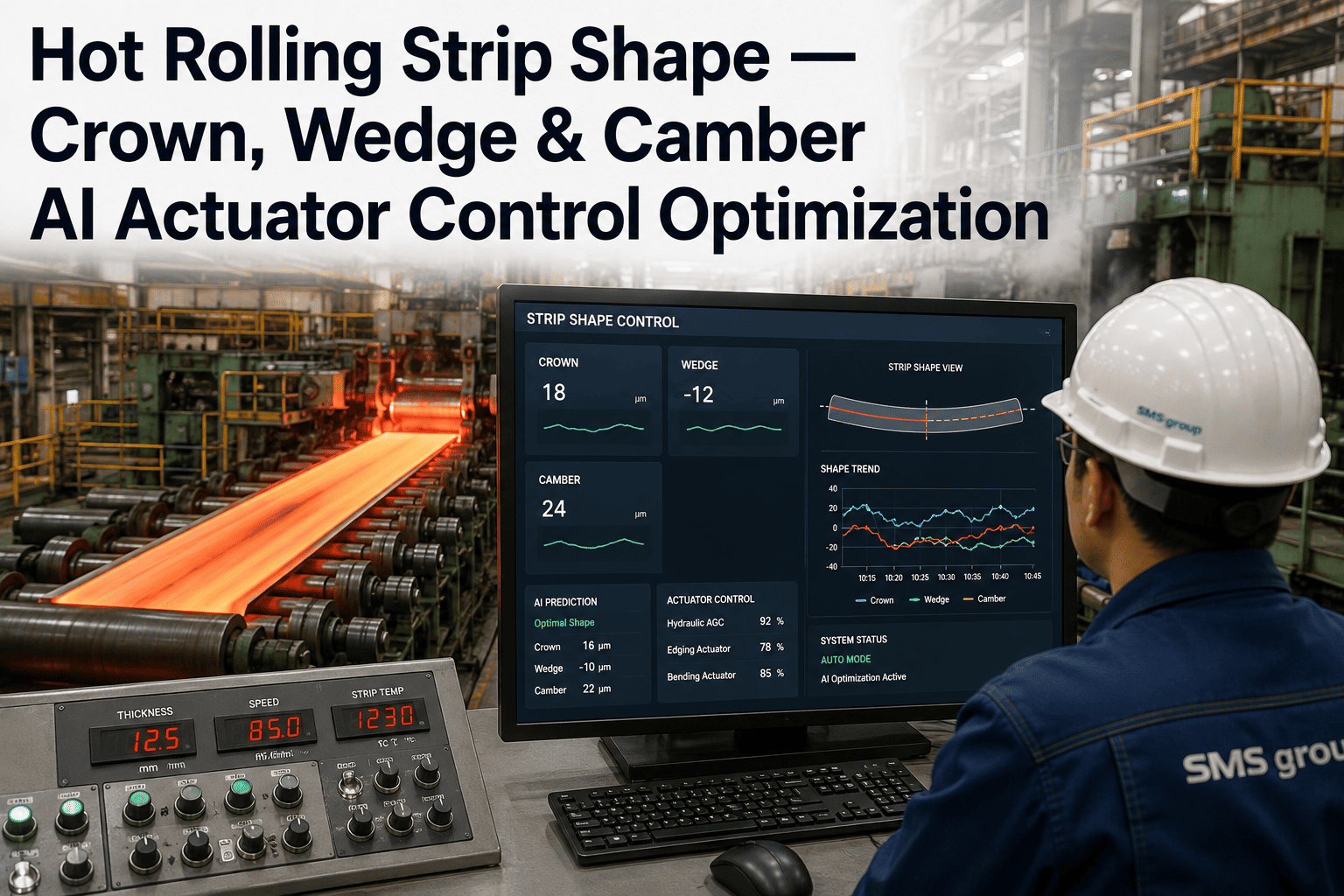
A hot strip mill can hold rolling force, temperature, and speed exactly on schedule and still ship coil that gets rejected on arrival, because crown, wedge, and camber are governed by a separate set of actuators that most control rooms watch far less closely. Work-roll bending and shifting shape the thickness profile across the strip width, leveling corrects wedge between the drive and operator sides, and camber builds up quietly from thermal and thickness asymmetries that no single sensor catches until the strip is already curving off the centerline. Process engineers who treat these three defects as one coupled actuator problem, rather than three separate troubleshooting exercises, cut both scrap and downstream customer complaints. Teams that book a demo of iFactory's shape-control monitoring usually start here, since crown, wedge, and camber account for a disproportionate share of hot mill quality holds.
Turn Crown, Wedge, and Camber Into a Solved Problem, Not a Recurring One
iFactory correlates work-roll bending, shifting, and leveling actuator data with real-time strip profile measurement, giving process engineers early warning before shape deviations reach reject tolerance.
Three Defects, One Root Cause: Uncoordinated Shape Actuators
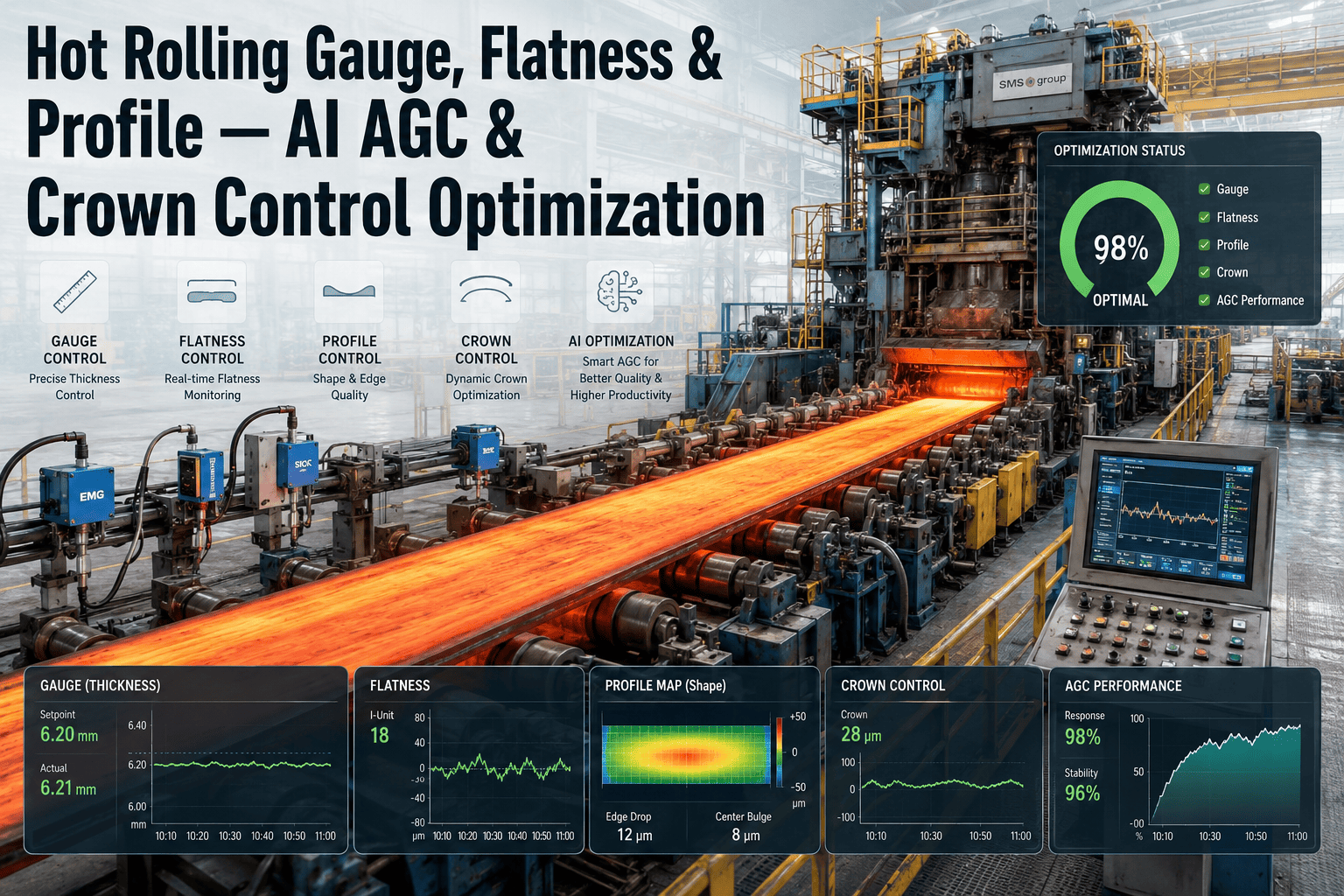
Crown describes uneven thickness distribution across the strip width, wedge describes a thickness difference between the drive side and operator side, and camber describes the strip curving away from a straight centerline as it exits the stand. All three trace back to the same family of actuators, work-roll bending, work-roll shifting, and stand leveling, which is why isolated troubleshooting rarely fixes the underlying pattern. Bending and shifting reshape the roll gap profile to correct crown, leveling adjusts the relative gap between drive and operator sides to correct wedge, and camber typically emerges from temperature and thickness asymmetry that these same actuators can partially compensate for if their combined effect is modeled correctly rather than adjusted one at a time.
Center-thick, edge-thin distribution corrected by work-roll bending and shifting force.
Drive-to-operator side thickness slope corrected through stand leveling adjustment.
Centerline curvature from thermal and thickness asymmetry, reduced by controlled edging force.
Which Actuator Controls Which Defect
Modern hot strip mills give process engineers several overlapping actuators to influence shape, and understanding which lever moves which defect, and by how much, is the foundation for any automated shape control strategy. Positive work-roll bending can reach roughly 200 tons per chock while negative bending reaches around 120 tons per chock on many mill designs, giving a wide range for crown correction without disturbing bearing life. Engineers who book a consultation with iFactory can review which actuator combinations are already installed on their mill before mapping a monitoring strategy around them.
| Actuator | Primary Defect Controlled | Mechanism | Typical Range |
|---|---|---|---|
| Work-Roll Bending | Crown / Flatness | Reshapes roll gap profile under load | +200 / -120 ton per chock |
| Work-Roll Shifting (CVC/ASR) | Crown / Roll Wear Distribution | Axially shifts variable-crown roll profile | Continuous, schedule-linked |
| Stand Leveling | Wedge | Adjusts drive-to-operator gap difference | Fine increment, per-pass |
| Pair-Cross | Crown / Flatness Range | Crosses work and back-up roll axes | Small angular adjustment |
| Edging Force (Roughing) | Camber | Induces lateral flow to offset curvature | Slab-to-slab feedback adjusted |
See Shape Deviation Before It Reaches Reject Tolerance
iFactory's platform ties actuator position data directly to measured strip profile, flagging drift patterns that precede crown, wedge, or camber holds.
Where AI Adds Precision Beyond Standard Shape Setup Models
Standard shape setup models calculate an initial actuator configuration for each schedule based on target crown curve, but they rely on parameters that are difficult to measure directly during rolling, such as work-roll thermal expansion and gradual wear evolution across a roll campaign. AI models close this gap by learning the actual relationship between actuator commands and measured shape outcome for each specific mill, roll set, and grade combination, then correcting the setup model's assumptions before the next schedule change rather than after a defect is already rolled.
Thermal Camber Compensation
Work-roll thermal expansion through a rolling campaign shifts the effective crown curve gradually, and AI models track this drift continuously rather than relying on a fixed thermal camber estimate calculated once per campaign.
Shift Position Optimization
Roll shifting position is not unique for a given target crown curve, so AI-based optimization selects shift positions that also extend roll campaign life without compromising flatness within acceptable ranges.
Camber-Wedge Decoupling
Edging force in the roughing mill can reduce camber independently of wedge correction in later stands, and AI-assisted control keeps these two corrections from working against each other across the schedule.
Cross-Stand Correction
When shape falls outside tolerance at an intermediate stand, correction can be distributed across remaining downstream stands rather than concentrated entirely at the final stand, reducing actuator strain.
Shape Control Impact, By the Numbers
Shape-related quality holds represent one of the more expensive and preventable categories of hot mill downgrade, particularly for advanced high-strength grades and coated products where downstream customers apply tighter flatness and profile tolerances than commodity grades tolerate.
Rolling Out AI Shape Monitoring Across a Hot Strip Mill
Shape monitoring depends on reliable profile measurement feeding a model that already understands each stand's actuator behavior, so rollout typically starts with the finishing stands where flatness tolerance is tightest before extending back toward the roughing mill and camber control.
Baseline Actuator-to-Profile Mapping
Historical actuator commands are correlated against measured profile data for each grade and gauge combination to establish the mill's actual response curve.
Live Drift Detection
The platform flags when actuator response begins diverging from the established baseline, indicating roll wear, thermal drift, or mechanical wear in bending cylinders.
Setup Model Correction
Recommended actuator adjustments are surfaced to the setup model ahead of the next schedule change, closing the loop between measured drift and future setup accuracy.
Extension to Roughing Mill Camber Control
Once finishing stand shape control is stable, monitoring extends upstream to roughing mill edging force and slab-to-slab camber feedback control.
Hot Rolling Shape Control — Frequently Asked Questions
What is the difference between crown, wedge, and camber?
Crown refers to thickness variation across the strip width, typically thicker at center than at the edges, while wedge refers to a thickness difference between the drive side and operator side of the same strip. Camber is different from both, describing the strip curving away from a straight line as it travels, usually caused by uneven temperature or thickness across the width rather than a rolling force issue alone.
Can AI shape monitoring work with an existing setup model rather than replacing it?
Yes, most mills already run a physics-based setup model that calculates initial actuator positions, and AI monitoring is designed to correct that model's assumptions using real measured outcomes rather than replace it entirely. This approach lets engineers keep trusted setup logic while closing the gap between calculated and actual shape response. Teams can book a demo to see this integration on a comparable mill configuration.
Why does roll shifting strategy matter beyond just correcting crown?
Roll shifting position is not unique for achieving a given target crown curve, meaning several different shift strategies can produce acceptable flatness while having very different effects on roll wear distribution. Optimizing shift position for both shape outcome and roll campaign life extends the useful life of expensive work rolls significantly.
How quickly can shape drift be detected after a roll change or grade transition?
Once baseline actuator-to-profile relationships are established for a given roll set and grade family, drift detection operates on a per-coil basis, meaning deviation from expected behavior can be flagged within the first few coils after a change rather than after an extended production run.
Does camber control in the roughing mill affect wedge correction downstream?
Camber and wedge correction can interact if actuators are adjusted independently without a shared model, since edging force applied to reduce camber changes lateral material flow that later wedge correction assumes is unaffected. Coordinated control keeps these corrections from working against each other across the schedule. Reliability and process teams can contact support for guidance specific to their stand configuration.
Bring Every Shape Actuator Into One Coordinated Model
iFactory helps process engineers move from reactive shape troubleshooting to coordinated, data-driven actuator control across bending, shifting, leveling, and edging force.