A rolling mill processes steel at 15-20 meters per second. At that speed, a single degree of temperature deviation in the reheat furnace creates dimensional inconsistencies across hundreds of meters of product before anyone notices. A manual operator adjustment that arrives two minutes late has already affected 2,400 meters of steel. This is the fundamental problem with human-controlled rolling and reheating operations: the process moves faster than human reaction time allows. The mills that dominate quality rankings and throughput benchmarks in 2026 aren't the ones with the newest stands. They're the ones where AI controls the parameters that human reflexes simply cannot.
Rolling Mill + Reheat Furnace Intelligence
Your Furnace Burns Fuel It Doesn't Need. Your Mill Runs Slower Than It Should. AI Fixes Both.
Automated rolling mill speed optimization and reheat furnace temperature control that improve throughput, cut energy waste, and eliminate quality rejects
5-12%
Energy savings per furnace
3-8%
Higher furnace throughput
<4 mo
Typical payback period
The Two Machines That Make or Break Steel Plant Profitability
The reheat furnace and the rolling mill are the most tightly coupled systems in a steel plant. When one underperforms, the other suffers. When both are manually controlled, the losses compound invisibly across every shift.
Reheat Furnace
Where Energy Becomes Steel Temperature
Manual Control Problems
Over-heating by 30-50°C to avoid under-heated rejects
10-30 min lag responding to mill delays
All slabs heated identically regardless of grade
3-8% excess fuel burned every shift
Rolling Mill
Where Temperature Becomes Product
Manual Control Problems
Speed restrictions from inconsistent slab temperature
Cobbles from thermal mismatch at stand entry
Dimensional drift undetected for minutes
60-70% of speed losses trace to equipment condition
Running your furnace and mill as two separate systems? See what integrated AI control looks like in a live demo.
What AI Actually Controls (and How It Outperforms Human Operators)
AI doesn't replace operators. It handles the hundreds of micro-adjustments per minute that no human can process at rolling speed, while operators focus on exception handling and strategic decisions.
Slab-Level Thermal Modeling
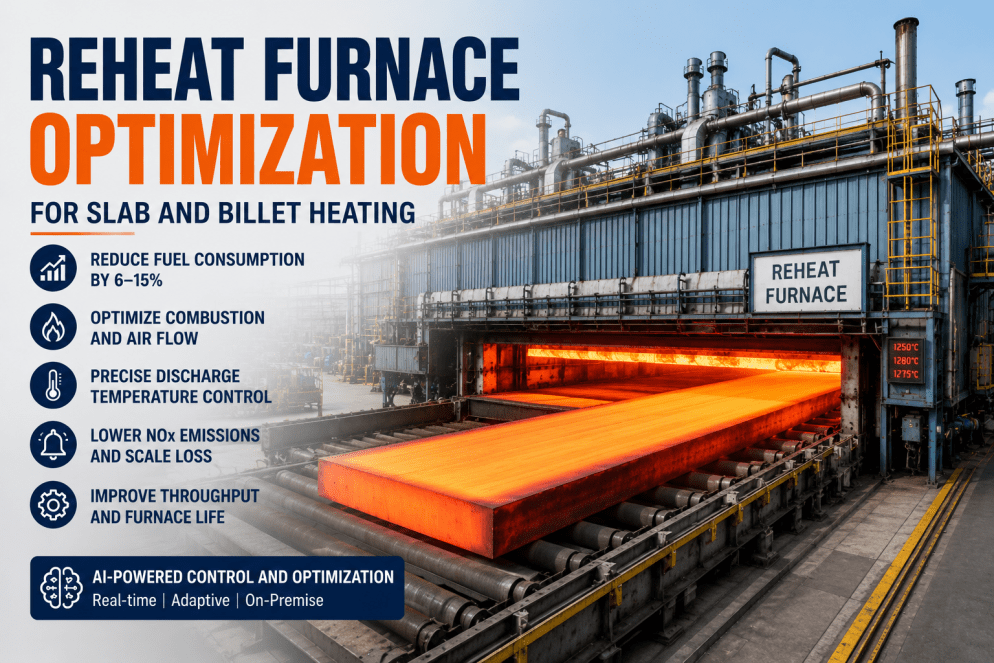
AI tracks the temperature gradient through the cross-section of every slab in the furnace, adjusting zone temperatures individually rather than treating all slabs identically. Result: discharge temperature accuracy within ±15°F versus ±50°F under manual control.
Dynamic Delay Response
When the rolling mill slows or stops, AI instantly reduces furnace energy input to match. Manual control lags 10-30 minutes during delays, wasting fuel and over-heating slabs. Mill delays account for 20-40% of total excess energy consumption.
Grade-Specific Heating Profiles
Different steel grades need different temperature curves. AI automatically assigns optimal heating profiles per slab based on grade, dimension, and target mechanical properties, even when diverse products sit adjacent in the furnace.
Adaptive Speed Optimization
AI continuously adjusts mill speed based on incoming slab temperature, stand load, and product spec. Instead of running at a conservative fixed speed, the mill operates at its true maximum for each specific piece of material.
AGC and Profile Prediction
Automatic Gauge Control response degrades as servo valves age. AI monitors AGC response time and correlates it with gauge deviation, flagging when response exceeds 18ms threshold. This prevents off-gauge strip before it happens.
Cobble Prevention
Every cobble traces to an equipment condition the data predicted. AI correlates threading speed, strip temperature, stand alignment, and roll condition to predict cobble risk and automatically adjust parameters to prevent it.
The Numbers: What Automation Actually Delivers
These aren't projections. They're benchmarks from steel plants that moved from manual to AI-controlled furnace and mill operations. The improvements happen simultaneously because AI resolves the trade-offs that manual control forces.
Energy
Fuel Savings Per Furnace
Manual
Baseline
AI-Controlled
5-12% reduction
$600K - $1.8M saved annually per furnace
Quality
Temperature Uniformity
Manual
±50°F variance
AI-Controlled
±15°F variance
50-70% improvement in uniformity
Throughput
Furnace Output Increase
Manual
Baseline
AI-Controlled
3-8% more tons/hr
Zero CapEx capacity expansion
Yield
Scale Loss Reduction
Manual
1.5-2.5% scale
AI-Controlled
15-30% less scale
More sellable steel from the same input
Defects
Roll-Related Surface Defects
Manual
Baseline
AI-Controlled
60-80% reduction
Within first 6 months of implementation
Downtime
Unplanned Mill Stoppages
Manual
Baseline
AI-Controlled
15% less downtime
Predictive maintenance prevents failures
Your Furnace and Mill Are Leaving Money on the Table
Every hour of manual operation burns excess fuel, produces unnecessary scale, and runs slower than your equipment's true capability. iFactory's AI closes those gaps automatically, shift after shift, without operator variability.
The Hidden Cost of "Good Enough" Manual Control
Manual furnace control has a built-in bias that costs steel plants millions every year without appearing in any report. Operators run furnaces hotter than necessary because the penalty for an under-heated slab is immediately visible (cobble, quality reject, mill delay), while the penalty for over-heating (excess fuel, scale loss, CO₂) is invisible at the operator level.
Average temperature above optimum that operators maintain as "safety margin." This single habit drives 3-8% excess fuel consumption, 15-30% additional scale formation, and accelerated refractory wear across every shift.
When the mill stops, slabs continue absorbing heat for 10-30 minutes before manual adjustment catches up. These delays account for 20-40% of total excess energy consumption. AI responds in seconds.
Different operators run the same furnace differently. Shift A might burn 8% more fuel than Shift C for identical product. AI eliminates this variance entirely, delivering the same optimized performance 24/7.
Implementation: Fast, Non-Disruptive, Proven
AI furnace and mill optimization isn't a rip-and-replace project. It layers intelligence on top of your existing PLCs, sensors, and control systems. Here's what the deployment timeline looks like.
01
Weeks 1-2
Connect and Map
Integration with existing SCADA, PLCs, and sensor networks. No equipment replacement. The AI system begins collecting data from furnace zones, mill stands, and quality systems to build your plant-specific model.
02
Weeks 3-4
Shadow Mode
AI runs in parallel with manual control, recommending setpoints without executing them. Operators see what the AI would have done differently, building confidence and validating the model against your specific operating conditions.
03
Month 2
Supervised Closed-Loop
AI begins adjusting furnace setpoints and mill parameters with operator oversight. Most plants see 3-5% energy savings in the first month of closed-loop operation, before the model has fully converged.
04
Month 3-4
Full Optimization
The AI reaches full convergence, delivering 5-12% sustained energy savings, tighter temperature uniformity, and measurable throughput gains. Payback on a 250 ton/hr furnace is typically achieved within 4 months.
No rip-and-replace. No multi-year IT project. See the deployment plan for your specific equipment.
Why Leading Steel Companies Are Automating Now
The global steel industry is undergoing the most significant technology shift in decades. Plants that delay automation aren't just maintaining the status quo — they're falling behind competitors who are compounding gains every quarter.
$6.47B
Global production monitoring market in 2025, growing to $10-12B by 2030
16%
Of manufacturers have real-time shop floor visibility today
7%
Of global CO₂ emissions come from steel production
$350B+
Projected green steel market by 2032 — emissions data is now a market access requirement
Frequently Asked Questions
How much energy can AI save in a reheat furnace?
AI-optimized reheat furnaces consistently achieve 5-12% fuel savings by eliminating over-heating bias, responding instantly to mill delays, and optimizing zone temperatures for each individual slab. For a 250 ton/hr furnace, this translates to $600K-$1.8M in annual fuel savings. Most plants see measurable improvement within the first month of closed-loop operation.
Does rolling mill automation work with older equipment?
Yes. The AI system integrates with existing PLCs, SCADA systems, and sensor networks. It doesn't replace your control infrastructure; it adds an intelligence layer on top of it. Whether your mill has legacy equipment or modern PLCs, the system connects to virtually any setup through standard industrial protocols.
How does AI improve rolling mill throughput without new equipment?
Most mills run at conservative speeds because inconsistent slab temperatures make aggressive rolling risky. When the furnace delivers slabs at precisely the right temperature with tight uniformity, the mill can safely run faster. AI also predicts equipment-condition issues (vibration, AGC degradation) that cause speed restrictions, enabling proactive maintenance that keeps the mill at peak speed.
What is the typical ROI timeline?
Payback periods for AI furnace optimization are typically under 4 months when calculated against fuel savings alone. When you add scale loss reduction, throughput improvement, and quality gains, the full ROI arrives even faster. This is one of the fastest-payback investments available in steel mill operations.
Will this disrupt our current production?
No. Deployment follows a phased approach: data collection, shadow mode (AI recommends without executing), supervised closed-loop, and full optimization. At every stage, operators maintain oversight and can override. There is zero production disruption during implementation. The AI learns your plant's specific patterns during live production.
Every Shift Without AI Is a Shift of Wasted Fuel, Lost Tonnes, and Preventable Rejects
iFactory's AI brings your reheat furnace and rolling mill into synchronized, optimized production. Less energy in, more quality steel out, shift after shift. See it with your own plant data.