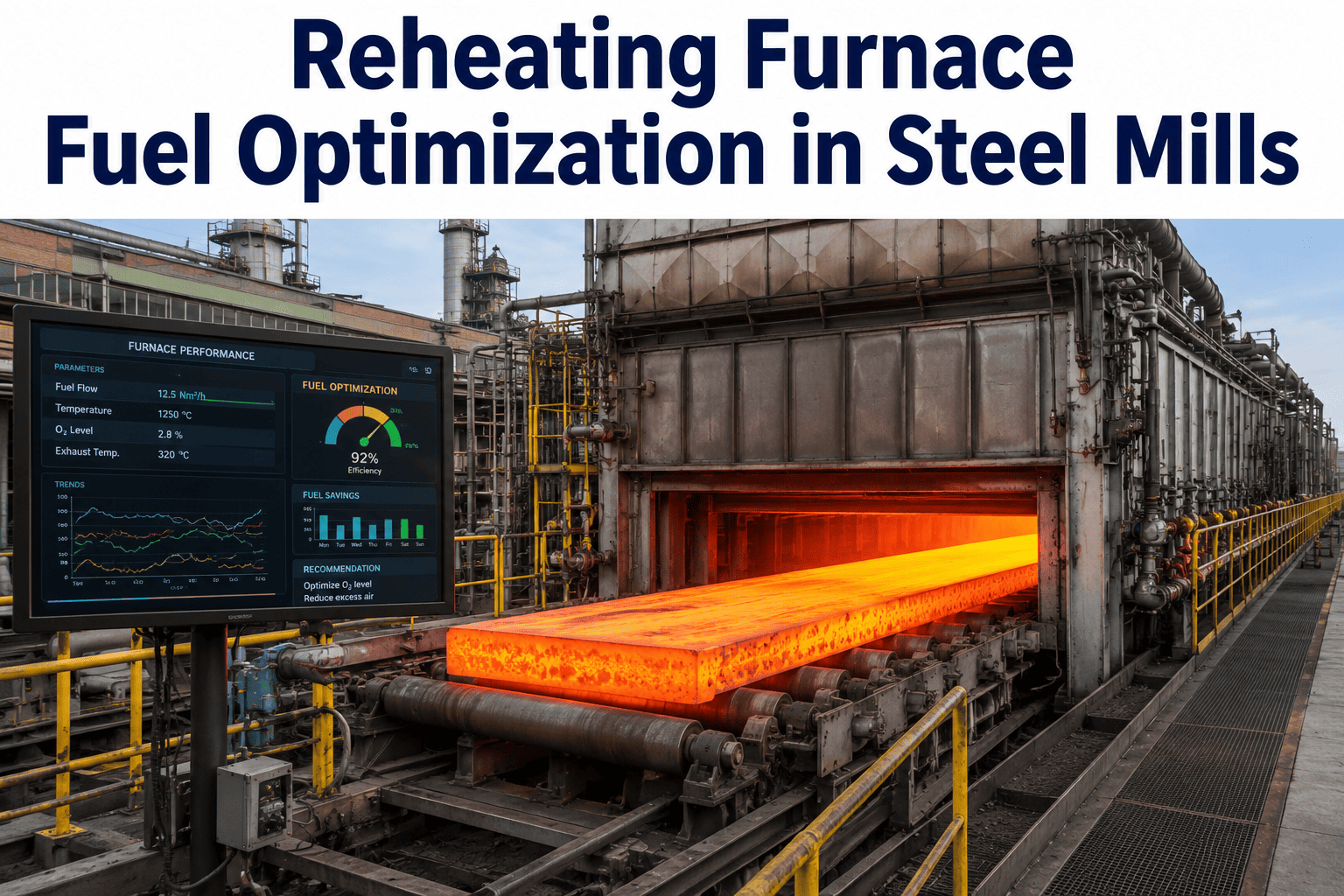
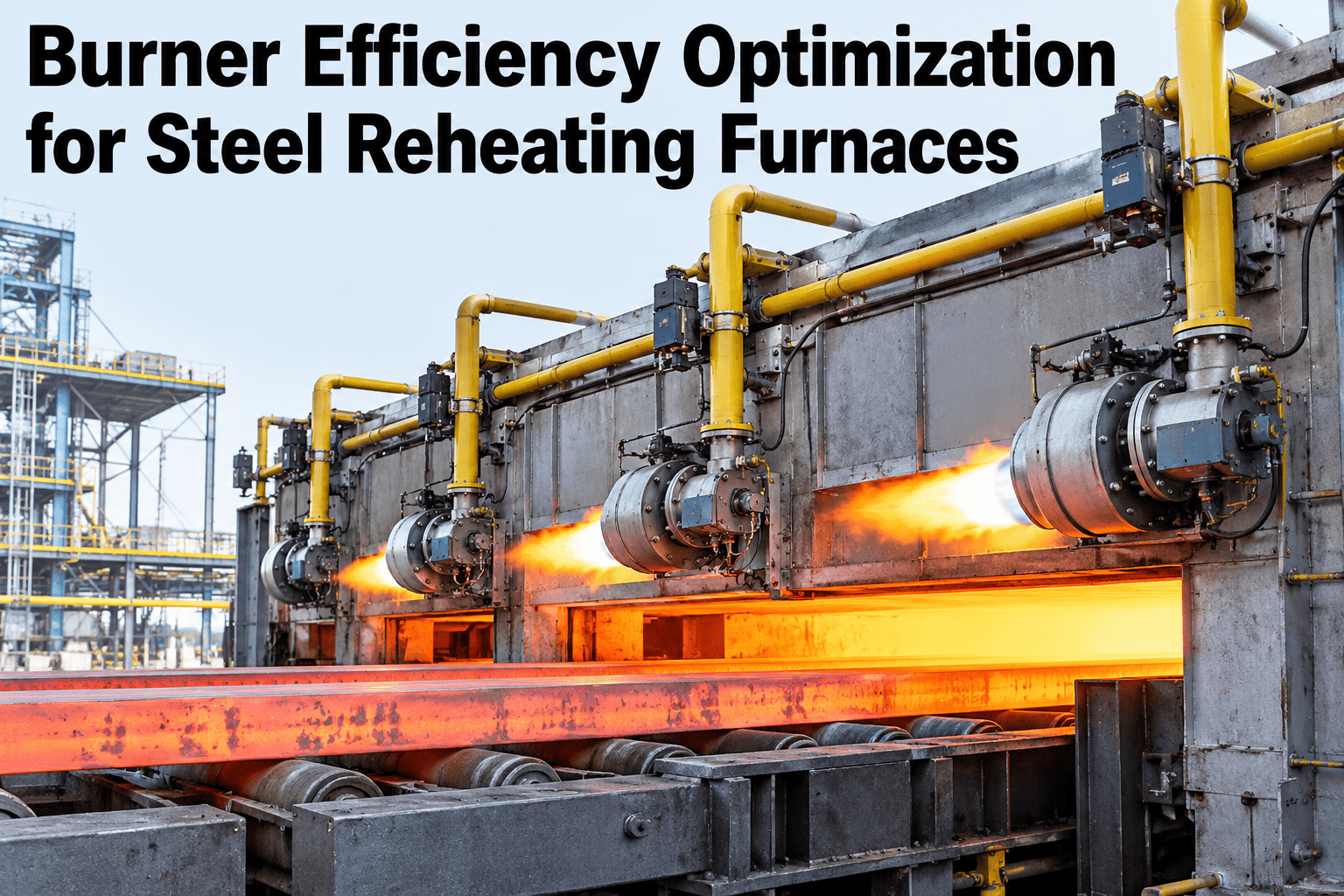
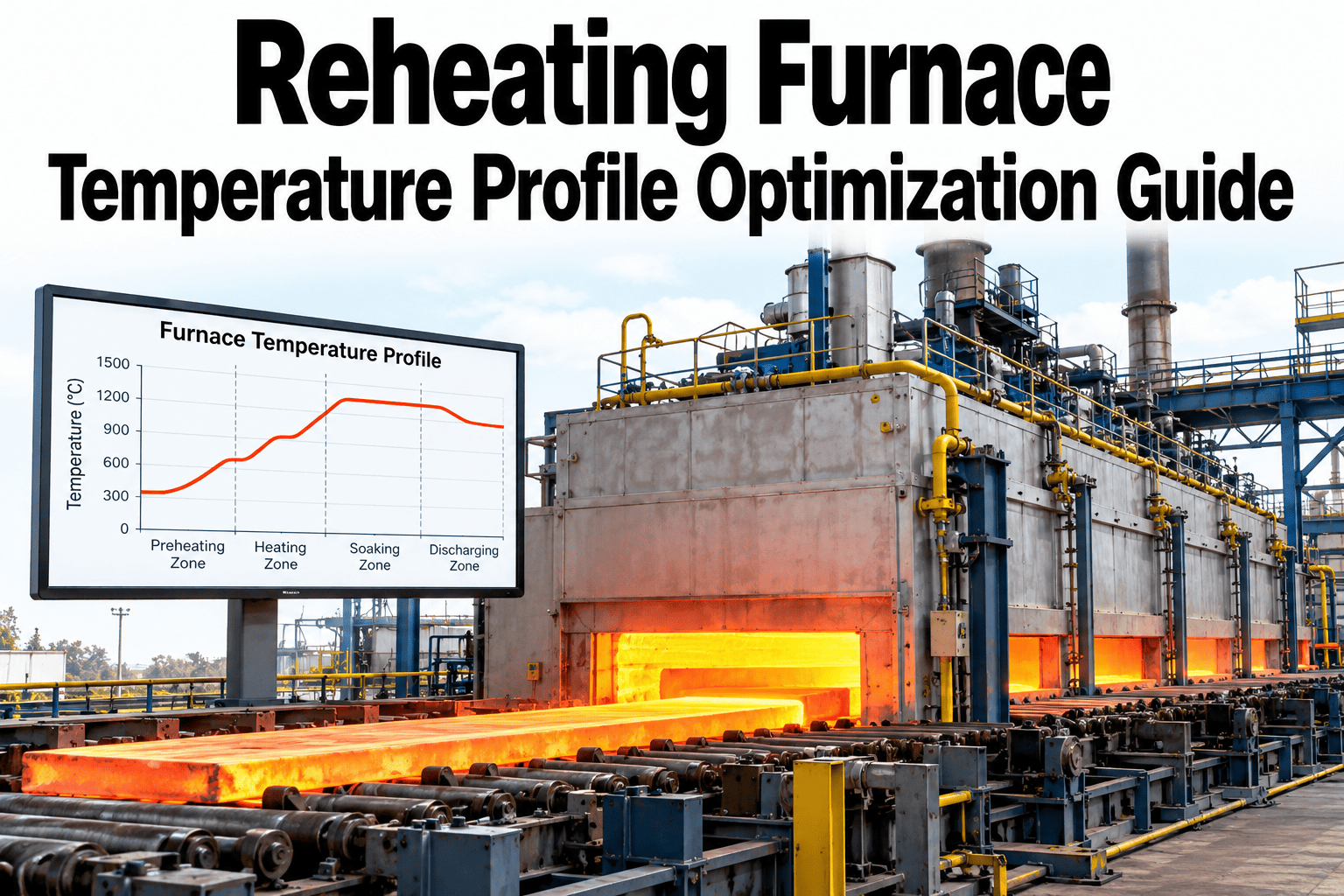
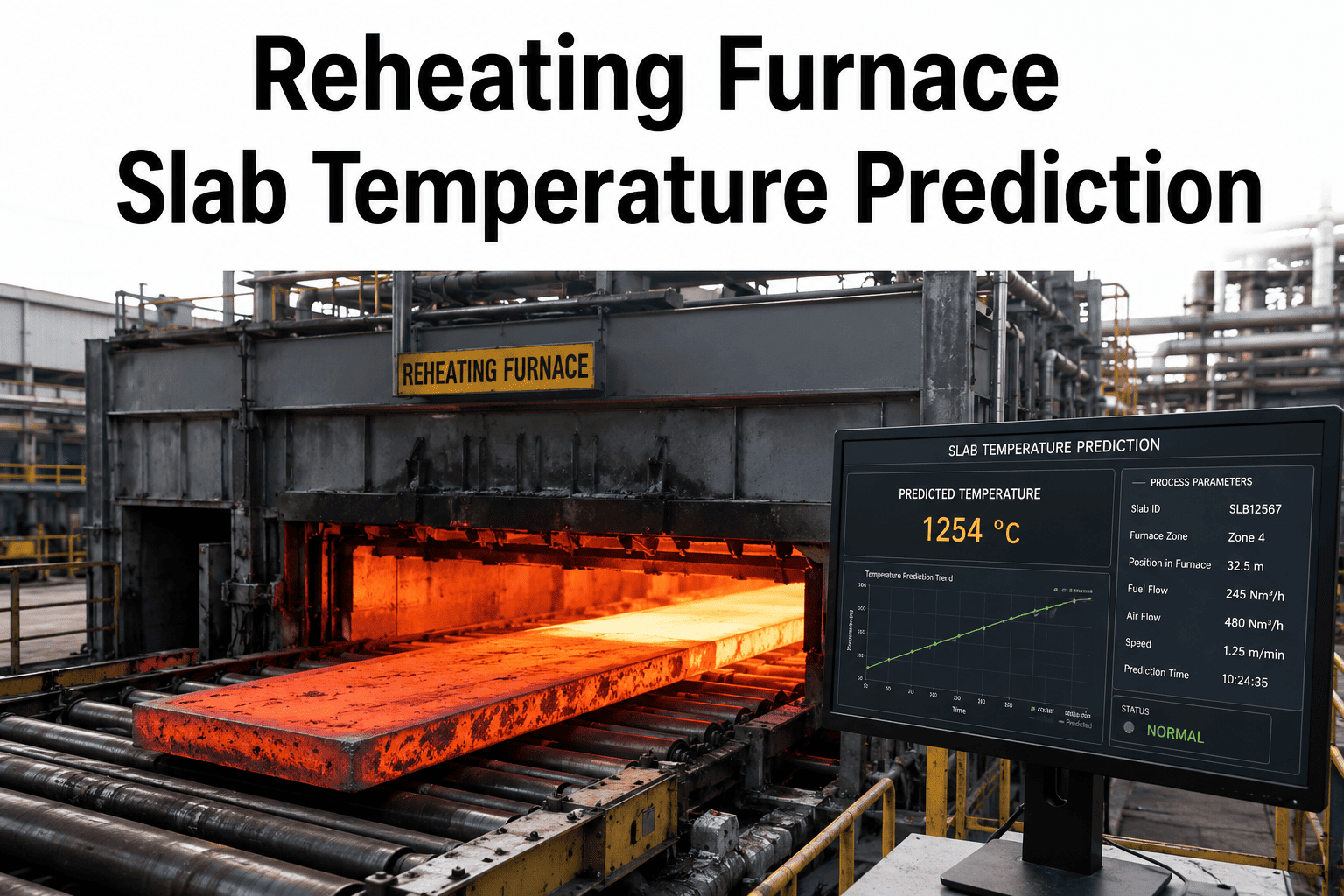
A reheating furnace in a steel rolling mill burns $8 million to $15 million in natural gas every year, running 8,000-plus hours annually to push 200 to 400 tons of slab per hour through zones that were set once and rarely revisited. The furnace manager adjusting zone temperatures is usually working from experience and a handful of thermocouple readings — setting for the average slab, not the actual one sitting in each zone right now. That gap between fixed zone setpoints and real slab-by-slab conditions is where 6 to 12% of fuel spend quietly disappears. Closing it does not require new burners or a furnace rebuild — it requires zone temperatures that actually track what each slab needs, continuously. Book a demo to see this running against your own furnace data.
Hot Rolling — HSM, Plate, Bar/Rod
Reheating Furnace Fuel Optimization in Steel Mills
14 min read
6-12%
Fuel consumption reduction achievable by tuning zone temperatures to actual slab tracking data instead of fixed setpoints
2nd
Rank of the reheat furnace among energy consumers in a hot strip mill, behind only the rolling mill drives themselves
±40-60°F
Typical cross-section temperature variation in furnaces running on fixed zone setpoints, against a ±15°F rolling requirement
4 mo
Typical payback period for AI-driven fuel optimization, among the fastest ROI of any capital investment in a steel mill
Why Fixed Zone Setpoints Waste Fuel Even When the Furnace "Works Fine"
A furnace running on fixed zone temperatures set by shift experience is not broken — it produces steel that meets spec, most of the time. The waste is invisible precisely because nothing looks wrong on the control room screen. Every slab passing through preheat, heat, and soak zones set for an average charge gets more or less energy than it actually needs, depending on its individual starting temperature, thickness, grade, and position in the charging sequence.
Thick slabs charged cold from the yard need meaningfully more residence time and zone temperature than a hot-charged slab arriving at 600 to 800°C straight from continuous casting. A fixed zone setpoint cannot serve both correctly at once — it either overheats the hot-charged slab, wasting fuel and increasing scale loss, or underheats the cold thick slab, risking an unacceptable discharge temperature that forces a rolling force correction downstream.
What Slab-Tracked Zone Optimization Actually Does
Rather than treating every slab in a zone identically, this approach tracks each individual slab's temperature history, thickness, grade, and residence time as it moves through the furnace, then adjusts zone temperature and burner output to deliver exactly the heat input that specific slab needs — not the average of everything currently in the furnace. Start free trial to see slab-specific tracking modeled against your furnace's current charging pattern.
Individual Slab Thermal History
Each slab's actual entry temperature tracked rather than assumed — hot-charged slabs from continuous casting get credited for the heat they already carry.
Position-Based Zone Adjustment
Zone temperature and burner output tuned to the specific slab currently occupying that zone, not a static setpoint applied to whatever happens to be there.
Grade and Thickness Compensation
Thicker slabs and different steel grades carry different heating time requirements, adjusted for automatically rather than forcing a one-size setpoint.
Discharge Temperature Prediction
Predicted exit temperature calculated continuously per slab, allowing correction before discharge rather than discovering a miss after the slab reaches the mill.
Where the Fuel Savings Actually Come From
Reduced OverheatingHot-charged and already-warm slabs no longer heated as though they entered cold, eliminating fuel spent on heat the slab did not need.
Fewer Reheat CorrectionsAccurate per-slab discharge prediction catches an under-heated slab before it reaches the mill, avoiding the fuel cost of a corrective reheat cycle.
Reduced Scale LossOverheating drives excess scale formation on the slab surface — tuning zone temperature to actual need rather than a worst-case average cuts this directly.
Better Charge Sequencing FitZone temperatures adjusting to the real charging sequence rather than assuming uniform slabs reduces the "slowest slab" throughput penalty across the whole batch.
Reheat Furnace Manager Note
This is not a replacement for manual furnace control judgment — it is a continuous input to it. The furnace manager still sets overall strategy and handles exceptions, but zone temperature decisions for each individual slab happen automatically at a frequency and precision no shift schedule of manual adjustments can match.
Fixed Setpoint vs. Slab-Tracked Zone Control
Why This Matters More on Mixed Charging Patterns
Plants running a consistent charge — same grade, same thickness, all cold-charged — see smaller gains from slab tracking, since a fixed setpoint tuned for uniform conditions is closer to correct more often. The savings compound sharply once charging patterns get mixed: hot-charged slabs interspersed with cold ones, multiple grades and thicknesses in sequence, and variable residence time driven by upstream casting or downstream mill scheduling. This is the normal operating condition at most mills, which is exactly why the fuel waste from fixed setpoints tends to be larger in practice than it looks on paper. Book a demo to model expected savings against your own charging mix.
Stop Heating Every Slab to the Same Average Setpoint
iFactory tracks individual slab thermal history, grade, and thickness through your reheat furnace and adjusts zone temperature accordingly — cutting fuel consumption 6 to 12% without a burner replacement or furnace rebuild.
What Mills Report After Deploying Slab-Tracked Fuel Optimization
6-12%
Fuel Reduction
Achieved by tuning zone temperature to actual slab conditions instead of a fixed average setpoint
±8°C
Discharge Accuracy
Typical predicted discharge temperature accuracy once slab-specific tracking is fully deployed
4 mo
Typical Payback
One of the fastest ROI timelines of any capital investment available in steel mill operations
Lower
Scale Loss
Reduced overheating directly cuts the excess scale formation that a worst-case zone setpoint produces
Frequently Asked Questions
QDoes slab-tracked zone optimization require replacing existing thermocouples or burners?
In most deployments, existing zone thermocouples and burner hardware remain in place, with the optimization system layering on top of the furnace's existing Level-1 and Level-2 control systems rather than replacing physical equipment. The more critical requirement is instrumentation accuracy — if zone thermocouples are drifting or poorly calibrated, the optimization model inherits that inaccuracy, which is why an instrumentation health check is typically the first step before deployment rather than an afterthought.
Book a demo to get an instrumentation readiness assessment for your furnace.
QHow does slab tracking know a slab's actual entry temperature if it wasn't measured directly?
For hot-charged slabs coming directly from continuous casting, entry temperature is typically derived from the casting process data itself combined with transit time since casting, since the thermal decay curve for a specific grade and thickness during transit is well characterized. For cold-charged slabs from yard storage, entry temperature is closer to a known ambient baseline with less variation to account for, which is one reason hot-charged slabs benefit more dramatically from accurate individual tracking than cold-charged ones do.
QWhat happens when the optimization system's temperature recommendation conflicts with the furnace manager's judgment?
The system is designed to operate as a continuous recommendation and adjustment layer within manager-defined boundaries, not as a fully autonomous decision-maker overriding operational judgment. A furnace manager retains override authority for known exceptions — an unusual grade requiring special handling, a downstream mill delay changing residence time requirements — while the day-to-day per-slab zone tuning that would be impractical to manage manually runs continuously in the background.
Start free trial to see how manager override controls integrate with automated zone recommendations.
QWhy do mixed charging patterns see larger fuel savings than consistent, uniform charging?
A fixed zone setpoint is essentially a single average tuned for whatever the "typical" slab looks like — the closer actual conditions stay to that average, the smaller the gap between fixed and optimized control. Mixed charging, with hot and cold slabs, multiple grades, and varying thickness moving through the same furnace, creates much wider variance from that average, meaning a static setpoint is wrong more often and by a larger margin. Since most mills run mixed charging as a normal operating condition driven by casting schedules and mill order books, the practical fuel waste from fixed setpoints tends to be higher than idealized single-grade calculations would suggest.
QDoes this approach work on both walking beam and pusher-type furnaces?
Yes, though the specific tracking mechanics differ — walking beam furnaces allow more precise individual slab position tracking since each slab moves in discrete, controlled steps, while pusher furnaces move slabs as a connected line where individual slab separation for tracking purposes requires slightly different modeling logic. Both furnace types benefit from slab-specific zone tuning, though walking beam furnaces' better inherent temperature uniformity control tends to make the marginal gain from tracking somewhat more visible in quality metrics, while pusher furnaces often see the larger fuel percentage improvement given their higher starting variance.
Turn Zone Temperature Into a Per-Slab Decision, Not a Shift Average
iFactory continuously tracks slab thermal history, grade, thickness, and position through your reheat furnace, tuning zone temperature to what each slab actually needs — cutting fuel spend while keeping discharge temperature within the tolerance your rolling mill requires.